
Your energy bill shows it before your eyes do. A few cold drafts in January, a hot upstairs room in July, and windows that seem to sweat every time the weather swings in Boise, Meridian, or Nampa. If you own a Treasure Valley home with older windows, you've probably wondered whether new ones save money, or whether they're mostly about looks and comfort.
The honest answer is that new windows can save money, but the amount depends on what you're replacing, how well the new units are matched to Idaho's climate, and how carefully they're installed. For some homes, the savings are modest. For others, especially homes with single-pane or very old leaky windows, the annual bill reduction can be meaningful, and the comfort change can be immediate.
Table of Contents
- Introduction to Window Savings
- Understanding the Key Efficiency Concepts
- How Window Features Drive Your Savings
- Calculating Annual Energy Bill Reductions
- Real Payback Examples for Treasure Valley
- Non-Energy Benefits of New Window Upgrades
- Incentives and Financing Options
- Getting an Accurate Estimate from C & C Windows & Doors
Introduction to Window Savings
A Boise house with older windows often shows the same pattern. The thermostat goes up in winter, the upstairs feels stale in summer, and the utility bill seems high for a home that is not unusually large. That is usually the point when homeowners start asking a practical question, how much money do new windows save?
The answer depends on what is already in the house. A window that is barely holding back outdoor weather has more room to improve than one that is already doing an average job. ENERGY STAR says replacing single-pane windows with ENERGY STAR-qualified models typically saves about $125 to $340 per year, while replacing double-pane, clear-glass windows saves less, about $20 to $70 per year ENERGY STAR savings guide.
The U.S. Department of Energy also says qualified replacement windows can reduce household energy bills by 7% to 15%, or roughly $71 to $501 per year, depending on the window type and climate match DOE window guide. Those ranges help set expectations, but they do not tell the whole story for Treasure Valley homes.
Local weather changes the picture. Winter heat loss matters, and summer sun can push cooling costs higher than many homeowners expect. Windows are only one part of the home shell, yet older glass, worn seals, and leaky frames can waste energy in plain sight.
The starting point matters most.
A house with failing windows usually shows larger savings after replacement than a home with newer, better-performing units. That is why a useful estimate begins with the windows already in place, then looks at how Boise and nearby communities use heating and cooling across the seasons.
Understanding the Key Efficiency Concepts
A window only saves money if it slows heat loss in winter and heat gain in summer. For Treasure Valley homeowners, that means learning a few labels that show how well a window handles both cold snaps and strong sun.
U-factor, SHGC, and air leakage
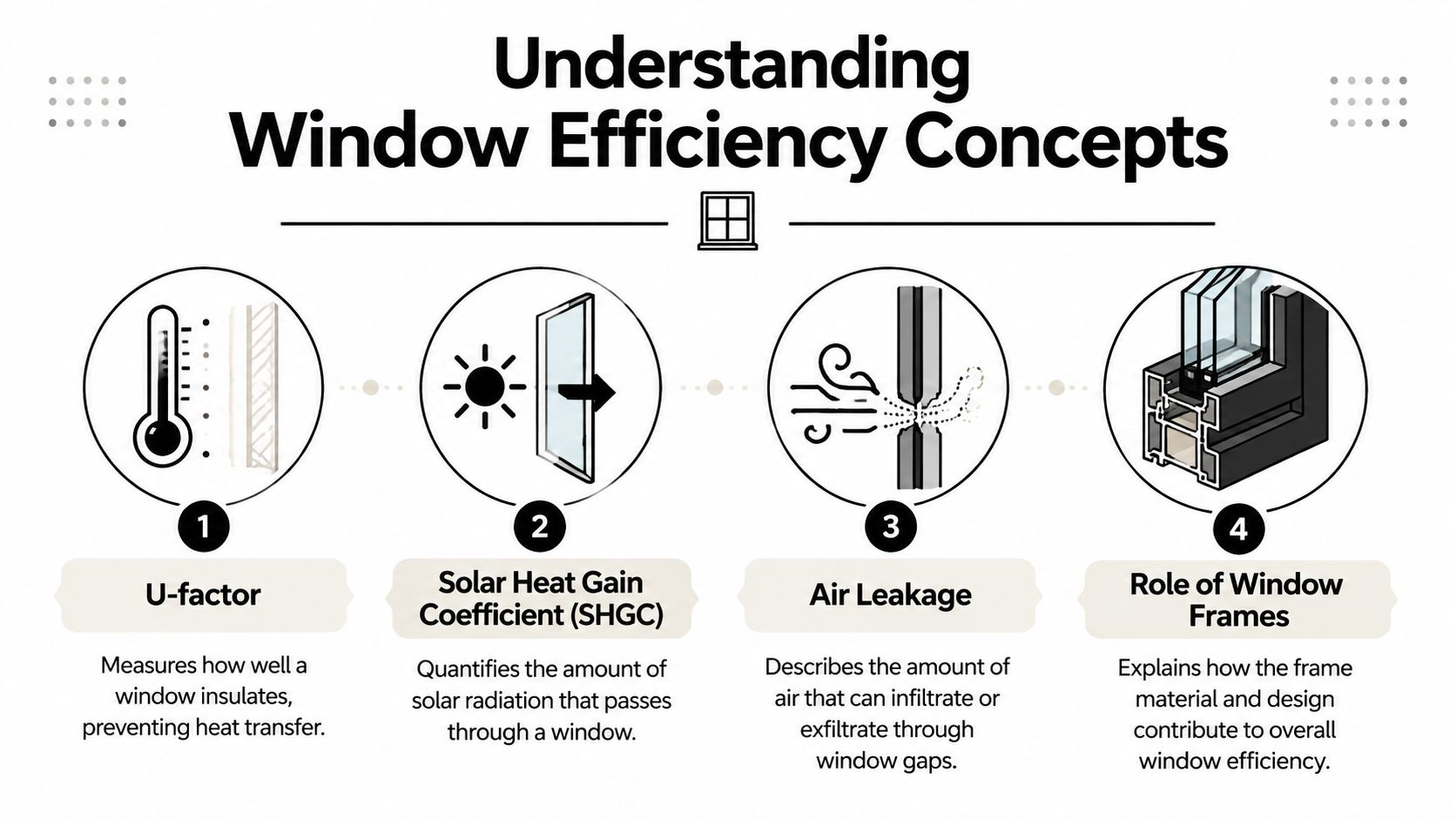
U-factor measures how easily heat moves through a window. A lower U-factor means the window holds indoor warmth better in winter and resists outdoor heat better when temperatures climb. That matters in Idaho, where heating and cooling both affect the same utility bill.
Solar Heat Gain Coefficient, or SHGC, measures how much solar energy gets through the glass. A window with the wrong SHGC for a given room can make a south-facing space feel too hot in summer or let helpful sun warmth into a cooler area in winter, depending on the home's orientation and the local climate. That is why the best choice depends on where the window sits on the house, not just whether the product sounds efficient.
Air leakage is the draft factor. A window can have good glass and still perform poorly if air slips around the sash, the frame, or the installation gap. Proper installation and a tighter product help limit those losses, which is one reason window replacement results can vary so much from house to house.
Why the frame matters as much as the glass
Frames do more than hold the glass in place. They affect how much heat moves through the edge of the window and how well the whole unit stays sealed over time. A window with better glass still loses ground if the frame conducts heat easily or if the seal around the unit breaks down.
The frame, the glazing, and the gas space all work together. Double or triple glazing, low-E coatings, argon or krypton gas fills, and thermally broken or nonconductive frames all reduce heat flow in different ways, which is why a complete window package matters more than one feature by itself FEMP residential windows guidance.
For Treasure Valley buyers, this Idaho window efficiency guide can help connect those labels to real-world home choices. It is easier to compare products once you know which part of the window is responsible for comfort, drafts, and heat loss.
ENERGY STAR Version 7.0 helps set the target. In the Northern zone, qualifying windows must meet U-Factor requirements of ≤ 0.22 to ≤ 0.26, and window air leakage must be ≤ 0.3 cfm/ft² ENERGY STAR Version 7.0 specification. Those numbers show the level of control needed to keep indoor air inside and outdoor weather outside.
If you are comparing products, the label alone is not enough. Glass, frame, and air seal all need to work together, or the window will only solve part of the problem.
How Window Features Drive Your Savings
A window upgrade does not save money just because it looks newer. It saves money because it slows the transfer of heat through the opening, which means the furnace and air conditioner do less work. In the Treasure Valley, that matters in both directions, because hot summer sun and cold winter air both push a home's windows in opposite ways.
A useful way to sort the features is by the job each one does.
Low-E coatings are thin metallic layers that reflect unwanted heat while still letting in visible light. Argon fills improve insulation between panes by slowing heat movement through the sealed space. Double- or triple-glazing adds more layers between indoors and outdoors, so heat has a harder time passing through the window assembly. Together, those parts turn the glass into a much better barrier.
The federal efficiency guidance for residential windows explains that these kinds of upgrades can cut conductive heat flow and solar heat gain, which is why better windows can reduce energy demand in a measurable way FEMP residential windows guidance. For homeowners trying to connect product labels to real home performance, that principle matters more than the marketing copy on the box.
More layers do not always mean the best result. A well-selected double-pane window may be the better fit for one home, while another house with stronger sun exposure, more wind, or a leakier shell may benefit from triple-pane construction. The better choice depends on the home's climate zone, which rooms get the most sun, and how much air the existing windows are already letting through.
A good window spec is a fit, not a trophy.
For Treasure Valley homeowners, the energy-efficient windows guide for Idaho is a practical place to start because it connects window performance to local climate needs instead of treating every house the same. That local lens helps explain why two homes can buy similar products and still see different savings.
When extra layers make sense
The biggest savings usually show up when the old windows were a weak point to begin with. A newer double-pane window that already performed fairly well will not create the same change as a failed single-pane unit. That is why the upgrade can feel dramatic in older homes, while the dollar savings are more modest in homes that already had decent windows.
The reason is straightforward. Windows affect both heating and cooling loads by reducing the energy lost in winter and the heat gained in summer. In a home with large west-facing glass or noticeable air leakage, that effect is easier to feel in day-to-day comfort. In a tighter home with better insulation, the savings still matter, but they start from a smaller problem.
Calculating Annual Energy Bill Reductions
A homeowner in the Treasure Valley usually wants one simple answer, how much of the monthly bill can new windows take off? The cleanest way to estimate that is to start with the window type being replaced, then compare it with the home's likely heating and cooling use.
Older single-pane windows usually offer the largest room for savings, while older double-pane units tend to produce smaller reductions because they were already doing some of the work. Across the country, industry guidance points to a broad annual household energy-bill reduction range, which helps set expectations, but the local result still depends on how much heat loss and sun gain the house is dealing with.
A simple way to think through the math
A window works a little like a weak spot in a winter coat. If that spot lets heat escape in January or lets the afternoon sun pour in during July, the furnace and AC have to make up the difference. Shrinking that loss does not erase the utility bill, but it reduces the amount of energy the system has to replace.
That is why older homes in the Treasure Valley often see a clearer change than homes that already have decent windows. Homes with drafty frames, failed seals, or glass that feels cold near the pane have more wasted energy to recover. Homes with tighter envelopes still benefit, but the savings start from a smaller problem.
The right way to read the estimate is as a range, not a promise. Weather, room orientation, and how hard the system works all change the outcome, which is why local homeowners often compare the number against their own heating habits and utility bills rather than against a national average alone.
Annual savings by starting window type
| Starting Window Type | Annual Savings Range |
|---|---|
| Single-pane windows | $125 to $340 |
| Older double-pane windows | $20 to $70 |
These ranges are most helpful when they are tied back to the condition of the original windows. A house with single-pane glass, visible drafts, or weak seals usually has a much larger starting loss than a home with newer double-pane units, so the potential reduction shows up more clearly in the bill. The Idaho heating-bill savings guide can help Treasure Valley homeowners connect that bill reduction to a real project budget.
The part many homeowners miss is that savings are not only about winter. In a valley climate with hot afternoons and cold snaps, new windows can reduce both the energy used to heat the house and the energy used to cool it, which is why the same upgrade can matter in more than one season.
Real Payback Examples for Treasure Valley
A Boise homeowner staring at a cold window in January usually wants one simple answer, how long until the replacement pays for itself. That answer depends on the price of the job, the condition of the old windows, and how much air the home has been losing all along.
Three common homeowner scenarios
A mid-century Boise home with original single-pane windows often shows the clearest payback. If the project targets the leakiest openings first, the household can compare the installed cost against the earlier $125 to $340 per year savings range tied to single-pane replacement.
A 1990s home with aging double-pane units usually looks different. Those windows may still block some weather, but they do not perform like newer products, so the yearly savings are smaller. In that case, the earlier $20 to $70 per year range for older double-pane replacement is the better reference point.
A newer renovation with triple-pane windows or higher-spec double-pane units often brings a different kind of return. The bill reduction may be modest, while comfort, draft control, and steady room temperatures become the bigger reasons to upgrade. For overall performance, earlier guidance placed ENERGY STAR-qualified replacements in the 7% to 15% annual energy-bill reduction range, or roughly $71 to $501 per year, depending on the starting conditions and how well the windows fit the climate.
What Treasure Valley homeowners should watch
Comparing your home to a generic national average usually leads to confusion. A north-facing room in Meridian does not behave like a west-facing wall in Nampa, and a tighter newer house will not show the same savings as an older house with visible leaks.
A better approach is to start with the condition of the existing windows, then compare that likely savings range to the installed price of the project.
The home's value at resale matters too. The DOE says homeowners recoup about 78% of window replacement costs when the home is sold. That does not mean every project pays back the same way, but it does show why window upgrades are often judged by more than the utility bill alone.
Non-Energy Benefits of New Window Upgrades
A new window project changes more than the utility bill. In many Treasure Valley homes, the first thing people notice is not the monthly savings. It is the way a room feels when the glass stops leaking cold air in winter or overheating in the afternoon sun.
Comfort, noise, and day-to-day livability
Modern replacement windows help reduce drafts and make indoor temperatures more consistent from room to room. A west-facing living room in Meridian can feel more stable in the late day, and a bedroom along an exterior wall in Nampa may stop swinging between chilly and comfortable as much as it did before. Noise reduction is another everyday benefit, especially for homes near busier streets, schools, or active neighborhoods where sound carries into the house.
That comfort gain often matters as much as the energy math. A window that no longer sweats as much in cold weather can feel cleaner to live with, and fewer drafts can make a room usable in seasons when you used to avoid it.
The resale angle matters too. The DOE notes that homeowners often recover a large share of window replacement cost at sale, which is one reason buyers and appraisers tend to view the upgrade favorably. DOE resale value note That does not turn windows into a guaranteed profit center, but it does show that the project can hold value better than many purely cosmetic improvements.
Why buyers notice windows
Curb appeal matters, but buyers also look closely at whether windows seem aged, foggy, or mismatched. New windows signal that a house has been cared for, and modern frames can freshen the exterior without changing the overall character of the property. Security perception is part of that first impression too, since updated hardware and tighter-fitting units often feel more solid than worn originals.
Condensation is another subtle factor. When a window assembly performs better, interior surfaces are less likely to collect moisture during normal day-to-day use. That will not remove every cold-weather issue, but it can make the home feel cleaner and more comfortable.
There is also a practical planning side to the decision. If you want to compare comfort, resale, and financing options before starting a project, a Treasure Valley window replacement tax credit guide can help you see how the pieces fit together.
If you are weighing the upgrade only by monthly savings, you may miss the broader return. A good window project changes how the home feels, how it looks, and how it presents to a future buyer.
Incentives and Financing Options
Homeowners often leave money on the table because they skip the paperwork. If you're planning an energy-efficient window project, start by checking whether the product qualifies for federal incentives and whether local programs apply in your area. ENERGY STAR says certified windows can lower household energy bills by up to 13% nationwide, which is one reason these projects often fit rebate and incentive programs ENERGY STAR products page.
A simple checklist for claiming help
- Confirm eligibility: Make sure the window model and installation details meet program rules.
- Gather paperwork: Keep invoices, product certifications, and application forms together.
- Mind the timing: File before deadlines and don't assume you can apply later.
The specific credit or rebate structure can change, so it's smart to verify the current rules before you sign. For a focused overview of the tax credit side, this Idaho window replacement tax credit guide is a useful reference point.
Financing can also make a big project easier to handle without waiting years to save the full amount upfront. The most useful path is the one that lets you upgrade with a payment plan that fits your household budget while still capturing the long-term energy and resale benefits.
Getting an Accurate Estimate from C & C Windows & Doors
A real estimate starts with the house, not with a brochure. The best approach is a measured in-home consultation where every opening is checked, the existing conditions are reviewed, and the right product choices are matched to the home's needs. That matters because a window estimate should reflect size, style, condition, and performance goals, not a rough guess.
What a good quote should include
First, the installer should measure each opening carefully and look at the current frame condition. Second, the product options should be tied to your goals, whether that's lower utility bills, quieter rooms, better curb appeal, or all three. Third, the installation plan should explain how the new windows will be fitted so the work is clean and precise.
A transparent estimate also helps you compare value instead of just comparing price. If one quote includes better sealing practices or a more appropriate glass package for Idaho's climate, that can change the long-term savings even when the upfront cost looks similar.
Best next step: Get a quote that connects the window spec to your actual home, not a generic “per window” number.
If you're in Boise or anywhere in the Treasure Valley, the fastest way to get a realistic number is to schedule an in-home consultation with C & C Windows & Doors at ccwindowscompany.com. A solid estimate will tell you what new windows can save, what they'll improve day to day, and whether the project fits your budget now.