
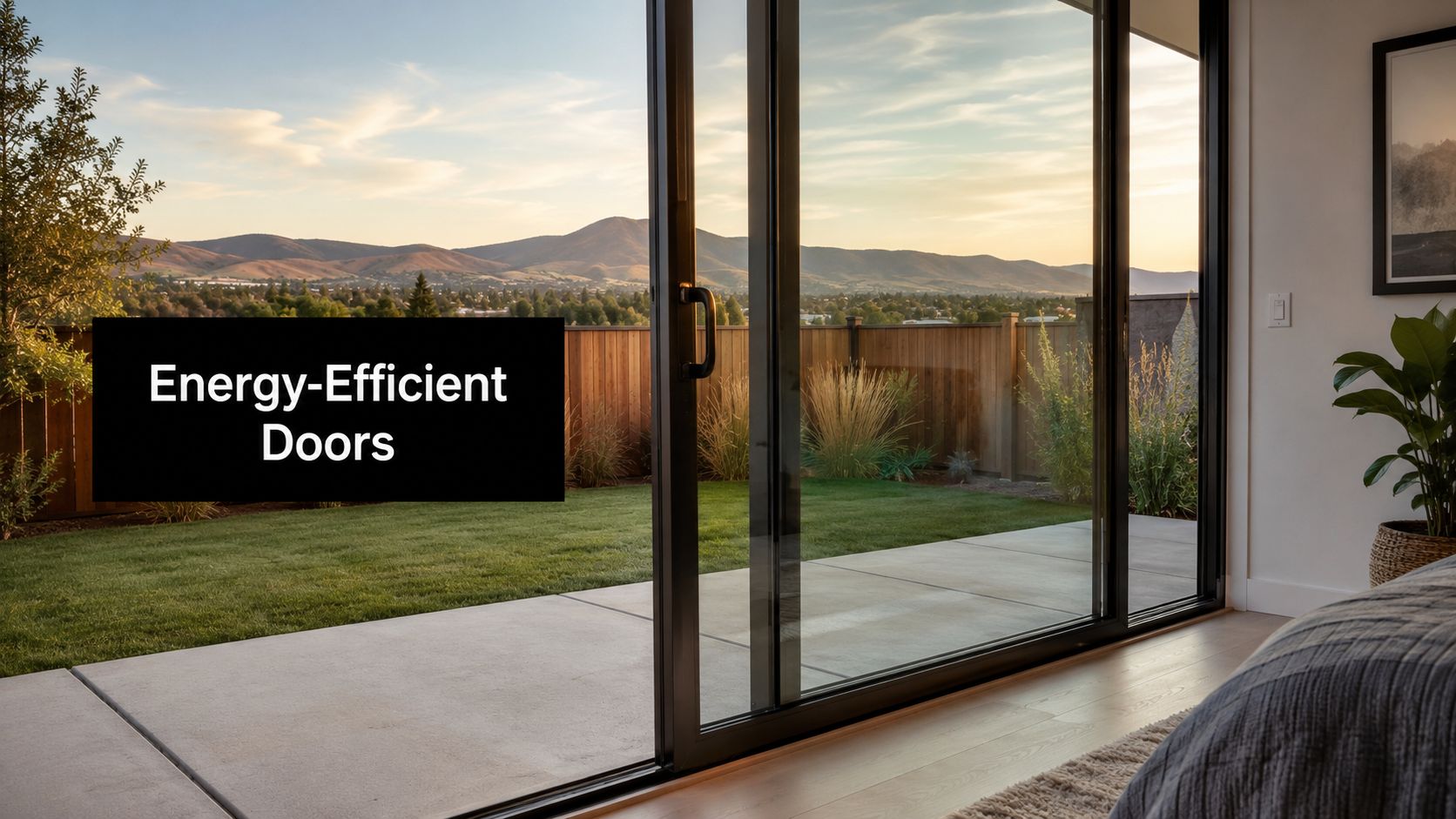
If your patio door sticks, rattles, or lets in a cold strip of air when the wind shifts across the Treasure Valley, you already know it's not just a style problem. In Boise, that door can be the difference between a room that feels settled in January and one that gets uncomfortable fast, and it can also be the spot where summer sun turns a living area into a heat trap. Homeowners usually notice the issue first as a draft, then as a room they avoid, and finally as a utility bill that never seems to settle down.
Energy-efficient patio doors solve more than one problem at once. The right door helps regulate temperature, cuts down on leakage, and makes a big glazed opening feel like part of the home instead of a weak spot in it. In Idaho, that matters because the opening faces real winter cold, strong afternoon sun, and the daily wear of a climate that asks more from a door than the brochure usually admits.
Table of Contents
- Why Your Patio Door is Key to a Comfortable Boise Home
- Decoding Energy Performance Ratings for Idaho's Climate
- Choosing Your Ideal Patio Door Type and Material
- The Anatomy of a High-Performance Patio Door
- Why Expert Installation Is Critical for Performance
- Estimating Costs and Calculating Long-Term Savings
- The C & C Windows & Doors Promise for Your Home
Why Your Patio Door is Key to a Comfortable Boise Home
A lot of Boise homeowners think of a patio door as a view and a pathway to the backyard. That's fair, until the room beside it starts acting like the least comfortable part of the house. On a cold January night, an older door can leak enough air to make the floor feel chilly. In July, the same opening can invite heat and glare that push the air conditioner to work harder.
The opening matters as much as the view
A patio door is a large glazed opening, so it has more influence on comfort than a smaller window does. When the glass, frame, and seals are weak, the room loses heat in winter and gains too much in summer. If you've ever stood near a sliding door and felt a faint draft, you've already felt the performance gap.
That gap shows up in daily life before it shows up on paper. Furniture near the door can feel drafty, blinds get pulled more often, and the room starts serving as a buffer zone instead of a usable part of the home. In a climate like Boise's, that's not a minor annoyance, it's a comfort failure.
Comfort, moisture, and utility bills are connected
An inefficient door can also contribute to moisture issues around the opening, especially when warm indoor air meets a cold surface. That's one reason the whole opening has to perform together, not just the glass package. A door that looks fine from across the room can still underperform if the installation or weatherproofing is weak.
Practical rule: if the area around the patio door feels different from the rest of the room, treat that as a performance clue, not just a cosmetic issue.
Homeowners often start shopping because they want a nicer look. A more impactful consideration is that energy-efficient patio doors can make a high-use room feel consistent again, which offers the primary benefit in Idaho's four-season climate. A door that behaves well in both cold snaps and bright afternoons is doing more than closing off an opening, it's helping the whole house feel easier to live in.
Decoding Energy Performance Ratings for Idaho's Climate
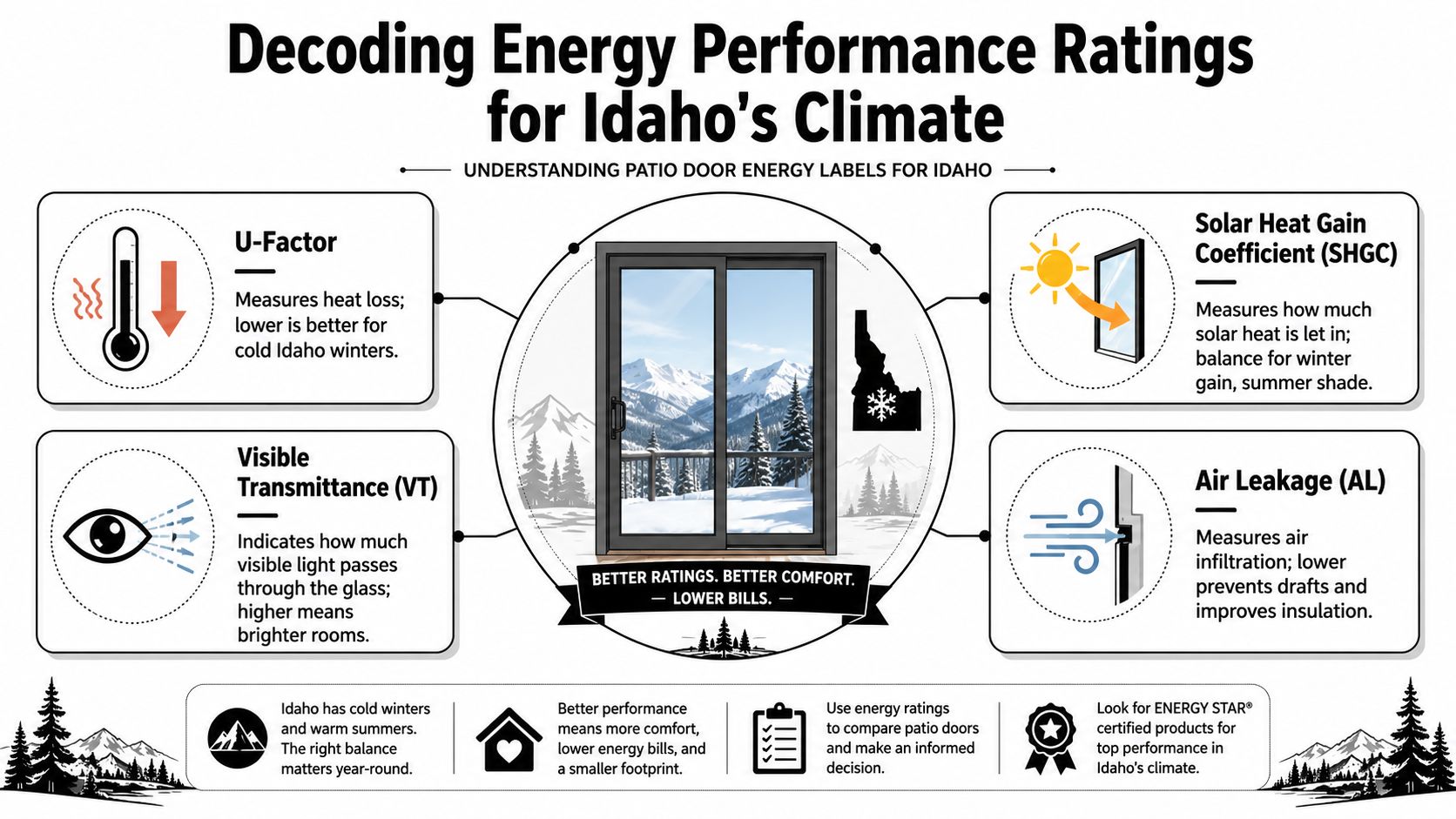
Energy labels look technical, but the important part is simple. They tell you how much heat moves through the door, how much sun comes through the glass, and how much outside air sneaks in around the edges. For Boise homeowners, those three ideas are the difference between marketing language and a door that fits the climate.
Start with U-factor, then check the rest
U-factor measures heat transfer through the door assembly. Lower numbers mean better insulation, which matters in colder weather because the door resists heat loss more effectively. In the guidance for Idaho's climate, qualifying patio doors are commonly identified by a U-factor of 0.30 or lower, while the more demanding ENERGY STAR Most Efficient tier calls for U-factor ≤ 0.20 in that guidance Glass Advisor patio door energy efficiency guide.
That makes U-factor the easiest first filter when you're comparing products. If the number is too high, the door may look good but still leak comfort. If the number is lower, you're usually looking at a stronger thermal performer before you even get into frame style or glass package.
SHGC and air leakage matter in Boise too
Solar Heat Gain Coefficient, or SHGC, tells you how much solar energy gets through the glass. That matters because Idaho homes don't all face the same sun exposure. Government guidance notes that south- and west-facing glass can create too much solar gain at certain times of year, and it recommends moderate-to-low solar gain glazing where summer overheating is a concern Natural Resources Canada guidance.
Air Leakage is the third piece. It measures how much outside air passes through gaps and seals. Lower is better because drafts don't care how good the glass is if the frame-to-wall connection is weak. A door with strong ratings on paper can still feel underwhelming if air slips around the edges.
For a broader home-efficiency plan, it helps to compare patio-door specs with the rest of the opening strategy used on a house, which is why some homeowners also look at an Idaho-focused window efficiency guide. The point isn't to memorize jargon. It's to use the label as a quick screen so you can compare doors that are specifically built for Boise weather instead of trusting broad “energy efficient” claims.
Choosing Your Ideal Patio Door Type and Material
A patio door has to do more than look right from the kitchen or deck. It needs to fit the opening, handle Idaho weather, and work the way the room gets used. A sliding door keeps the path clear, French doors change the feel of the room, and a bi-fold system can open up a wider passage when the layout supports it. Each one solves a different problem, and the better choice depends on traffic flow, sun exposure, and how much upkeep you want to take on.
Door style should follow room function
Sliding patio doors usually make the most sense when space is tight or furniture sits close to the opening. French doors fit well in rooms that have room for swing clearance and a more traditional look. Bi-fold doors are a stronger design choice when a homeowner wants a broader opening to the outdoors and the wall layout can handle the hardware and stacking panels.
The common mistake is picking the style first and the performance second. A door that fits the room and seals tightly will usually feel better day to day than a showier option that fights the space. The core question is whether the opening needs easy everyday movement or a more open connection to the patio.
Material choice changes comfort and upkeep
Frame material affects comfort, durability, and maintenance over time. Vinyl is often chosen for value and low upkeep. Fiberglass handles temperature swings well and tends to suit homeowners who want a sturdier frame with less movement over time. Wood has a classic appearance, but it needs more care and is less forgiving when moisture or strong sun become part of the equation.
Practical rule: in Boise, match the frame to the exposure, not just the showroom sample.
The opening matters too. A poorly matched frame can still lead to drafts, sticking, or uneven wear even if the door looks good on paper. That is why the full opening, frame, seals, and installation, has to be considered together. If you want to compare style choices before narrowing the material, this sliding-door versus French-door guide is a useful place to start.
Patio Door Frame Material Comparison for Boise Homes
| Material | Energy Efficiency | Durability & Maintenance | Best For |
|---|---|---|---|
| Vinyl | Good thermal performance and low upkeep | Easy to care for, but less premium in feel | Budget-conscious homeowners who want simple maintenance |
| Fiberglass | Strong thermal stability and solid all-around performance | Durable and low-maintenance in changing weather | Boise homes that need a balanced, long-term option |
| Wood | Can perform well with the right build, but needs more care | Higher maintenance, especially with exposure | Homeowners prioritizing traditional appearance |
The best choice is usually the one that fits the opening, the climate, and the way the family uses the space. A door with the right material can still underperform if the install is sloppy or the frame is not squared, flashed, and sealed correctly. That is where local experience matters, because the product spec only pays off when the whole opening is built to work as one system.
The Anatomy of a High-Performance Patio Door
A high-performance patio door starts with the whole opening, not just the glass. The sash, frame, threshold, seals, and installation all shape how the door performs once it faces Boise heat, winter cold, and day-to-day use. A product can look efficient on a spec sheet and still waste energy if the opening is out of square or the seal line is weak.
Glass package is the heart of the door
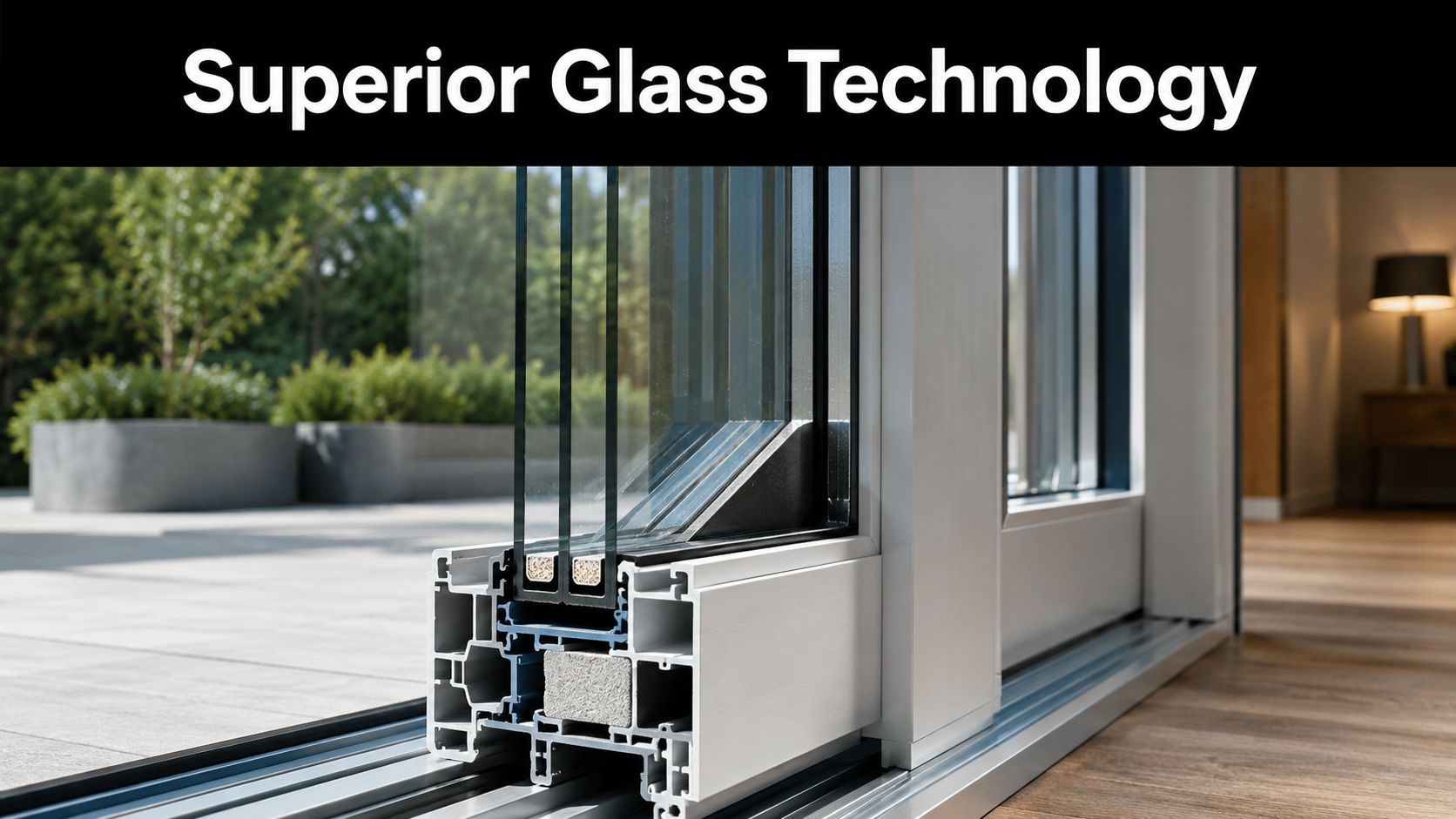
Triple-pane glass is a meaningful upgrade over basic glazing, and one industry guide reports that it can reduce energy costs by up to 40% versus standard double-pane options Five Seasons Windows energy savings guide. The same guide says ENERGY STAR-qualified sliding glass doors can save $150 to $400 per door per year, with 20% to 35% lower heating and cooling costs compared with standard single-pane patio doors Five Seasons Windows energy savings guide.
Low-E coatings help control heat flow while still letting in useful daylight. Gas fills, such as argon, add insulating value between panes. Those features work together, but only if the rest of the door is built and installed to hold that performance.
Small parts influence the full result
The hardware and frame details still matter in daily use. Weatherstripping, rollers, threshold design, and the way the sash closes all affect comfort, noise control, and how easy the door is to operate. If the rollers drag or the closure does not compress evenly, the door can feel loose and drafty even when the glass package is strong.
Drainage and stable framing matter just as much in our climate. A true sloped sill helps move water away from the opening, and composite-reinforced sashes can add stability where cheaper frames may flex. C & C Windows & Doors also pays attention to secure low-profile locking and the fit of the entire opening, because those details affect how the door holds up after installation and through the seasons.
If you want the specs to translate into real savings, a licensed window installer in Boise has to measure, prep, flash, and seal the opening correctly. That work determines whether the door performs the way it should once the weather turns.
Plain truth: the glass gets the attention, but the frame-to-frame details decide whether the door performs after the first season.
A strong patio door earns its reputation through insulation, sealing, drainage, smooth operation, and a properly prepared opening working together.
Why Expert Installation Is Critical for Performance
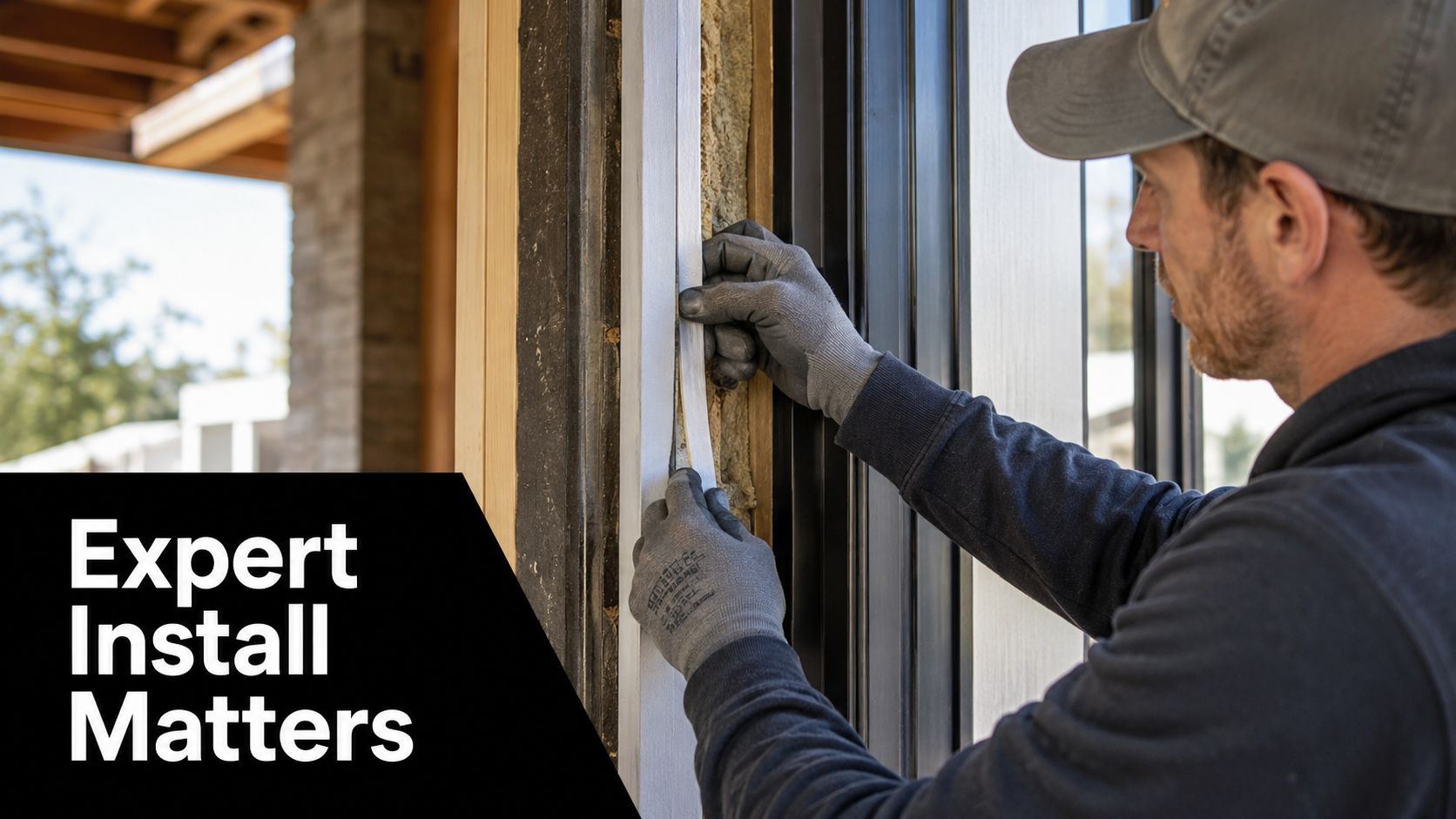
A premium door can still fall short if the opening is not prepared the right way. Homeowners often focus on the product label and overlook the work around it, but a patio door is a system. If the fit, seal, or flashing is off, the whole opening loses performance.
The opening can undo the product
The frame, threshold, anchors, flashing, sealant, and weatherstripping all affect whether a door cuts heat loss and air leakage, and poor installation details can wipe out projected savings Wilcox Door energy-efficient patio doors. A door can test well on paper and still leave a homeowner frustrated if the surrounding opening is not right.
A rushed install or a do-it-yourself job usually shows up in familiar ways. The door may sit out of level, the latch may feel finicky, or the seals may not compress evenly. Once that happens, drafts and water intrusion become ongoing risks, not small annoyances you ignore for a season.
A good installer protects the opening, not just the product
Professional installation is more than setting the door in place. It starts with careful measurements, continues with prep of the rough opening, and ends with sealing and cleanup that leave the room ready to use. That process matters because the whole opening has to work with the door, not against it.
For homeowners comparing local options, this Boise installer guide explains why licensing and process matter in the field. The point is straightforward, even the best-rated patio door will not deliver its full value if the surrounding work is sloppy.
What to insist on
- Accurate sizing: The door has to fit the opening without forcing the frame.
- Proper flashing: Water needs a clear path away from the structure.
- Clean sealing: Air and moisture should not sneak through the perimeter.
- Tight weatherstripping: The closure should feel even and consistent.
- Debris-free finish: The job should end with the opening ready to use.
That is also why homeowners looking at C & C Windows & Doors often pay close attention to the installation process as much as the door itself. In this category, the labor is part of the product.
Estimating Costs and Calculating Long-Term Savings
A new patio door is a real investment, so cost is usually the first question homeowners ask. Size, material, glass package, and custom features all affect the final price, and that still leaves the work needed to remove the old unit and prepare the opening. The smarter way to evaluate the expense is to look at what the door costs today and what it returns in comfort, lower utility use, and fewer draft complaints over time.
Savings can change the math
Energy-efficient patio doors can help the numbers work over the long run, but the size of the benefit depends on the old door you are replacing, how exposed the opening is, and how well the new unit is installed. In a Boise home, that matters because the patio door has to deal with both summer heat and winter cold, and a weak seal or poor fit can erase much of the value you expected from the upgrade.
If the existing door leaks conditioned air, the new one can start paying back in comfort right away. That makes the return easier to see, especially in rooms where the patio door sees daily use and the temperature swings are obvious.
Financing can make the upgrade easier to start
A lot of homeowners delay a project like this because they want the budget to line up perfectly. That often means another season of hot afternoon sun, cold drafts, or a door that does not perform the way it should. Financing through Synchrony can make the project easier to schedule without forcing you to treat it as an all-or-nothing decision.
The timing matters because an inefficient opening keeps costing you while it stays in place. If you are replacing a patio door for efficiency, the financial case should include comfort, energy use, and the value of a properly installed opening, not just the invoice. A door that fits well, seals well, and is installed with care is a home improvement that can help lower ongoing costs, not just another purchase.
The C & C Windows & Doors Promise for Your Home
The biggest lesson in patio-door selection is that the label alone doesn't tell the whole story. Boise homeowners need a door with the right performance ratings, a frame and glass package that fit the exposure, and installation that protects the opening as carefully as the product. That combination is what turns a patio door into a comfort upgrade instead of just a replacement.
C & C Windows & Doors works from that whole-system mindset with 20+ years of local experience, American-made products engineered for Idaho conditions, a lifetime limited warranty on products and labor, and a process built around custom measurements and meticulous installation. Their approach aligns with what matters most in Treasure Valley homes, the door has to fit the climate, the opening, and the way the home is used.
Homeowners who want a more comfortable, efficient patio opening should look for those same priorities in any quote they consider. The right decision is the one that respects the ratings, the orientation, and the installation details all at once.
A CTA for C & C Windows & Doors.