
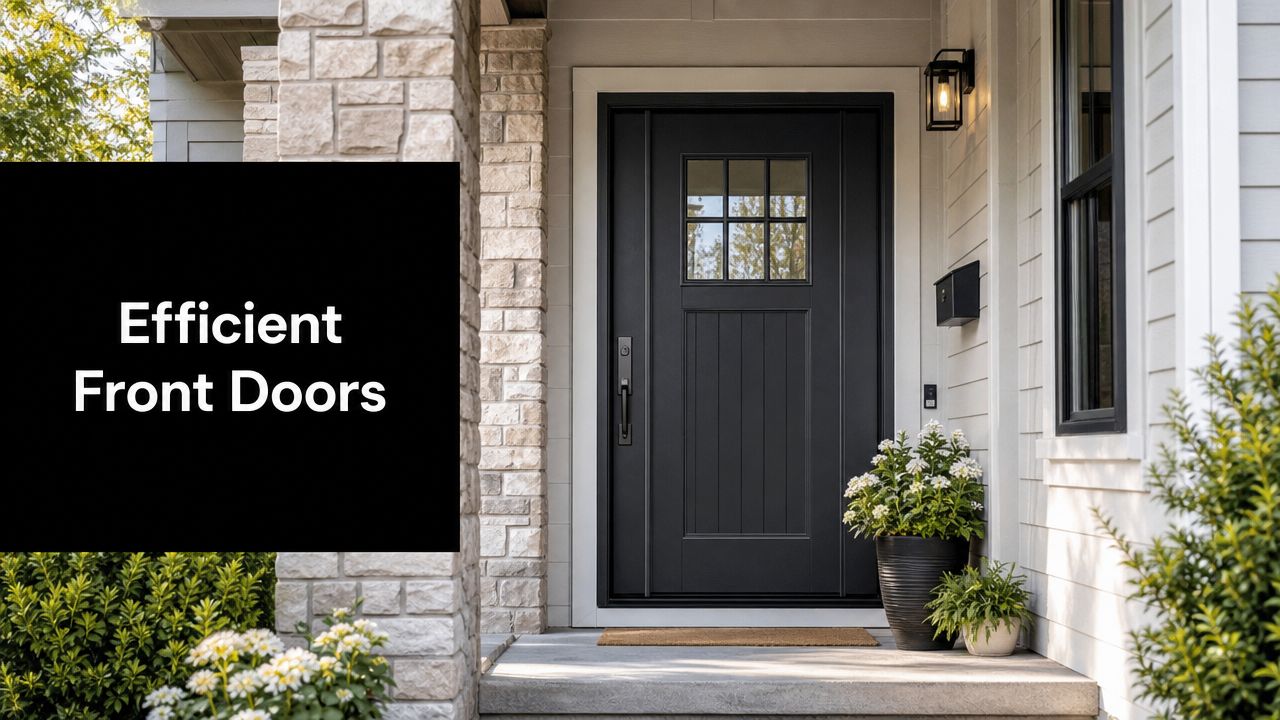
You're probably standing in your entryway in January, feeling a cold line of air around the door, or in July touching a handle that's been baking in the sun. That's the moment most homeowners in the Treasure Valley stop looking at the front door as decoration and start seeing it for what it is, a thermal boundary that can make the whole house feel better or worse. A good energy-efficient front door isn't just about looks, it's about how the slab, frame, glass, seals, and threshold work together to block heat transfer and stop drafts.
A lot of people buy the wrong thing because they shop by style first. That's backward. A front door can look premium and still leak air, soak up summer heat, or underperform because the frame and weatherstripping were an afterthought. The right way to shop is to judge the whole assembly, then decide whether the design fits your house.
Table of Contents
- What Counts as an Energy-Efficient Front Door
- Key Performance Metrics That Matter
- Comparing Door Materials for Real-World Performance
- Why the Treasure Valley Climate Changes the Equation
- What You Can Expect to Save on Energy Bills
- Installation Details That Decide Real Performance
- Common Myths That Lead to Costly Mistakes
- Why Local Homeowners Choose C & C Windows & Doors
What Counts as an Energy-Efficient Front Door
A Boise homeowner notices it first on a cold morning. The hallway near the entry feels colder than the rest of the house, even though the furnace is running. In July, the same door can feel hot to the touch on the sun side, and the foyer never quite catches up with the thermostat. That points to a front door that is failing as part of the home's thermal shell.
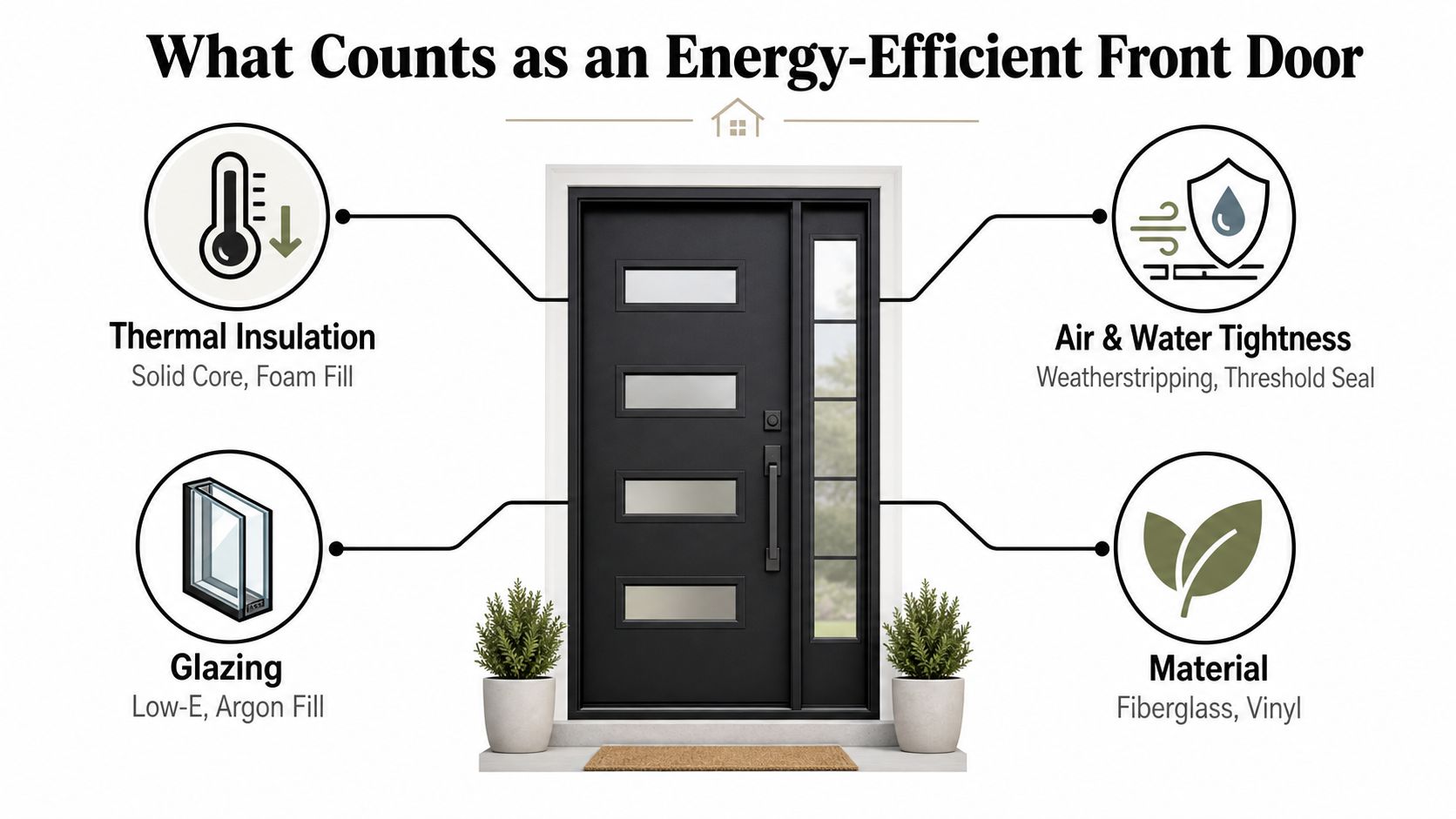
An energy-efficient front door is a complete thermal assembly, not a slab sitting in a hole. The door itself matters, but so do the frame, glazing, threshold, and perimeter seals. When any one of those parts is weak, the whole entry underperforms.
The door is only part of the system
The biggest mistake I see is homeowners asking whether they need a wood door, a steel door, or a fiberglass door, as if the surface material settles it. It doesn't. What matters is how the full assembly handles conduction, air leakage, and, when glass is involved, solar gain.
The front door is also a regulated thermal boundary. In the UK, October 2010 marked a major milestone when all new doors had to meet a U-value of 1.8 W/m²K or less (OVO Energy guide). That matters because lower U-values mean better insulation performance. The same guidance also notes that double-glazed doors outperform single-glazed designs, and that draught excluders or weather strips compress to form a seal when the door is closed.
What to look for in plain English
A door that performs well usually has an insulated core, tight weatherstripping, and a frame that's built to stay square. If the perimeter leaks, you'll feel it even if the slab itself is well insulated. That's why I always tell homeowners to think in terms of the whole entry, not a showroom sample.
Practical rule: If you can feel a draft at the threshold or latch side, the assembly is failing, no matter how nice the panel looks.
For Treasure Valley homes, that matters more than many homeowners realize. We get cold winters, hot summers, and plenty of temperature swing in between, so a front door has to do real work year-round. Choose the assembly that seals, insulates, and stays aligned, because that is what keeps comfort inside where it belongs.
Key Performance Metrics That Matter
A front door label can look technical and still tell you very little unless you know what the numbers mean. Buying a coffee thermos is a fair comparison. You do not care how fancy it looks on the shelf, you care whether it keeps heat where it belongs. Doors work the same way, except the label measures different parts of the same job.
U-factor and R-value
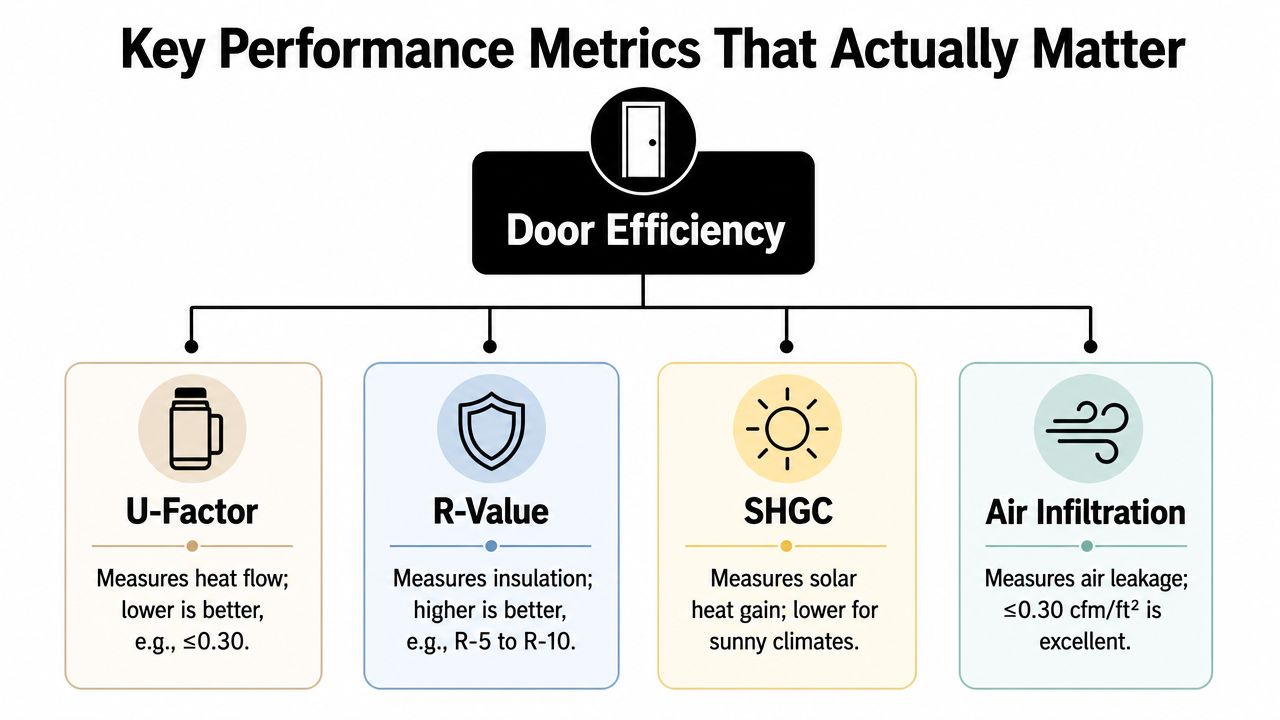
U-factor measures how quickly heat moves through the whole door assembly. Lower is better. R-value measures resistance to heat flow. Higher is better. Those two numbers tell you whether the door is fighting heat loss or letting it happen.
Industry guidance says a modern high-performance front door in the UK market can target about 1.4 W/m²K, and premium insulated-core systems can reach 1.0 W/m²K or below (Brow Windows). Another industry guide says buyers should look for an R-value of 5 to 7, with insulated fiberglass doors reaching R-6 or higher, insulated steel doors typically at R-5 to R-6, and basic wood doors often only R-2 to R-4 (Today's Entry Doors).
SHGC and air leakage
If your door has glass, solar heat gain coefficient, or SHGC, matters. It tells you how much solar heat comes through the glass. In a sunny climate, lower SHGC usually makes more sense on exposed entries. Air infiltration matters just as much, because a leaky door wastes comfort fast. A great core with bad seals is still a bad door.
ENERGY STAR and NFRC labeling are useful because they force you to look at the full product, not the marketing copy. A verifiable technical benchmark for an efficient front door is its R-value, U-factor, and SHGC (GBD Magazine). If those labels are not available, I'd pass.
The quick buyer test
Use this simple filter:
- Check the whole-door rating. Do not judge the slab alone.
- Compare the seal package. Weatherstripping and threshold design matter.
- Match the glass to your climate. More glass means more need for better ratings.
- Confirm certification. ENERGY STAR is easier to trust than a sales pitch.
A good door should reduce heat transfer, reduce drafts, and feel stable at the entry. If it does not do all three, keep shopping.
For homeowners who are comparing full-entry systems, including glazed options, it also helps to review a dedicated guide to energy-efficient patio doors, because the same sealing and rating logic applies.
Comparing Door Materials for Real-World Performance
The material matters, but not the way many think. A door doesn't become efficient just because it's steel or fiberglass. What matters is whether the material is paired with a strong core, a decent frame, and seals that don't fall apart in weather.
Fiberglass, steel, wood, and composite
Fiberglass usually gives the best balance of insulation, moisture resistance, and finish options. Steel is a solid choice when you want security and dependable performance. Wood still has a place if curb appeal is the priority, but basic wood doors tend to trail the better insulated options. Composite doors sit in the middle for many buyers, depending on how they're built.
| Energy-Efficient Front Door Materials Compared | Typical R-Value | Maintenance | Best For |
|---|---|---|---|
| Fiberglass | R-6 or higher | Low maintenance, stable finish, good moisture resistance | Homeowners who want strong insulation and wood-grain looks |
| Steel | R-5 to R-6 | Moderate maintenance, can need touch-up care | Buyers who want strength and efficient performance |
| Wood | R-2 to R-4 | Higher maintenance, more sensitive to weather | Curb appeal first, efficiency second |
| Composite | Varies by build | Usually moderate | Buyers wanting a middle-ground option |
Those ranges line up with the performance targets noted above, where insulated fiberglass tends to reach R-6 or higher, insulated steel generally falls around R-5 to R-6, and basic wood often lands around R-2 to R-4 (Today's Entry Doors).
What I'd choose in Idaho
For Treasure Valley weather, I lean fiberglass first. It handles temperature swings well, doesn't ask for much upkeep, and can be built to look like painted wood without the constant maintenance. Steel is a good second choice when budget and security matter.
Wood is fine if you love the look and you're willing to maintain it. Just don't buy wood thinking it automatically performs well. It usually doesn't unless the entire assembly is designed and installed carefully.
Bottom line: Buy the performance package first, then choose the finish that fits the house.
If you're comparing front-door options against other exterior openings, the same logic applies across the home. A useful comparison for patio-entry shoppers is this energy-efficient patio door guide, because the whole-house envelope works best when every opening is spec'd with the same discipline.
Why the Treasure Valley Climate Changes the Equation
Boise, Meridian, Eagle, Nampa, and the surrounding communities don't ask much of a decorative door. They ask a lot of a thermal one. Cold winter nights punish weak seals, and hot July sun exposes cheap glazing and poor orientation choices fast. A door that looks fine in a showroom can disappoint badly once it's sitting in a south-facing opening all day.
Match the door to the exposure
If the entry gets hard sun, I want glass choices and coatings that don't overheat the foyer. If the entry is shaded or north-facing, I care more about reducing winter heat loss. That's why ENERGY STAR climate-zone ratings and whole-product labeling matter more than guessing based on appearance alone.
Industry guidance also points buyers toward the full assembly, not just the slab. For practical performance, I want low-E coatings, argon gas fill, thermally broken or low-conductivity frames, and true sloped sills that shed water instead of trapping it. Those details keep the assembly tight through Idaho's seasonal swings and help the door stay comfortable year after year.
Don't ignore air sealing
Air leakage is the silent killer of door performance. A well-built door with poor threshold contact or sloppy perimeter sealing can feel drafty no matter how good the core is. That's why I'm picky about the installation details, especially in older Treasure Valley homes where openings have settled or been patched more than once.
The strongest guidance I've seen keeps returning to the same point, the full door system matters more than style alone. The door, frame, glass, and seal package have to work together. If one part is weak, the comfort hit shows up right away.
In our climate, the difference between a decent door and a great one is usually in the seals, the frame, and the installation.
The local takeaway is simple. Choose a front door for Idaho weather, not for a catalog photo. If the product can't handle heat, cold, and air movement at the same time, it's not the right door for a Treasure Valley house.
What You Can Expect to Save on Energy Bills
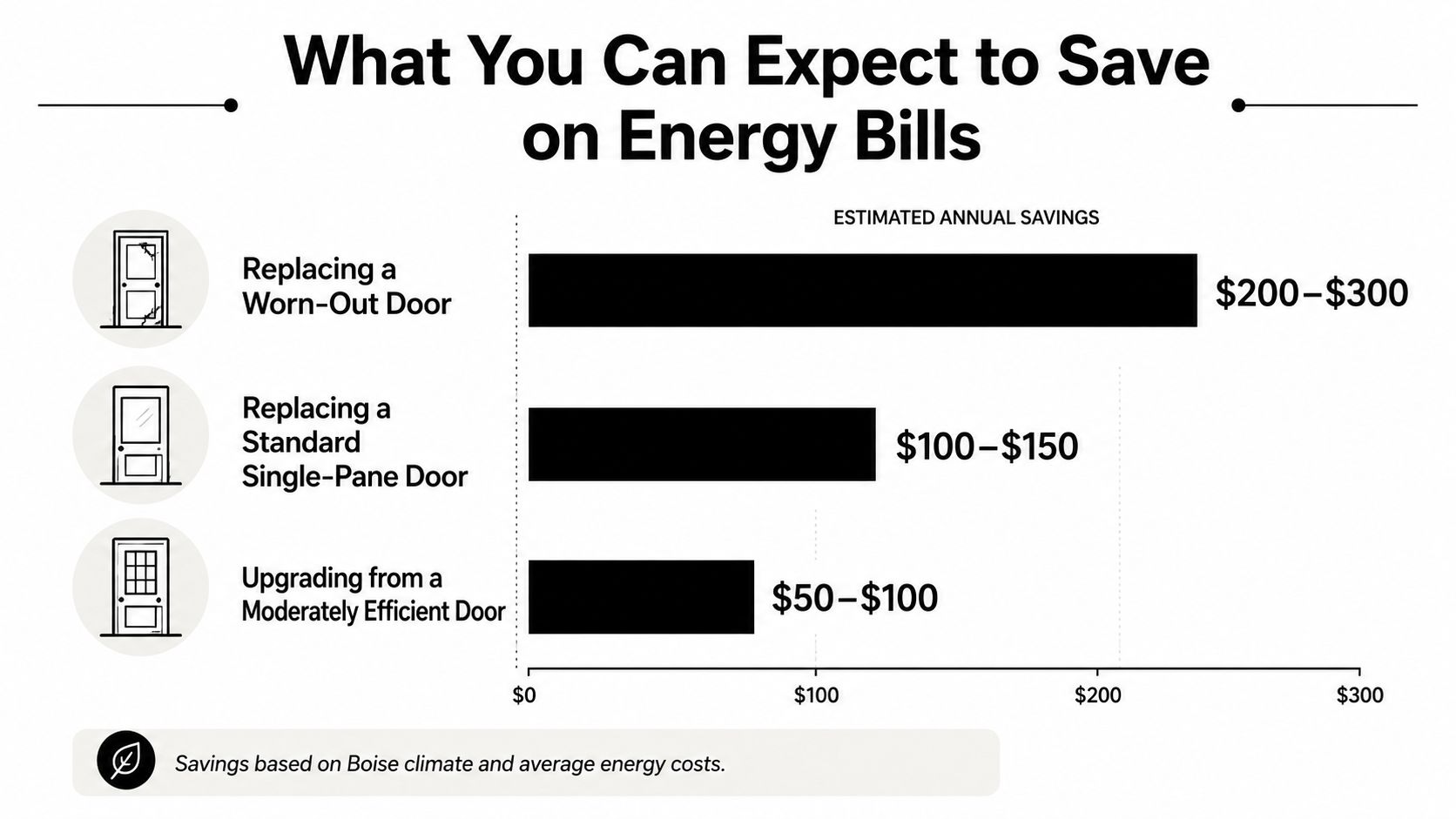
Homeowners always want a straight answer on savings, and the straight answer is this, a front door can trim your energy bills, but only if the old door was a problem in the first place and the new one is installed like it should be. A tight, efficient door on a home that already had a decent entry will not produce the same result as replacing a drafty setup that leaks conditioned air around the slab, frame, and threshold.
The numbers that matter
Independent guidance says energy-efficient front doors can save homeowners $150 to $350 per year in heating and cooling costs, and ENERGY STAR-certified doors reduce energy bills by approximately 12% on average (SolarTech Online). Another estimate says replacing a very leaky, outdated front door can cut overall heating and cooling costs by about 5% to 10%, which works out to roughly $100 to $200 per year for a home spending $2,000 annually on heating and cooling.
Those are useful ranges, not promises. If your current door is already halfway decent, expect comfort gains first and savings second. If it is old, drafty, and badly sealed, the savings become more meaningful.
The federal tax credit
There is also a federal incentive in the U.S. for qualifying exterior doors. The credit is 30% of project cost or $250 per door, with a $500 maximum, and it applies to doors purchased and installed between January 1, 2023, and December 31, 2025. The door has to be ENERGY STAR certified to qualify (Masonite).
That credit does not replace the need for a good product or a clean install. It just makes a solid upgrade easier to justify. If you are already replacing a door, I would treat the tax credit as a bonus, not the reason to buy a weak product.
My advice on payback
Do not buy the cheapest door and hope the bill drops. Buy the right thermal assembly, then let the utility savings and tax credit do their part. That means the slab, frame, weatherstripping, threshold, and installation all need to work together in a Treasure Valley house that sees cold winters, hot summers, and plenty of air movement.
If you are mapping out a full home upgrade plan, this guide to the best energy-efficient home improvements helps show where a new front door fits alongside other projects.
The best case is simple. You improve comfort, cut drafts, and keep more of your heating and cooling dollars inside the house.
Installation Details That Decide Real Performance
A door can come with great ratings and still disappoint if the install is sloppy. I've seen homeowners blame the product when the problem was a crooked frame, bad threshold contact, or a rough opening that never got sealed properly. The installer has more influence on real-world performance than most sales brochures admit.
Pre-hung beats slab-only for most homes
For most replacements, I prefer a pre-hung system because it gives you the door, frame, and weatherstripping as a matched unit. That matters when the old frame is out of square, swollen, or patched from previous work. A slab-only swap can make sense in a narrow set of cases, but it's not the best default choice.
The inspection points are simple:
- Frame squareness: If the frame is off, seals won't compress evenly.
- Threshold fit: The bottom seal needs consistent contact, not a guess.
- Perimeter sealing: Gaps around the rough opening need proper insulation and caulking.
- Flashing and drainage: Water management matters as much as air sealing.
- Lock alignment: A low-profile, well-set lock helps the door close cleanly without fighting the frame.
Ask about the warranty before you sign
I'd want a warranty that covers both the product and the labor. That tells me the installer stands behind the whole job, not just the box that came from the supplier. A good warranty doesn't fix a bad install, but it does separate serious contractors from the ones who vanish once the check clears.
Practical rule: If the bid doesn't explain how the opening gets measured, sealed, and flashed, it's not a serious bid.
The installation process should also start with exact measurements, not rough guesses. If the door doesn't fit the opening properly, you're asking the weatherstripping to do a job it was never designed to do. That's why a step-by-step approach matters, and why the same discipline you'd expect in a careful window installation process applies here too.
Common Myths That Lead to Costly Mistakes
The first myth is that thicker automatically means better. It doesn't. A thick door with weak seals and a sloppy frame still leaks. A slimmer, properly built, well-sealed door can outperform a heavier one that was chosen for appearance alone.
The second myth is that wood is always inefficient. That's too simplistic. Wood can look excellent and perform acceptably in some setups, but the baseline performance is usually weaker than a well-built insulated fiberglass or steel system. If efficiency matters, wood has to earn the spot.
Triple-pane isn't always the answer
More glass protection sounds better, and sometimes it is. But triple-pane or heavily glazed front doors aren't automatically the best answer in every climate or every orientation. In sunny or mixed conditions, the balance between insulation, solar gain, weight, and cost matters. The right call depends on the opening, not on a universal rule.
The fourth myth is that a new slab will fix chronic drafts. It usually won't if the problem is the frame, threshold, or weatherstripping. If air is leaking around the assembly, a slab swap can leave the underlying issue untouched.
A well-sealed existing door with targeted air-sealing can sometimes outperform a premium replacement when the real problem is leakage, not conduction.
That's the part most homeowners miss. Start with the problem you have, not the product the showroom wants to sell you. If the issue is air movement, fix air movement first.
Why Local Homeowners Choose C & C Windows & Doors
Treasure Valley homeowners who want this done right usually want the same things, a local crew, a clean install, and products that fit Idaho weather instead of fighting it. C & C Windows & Doors is built around that approach, with 20-plus years of Treasure Valley experience, factory-trained installers, free in-home consultations, custom measurements, and debris-free installation. They also offer ENERGY STAR 7.0-compliant products, ClimaTech Low-E coatings, argon gas fills, and optional triple-pane glass for homeowners who want stronger efficiency and comfort.
That matters because the front door conversation is never just about the door. It's about the complete assembly, the fit, the finish, and whether the installer knows how to handle a real Idaho opening. A lifetime limited warranty on products and labor gives homeowners more confidence than a bare product-only promise, and financing through Synchrony makes the upgrade easier to schedule without cutting corners.
Verified feedback from Boise, Meridian, and Eagle consistently points to craftsmanship, punctuality, and immediate energy savings. That's the kind of local proof homeowners should care about, not vague marketing talk. C & C serves Boise, Meridian, Eagle, Nampa, Caldwell, Kuna, Garden City, and Star, so the support is close to home when the job needs attention.
If you're ready to stop feeling drafts at the entry and want a front door that performs in Treasure Valley weather, reach out to C & C Windows & Doors for a free in-home consultation. A well-built, well-installed door pays you back every time the weather turns.