You've probably felt it, that January utility bill lands in the mailbox, and the number looks stubbornly high even though the thermostat stayed reasonable and you already sealed the obvious gaps. In a lot of Treasure Valley homes, the windows get blamed first, because they're the part you can see, feel, and hear when a room stays cold or a pane sweats on the inside. That instinct isn't wrong, but it's only half the story. Window replacement for lower utility bills can absolutely pay off in Idaho, especially when the old units are failing, but the smartest homeowners separate the emotional frustration from the actual economics before they spend a dollar.
Table of Contents
- Why Idaho Homeowners Are Rethinking Their Windows
- How Windows Drive Up Your Energy Bills
- Realistic Savings From Single-Pane and Double-Pane Replacements
- Window Features That Matter for Idaho's Climate
- Are Windows Really the Best First Energy Upgrade
- How to Evaluate Your Options and Choose a Local Installer
- Making Your Window Replacement Decision
Why Idaho Homeowners Are Rethinking Their Windows
A lot of Boise and Meridian homeowners reach the same breaking point. The furnace runs, the thermostat says 70, and the front room still feels chilly near the glass while the back bedrooms overheat in the afternoon. The windows become the obvious suspect because they're where you notice drafts, condensation, and uneven comfort every single day.
That frustration is why window replacement for lower utility bills keeps moving up the list for older Treasure Valley homes. Windows are also one of the few upgrades people can see and feel immediately, which makes them easier to justify than hidden work in the attic or crawlspace. But the smart move isn't to assume every old window is a money pit. Some are. Some are just part of a bigger shell problem.
Idaho weather puts extra pressure on weak windows
Idaho homes deal with cold winters, hot summers, and fast temperature swings. That combination punishes old single-pane glass, tired seals, and frames that were never designed for modern energy expectations. A window that looks fine in October can feel useless by mid-January.
Practical rule: If you can stand next to a window in winter and feel the room temperature shift, that window is no longer doing its job.
Homeowners usually start asking for quotes when one of three things happens. The heating bill keeps creeping up, the house has uncomfortable hot and cold zones, or they're already planning a remodel and don't want to patch aging windows one more time. Those are sensible triggers. What's not sensible is treating windows like a magic fix for every energy problem in the house.
How Windows Drive Up Your Energy Bills
A bad window wastes money in three ways. It lets heat move through the glass, leaks conditioned air around the frame, and allows sunlight to change the temperature of the room more than it should. In a Boise winter, a single-pane window works like a thin layer between you and the cold. The room takes the hit.
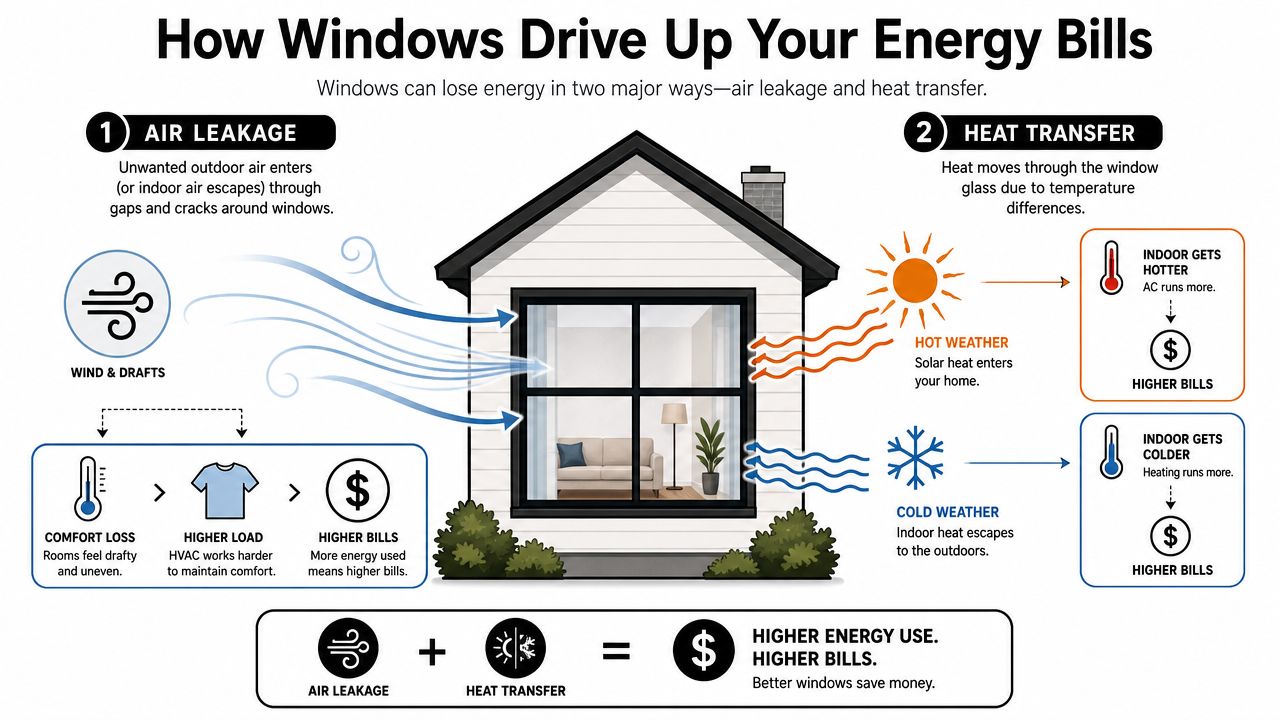
Window-related heating and cooling losses account for about 25% to 30% of residential energy use, according to U.S. Department of Energy guidance summarized in The Spruce's DOE and ENERGY STAR overview. That is why old windows feel expensive in daily use. They are not just glass. They are part of the home's thermal envelope, and weak envelope components bleed comfort and money all day long.
What modern windows do differently
Modern replacement windows use double or triple glazing, argon gas fills, and Low-E coatings to slow conductive and radiative heat transfer, according to the U.S. Department of Energy's window guidance on efficient windows. That changes how much heat the window passes, stores, and reflects. Low-E glass can also reduce UV-related fading by as much as 75% in the DOE guidance just cited.
Older windows usually fail in more ordinary ways. Weatherstripping wears down. Seals break. Frames loosen. Once that happens, the glass is no longer the only problem. Air moves around the sash and into the room, and the HVAC system has to keep compensating.
See how new windows can cut heating bills in Idaho
The signs are easy to spot
If you are looking at the same problem windows every winter, the clues usually line up:
- Condensation between panes: The seal has failed, and the insulating layer is compromised.
- Drafts near the frame: Air is slipping through where it should not.
- Rooms that never feel right: The thermostat says one thing, the room feels like another.
- Visible fading on flooring or furniture: Too much UV light is coming through.
A window does not have to be shattered to be inefficient. If the seal is dead, the comfort penalty is real.
That is why replacement windows are engineered so differently from what was common 20 or 30 years ago. The best products do more than look cleaner. They manage heat flow, air leakage, and solar gain with far more control than the old units most Idaho homes still have.
Realistic Savings From Single-Pane and Double-Pane Replacements
A lot of homeowners want a simple answer here, and the straightforward truth is this. Single-pane replacement and double-pane replacement are not the same financial decision. Your starting point sets the payback. If the house still has single-pane windows, the savings case is much stronger. If the home already has older double-pane windows, the utility savings are thinner and the decision usually rests more on comfort and long-term performance.
A U.S. Department of Energy summary quoted in the source set says replacing single-pane windows with ENERGY STAR-certified models can reduce annual household energy bills by about 7% to 15%, which the DOE translates to roughly $71 to $501 per year depending on climate, utility rates, and the window being replaced as summarized here. ENERGY STAR also says certified windows, doors, and skylights can cut heating and cooling costs by up to 13% nationwide versus non-certified products in its product guidance. That is the stronger savings case, and it comes from replacing a poor window package.
Savings depend on what you already have
If you are replacing older double-pane windows with newer double-pane units, the savings are much smaller. Industry summaries report around $200 per year at most for double-pane to newer double-pane upgrades, while other estimates put annual savings for older double-pane replacements at about $27 to $197 in the cited statistics summary. That is real money, but it is not the kind of payoff you get from leaking single-pane glass.
The takeaway is simple. Windows save the most when you are escaping a bad starting point. If the house is full of original single-pane windows, replacement can make sense on both comfort and utility savings. If the house already has decent double-pane units, you are usually paying more for comfort, appearance, and durability than for a quick energy return.
| Window Replacement Savings by Starting Window Type | Annual Savings Range | Typical Payback Period | Best Savings Scenario |
|---|---|---|---|
| Single-pane windows to efficient replacements | $71 to $501 per year, with some summaries citing $101 to $583 DOE summary via The Spruce and industry overview via A Crew Windows and | 10 to 30+ years in the cited estimates industry summary | Old, leaky windows in a cold or mixed climate |
| Older double-pane to newer double-pane | About $27 to $197 annually in some estimates, with another summary saying around $200 per year at most industry summary | Usually slower than homeowners expect | Homes with failed seals, comfort complaints, or damaged frames |
For Treasure Valley homeowners, that table should settle the question fast. If the house still has original single-pane windows, replacement deserves real attention. If not, do not let a sales pitch pretend the savings are bigger than they are.
A practical guide from C & C Windows & Doors on heating-bill savings in Idaho reaches the same conclusion. The starting window type matters more than almost anything else.
Window Features That Matter for Idaho's Climate
Idaho weather rewards windows that do more than look clean from the curb. They need to keep heat inside during winter, cut unwanted solar gain in summer, and stay comfortable through those shoulder-season swings that hit the Treasure Valley hard. A nice frame does nothing if the window package cannot handle the climate.
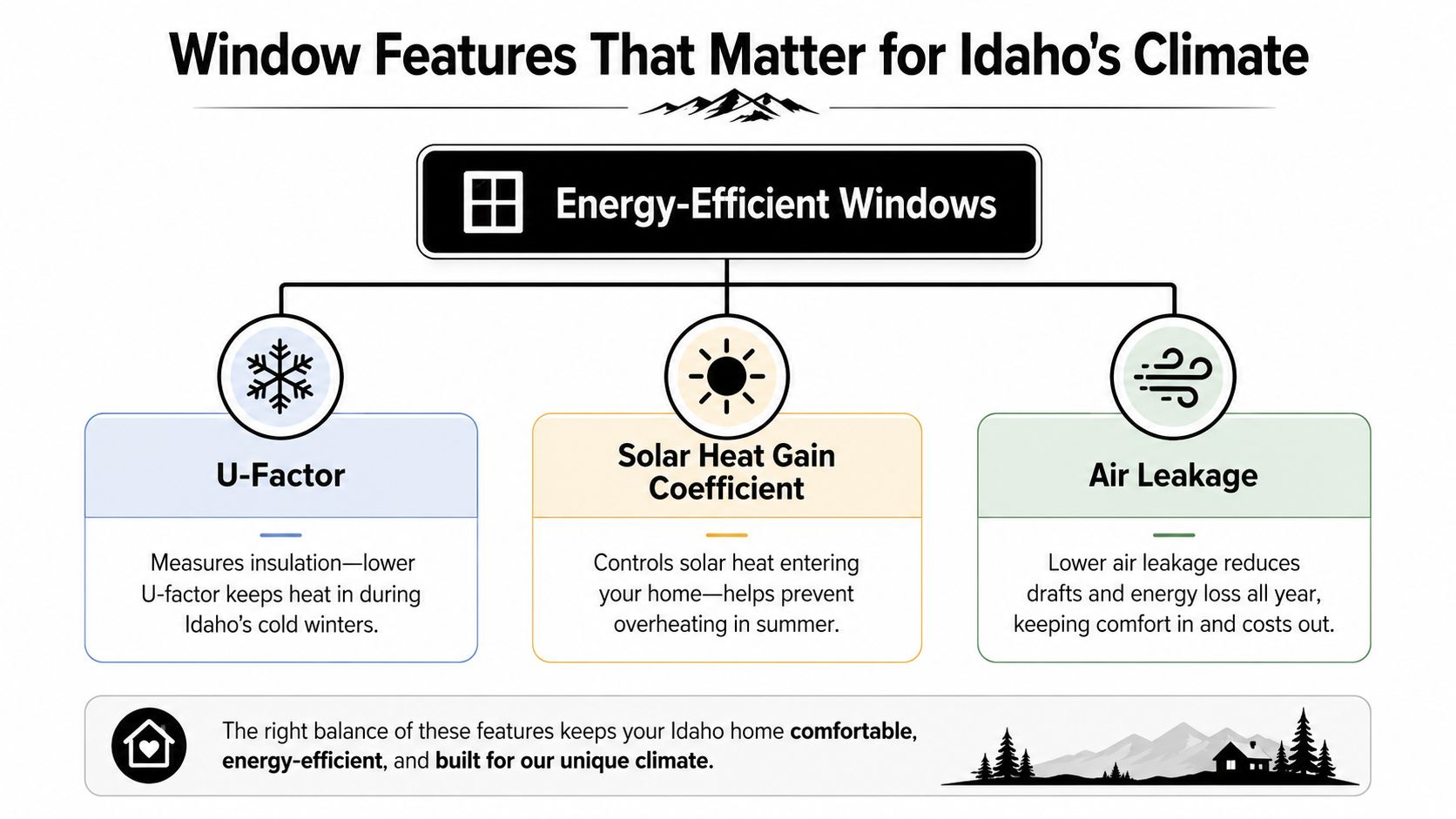
The three numbers worth your attention are U-factor, Solar Heat Gain Coefficient, and air leakage. ENERGY STAR uses climate-zone labeling for a reason, because the right window for Idaho is not the same as the right window for a hotter or more humid region as explained on ENERGY STAR's window page. The label tells you whether a product is built for your region's demands, not just whether the brochure sounds impressive.
Start with the glass package
The U.S. Department of Energy explains that double or triple glazing, inert gas fills like argon, and Low-E coatings reduce conductive and radiative heat transfer in its window efficiency guide. That is the core of a high-performance window. The rest matters, but it matters after the glass package is right.
In practical Idaho terms, low-E coatings help limit winter heat loss and reduce summer glare, while argon improves insulation between panes. The DOE also notes that low-E glass can reduce UV-related fading by as much as 75%. That matters in homes with hardwood floors, rugs, or furniture that sit in direct sun.
Don't ignore frame and installation quality
A strong glass package still underperforms if the installation is sloppy. Tight locking hardware, proper sealing, and a frame built for the climate all affect how the unit performs once it is in the wall. Narrowline frames and composite-reinforced sashes are worth asking about because they support the structure without turning the window into a thermal weak point.
Practical rule: The rated performance only matters if the installed window is sealed correctly around the opening.
If you are comparing product lines, ask whether the window is built for ENERGY STAR climate-zone criteria, whether it uses Low-E glass, whether the glazing is argon-filled, and how the installer handles drainage and air sealing. This Idaho-focused guide from C & C Windows & Doors is useful because it keeps the conversation local instead of generic.
In Idaho, triple-pane can make sense in colder or more exposure-heavy areas, but it is not a default purchase for every house. The better question is whether the whole assembly, glass, frame, and installation, matches the home's real exposure and comfort problems.
Are Windows Really the Best First Energy Upgrade
A lot of Idaho homeowners want to start with windows because they are visible, familiar, and easy to price. That instinct is understandable, but it is not always the smartest first move. The U.S. Department of Energy's guide summary says whole-house savings from window upgrades are often only 7% to 15% on annual energy bills, and it also points homeowners toward air sealing and insulation as more cost-effective first steps. That is the right order for many homes.
If the attic is thin on insulation, ducts leak, or the house has gaps around penetrations and framing, new windows will not fix the biggest losses. You can put good glass in the walls and still leave the main problem untouched. In Idaho's climate, that means windows should be a targeted upgrade, not the first answer for every high utility bill.
A simple decision filter works better than guesswork
Start with the condition of the house, then decide where your money does the most work.
- Choose windows first: If you have original single-pane units, repeated condensation, or rooms that stay uncomfortable even though the rest of the house is reasonably tight.
- Choose sealing and insulation first: If drafts show up in several places, the attic is weak, or the envelope has never been professionally tightened.
- Bundle windows with a renovation: If you are already opening walls, updating trim, or replacing several exterior components at once.
The economics change depending on what you are replacing. Single-pane windows are usually the clearest case for immediate replacement because they are weak on comfort and efficiency from the start. Double-pane windows already perform better, so a like-for-like swap often has a slower payback unless the existing units are failing or the home has comfort problems tied directly to the windows. That is why I tell homeowners to sort the project by need, not by appearance.
There is more to the decision than utility bills. Replacement can improve comfort, cut noise, and sharpen curb appeal. Those are real benefits, and they matter more when you are already planning to stay in the house for a while. Still, budget should lead the decision, especially when the payback on double-pane replacement is slow and the easier savings are waiting in the attic or around the air leaks.
If you are comparing options and trying to decide whether to move ahead, a practical guide to choosing a window company in Boise helps you separate a true upgrade from a sales pitch. The simple question is the one that matters most. Are the windows the main problem, or just the most visible one?
How to Evaluate Your Options and Choose a Local Installer
Start with the condition of the existing windows, not the quote. If the sash is warped, the seals are gone, or the frames are rotting, replacement makes sense. If the windows are structurally sound but the home leaks in other places, spend your first dollars elsewhere and revisit the windows later.
A good consultation should include custom measurements, not a rough guess from the driveway. It should also explain how the window will be installed, how debris will be handled, and what the final finish will look like once the trim goes back on. That level of detail tells you whether the installer cares about the result or just the sale.
Ask better questions before you sign
- Measurement method: Are they taking exact custom measurements, or quoting from a quick estimate?
- Product fit: Are the windows matched to Idaho's climate, not just sold as “energy efficient” in the abstract?
- Warranty coverage: Does the warranty cover both product and labor, and for how long?
- Financing and rebates: Is financing available, and are ENERGY STAR-certified products being used where possible?
If you want a local example, C & C Windows & Doors offers free in-home consultations, custom measurements, debris-free installation, financing through Synchrony, and a lifetime limited warranty on products and labor. That's the kind of service structure you want to see when the project is tied to long-term comfort and energy performance.
For a fuller checklist on what to look for in a Boise installer, the guide at how to choose a window company in Boise, Idaho is a practical place to start. Don't be shy about asking for references from Boise, Meridian, or Eagle homeowners. Local feedback tells you more than polished brochures ever will.
If a quote is vague on measurements, installation method, or warranty terms, keep shopping.
Making Your Window Replacement Decision
The decision comes down to three paths. Replace now if you have failing single-pane windows and you're tired of wasting heat, fighting drafts, and living with uneven rooms. Plan and save if you have older double-pane units, because the comfort upgrade may make sense even when the utility-bill payoff is slower. Seal first if the bigger problem is air leakage, insulation, or duct loss elsewhere in the house.
That's the honest framework. It respects the budget and avoids the common trap of treating every old window like an emergency. It also keeps the focus on real results, not showroom language.
If you want the clearest next move, schedule a free in-home consultation with a local installer who can measure the house correctly and tell you where the money goes. Treasure Valley homeowners who take that step usually stop guessing fast, and they get a much better read on whether now is the right time or whether the smarter first spend is somewhere else.
C & C Windows & Doors helps Treasure Valley homeowners sort out the numbers, the comfort issues, and the install details before they commit to a project. If you're weighing window replacement for lower utility bills, visit C & C Windows & Doors to schedule a consultation and get a local assessment that's tied to Idaho's climate, not a generic sales pitch.