There is no window replacement tax credit in Idaho for 2026. The federal Energy Efficient Home Improvement Credit for windows expired on December 31, 2025, so windows installed in 2026 don't qualify for that federal tax break.
That surprises a lot of Boise-area homeowners because the federal credit got most of the attention. In practice, though, the smarter 2026 savings strategy in Idaho is local utility and program rebates. That's where the primary opportunities are now, especially if you're replacing older, drafty windows with higher-performing models that meet rebate standards.
Table of Contents
- Planning Your 2026 Window Upgrade in Idaho
- The Federal Window Tax Credit Reality for 2026
- Your Guide to Active Idaho Energy Rebates
- How to Qualify for Idaho Window Rebates
- Claiming Your Rebate A Step-by-Step Process
- Maximize Your Savings with C & C Windows and Doors
Planning Your 2026 Window Upgrade in Idaho
If you're planning a window project this year, start with a realistic budget. Don't build your numbers around a federal tax credit that no longer applies. Build them around product performance, installation quality, and the rebate options tied to your utility provider.
That changes the way Idaho homeowners should shop. The old question was, "Will I get a federal credit?" The better question now is, "Which windows meet the rebate tier available for my home, and what documentation will I need?"
In Boise and across the Treasure Valley, that's a practical shift, not a minor detail. A tax credit affects your return later. A rebate is usually more direct, more concrete, and often easier to plan around during the purchase process.
Practical rule: Price the project based on today's active incentives, not yesterday's expired ones.
Before you choose a window line, get clear on the full project scope. That includes frame condition, glass package, installation method, and whether the performance ratings line up with available utility requirements. If you're still sorting out baseline pricing, this guide to window replacement cost in Boise, Idaho is a useful place to start.
A smart 2026 plan usually looks like this:
- Confirm your real incentive path. For most Idaho homeowners, that's a rebate program rather than a federal tax credit.
- Choose for performance first. Utilities care about measurable efficiency ratings, not marketing language.
- Keep every document. If the paperwork is sloppy, the rebate process gets harder fast.
Homeowners who handle it this way avoid the biggest mistake I see. They don't assume every "energy-efficient" window will qualify for every program. They verify first, buy second, and file with complete records.
The Federal Window Tax Credit Reality for 2026
The federal answer is straightforward. The Energy Efficient Home Improvement Credit for windows expired on December 31, 2025, and the IRS states that qualifying improvements had to be placed in service between January 1, 2023 and December 31, 2025. During that period, the credit was worth 30% of eligible costs, capped at $600 for exterior windows and skylights and $1,200 total for the broader home-efficiency category, according to the IRS page on the Energy Efficient Home Improvement Credit.
What placed in service means
This is the part that trips people up. "Placed in service" doesn't mean when you first started shopping, signed the contract, or paid a deposit. It means the improvement was installed and ready for use in the qualifying period.
So if your windows are installed in 2026, you're outside the federal window for that credit. It doesn't matter that the product is efficient. It doesn't matter that you intended to claim it. The installation timing is what matters.
If your 2026 project depends on the federal window credit to make the numbers work, rework the budget now.
What homeowners should take from this
Don't waste time hunting for a hidden federal exception that isn't there. For Idaho homeowners filing 2026 returns, there is no active federal window replacement tax credit available for 2026 returns under Section 25C, based on the IRS guidance linked above.
That's the bad news. It's also useful news because it clears out the confusion.
Here's the practical takeaway:
- Old federal credit rules are historical context. They tell you what used to be available, not what you can count on for a 2026 installation.
- Your project can still make financial sense. Energy savings and comfort upgrades still matter even without the tax credit.
- Local rebates deserve your attention. In Idaho, that's where homeowners should focus if they want an active incentive path.
A lot of online articles blur 2025 rules into 2026 planning. That's sloppy. If you're making decisions this year, you need current reality, not recycled credit language from last year's posts.
Your Guide to Active Idaho Energy Rebates
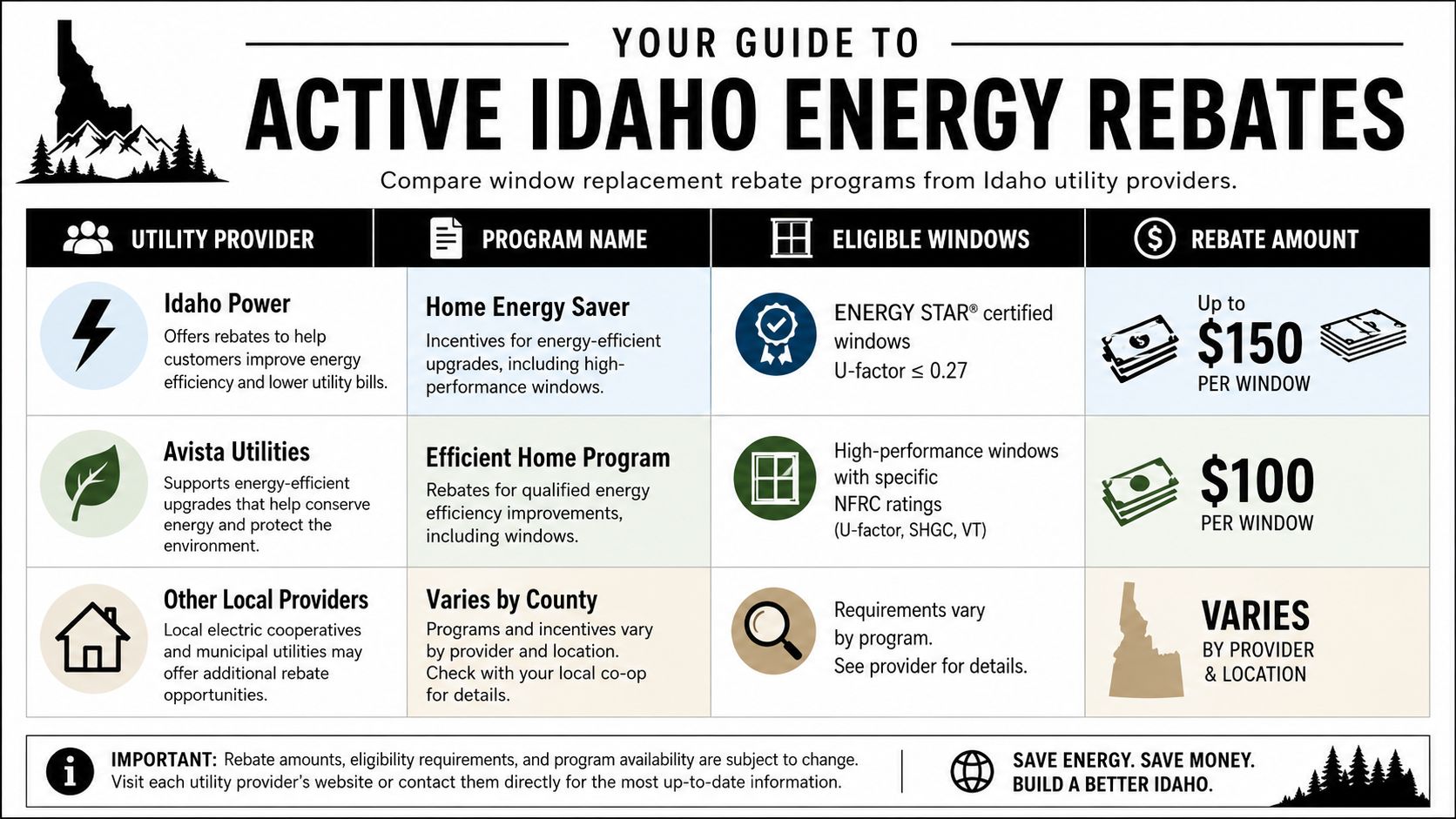
The good news is that Idaho homeowners still have a live path to savings. It just isn't the federal tax code anymore. It's rebates.
A rebate isn't the same thing as a tax credit. A tax credit affects what you owe on your return. A rebate is tied to a qualifying purchase and usually depends on the efficiency specs, your utility, and the required paperwork. For many homeowners, that's often easier to use because the incentive is tied directly to the project itself.
Why rebates matter more in 2026
Idaho's incentive environment has leaned toward utility and performance-based programs. That's the lane worth paying attention to if you're replacing windows now.
One useful example comes from Avista's Idaho rebate schedule. It has offered $180 per window for contractor-installed windows in electric-heated homes with U-factors from 0.29 to 0.23, and $225 per window for contractor-installed windows at 0.22 or below. For natural-gas homes, the listed amounts were $45 per window and $56 per window in those same performance tiers, as shown on Avista's Idaho window rebate page.
The same source context also notes broader Idaho retrofit rebate ranges of $2,000 to $4,000 for individual households and up to $400,000 for multifamily buildings. The takeaway is clear. In Idaho, the financial value has shifted toward state and utility rebate structures rather than the expired federal window credit.
A useful Idaho example
That shift changes how you should compare products. If one window qualifies for a stronger rebate tier and another doesn't, the cheaper quote on paper may not be the better value.
Here's an illustrative comparison using the verified Avista figures above.
| Utility Provider | Home Heating Source | U-Factor ≤ 0.22 | U-Factor 0.23-0.29 |
|---|---|---|---|
| Avista | Electric | $225 per window | $180 per window |
| Avista | Natural gas | $56 per window | $45 per window |
Two points matter here:
- Performance affects the rebate. Better thermal performance may qualify for the better tier.
- Heating source affects the rebate. Electric-heated and natural-gas homes may not receive the same amount.
Rebates reward measurable efficiency. That's why the spec sheet matters as much as the showroom sample.
If you're comparing options, start with the actual efficiency label and not just the sales language. General claims like "high-efficiency" or "premium glass" don't secure a rebate. The rating does. If you want a deeper overview of what those ratings mean in real homes, this guide to energy-efficient windows in Idaho is worth reading before you buy.
How to Qualify for Idaho Window Rebates
Qualifying usually comes down to two things. The window has to meet the performance requirements of the program, and the installation has to meet the program's rules.
That's why homeowners get frustrated when they shop by appearance alone. A beautiful replacement window can still miss the rebate target if the thermal specs don't line up.
What U-factor actually means
U-factor is one of the main numbers utilities use when they evaluate window efficiency. In simple terms, it measures how much heat moves through the window. Lower numbers generally indicate better insulating performance.
That matters in Idaho because homeowners want windows that help reduce heat loss during cold weather and improve indoor comfort year-round. When a rebate schedule creates tiers around U-factor, that's the utility's way of rewarding stronger thermal performance.
You don't need to become a building scientist. You do need to ask for the exact rating on the product you're considering.
What usually determines eligibility
Most rebate programs care about details that homeowners often overlook:
- Product ratings: The window needs to match the required efficiency tier shown in the rebate rules.
- Installation method: Some programs specifically require contractor installation.
- Documentation: You usually need the invoice, the product details, and the manufacturer labels or equivalent proof.
- Timing: Programs can require submission within a certain application window and under current program terms.
Careful shopping yields rewards. Ask these questions before you sign:
- What is the exact U-factor of this configuration? Not the brochure average. The actual configuration you're buying.
- Is professional installation required for the rebate I'm targeting?
- Will I receive all labels and paperwork needed for the application?
Worth remembering: The best-looking window in the showroom isn't automatically the best rebate candidate.
Homeowners also get tripped up by upgrades. Glass packages, spacer systems, and multi-pane configurations can affect performance. That's good when the window moves into a better qualifying tier. It's a problem when assumptions replace verification.
If you're trying to qualify for a top rebate tier, demand precision. Ask for the rating, ask how the installed product will be documented, and keep copies of everything. That discipline matters more than the marketing pitch.
Claiming Your Rebate A Step-by-Step Process
A rebate only helps if you claim it. Plenty of homeowners do the hard part, choose better windows and pay for installation, then lose momentum on the paperwork. That's avoidable.
Treat the rebate application as part of the project, not an afterthought.
The paperwork that matters
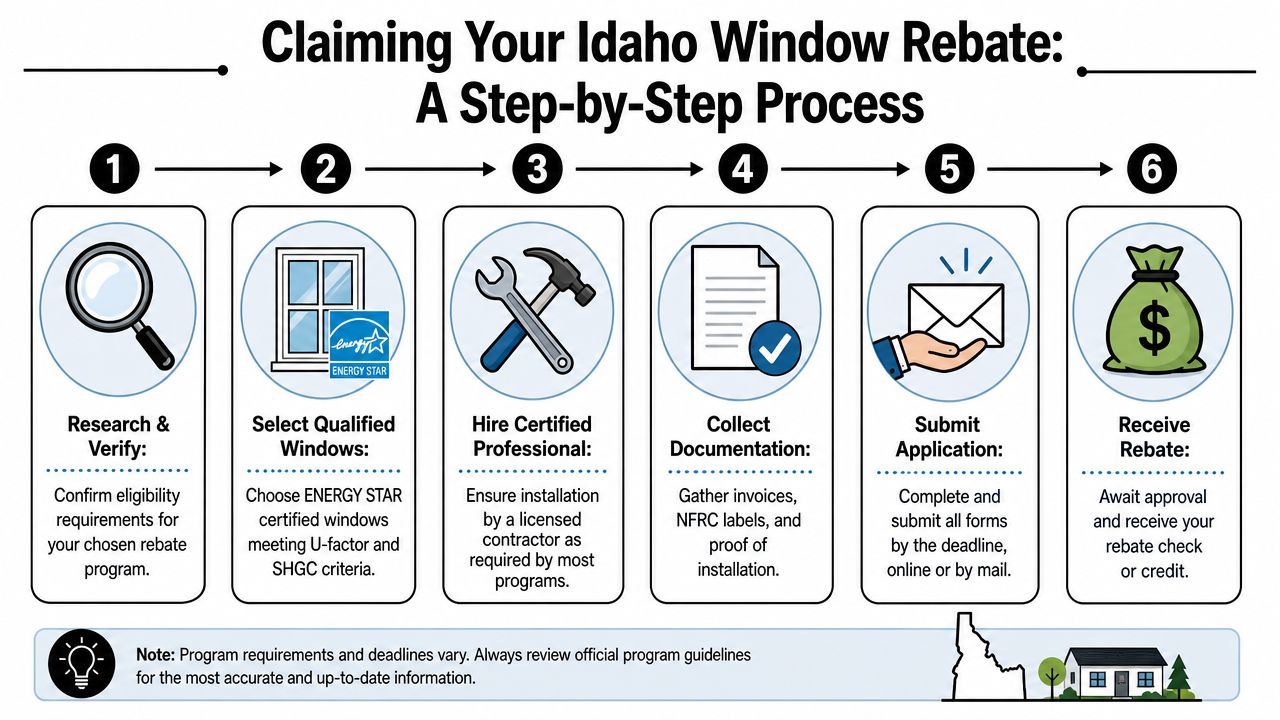
The basic process is usually straightforward:
- Verify the active program rules before purchase. Check the utility's current requirements for eligible products and installation standards.
- Select windows that match the required performance tier. Don't rely on assumptions.
- Use professional installation if the rebate requires it. Many programs care who installs the product and how the work is documented.
- Collect every supporting document immediately after installation. Keep the final invoice, product information, and efficiency labels.
- Submit the application completely. Incomplete submissions create delays and rework.
The most important habit is simple. Keep a single folder for the project. Put every proposal, invoice, label, and confirmation in it.
How to avoid getting kicked back
Most rebate problems come from preventable mistakes, not complicated policy issues.
Use this checklist:
- Match the invoice to the application. Names, address, and product details should line up.
- Save the efficiency labels. If the program wants proof of ratings, you'll need it.
- Read the contractor requirement carefully. If the program says contractor-installed, don't assume self-install qualifies.
- Submit promptly. Waiting invites missing paperwork, forgotten details, and expired windows for filing.
Clean paperwork wins. Sloppy paperwork stalls.
If you want one rule to follow, it's this: verify the qualifying specs before installation and preserve the proof after installation. That's what keeps a rebate from turning into a headache.
Maximize Your Savings with C & C Windows and Doors
The window replacement tax credit Idaho 2026 search leads to a blunt answer. The federal credit is gone for 2026 installations. Homeowners who keep chasing it are wasting time.
The better move is to treat Idaho rebates as the primary savings path and choose windows that are engineered for that standard. That means paying attention to U-factor, installation requirements, and documentation from day one.
It's also why product quality matters. Better-designed replacement windows can support the comfort and efficiency goals that rebate programs are built around. If you're comparing options, this review of Mezzo windows for Idaho homeowners gives useful context on features that matter in local conditions, including energy-focused upgrades and long-term value.
The right project plan is simple. Buy for performance. Install correctly. File clean paperwork. That's how Idaho homeowners should approach window replacement in 2026.
If you want help sorting through qualifying window options, performance ratings, and the rebate paperwork that goes with them, talk with C & C Windows & Doors. Their Boise-based team handles in-home consultations, custom measurements, and professional installation for Treasure Valley homeowners who want energy-efficient replacement windows done right.