
You've just walked in from a Tri-Cities afternoon that turned the living room into a greenhouse. The air conditioner is running, the west-facing glass feels hot to the touch, and one bedroom is still several degrees warmer than the rest of the house. Before you replace every window, focus on the specification that controls that afternoon heat: solar heat gain, not just the number of panes.
The best windows for hot summers in the Tri-Cities combine low-SHGC Low-E glass, an appropriately low U-factor, a stable frame, and professional installation. The right choice also depends on whether the opening faces west, south, east, or north. Shading, ventilation, and window placement matter just as much as the glass package.
Table of Contents
- Why Tri-Cities Summers Are a Window Problem
- SHGC and U-Factor Explained Without the Jargon
- Low-E Coatings Argon Fills and Double vs Triple Pane
- Frame Materials and Window Styles That Handle the Heat
- Shading Orientation and Ventilation That Stack With the Glass
- Cost vs Savings Match the Window to Your Priority
- Installation Quality and Warranty That Protect the Investment
- Recommendations Next Steps and Homeowner FAQ
Why Tri-Cities Summers Are a Window Problem
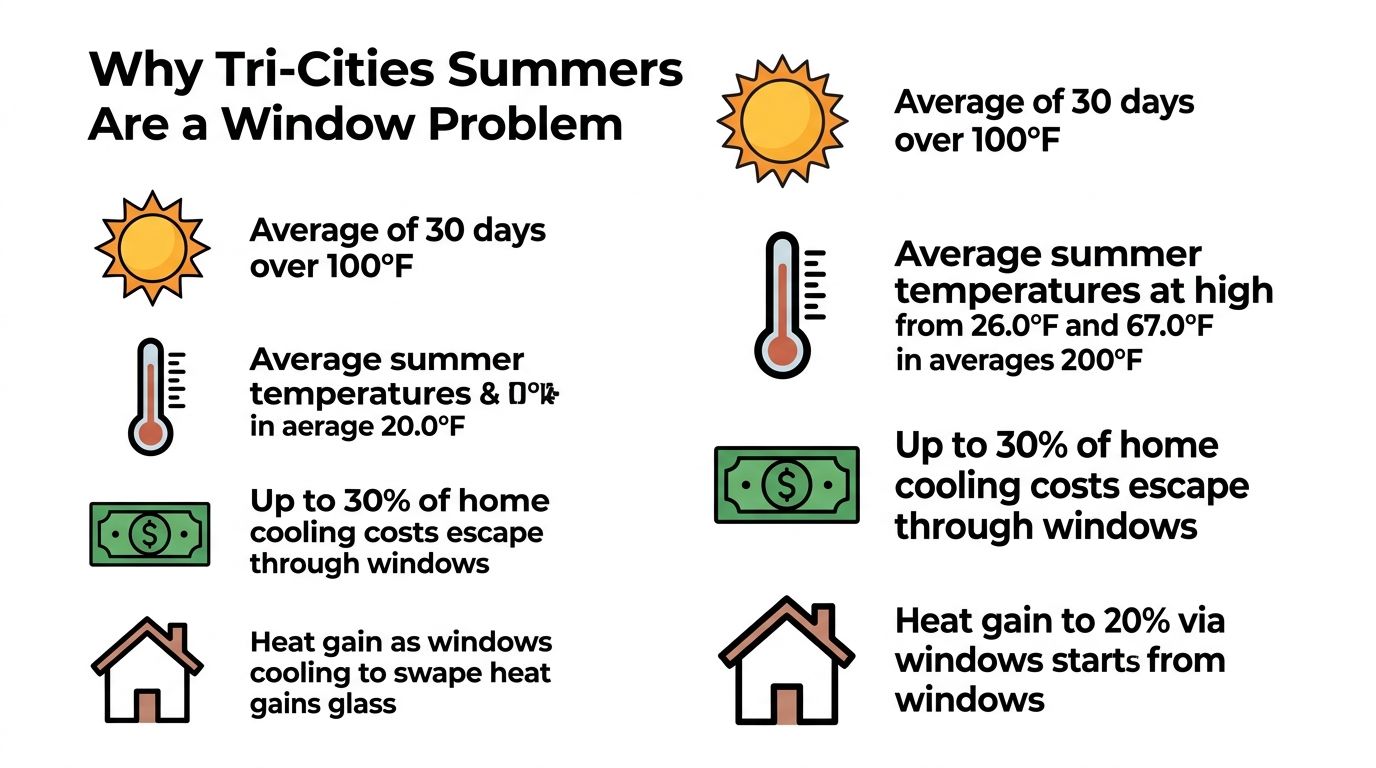
A Tri-Cities home can feel comfortable in the morning and punishing by late afternoon. Direct sun strikes west-facing rooms, south-facing glass carries a heavy daytime heat load, and the cooling system has to respond to outdoor heat while indoor rooms gain warmth through the windows.
Ordinary clear double-pane glass can allow about 75% of the sun's heat into a home, according to ENERGY STAR window guidance from the U.S. Department of Energy. Double glazing helps slow conductive heat flow, but it doesn't automatically stop solar radiation. That distinction explains why a room can remain hot even when the window is technically “energy efficient.”
The practical symptoms are familiar:
- Overworked air conditioning: The system runs longer because solar heat keeps entering after the room has cooled.
- Uneven temperatures: West rooms overheat while shaded rooms feel comfortable.
- Interior fading: Furnishings and finishes receive repeated solar exposure through untreated glass.
- Poor evening comfort: The building holds heat after the sun has moved away.
The fix isn't just buying triple-pane windows. A well-selected double-pane unit with solar-control Low-E glass can be a better hot-weather choice than a poorly specified triple-pane product. Start with orientation, then compare SHGC, U-factor, glass coatings, frame construction, shading, and installation details. Homeowners comparing the project scope can also review this guide to window replacement cost in Tri-Cities, Washington.
The practical diagnosis: If the west-facing room is the problem, buy glass that rejects afternoon solar heat before paying for extra panes everywhere.
SHGC and U-Factor Explained Without the Jargon
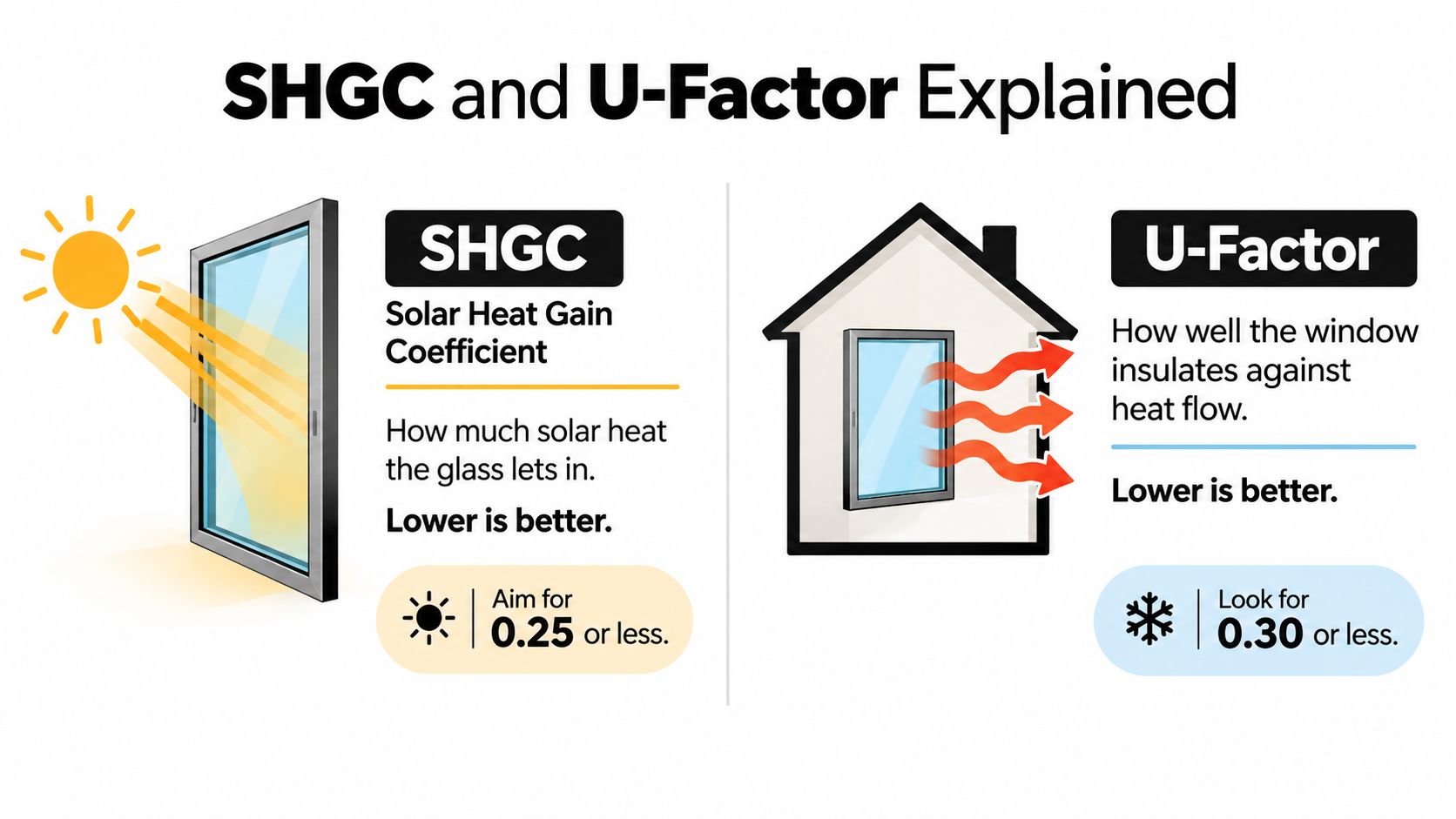
A window can have excellent insulation and still make a west-facing room uncomfortably hot. The label gives you two ratings to prevent that mistake: Solar Heat Gain Coefficient, or SHGC, and U-factor. They address different heat paths, so compare both instead of choosing by pane count alone.
SHGC controls sun-driven heat
SHGC ranges from 0 to 1 and shows how much solar heat enters through the window. Lower values reduce afternoon heat gain, which makes them the starting point for exposed Tri-Cities glass. The U.S. Department of Energy's window guide describes SHGC as a standardized way to compare products for different climate needs.
Use the exposure to set the target:
- West and south openings: Choose SHGC of 0.25 or lower where direct sun reaches the glass for long periods.
- East openings: Low-SHGC glass makes sense where morning sun overheats bedrooms, kitchens, or other occupied rooms.
- North openings: A higher SHGC can work when the opening stays well shaded and receives little direct sun.
ENERGY STAR lists SHGC of 0.23 or lower for Southern and South-Central climate categories. Its residential requirements specify U-factor of 0.32 or lower with SHGC of 0.23 or lower for Southern climates, and U-factor of 0.28 or lower with SHGC of 0.23 or lower for South-Central climates, as shown in ENERGY STAR's residential window requirements.
U-factor controls heat flow through the assembly
U-factor measures how effectively the complete window resists conductive heat flow. Lower values mean better insulation through the glass, frame, and other parts of the assembly. ENERGY STAR's Southern climate requirement of U-factor 0.32 or lower is a reasonable ceiling. I'd look for 0.30 or lower when the product and budget allow it.
Keep the jobs separate. Low SHGC limits solar heat entering through the glass. Low U-factor slows heat transfer through the entire window, which matters during both hot afternoons and cooler periods.
Read the NFRC label, not only the sales brochure. Whole-window ratings include the frame, while center-of-glass figures can make a unit appear more efficient than the installed product. Lower SHGC can also reduce useful winter sun, so match the glass to orientation, shading, and room use. The right question is which glazing package cuts cooling load on that specific exposure, then how shading and ventilation will support it.
Low-E Coatings Argon Fills and Double vs Triple Pane
The glass package deserves more attention than the pane count. For a typical Tri-Cities replacement project, I'd choose spectrally selective Low-E glass with argon in a quality double-pane unit before upgrading blindly to triple pane.
Spectrally selective Low-E coatings are designed to reduce infrared heat while preserving more visible daylight than heavily reflective glass. Lawrence Berkeley National Laboratory explains this hot-climate approach in its guidance on window strategies for hot climates. Traditional reflective coatings can control glare and heat, but they may make interiors feel darker or more mirror-like.
Argon fills improve the space between panes by slowing heat movement compared with air. Krypton can provide additional insulation in certain designs, but the improvement often doesn't justify its added cost for a standard hot-summer replacement.
| Option | SHGC Range | U-Factor Range | Hot-Summer Verdict |
|---|---|---|---|
| Clear double pane | Higher solar gain | Moderate | Weak choice for exposed west glass |
| Double pane with standard Low-E | Moderate to low | Improved | Usable, but verify the actual SHGC |
| Double pane with spectrally selective Low-E and argon | Low | Low | Best balance for most Tri-Cities homes |
| Triple pane with solar-control Low-E | Low | Very low | Premium comfort, but not automatically better for cooling |
| Reflective or heavily tinted glass | Low | Varies | Strong solar control, with daylight and appearance trade-offs |
Hot-summer winner: Quality double pane, spectrally selective Low-E, argon fill, and a low SHGC matched to the exposure.
Triple pane makes sense when winter insulation, street noise, or premium whole-home comfort justifies the price. It can also help on a heavily exposed north-facing elevation where conductive heat flow matters more than solar gain. It isn't the default answer for a west-facing Tri-Cities window.
The same principle applies when evaluating whether argon gas windows are worth it. Ask for the complete NFRC rating, not a promise that “triple pane” or “gas-filled” automatically means better cooling performance.
Frame Materials and Window Styles That Handle the Heat
Glass controls most of the solar load, but the frame determines how reliably the unit handles repeated heat exposure and seasonal movement. A frame that expands, conducts heat, or deteriorates can undermine an excellent glazing package.
Vinyl remains the value baseline. Specify heat-stabilized or composite-reinforced vinyl rather than the thinnest low-cost profile, particularly on large, sun-exposed openings. Fiberglass offers stronger dimensional stability and can reproduce a painted-wood appearance with less upkeep. Wood-clad windows look refined, but the exterior requires disciplined maintenance in a dry, sunny climate.
Aluminum should have a thermal break. Without one, aluminum conducts heat directly through the frame and into the interior perimeter. That isn't a detail I'd overlook.
| Frame Material | Heat Stability | Maintenance | Best Paired Style | Climate Verdict |
|---|---|---|---|---|
| Reinforced vinyl | Good when properly engineered | Low | Double-hung or sliding | Strong value choice |
| Fiberglass | Excellent | Low | Casement or picture | Best performance upgrade |
| Wood-clad | Good with maintenance | High | Picture or casement | Premium appearance |
| Thermally broken aluminum | Good with correct design | Low to moderate | Large picture units | Appropriate for modern profiles |
Window style changes both air leakage and ventilation. Casements close tightly and can catch breezes when open, making them especially useful on east and west walls. Picture windows provide large, uninterrupted glass and work well where you want a low-SHGC view, but they don't ventilate.
Double-hung and sliding windows remain dependable whole-house choices. They're easy to operate and usually cost less than complex specialty units, though their meeting rails and operating tracks can create more potential leakage than a well-built casement.
My practical match is simple: casements for breezy east and west rooms, picture windows for shaded views, and double-hung units where value and easy operation lead the decision.
Shading Orientation and Ventilation That Stack With the Glass
Low-SHGC glass can't defeat every afternoon heat problem by itself. If west-facing glass receives direct sun, stop the heat outside the window whenever possible.
Use exterior solar screens, operable awnings, deep roof overhangs, or well-placed deciduous landscaping. South-facing overhangs are especially useful because they can block high summer sun while preserving useful daylight. Interior cellular shades add another layer. Guidance on window treatments for hot summers in Eastern Washington cites cellular shades at up to 15% total site-energy savings for heating and cooling compared with homes without shading devices.
Orientation should guide both glass selection and window size:
- West: Keep openings controlled and shade them aggressively.
- South: Use low-SHGC glass with an effective overhang.
- East: Manage morning glare and heat, especially in sleeping areas.
- North: Use this side for daylight and views when the design allows it.
Ventilation becomes valuable when outdoor air cools in the evening. Pair a lower operable casement with a higher operable window to encourage cross-flow. Window fans can flush warm indoor air overnight, while a whole-house fan can work well in suitable ranch-style layouts.
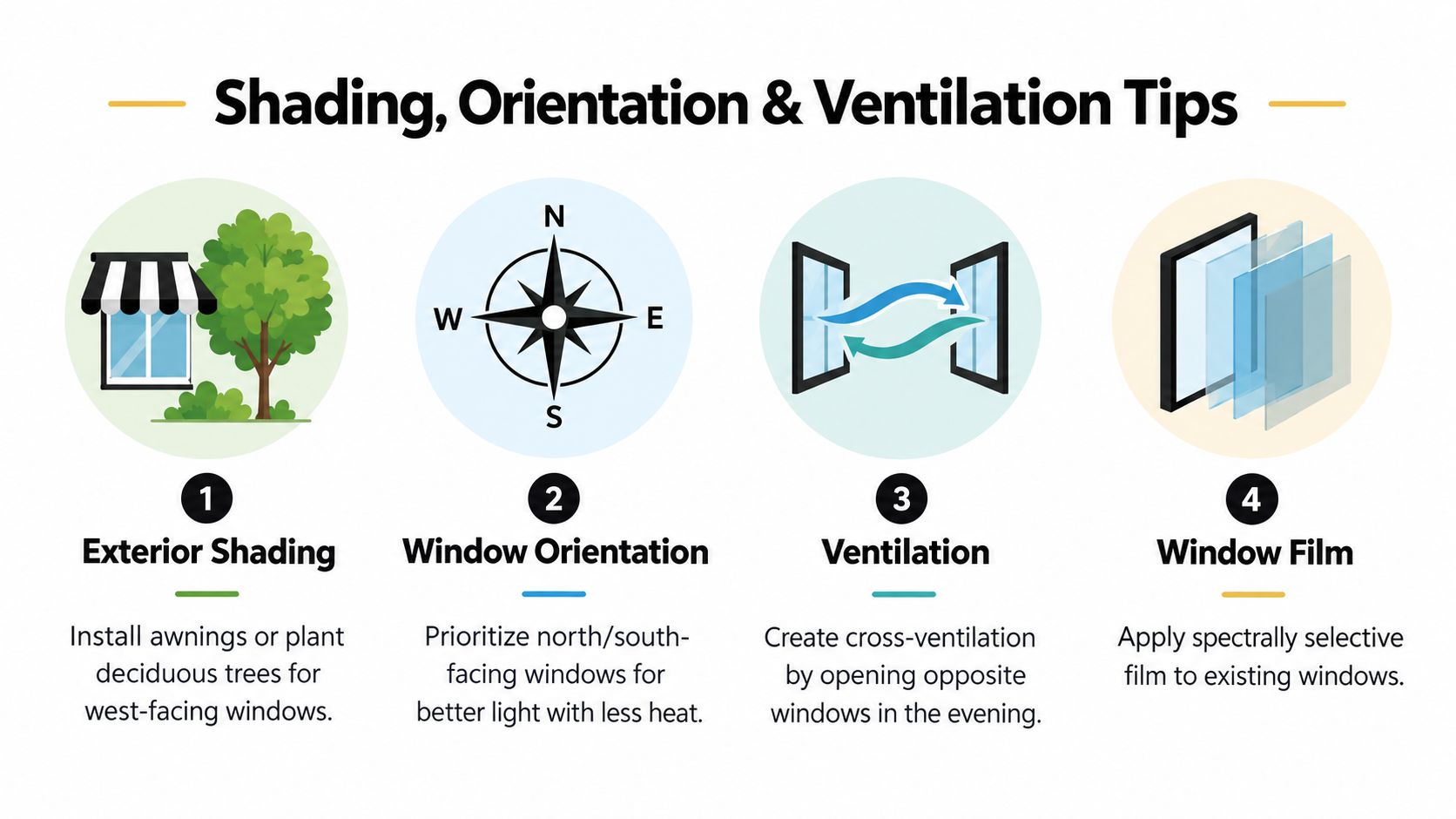
The best window decision is therefore a system decision. Glass rejects heat, shading blocks it before entry, and ventilation removes accumulated warmth when outdoor conditions cooperate.
Cost vs Savings Match the Window to Your Priority
I won't give you a fake payback period. Cooling savings depend on the existing glass, room orientation, insulation, HVAC condition, shade, and how much of the home you replace. The useful comparison is between package levels and the problem each one solves.
The price bands below are planning figures supplied for this buying framework, not guaranteed quotes. Installation complexity, opening size, trim, stucco work, disposal, and full-frame conditions can change the final number.
| Priority Profile | Recommended Package | Installed Cost per Opening | Expected Cooling Savings | Payback Framing |
|---|---|---|---|---|
| Budget-first | Low-SHGC Low-E double pane with argon on worst-sun openings | $400 to $650 for builder-grade vinyl double pane | Focus savings where solar exposure is highest | Target the rooms that overheat first |
| Balanced efficiency | Premium Low-E double pane, argon, reinforced vinyl or casement | $700 to $1,100 | Better whole-home comfort than scattered basic replacements | Compare comfort improvement with project scope |
| Luxury comfort | Triple-pane fiberglass or composite | $1,100 to $1,800 | Stronger insulation and comfort potential | Justify through whole-home goals, not pane count alone |
| Noise reduction | Laminated glass or asymmetric panes | Varies by specification | Cooling benefit depends on the glass package | Buy for acoustic performance, not presumed energy payback |
| Resale | Consistent street-facing window style and documented performance | Varies by opening and finish | Hard to isolate from other upgrades | Prioritize visual consistency and transferable documentation |
For a budget-focused homeowner, replacing the west and south openings first often makes more sense than installing premium units in shaded rooms. A balanced buyer should specify low SHGC, argon, and a consistent whole-house plan. A luxury buyer can justify fiberglass or composite frames with triple-pane glass when sound control and year-round comfort matter.
Don't expect noise-reduction glass to solve a solar-control problem unless its SHGC rating also fits the exposure. Likewise, don't buy an expensive package for resale without keeping the street-facing elevations visually consistent.
Installation Quality and Warranty That Protect the Investment
A premium window installed badly is an expensive draft. The installer must manage the opening, sill, flashing, insulation, sealants, trim, and operating clearances. Tri-Cities stucco exteriors make that sequence especially important because careless removal can damage the finish or leave water-management details unresolved.
Retrofit installation can preserve existing trim when the frame is sound. Full-frame replacement makes more sense when the existing frame, sill, or surrounding structure has deterioration. The right choice depends on the condition of the opening, not just on which method produces the lower initial quote.
Factory-trained installation programs can show that a crew has product-specific training, but certification alone isn't a substitute for references and jobsite questions. Ask who will perform the work, how the installer handles stucco, and whether the written scope identifies foam, flashing, perimeter sealing, and interior finish work.
Your warranty review should cover:
- Glass seal failure: Confirm what happens if the insulated glass loses its seal.
- Product terms: Check whether coverage is non-prorated or prorated.
- Transferability: Ask whether the warranty can pass to a future homeowner.
- Labor coverage: Verify whether installation labor is included.
- Documentation: Keep the invoice, product labels, warranty certificate, and final walkthrough record.
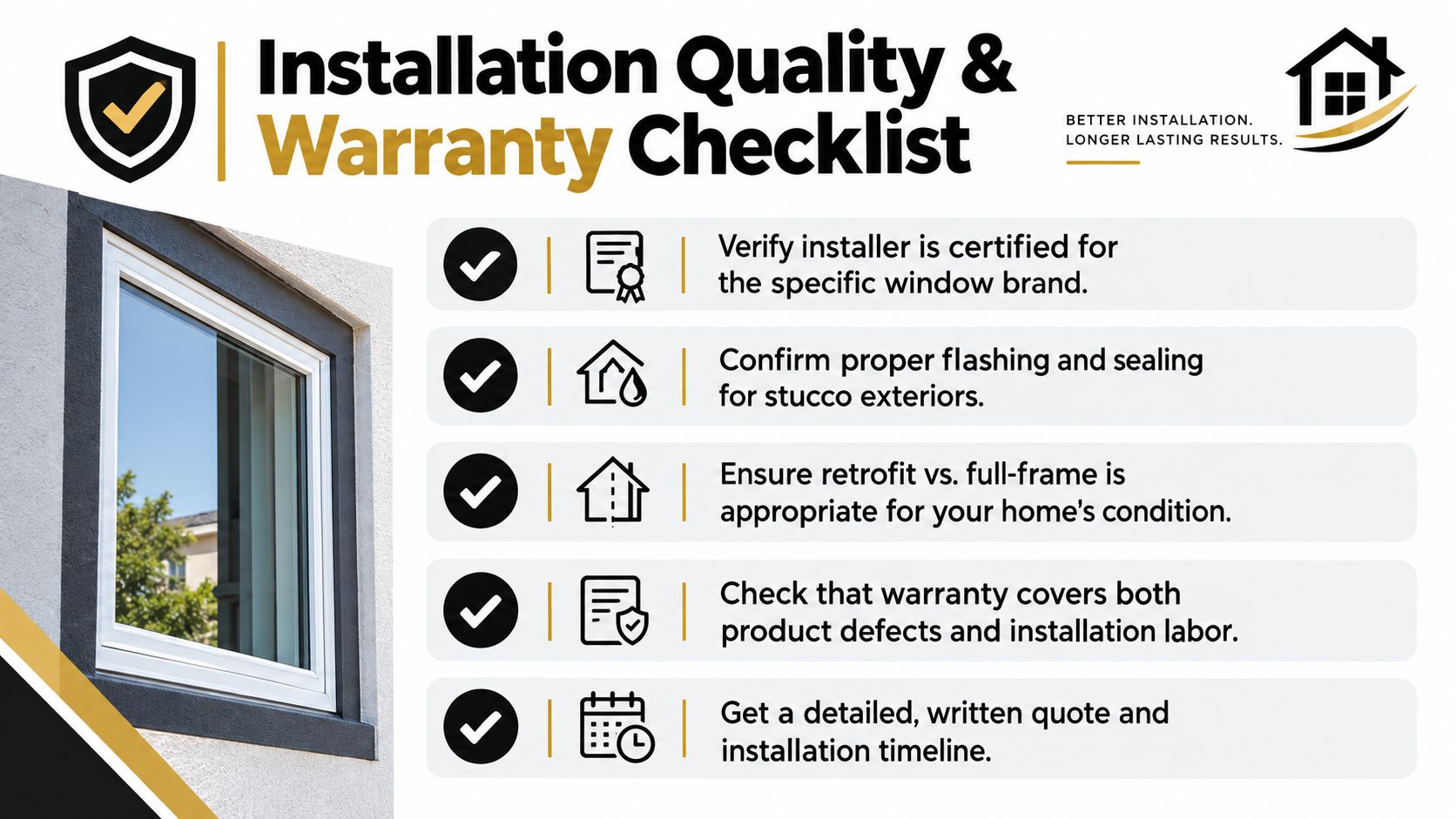
Before signing, verify the installer's license and insurance, request references from similar homes, and ask to see the NFRC label for the actual products being installed. Confirm the retrofit or full-frame approach in writing, then photograph the flashing and sealing before the trim covers the work.
Homeowners comparing local installation options can review window companies in Kennewick, Washington. The central point remains simple: the glass can only perform as well as the opening, installation, and warranty paperwork allow.
Recommendations Next Steps and Homeowner FAQ
Your best choice depends on what you want the replacement to accomplish.
- Budget-focused: Choose double-pane glass with spectrally selective Low-E, a reinforced vinyl frame, and low SHGC on east and west exposures first.
- Balanced efficiency: Choose double pane with argon, low-SHGC Low-E, and casements where ventilation and sealing matter.
- Premium comfort: Consider triple pane, warm-edge spacers, fiberglass or composite frames, and exterior shading as a complete package.
- Resale-driven: Use a consistent style on visible elevations, document performance ratings, and confirm whether the warranty transfers.
Common homeowner questions
How long does installation take?
The schedule depends on the number of openings, access, trim, stucco, and whether the project uses retrofit or full-frame installation. Ask for a written sequence rather than accepting a vague completion promise.
Should I replace every window at once?
Not always. If the budget is limited, start with the rooms that receive the strongest direct sun. A whole-home replacement makes sense when appearance, warranty consistency, and uniform operation matter more than staged spending.
What SHGC should I target?
For heavily exposed west and south windows, aim around 0.25 or lower. ENERGY STAR's hot-climate guidance generally points to 0.23 or lower in Southern and South-Central categories, as covered in the earlier performance discussion.
Is triple pane worth the cost?
It can be, especially for premium comfort, noise control, or a whole-home project. It isn't automatically the best cooling choice if a double-pane unit has better solar-control glass.
What about financing and rebates?
Ask the installer about current financing and incentive eligibility before signing. Programs change, and qualification depends on the exact product, location, and project documentation.
How do I verify performance after installation?
Operate every sash and lock, inspect perimeter seals and trim, review the product labels, and document any condensation, air leakage, or operating problem promptly. The final walkthrough should match the written scope.
Request an in-home assessment before choosing a product. The assessment should review each window's orientation, existing frame condition, shading opportunities, ventilation needs, and budget, then match the glass and frame to the actual problem.
C & C Windows & Doors offers custom measurements, energy-efficient Low-E and argon window options, optional triple-pane glass, and professional replacement installation for homeowners evaluating hot-summer comfort. Visit C & C Windows & Doors to request an in-home assessment that accounts for orientation, existing openings, and your project priorities.