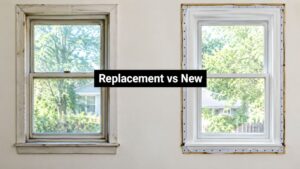

You're sitting at the kitchen table in Meridian, looking at the slider that whistles on a January morning. The bedroom window feels drafty, condensation pools on the sill in November, and by four o'clock in July, the west-facing picture window has turned the living room into a greenhouse. If your bonus room faces I-84 or sits under an airport flight path, traffic and aircraft noise may be part of the daily irritation too.
The best windows for Idaho climate aren't chosen from a generic national list. Idaho stretches across multiple ENERGY STAR climate zones, and a window that makes sense in the Treasure Valley isn't automatically the right choice for Coeur d'Alene, Idaho Falls, McCall, or Sun Valley. This guide connects the window's actual ratings, glass package, frame, and installation details to the outcomes you care about: warmer bedrooms, cooler west-facing rooms, fewer drafts, less condensation, and better noise control.
Table of Contents
- Why Idaho Needs a Different Window
- How Idaho's Climate Stresses a Window
- The Performance Numbers That Actually Matter
- Matching Window Style to Each Room
- Glass Upgrades Worth the Money in Idaho
- Frames, Drainage, and Installation Details
- Your In-Home Consultation Checklist
- The Right Window Spec for Treasure Valley Homes
Why Idaho Needs a Different Window
A drafty slider in Meridian, an overheated west-facing room in Eagle, and highway noise near I-84 do not need the same window package. Boise, Nampa, Caldwell, Meridian, and the nearby foothills share a cold, dry interior climate, yet each home has different exposure, orientation, and wind conditions. The right choice depends on the room and the site, not a statewide product list.
Boise's average monthly highs rise from about 38°F in January to roughly 93°F in July. Annual precipitation stays relatively low, at about 11.7 to 13.6 inches, depending on the climate dataset, and Boise records approximately 70 to 77 days with measurable precipitation each year. That dry shoulder-season pattern can make replacement work easier to schedule. (Boise climate averages and seasonal conditions)
Those conditions put specific demands on a window. A bedroom needs a warm interior surface and dependable air sealing to reduce a cold draft. A west-facing living room needs solar control to limit late-afternoon overheating. A home near I-84 needs tighter frame sealing and glass selected for noise control. An exposed foothills lot also needs installation details that can handle wind.
Start with the room, not the sales brochure
Begin with the opening's orientation, size, exposure, and purpose. A north-facing bedroom, west-facing picture window, and frequently used patio slider should not receive the same specification.
- Name the discomfort. Identify heat loss, solar heat, air movement, condensation, or outside noise.
- Check the exposure. North, south, and west walls call for different glass decisions.
- Set the performance target. Compare U-factor, SHGC, air leakage, and condensation resistance on the actual label.
- Inspect the installation plan. Sill preparation, flashing, shims, and perimeter sealing can determine whether the window performs as rated.
Installer's rule: A window quote should explain how the product fits your house, not just list a brand and a price.
How Idaho's Climate Stresses a Window
A west-facing living room can feel comfortable at breakfast and overheat by late afternoon. A bedroom slider can stay shut because its frame admits a winter draft. Near I-84, traffic noise can remain obvious even after replacing single-pane glass. Idaho windows fail homeowners in different ways because the state contains several distinct climate zones and exposure conditions.
Temperature remains a major stressor, but the repeated seasonal swing described earlier affects more than the glass. Seals, frames, and surrounding materials expand and contract, while sharp high-desert temperature drops after hot afternoons test the assembly's joints. A poorly installed slider often reveals the problem first through air movement at the meeting rail or sill.
Cold weather also changes how indoor moisture behaves. Condensation on the glass or sill usually means a cold interior surface is meeting household humidity. The window may not be the sole cause. Ventilation, indoor moisture, blinds, furniture placement, and the glass edge can all influence where moisture collects.
Solar exposure requires a separate decision. West-facing Treasure Valley glass receives strong afternoon sun, creating glare and overheating that a low U-factor alone cannot prevent. Choose glass with an SHGC suited to the room's orientation and cooling load. That choice matters more on a west wall than on a shaded north-facing bedroom.
Wind and sound depend on the property. An exposed Boise Foothills home needs tighter air control and careful perimeter sealing. A house along I-84, the Connector, or near Boise Airport needs a discussion about glass thickness, frame sealing, and acoustic performance. Insulation by itself will not solve highway noise.
Climate stressors homeowners notice first
| Climate stressor | Window problem it creates |
|---|---|
| Daily and seasonal temperature shifts | Seal movement, cold interior glass, and frame expansion and contraction |
| Cold, dry indoor conditions | Condensation risk when indoor humidity meets a cold glass edge or sill |
| Strong west and south exposure | Summer overheating, glare, and fading on exposed glass |
| Foothills and open-lot wind | Air leakage, pressure on hardware, and greater demands on flashing and perimeter seals |
| Traffic and airport noise | Exterior sound entering through glass, meeting rails, and frame gaps |
Northern Idaho calls for a different specification from the Treasure Valley. McCall and Sun Valley homes face harsher winter heating demands and may justify more insulation. Twin Falls homeowners often need closer attention to wind exposure. Treating Idaho as one market produces the wrong glass, frame, or installation plan for the room and the property.
The Performance Numbers That Actually Matter
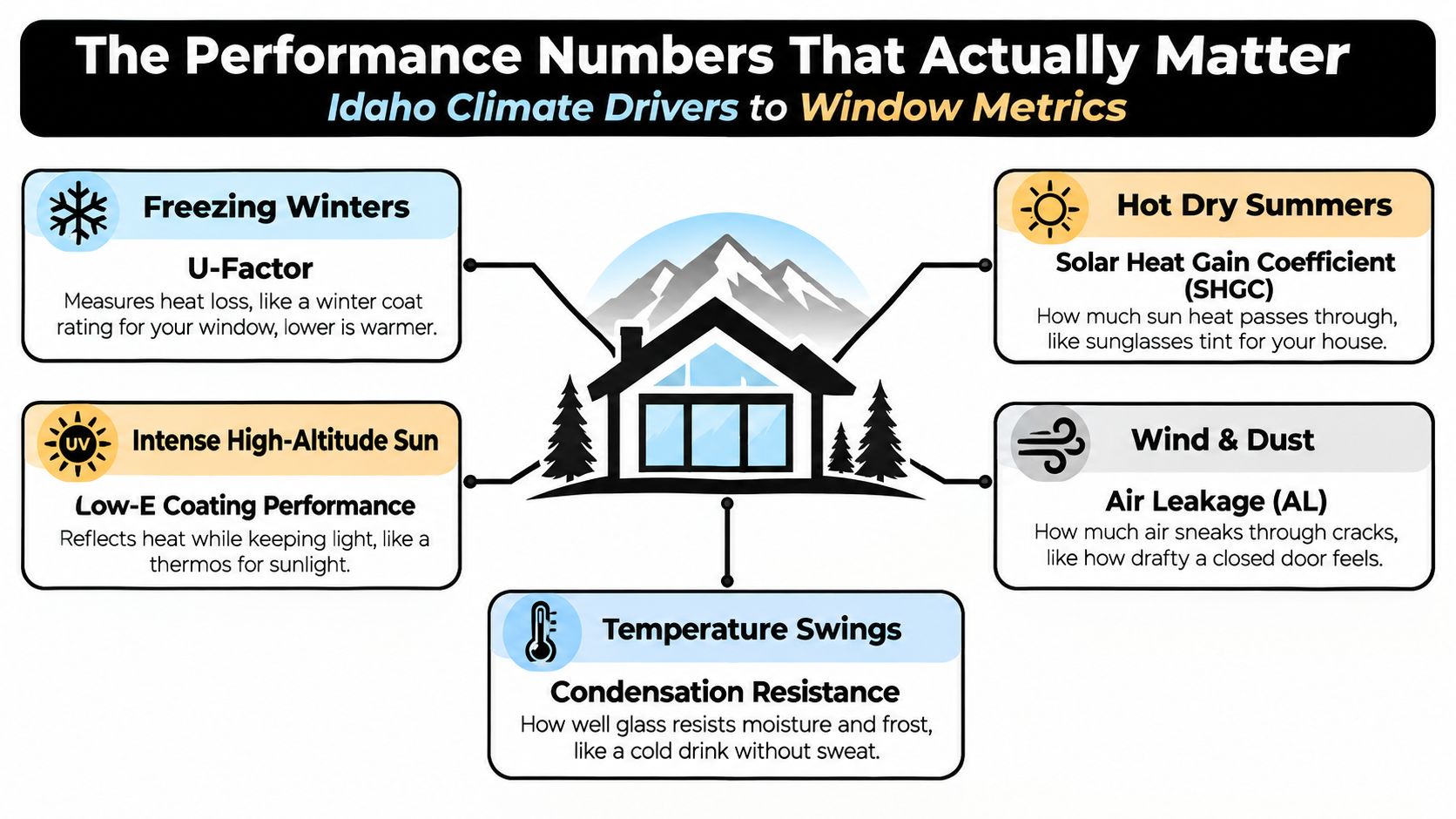
The number I look at first for an Idaho home is U-factor. It measures how readily heat moves through the window assembly, so a lower value means better resistance to winter heat loss. Think of it as the thickness and quality of the window's winter coat. The U.S. Department of Energy advises homeowners in cold climates to choose the lowest U-factor they can afford, while using climate-specific SHGC guidance for solar gain. (U.S. Department of Energy window efficiency guidance)
For southern Idaho, including the Treasure Valley, ENERGY STAR Version 7.0 places the region in the North-Central framework. Its published target is a U-factor of 0.24 or lower with SHGC at 0.40 or lower. Northern Idaho uses a stricter Northern-zone target of 0.22 or lower for U-factor with SHGC at 0.17 or higher, depending on the product class. (ENERGY STAR climate-zone search)
Match the metric to the complaint
- U-factor: Choose lower values when the bedroom window feels cold or the slider creates a winter chill. The Idaho code evaluation identifies maximum U-factors of 0.32 in CZ5 and 0.30 in CZ6, with no SHGC requirement in those zones. (Idaho residential code compliance evaluation)
- SHGC: Treat this like sunglasses for the west wall. It controls how much solar heat enters, so the right value depends on orientation, overhangs, shading, and how badly the room overheats.
- Air leakage: This tells you how much air passes through the closed unit. Think of it as the difference between a properly weatherstripped door and one with a visible gap. Ask for the tested rating on the exact product.
- Condensation resistance: This indicates how well the assembly resists moisture forming on cold surfaces. It matters when you see water collecting at the lower glass edge or sill on a winter morning.
- Noise performance: STC is a useful comparison point for traffic and aircraft noise. Near I-84 or the airport, ask for the tested acoustic rating rather than accepting “quiet glass” as a description.
The ENERGY STAR label helps organize the decision, but don't stop at the logo. Compare the actual NFRC label for each opening, because a large picture window, a casement, and a slider may carry different ratings.
Matching Window Style to Each Room
Window style affects both comfort and maintenance. In Idaho, weak moving seals become obvious during cold wind, while large glass areas magnify summer solar gain. Choose the operating design around the room's ventilation needs and exposure, not just the lowest line item.
A casement window is my first choice where a tight seal matters. Its sash presses against the weatherstripping when closed, making it a strong fit for a north-facing bedroom or a front elevation exposed to winter wind. Casements can also capture breezes effectively when you want natural ventilation.
Double-hung windows remain practical in bedrooms, hallways, and traditional elevations. Opening the upper sash lets warm air escape during summer, while the lower sash admits cooler air. Their trade-off is straightforward: aging sash seals can allow more air movement than a properly closed casement.
For a large living-room opening, a picture window delivers maximum fixed glass with no operating sash to leak air. Add operating flanks if the room needs ventilation. Sliders work well where horizontal operation is convenient, including kitchen openings and patio transitions, but the meeting rail deserves close inspection because it's a common draft location as hardware and seals age.
| Window Style | Best Room / Orientation | Strength in Idaho Climate | Trade-Off |
|---|---|---|---|
| Casement | Bedrooms, north-facing rooms, windy elevations | Tight compression seal and effective ventilation | Crank hardware needs clearance and maintenance |
| Double-hung | Bedrooms, hallways, traditional front elevations | Flexible ventilation from top and bottom sashes | Aging sash seals can increase air leakage |
| Picture | Living rooms, foothill views, large fixed openings | Minimal air infiltration and unobstructed glass | Doesn't provide ventilation by itself |
| Slider | Wide kitchen openings, accessible rooms, patio-adjacent spaces | Easy horizontal operation | Meeting rail can become a draft point |
For a more detailed style comparison, review this casement versus double-hung window guide for Boise homeowners. The key decision remains room-specific: tightness for the bedroom, glass area for the view, and ventilation where the household needs it.
Glass Upgrades Worth the Money in Idaho
Think of glass upgrades as a ladder. Start with the foundation, then pay for the next feature only when the room's exposure or comfort problem justifies it.
A quality double-pane unit with climate-appropriate Low-E glass is the baseline I'd expect for a Treasure Valley replacement. Low-E coatings help manage winter heat loss and summer solar gain while allowing daylight into the room. If your existing windows are clear-glass units with failing seals, this is a meaningful change in comfort.
Argon fill is the next sensible step. The gas occupies the space between panes and slows heat movement inside the insulated glass unit. It's a standard, practical upgrade for many Idaho homes and pairs well with Low-E glass.
Triple pane has a place, but it isn't automatically the right answer for every Boise opening. I'd look closely at it for a large west-facing window, a bedroom exposed to highway noise, chronic winter condensation, or a home in a colder mountain setting. It can also improve the feel of the glass near the occupant, which matters when a bed, desk, or sofa sits close to the window.
Spend carefully on the details
Warm-edge spacers deserve more attention than they usually get. They reduce heat transfer at the perimeter of the glass and can help address cold-edge condensation. Ask whether the spacer is a low-conductance foam or stainless-steel design, and make sure it appears in the written specification.
Krypton gas belongs near the top of the upgrade list, not the starting point. It can make sense in a tightly designed triple-pane package or a particularly cold northern Idaho installation, but it's a poor substitute for fixing air leakage, drainage, or installation quality.
| Upgrade | Idaho Value | Where I'd Use It |
|---|---|---|
| Climate-tuned Low-E double pane | Strong baseline for heat and solar control | Most Treasure Valley rooms |
| Argon fill | Practical insulation improvement between panes | General replacement projects |
| Warm-edge spacer | Helps manage cold glass edges and condensation | Bedrooms and high-humidity rooms |
| Triple pane | Better comfort and sound control in demanding openings | Large exposures, highway-facing rooms, colder regions |
| Krypton | Specialized premium choice | Tight triple-pane packages and colder locations |
For a closer look at the gas-fill decision, see this guide to whether argon gas windows are worth it in Idaho.
Frames, Drainage, and Installation Details
A high-performing window installed badly becomes a cold, leaky opening. In Idaho, installation failures often reveal themselves at the sill, where snowmelt, wind-driven rain, and interior condensation all meet.
Quality vinyl remains a practical frame choice for many Treasure Valley homes because it resists rot and needs little maintenance. Don't assume every vinyl frame is equal, though. Large picture windows can expose weak hollow chambers to sagging, so look for fusion-welded corners, solid reinforcement where required, and a frame design that supports the size of the opening.
Fiberglass is worth considering when dimensional stability is a priority, especially on large south-facing glass or premium projects. It generally costs more, but the frame material should be evaluated alongside the glass, opening size, and installation method. A well-installed, properly specified vinyl window can outperform a poorly installed fiberglass unit.
The sill controls the outcome
The installation should include:
- A sloped sill pan: Water needs a deliberate path toward the exterior, not a flat cavity where it can collect.
- Flashing tape at the sides and top: The installer should integrate the window with the existing weather-resistive barrier rather than covering the perimeter.
- Low-expansion foam: The correct window-and-door foam fills the gap without bowing the frame.
- Proper shimming: Shims support the unit at the prescribed points, including the nailing-fin area where applicable, without distorting the frame.
- A continuous interior air seal: This controls drafts around the rough opening, where a good glass package can't compensate for gaps.
For 1990s Boise subdivisions with stucco or finished siding, a narrowline replacement approach can reduce unnecessary trim disruption. C & C Windows & Doors offers narrowline, composite-reinforced frames designed to fit existing openings while retaining a true sloped sill for drainage. That approach is useful when the homeowner wants improved performance without turning a straightforward window project into a large exterior repair.
Your In-Home Consultation Checklist
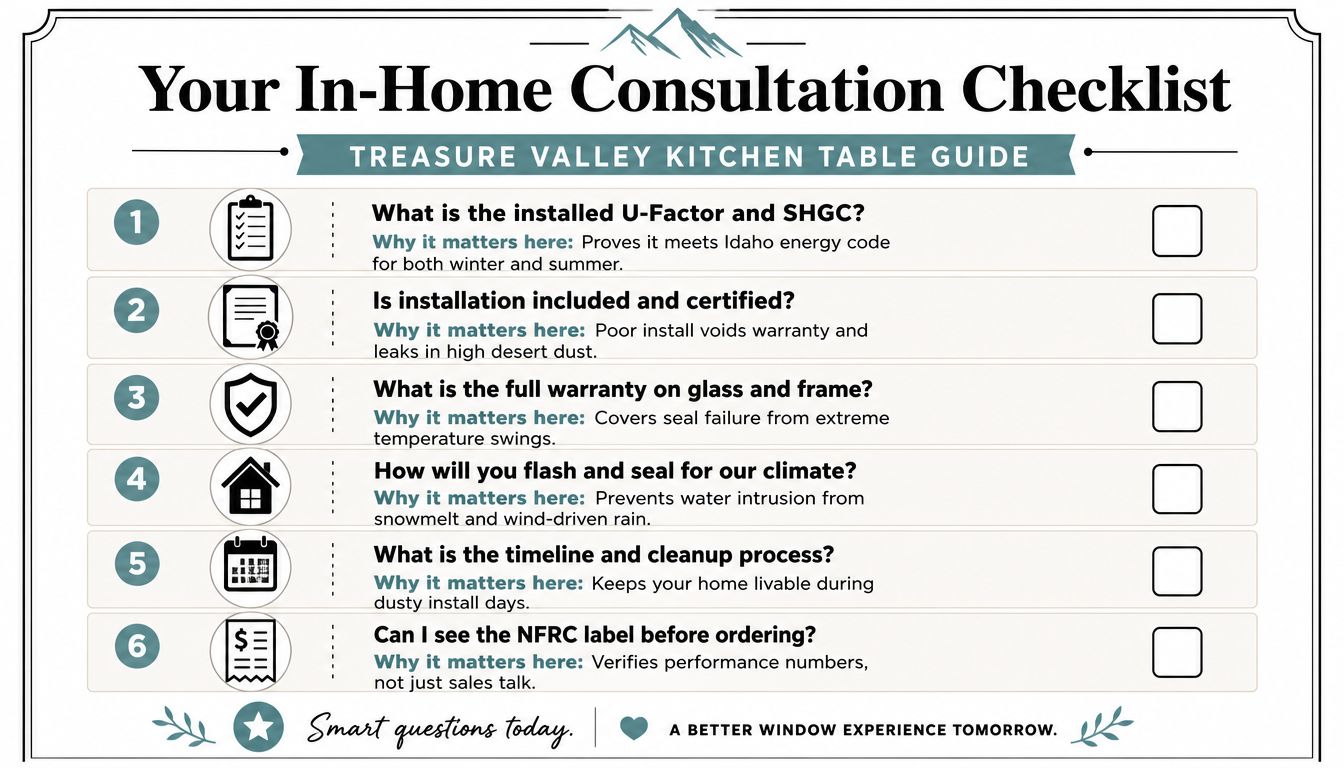
Bring this list to the kitchen table when the estimator arrives. The goal is to compare the exact products and installation plan, not two vague promises from two salespeople.
- Ask for the NFRC label for every quoted opening. Why it matters here: the label shows the actual U-factor and SHGC for the specific size and configuration, not a brochure's best-case number.
- Ask which ENERGY STAR climate zone the product qualifies for. Why it matters here: northern Idaho and the Treasure Valley don't use identical performance targets.
- Ask which Low-E coating is specified. Why it matters here: the coating should suit the room's winter heating needs and summer sun exposure. Ask whether the stack is hard-coat or soft-coat.
- Ask about argon fill and the spacer. Why it matters here: the gas fill and warm-edge spacer affect the insulated glass unit's edge and center performance.
- Request air-leakage and condensation-resistance ratings in writing. Why it matters here: “we seal everything” describes a promise, not a tested product result.
- Ask who installs the windows. Why it matters here: find out whether the crew consists of full-time employees or subcontractors, and ask about training for flashing the sill pan into the existing weather-resistive barrier.
- Read the warranty before signing. Why it matters here: confirm who covers the frame, labor, glass, and insulated-glass seal failure, and whether installation errors are included.
- Request references from older Idaho installations. Why it matters here: a project that has experienced multiple winters tells you more than a freshly completed installation.
Take photographs of every opening before the visit, including the sill, trim, exterior cladding, and any visible staining. That gives each contractor the same starting information and makes it easier to compare full-frame replacement with an insert approach.
For more questions to carry into the appointment, use this window contractor consultation checklist.
The Right Window Spec for Treasure Valley Homes
The right specification depends on the complaint, the room, and Idaho's climate zone. Use the baseline defined in Section 3, then adjust it to the opening rather than accepting one package for the whole house.
| Homeowner problem | Recommended direction | What to verify | Best fit |
|---|---|---|---|
| Cold draft at a standard replacement opening | Use the baseline package from Section 3 | Exact NFRC label, operation, and air-leakage rating | Bedrooms and hallways |
| Summer overheating on a west wall | Keep the baseline and select glass with lower solar gain for that orientation | SHGC on the NFRC label, plus room exposure | Living rooms and west-facing spaces |
| Drafty slider | Prioritize a tighter operating style and a properly sealed replacement opening | Tested air leakage and the installer's drainage plan | Patio and exterior-facing sliders |
| Highway noise near I-84 | Evaluate triple pane and compare tested acoustic ratings | STC rating for the exact size and configuration | Bedrooms and bonus rooms |
| Colder mountain installation | Use the stricter local performance target and evaluate triple pane | U-factor, condensation resistance, and climate guidance | Homes near McCall or Sun Valley |
Triple pane earns consideration when the opening has a clear job to do. It can suit large west-facing glass, a second-story room with strong afternoon sun, a bedroom near I-84, or a home in a colder high-elevation area. More panes do not automatically produce the sound result you want, so require the tested acoustic rating.
Treasure Valley homes still need room-by-room decisions. A south-facing room may need a different SHGC choice than a shaded north-facing room. A slider needs attention to operating hardware and air leakage, while a fixed picture window may shift the priority toward glass performance and installation. Treating Boise, McCall, and Sun Valley as one market leads to the wrong quote.
Bring three requests to the consultation:
- Book a free in-home measurement so the quote reflects the rough opening, sill condition, and exterior cladding.
- Request the NFRC label for the exact window being quoted, including size, operation, glass package, U-factor, and SHGC.
- Ask the installer to explain the drainage plan, including the sloped sill pan, flashing, foam, and connection to the existing weather-resistive barrier.
Photograph each opening before the visit, including the sill, trim, exterior cladding, and visible staining. Use this window contractor consultation checklist to compare contractors on the same information.
C & C Windows & Doors offers free in-home measurements and replacement windows with Low-E coatings, argon fills, optional triple-pane glass, and narrowline composite-reinforced frames suited to Treasure Valley openings. Visit C & C Windows & Doors to request a consultation and compare the exact NFRC label and drainage plan for your home.