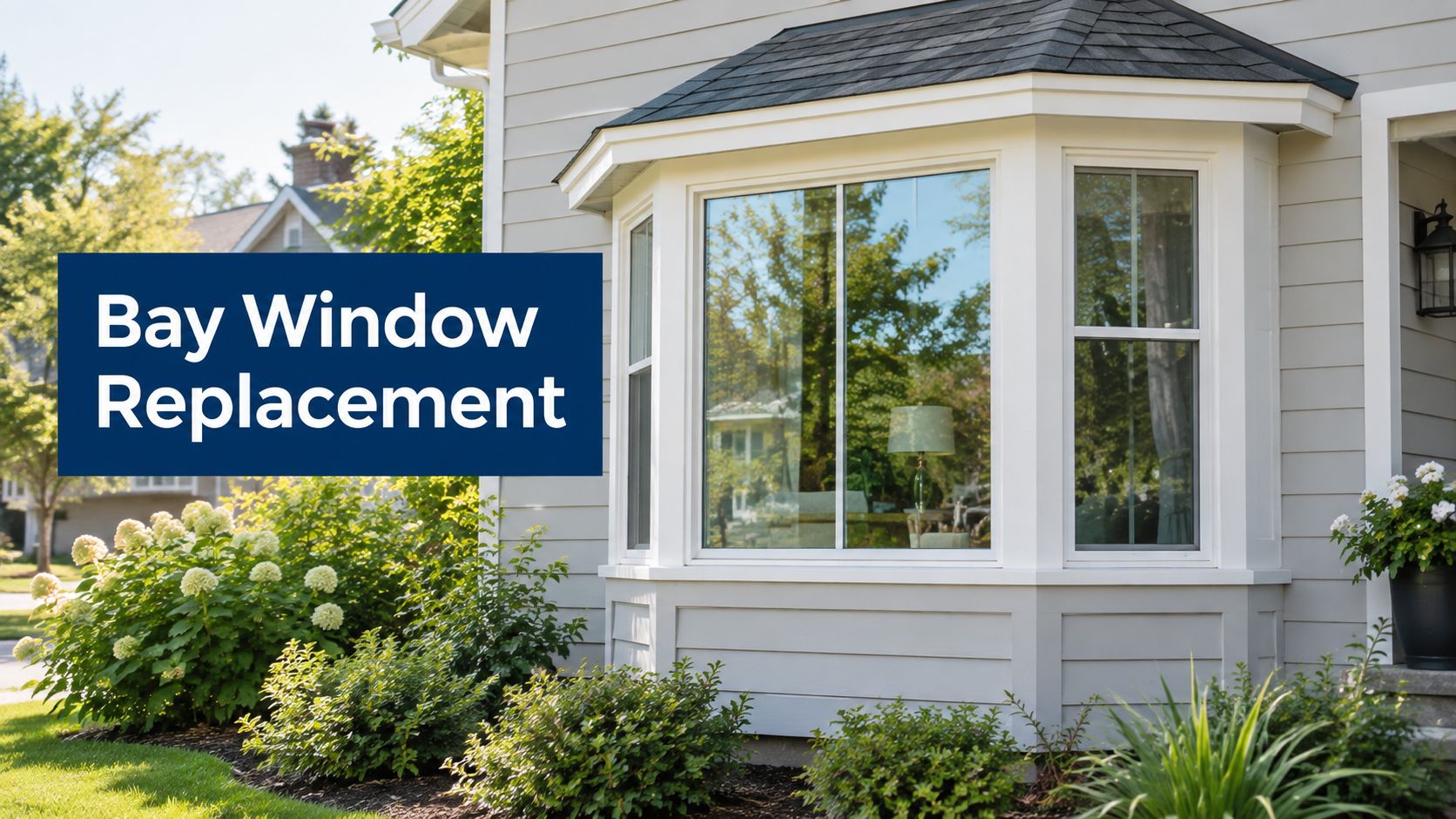
You're standing in the living room on a cold Meridian morning, and the bay window is the only place that feels uncomfortable. The glass is foggy between the panes, the interior sill is cold, and weatherstripping hasn't stopped the draft. You start by searching for better glass, then discover that bay window replacement in Meridian is also a structural, installation, energy-rating, and rebate decision.
That distinction matters in the Treasure Valley. Cold inversions can expose weak seals and poor insulation, while intense summer sun can make a west-facing bay a heat source by afternoon. A successful project has to address the frame, support system, flashing, glass specifications, installer paperwork, and timing together.
Table of Contents
- Why Meridian Homeowners Replace Bay Windows
- What Makes a Bay Window Structurally Different
- Energy-Efficient Glass Options for the Treasure Valley
- How Idaho Rebates Decide the Real Price
- Installation Process and Idaho Timing
- Replace, Retrofit, or Add Storm Windows
- What Local Replacement Actually Pays Back
- Choosing a Meridian Installer and Protecting the Investment
Why Meridian Homeowners Replace Bay Windows
The first warning is often failed insulated glass. Fog or moisture between panes means the seal has deteriorated, and cleaning the surface won't correct it. A replacement sash or full unit may be necessary, depending on whether the surrounding frame remains sound.
Wood rot is another common trigger, especially where the seat board meets the exterior wall. That junction sees water, snow, and repeated temperature changes. If the wood has softened, replacing only the glass leaves the damaged structure in place.
Persistent drafts also deserve more than another bead of caulk. When air continues moving after weatherstripping has been replaced, the leak may sit in the frame, the wall connection, the roof tie-in, or the flashing around the bay. Ice patterns on the interior sill during January point to a cold surface and possible air leakage, not merely an uncomfortable room.
Practical rule: If the sill, frame, or roof connection shows damage, stop comparing glass packages until the assembly has been inspected.
Orientation changes the decision. A bay facing west receives strong afternoon sun, which can create glare, uneven room temperatures, and added cooling demand. A north-facing bay tends to expose insulation weaknesses more severely during cold weather. The same replacement package won't perform identically in every room.
Meridian's active resale market adds another consideration. In August 2026, the city's median listing price was $639,945, homes typically spent 37 days on the market, and the median listing price per square foot was $284. About 1,260 homes were listed for sale at that time, according to Meridian housing market data from Realtor.com. A visibly failing bay window can affect how buyers experience the room and how they judge the home's upkeep.
The practical sequence is simple:
- Inspect the structure.
- Identify the air and water failures.
- Choose an NFRC-rated glass package.
- Confirm rebate eligibility before ordering.
- Schedule installation when the exterior work can be sealed properly.
What Makes a Bay Window Structurally Different
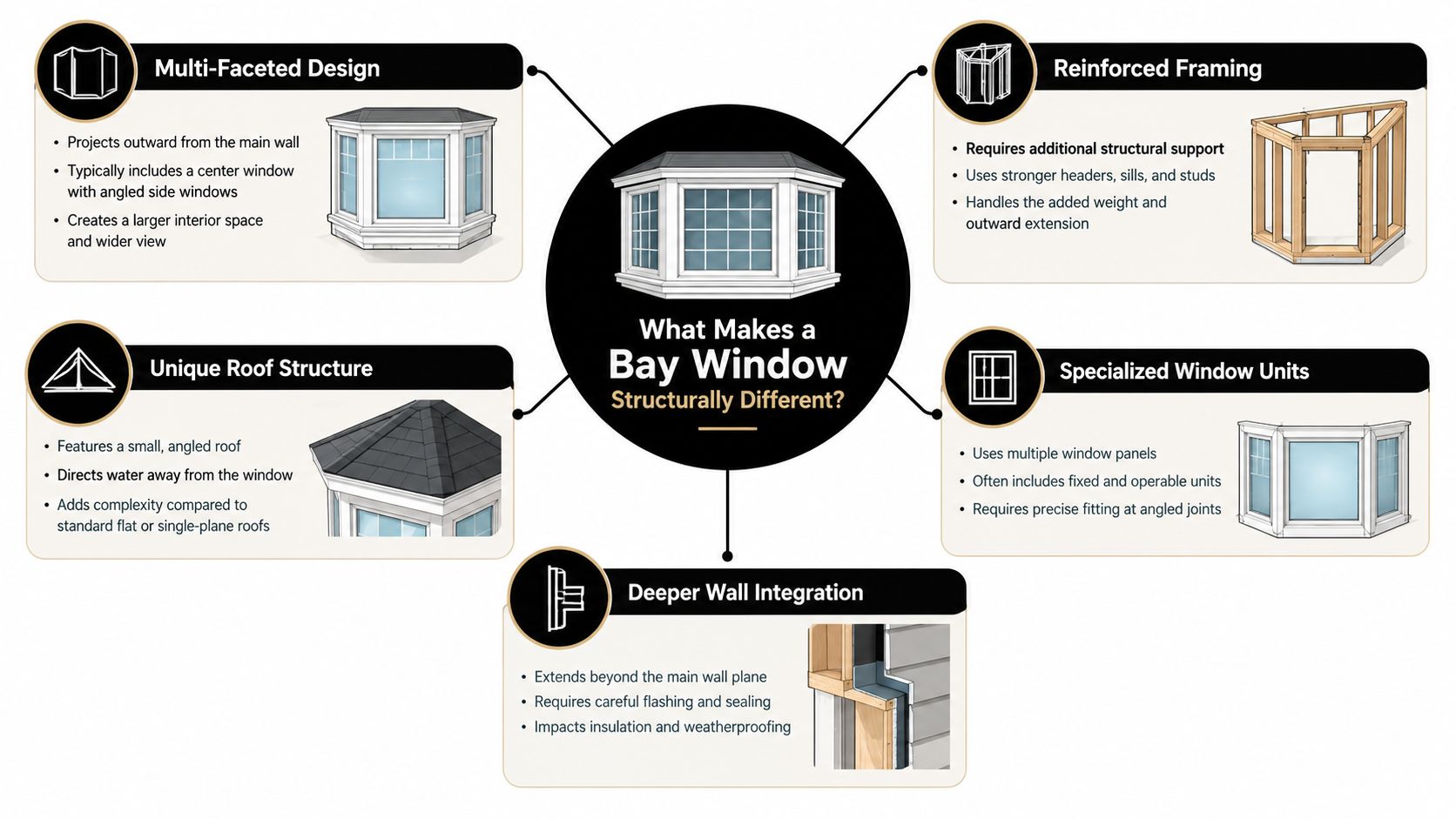
A flat replacement window sits inside a wall opening. A bay window projects beyond that wall, so it behaves more like a small roof attached to the house than a single piece of glass. The unit must carry its own dead load as well as roof and snow or wind loads.
Technical guidance notes that bay assemblies can add 200 to 400 or more pounds to the wall structure and may need overhead support at 30 to 45 degrees, reinforced base blocking, or knee braces. Some framing specifications call for support capacity around 1,300 pounds. These figures are summarized in this technical bay window installation guide.
Verify the load path first
Before demolition, the installer should determine how the bay's weight reaches the home. That may involve a structural header above the opening, a seat board below the window, exterior brackets, knee braces, or a combination of supports. The inspection should look for sagging, separated trim, cracked drywall, soft wood, and movement at the roof-to-wall connection.
The visible window is only one component. The complete assembly includes:
- Framing: The header, side framing, seat board, and projection supports carry the load.
- Weather protection: Sheathing, flashing, roof material, and house wrap keep water out.
- Finish work: Interior casing, exterior trim, and siding transitions hide and protect the opening.
A crew that quotes only the replacement window has not yet addressed the whole project. A new unit can be perfectly manufactured and still fail if the support ledger is weak, the deck drains inward, or the roof tie-in is improperly flashed.
Structural warning: Don't approve a bay replacement based on glass specifications alone. Confirm the support system and drainage path before selecting the window.
Energy-Efficient Glass Options for the Treasure Valley
Meridian homeowners should compare NFRC-rated U-factor and SHGC, not marketing labels such as “high efficiency.” U-factor describes conductive heat transfer. A lower U-factor generally means less heat passes through the window, which helps reduce winter heat loss. SHGC helps describe how much solar heat enters through the glazing.
ENERGY STAR qualification depends on climate zone. The applicable specification identifies a colder northern target of U-factor 0.22 or lower with SHGC 0.17 or higher, while north-central zones allow U-factor 0.24 or lower with SHGC 0.40 or lower. Review the ENERGY STAR residential window specification and the actual NFRC label for the product being proposed.
Match the package to the room
A double-pane Low-E unit with argon can be a sensible choice when the frame is sound and the bay has moderate exposure. Triple-pane glass offers stronger insulation, but it also adds weight, which makes the structural review even more important for a projecting assembly.
| Package | Typical U-Factor | Best Use in Meridian |
|---|---|---|
| Double-pane Low-E with argon | Verify on the NFRC label | Sound frames, moderate exposure, practical replacement budgets |
| Upgraded double-pane Low-E with argon | Verify on the NFRC label | Homes seeking improved comfort without the added weight of triple-pane |
| Triple-pane Low-E with argon or krypton | Verify on the NFRC label | Cold rooms, severe exposure, and projects targeting a lower U-factor |
The right choice depends on orientation, heating system, comfort complaints, frame condition, and rebate requirements. A west-facing bay may need stronger solar-control planning than a shaded north-facing unit. A room with persistent winter discomfort may justify a lower U-factor more readily than a room that already feels balanced.
For a broader explanation of Idaho window specifications, see this energy-efficient windows guide for Idaho. The key is to compare the complete NFRC rating, not just the number a salesperson highlights.
How Idaho Rebates Decide the Real Price
The most expensive glass package isn't automatically the smartest purchase. The better package is the one that reaches the required performance tier, fits the existing bay, and comes with documentation that survives the rebate review.
Avista's Idaho window rebates use U-factor thresholds. One incentive tier requires contractor-installed windows with U-factors from .29 to .23, while a higher tier requires .22 or below. Applications are due within 120 days of installation. The Avista Idaho windows rebate requirements should be checked before the order is placed because eligibility depends on the installed product and supporting records.
Treat paperwork as part of the installation
Ask the installer to preserve the NFRC sticker, itemized invoice, and dated installation photographs. Don't wait until the project is complete to discover that the ordered unit doesn't meet the required U-factor or that the label was discarded during cleanup.
| U-Factor Band | Typical Glass Package | Avista Rebate | Best For |
|---|---|---|---|
| .29 to .23 | Double-pane Low-E with argon, subject to product qualification | Verify current incentive amount with Avista | Homeowners seeking qualifying efficiency without maximum glazing weight |
| .22 or below | Higher-performance double-pane or triple-pane package, subject to product qualification | Verify current incentive amount with Avista | Colder rooms and projects targeting the higher performance tier |
Don't assume every utility program stacks automatically. Idaho Power and municipal programs may operate alongside Avista, but the homeowner should confirm the rules for the property, fuel source, product, and installation date.
For related federal tax-credit planning, review this Idaho window replacement tax credit guide. Tax treatment and rebate rules aren't interchangeable, so keep the utility application and tax documentation in separate project records.
Installation Process and Idaho Timing
A proper bay installation follows the condition of the house, not the order shown in a sales brochure. The first step is a fresh on-site measurement. Meridian homes settle, older openings move out of square, and the dimensions visible after trim removal may differ from the original estimate.
The work sequence that prevents callbacks
The crew should then inspect the header, knee braces, seat board, and roof tie-in before removing the old unit. If the support system can't carry the replacement assembly, the installer needs to correct that before setting the new window.
The installation typically proceeds as follows:
- Re-measure the opening: Confirm width, height, projection, and the condition behind the trim.
- Check the framing: Verify the header and support path before demolition.
- Set or repair the support ledger: Establish a stable base for the seat board and projected load.
- Flash the deck: Direct water toward the exterior instead of trapping it beneath the unit.
- Integrate house wrap: Tie the new flashing into the existing weather-resistive barrier.
- Shim the seat board: Keep the assembly supported while preserving outward drainage.
- Seal and finish: Air-seal the frame, install trim, and complete the exterior siding or roofing transition.
The sealing and trim work deserve as much attention as the glass. A poorly sealed perimeter can undermine an efficient unit, and a badly finished roof juncture can send water behind the wall.
Choose a workable Idaho season
April, May, September, and early October are practical shoulder-season windows for exterior work because sealants can cure properly and the open-wall period is easier to manage. Winter installation remains possible, but cold-rated adhesives and tented enclosures add complexity, labor, and scheduling pressure.
Don't let a crew rush an exposed bay because the calendar is inconvenient. If the project must happen during colder weather, the bid should identify the products and procedures being used to protect the opening.
Replace, Retrofit, or Add Storm Windows
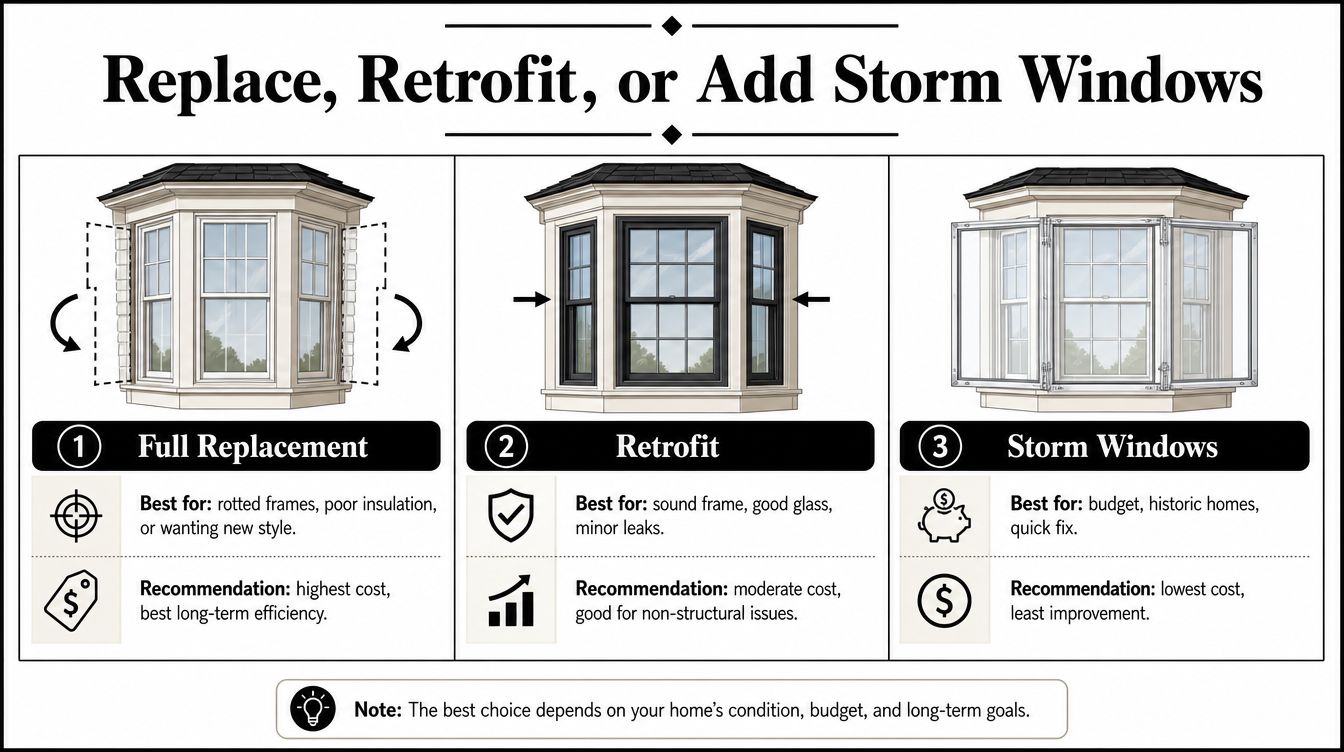
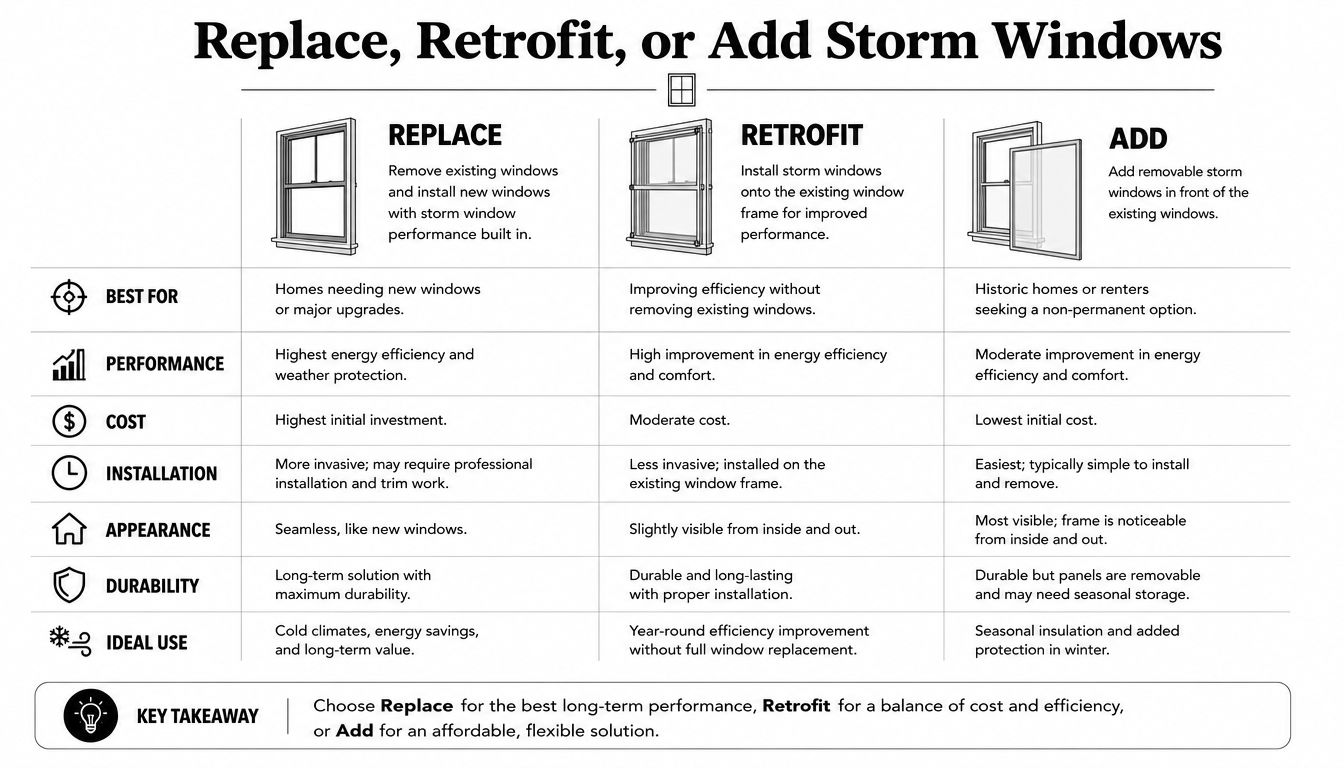
Meridian homeowners have three legitimate paths. The correct one depends on whether the problem is the entire assembly or only the glazing.
Full replacement
Replace the entire unit when the frame is rotted, the bay roof leaks, the seat board sags, or the projection needs to change. This is the most disruptive path, but it addresses the structure, flashing, frame, sash, and finish as one system. It also gives you the clearest opportunity to specify a qualifying NFRC performance package.
For most Meridian homes with a 1990s-era bay and fogging glass, I recommend full replacement rather than a cosmetic retrofit. Fogging alone doesn't prove that the frame has failed, but aging bays often have hidden deterioration around the sill and roof connection.
Glazing retrofit
A sash or glazing retrofit makes sense when the existing frame is dry, square, stable, and properly supported. It creates less disruption and can improve comfort, but it won't correct rotten wood, a failing roof tie-in, or a distorted opening.
Rebate eligibility depends on the replacement product and installed specifications. Don't assume a glass-only job qualifies because the new glass has a low advertised U-factor.
Storm windows
Storm windows are the least invasive option. They can suit historic homes, rental properties, and owners who want to preserve an original surround. Idaho-focused guidance notes that ENERGY STAR-certified storm windows can save about 20% on annual bills over single-pane clear glass and may pay back in about three years, as summarized by Idaho window efficiency guidance.
The tradeoff is limited improvement compared with correcting a failed frame or replacing the entire bay. Storm panels won't repair rot, eliminate a leaking roof connection, or change the bay's structural behavior.
What Local Replacement Actually Pays Back
A useful payback example has to start with a real decision, not a brochure promise. Consider a representative two-story home in southeast Meridian with a south-facing bay over the living room. The homeowner notices cold glass, uneven comfort, and failed seals, but the surrounding trim hasn't yet been opened for inspection.
The first decision is whether the frame and roof connection are serviceable. If they are not, a glazing-only solution would preserve the source of the problem. If the structure is sound, a retrofit or storm layer may deserve comparison before committing to a full rebuild.
Energy savings should be treated as one part of the calculation. The U.S. Department of Energy says replacing poor-performing windows with ENERGY STAR-qualified models can save 7% to 15% on annual energy bills, or roughly $71 to $501 per year, depending on climate and window type. The same federal guide says replacing old single-pane windows with ENERGY STAR-certified windows can reduce household energy bills by up to 13% based on a nationwide average. See the U.S. Department of Energy window efficiency guide.
Build the decision around three returns
Comfort comes first. A properly supported, sealed, lower-U-factor bay can make the living room feel more even. That benefit matters every day, even when the energy-bill savings take time to accumulate.
Rebates come next. The federal tax credit allows 30% of product cost up to $600 for windows in one taxable year, subject to the applicable requirements in the federal guidance linked above. Utility incentives require separate qualification and paperwork.
Resale documentation protects the last layer. Keep the NFRC label, invoice, permit records where applicable, warranty information, and rebate approval together. A future buyer can't value performance they can't verify.
| Line Item | Value | Notes |
|---|---|---|
| Energy impact | Qualitative improvement | Depends on the old unit, replacement rating, exposure, and household use |
| Utility rebate | Product-dependent | Confirm the qualifying U-factor and current Avista rules before ordering |
| Federal credit | 30% of product cost, up to $600 | See the federal eligibility guidance |
| Resale contribution | Qualitative | Documented work supports buyer confidence and appraisal review |
| Comfort return | Immediate after proper installation | Most noticeable near cold glass, drafts, and sun-exposed glazing |
The contrarian answer is important. If the existing bay frame is sound, full replacement isn't automatically the best financial move. Idaho-focused guidance says efficient windows can cut heating and cooling costs by roughly 12% to 33%, while certified storm windows may deliver meaningful savings with less disruption. Compare the complete replacement against a retrofit and storm option before deciding.
Choosing a Meridian Installer and Protecting the Investment
A bay project needs a different screening process than a standard flat-window replacement. Start with the contractor, not the catalog.
The pre-sign checklist
- Confirm registration: Ask for Idaho Public Works registration when the scope includes structural work.
- Verify permitting: Require confirmation that the appropriate Meridian building permit has been pulled when framing changes are involved.
- Demand an itemized bid: Separate the unit, installation labor, header and support work, interior trim, exterior finish, flashing, and roofing.
- Request relevant references: Ask for two recent Treasure Valley bay-window projects, not just ordinary single-hung replacements, and drive by one if the homeowner permits it.
- Separate warranties: Get the manufacturer glass warranty and installation labor warranty in writing. They cover different failures and may have different terms.
- Confirm paperwork ownership: Establish who supplies the NFRC label, invoice, photographs, and rebate documents before installation begins.
A regional sales crew can quote a beautiful window and still miss the support ledger, roof drainage, or perimeter sealing. The installer should be able to explain the load path in plain language and identify what happens if concealed rot appears after trim removal.
For a local comparison checklist, review this guide to choosing a window company in Meridian, Idaho. Use it to compare scope and documentation, not just the bottom-line price.

Maintain the details that prevent expensive failures
Vacuum the sill weep holes each fall so water can escape. Inspect the flashing above the roof juncture every two years, and re-caulk the exterior-to-siding seam before the first hard freeze. Keep the manufacturer's documentation and rebate paperwork in a labeled envelope inside the project file, where it can support a future appraisal or warranty claim.
C & C Windows & Doors provides free in-home consultations, custom measurements, same-day estimates, and replacement windows designed for Treasure Valley homes. Its scope can include the performance specifications, support review, and installation documentation that a Meridian bay project requires.
C & C Windows & Doors can inspect your existing bay, compare full replacement with retrofit options, and identify an NFRC-rated package suited to the room's exposure and rebate requirements. Visit C & C Windows & Doors to request an in-home consultation and plan the project before the next cold season.