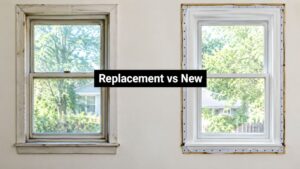

You notice it first in the room you use every day. In January, the chair by the window feels colder than the rest of the living room. In July, the west side of the house heats up before dinner and the AC keeps running. Maybe the glass fogs at the edges. Maybe the sash sticks. Maybe your power bill just feels too high for a house that should be comfortable.
That's a common Meridian problem. Our homes deal with cold winter mornings, bright sun, dry air, and long summer afternoons that hit certain walls much harder than others. Old windows don't fail all at once. They wear out in ways you can feel slowly, room by room.
Table of Contents
- Are Your Windows Ready for Another Meridian Season
- Decoding Energy Efficient Window Technology
- What Meridian's Climate Demands from Your Windows
- Calculating Your Return on Investment
- How C & C Windows Meet Idaho's Highest Standards
- The Replacement Process From Consultation to Installation
- Navigating Permits Rebates and Financing
- Frequently Asked Questions About Window Replacement
Are Your Windows Ready for Another Meridian Season
A lot of homeowners start looking into energy-efficient windows in Meridian ID after a bad week of weather. One cold snap, one stretch of afternoon glare, and suddenly the house feels older than it did last month.
You might have a bedroom that's always chilly in winter. You might keep the blinds shut on the west side because the late sun is too strong. Or you may hear more outside noise than you used to, which is often a sign that the old window system isn't doing much to buffer the room anymore.
Small signs usually point to bigger comfort issues
The tricky part is that old windows can look “fine” from the curb. But inside the house, the symptoms are easy to spot:
- Drafts near the frame: You feel moving air even when the window is locked.
- Condensation or haze: The glass looks cloudy, especially around the edges.
- Hard operation: The sash sticks, won't stay up, or doesn't lock smoothly.
- Hot and cold zones: One room feels different from the rest of the house.
Old windows rarely fail in a dramatic way. Most homeowners notice comfort problems first, then energy loss, then frustration with operation.
If that sounds familiar, it helps to stop thinking of window replacement as a cosmetic project. In Meridian, it's often a building-envelope upgrade. The right glass, frame, and installation details can make a room feel warmer in January and calmer in August, even before you look at the utility bill.
Decoding Energy Efficient Window Technology
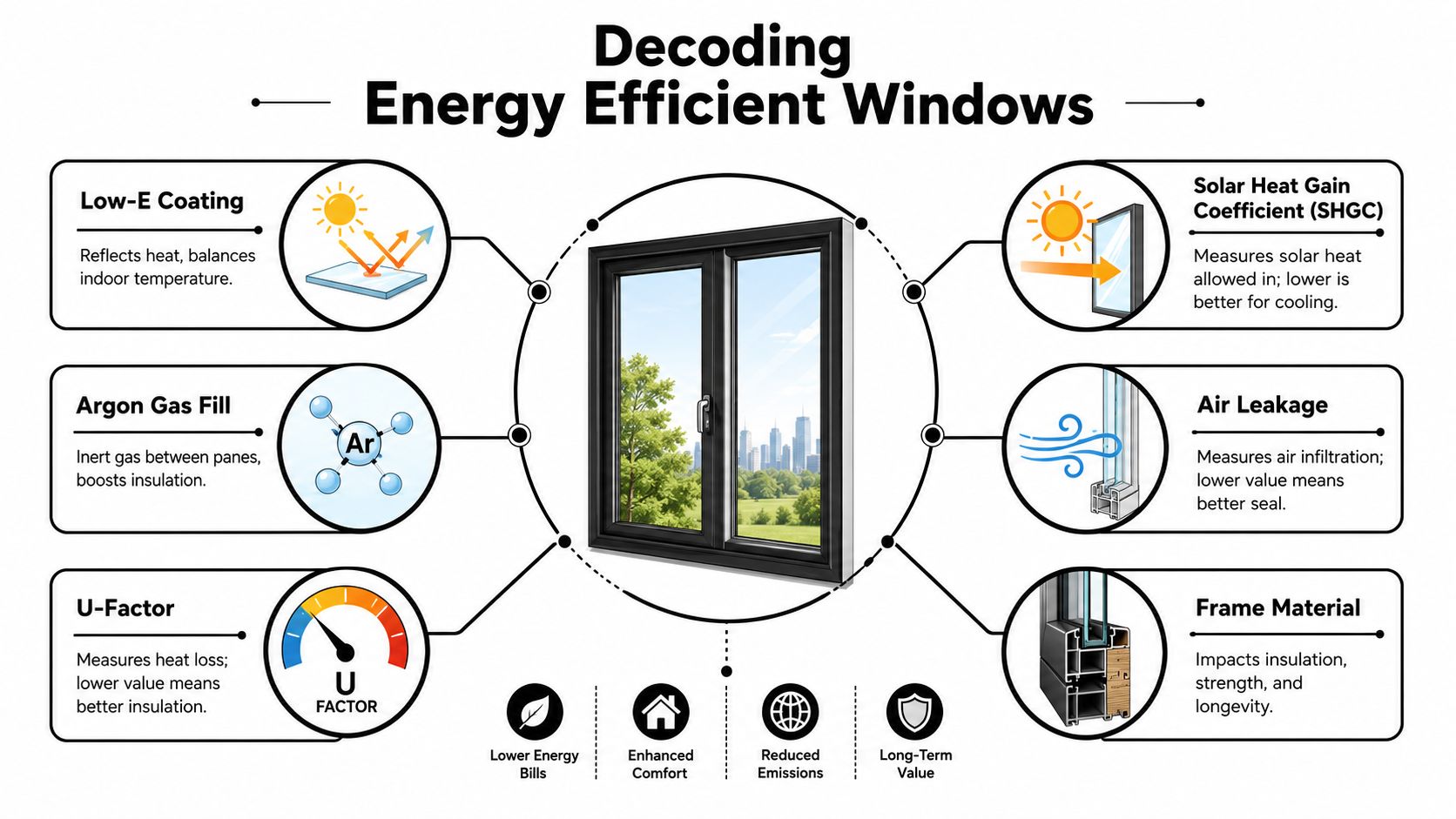
Window labels can feel like a wall of jargon. Low-E, argon, U-factor, SHGC. Most homeowners don't need a lecture on lab testing. They need to know what those terms mean when they're standing in a cold bedroom or a sun-blasted family room.
Here's the simple version. Good windows slow heat movement, limit drafts, and manage sunlight instead of treating every side of the house the same.
What the glass package actually does
Think of Low-E coating as a very thin invisible layer that helps control heat transfer through the glass. A useful mental image is the reflective lining inside a thermos. It helps keep indoor heat from escaping in winter and helps reduce unwanted heat coming in during summer.
Argon gas fill sits between panes and improves insulation. You won't see it, but it's one of the features that helps modern insulated glass perform better than old single-pane units.
U-factor is the number many homeowners should pay the most attention to first. A lower U-factor is better. It works a bit like a golf score. Lower means less heat loss through the window assembly.
Solar Heat Gain Coefficient, or SHGC, tells you how much solar heat the window lets in. Lower often helps with cooling, but in Meridian, lower isn't always better on every wall. That's where many generic guides oversimplify the decision.
For a deeper local breakdown of product types and ratings, this Idaho energy-efficient window guide from C & C Windows & Doors is useful reading before you compare quotes.
Why window style changes performance
The glass matters, but the operating style matters too. A casement window that cranks closed seals differently than a double-hung window with moving upper and lower sashes.
According to Andersen's ENERGY STAR 7 update overview, casement, awning, and picture windows are 15% to 25% more energy-efficient than double-hung units because they seal tighter against wind pressure and reduce air leakage through the full frame assembly.
That doesn't mean double-hung windows are wrong. It means you should choose them for a reason, not by default.
A practical way to compare common styles:
| Window type | Typical strength | Tradeoff |
|---|---|---|
| Casement | Tighter seal and strong airflow control | Operates outward |
| Awning | Good seal and works well in light rain | Smaller opening area |
| Picture | No operable gaps, strong efficiency potential | Doesn't open |
| Double-hung | Familiar look and easy operation style | More opportunity for air leakage |
Practical rule: If a room is drafty or exposed to wind, the operating style can matter almost as much as the glass package.
The frame material matters too. Wood, vinyl, and fiberglass are commonly used because they reduce thermal transfer better than more conductive alternatives. Put all of those pieces together, and “energy efficient” starts to mean something you can evaluate.
What Meridian's Climate Demands from Your Windows
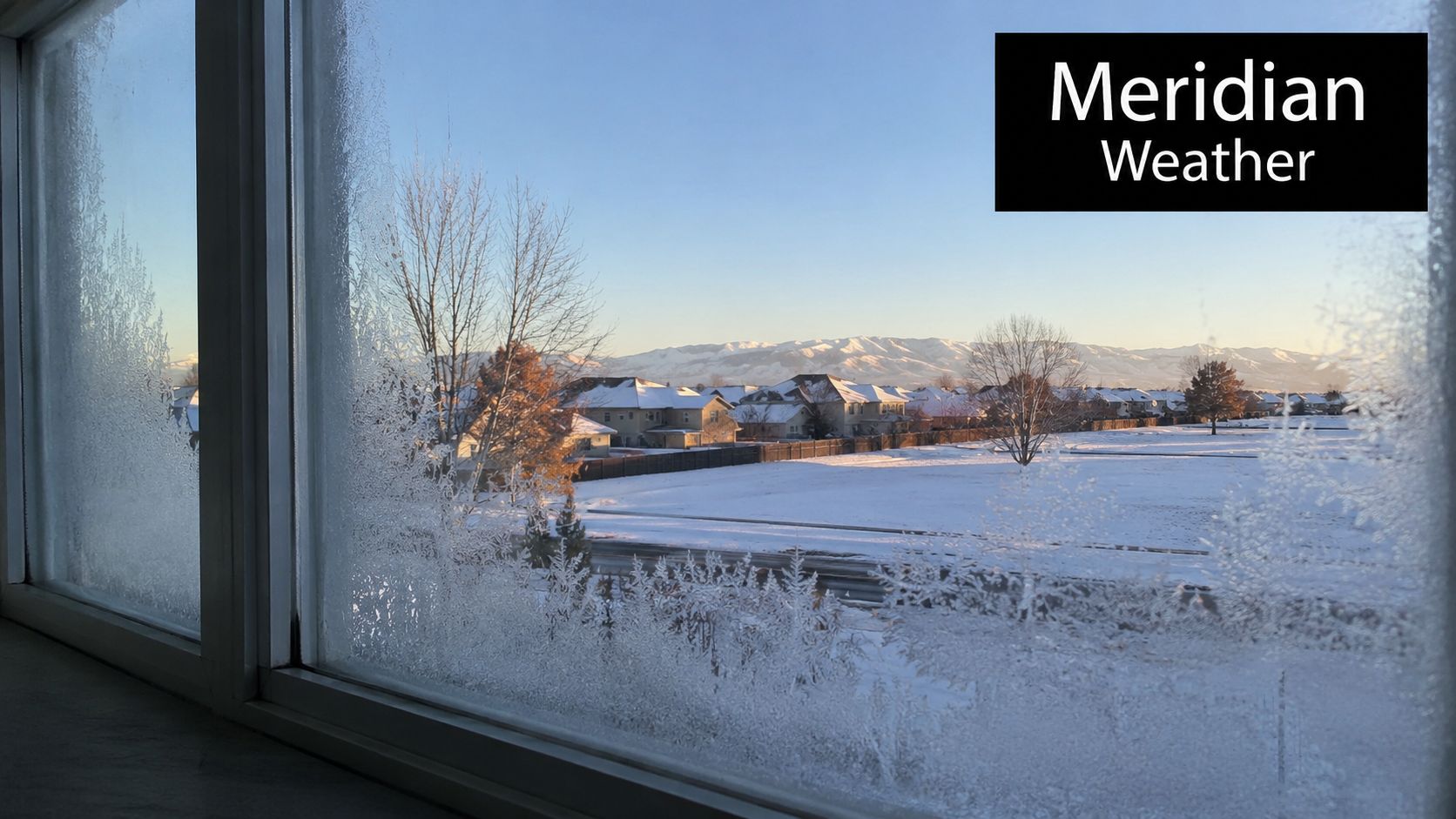
A January morning in Meridian can leave one bedroom feeling chilly while the south side of the same house is already warming up in the sun. Then July arrives, and that west-facing bonus room turns hot by late afternoon. Windows have to handle both situations well, and that is why energy-efficient windows in Meridian ID should be chosen for each side of the home, not picked as one identical package for every opening.
Why one spec for the whole house falls short
Meridian sits in a climate that asks windows to do two jobs at once. In winter, they need to slow heat loss so rooms stay comfortable near the glass. In summer, they need to limit unwanted solar heat, especially on walls that get strong afternoon sun.
That is where orientation matters.
The U.S. Department of Energy explains in its guide to energy-efficient window selection that south-facing windows can work well with a higher SHGC, while west-facing windows often benefit from a lower SHGC. In everyday terms, SHGC is the amount of solar heat a window lets through. A higher number lets in more sun heat. A lower number blocks more of it.
For Meridian homeowners, that can make a real difference in comfort. A south-facing living room may benefit from letting in some winter sun, while a west-facing family room often needs more protection from summer glare and heat buildup.
How to match the window to the wall
A good way to sort this out is to ask a simple question for each room. Is this room losing heat, gaining too much sun, or both?
- South-facing rooms: Often a good place to allow more helpful winter sun if summer shading is decent.
- West-facing rooms: Usually the first place to control late-day summer heat.
- North-facing rooms: Usually need insulation performance first, because they get little useful solar warmth.
- East-facing rooms: Often fall in the middle, so the right choice depends on how the room is used in the morning.
A window works a bit like a winter coat and a sunshade in one product. U-factor tells you how well it slows heat loss. SHGC tells you how much solar heat it allows in. On a north wall in Meridian, the coat matters most. On a west wall, the sunshade role often matters more.
That is why the same glass package everywhere can leave comfort problems behind. A lower SHGC on the west side may help a room stay usable on summer evenings. A stronger insulating package on the north side may make a bedroom feel less cold on winter mornings.
What this means in a real Meridian home
Here is a common example. A north-facing bedroom that feels cold is usually asking for lower heat loss and better air sealing. A west-facing great room that gets hot before dinner is usually asking for better solar control. Those are different problems, so they often need different window specs even if the windows look the same from the street.
Homeowners who want a clearer picture of the savings side can also review how new windows can lower heating bills in Idaho.
Modern ENERGY STAR standards have also become more climate-specific, which helps narrow down the right targets for homes in this part of Idaho. The label matters, but the better question is still practical: which side of your house is uncomfortable now, and what is causing it? That answer usually points you to the right combination of U-factor, SHGC, and air sealing.
Calculating Your Return on Investment
The money question is often asked early, and that's fair. Window replacement is a real investment. The useful way to look at it is part savings, part comfort, part long-term house performance.
The strongest financial baseline available for this area comes from Boise-area estimates tied to Idaho climate conditions. For homes with old single-pane windows, the energy savings can be meaningful.
What the numbers look like in a typical Boise area home
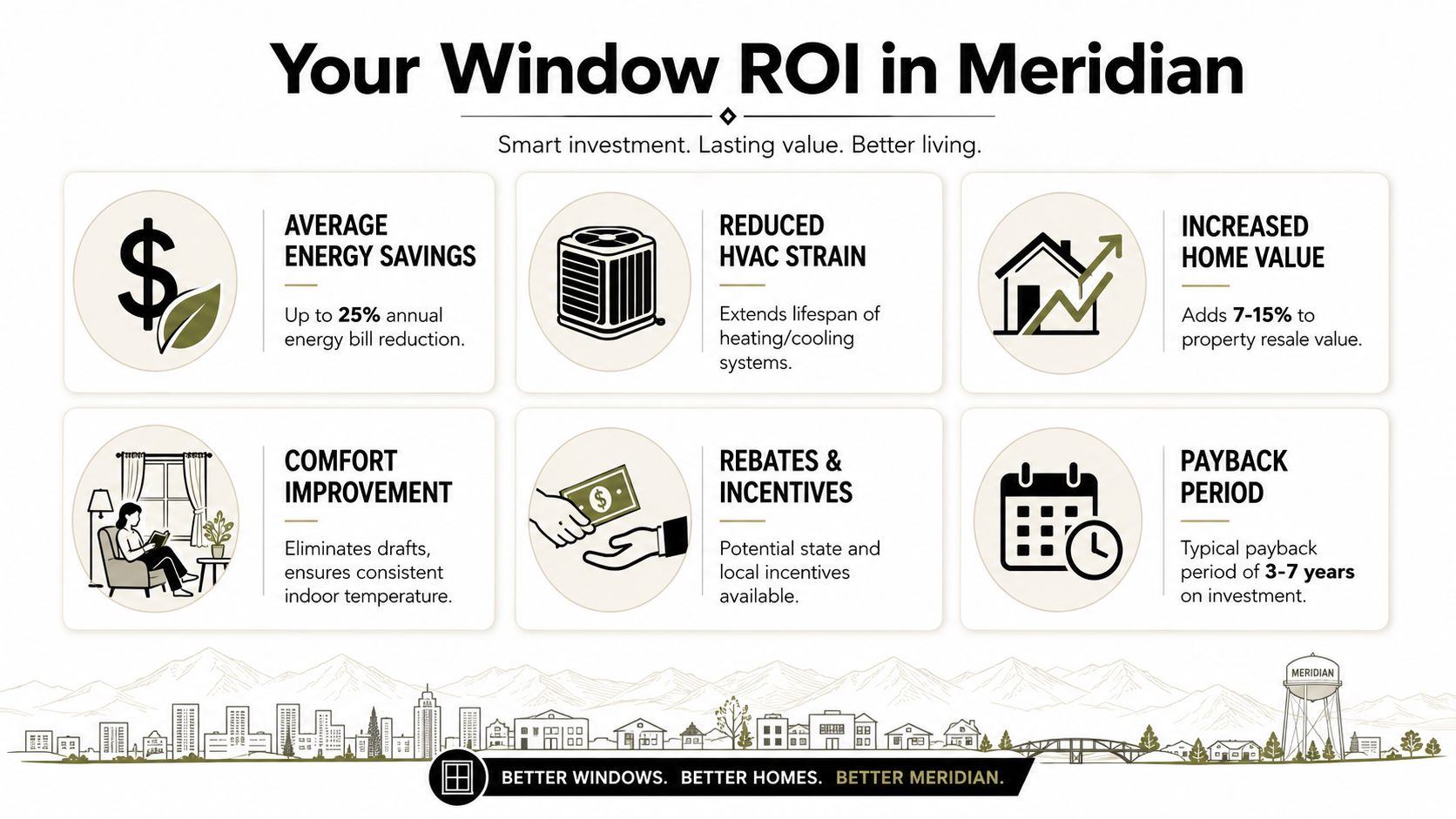
According to this Idaho climate window savings breakdown, replacing old single-pane windows with ENERGY STAR 7.0 certified models in Idaho can reduce annual heating and cooling costs by 12% to 33%. The same source says that for a typical 2,000-square-foot home in Boise with about 15 windows, upgrading from single-pane to double-pane Low-E windows with argon gas typically saves $300 to $500 per year, while triple-pane Low-E systems with argon typically save $500 to $700 per year.
It also notes that homes built in the 1980s or earlier with original single-pane windows can see higher returns, with double-pane upgrades saving $350 to $550 annually and triple-pane upgrades saving $450 to $700. Reported payback periods are 10 to 15 years for double-pane and 15 to 20 years for triple-pane.
Here's that comparison in a cleaner format:
| Upgrade path | Typical annual savings | Typical payback |
|---|---|---|
| Single-pane to double-pane Low-E with argon | $300 to $500 | 10 to 15 years |
| Single-pane to triple-pane Low-E with argon | $500 to $700 | 15 to 20 years |
| Older 1980s-or-earlier home to double-pane | $350 to $550 | Qualitatively longer-term investment |
| Older 1980s-or-earlier home to triple-pane | $450 to $700 | Qualitatively longer-term investment |
If you want a homeowner-focused explanation of how heating bill reductions show up in real Idaho conditions, this article on whether new windows save money on heating bills in Idaho is worth reading.
The return you feel before the payback is done
Payback matters. So does daily life.
Most homeowners notice the non-financial return much sooner:
- Draft reduction: Chairs, beds, and desks near windows feel usable again.
- More even temperatures: Rooms stop swinging so far from the thermostat setting.
- Less outside noise: Better glass packages and tighter frames can quiet the house.
- Smoother operation: Locks, sashes, and screens work the way they should.
Those gains don't show up on a utility statement, but they're often the reason people say the project was worth doing.
How C & C Windows Meet Idaho's Highest Standards
A good window package for Meridian should do more than look nice in the opening. It should match Idaho code, fit the way your house faces the sun, and hold up through cold snaps, summer glare, and years of opening and closing.
What to look for in a Meridian window package
As noted earlier, current ENERGY STAR targets for our region give you a useful baseline. In plain language, lower U-Factor helps keep indoor heat from slipping outside in winter, and lower SHGC helps control how much solar heat comes through the glass in summer.
That baseline matters, but Meridian homeowners often miss the next step. The best choice is not always the same window in every room.
A north-facing bedroom usually benefits from stronger insulation first, because it gets less direct winter sun and can feel cold all season. A south-facing living room may need a more careful balance, since winter sun can help warm the space, but too much solar gain can make that room uncomfortable in summer. West-facing rooms are often the toughest. Late-day sun can turn them into hot boxes, so glass that better limits solar heat gain can make a noticeable difference.
For many homes here, a solid package includes:
- Low-E glass coatings: These reflect heat in useful ways, helping indoors stay warmer in winter and less overheated in summer.
- Argon-filled insulated glass: This adds another layer of thermal resistance between the panes.
- Optional triple-pane glass: A practical upgrade for homes with harsh exposure, traffic noise, or rooms that stay uncomfortable even after HVAC adjustments.
- Different glass options by elevation: North, south, and west walls do not all need the same solar performance.
C & C Windows & Doors offers windows with ClimaTech Low-E coatings, argon gas fills, and optional triple-pane glass. Those features line up well with what many Meridian homes need, especially when the glass package is chosen room by room instead of as a one-size-fits-all order.
How the frame and sash matter too
Glass gets the attention, but the frame and sash do a lot of the daily work. They are the parts that keep the unit square, help seals stay tight, and affect how the window feels after years of use.
Here is a simple way to look at it. High-performance glass in a weak frame is like putting a good winter coat over worn-out shoes. Part of the system is doing its job. Part of it is still letting comfort escape.
Details worth checking include:
- Composite-reinforced sashes: These help moving parts stay stable and reduce the chance of warping over time.
- Narrower frame profiles: These preserve more glass area while still supporting efficiency goals.
- Well-designed locking hardware: This affects security, alignment, and how easily the sash closes against weatherstripping.
- Sloped sills: These help water drain away instead of lingering where it can cause long-term trouble.
Installation still decides whether those features perform the way they should. A well-built window needs a precise fit, proper insulation around the opening, and careful air sealing. That full system is what helps turn technical specs into the results homeowners care about: fewer drafts near the couch, steadier room temperatures, and less strain on the furnace and AC.
The Replacement Process From Consultation to Installation
Most homeowners don't replace windows often, so the process can feel bigger than it is. The good news is that a well-run project is usually straightforward. The key is knowing what should happen, in what order, and what questions are worth asking before anything is ordered.
What happens at the consultation
A useful consultation should feel educational first. You walk the house, identify the rooms that bother you most, and discuss how each side of the home behaves through the seasons.
Bring specific observations, not just a general complaint. For example:
- Cold bedroom on the north side: That points toward insulation and air leakage concerns.
- Hot family room after work: That often points toward west-facing solar gain.
- Windows that won't open well: That raises operation, hardware, and frame-condition issues.
- Condensation or fogging: That may indicate seal failure or aging insulated glass.
The measuring step matters more than many people realize. Replacement windows are ordered to fit existing openings, so precise dimensions shape everything that follows, from appearance to weather-tightness to how smoothly the sash operates later.
What installation day usually feels like
A careful crew protects floors, removes old units methodically, installs the new windows, insulates and seals the openings, and checks operation before cleanup. Homeowners often worry the house will be torn apart for days. In most cases, the experience is more orderly than expected when the team has a clear process.
A good installation day usually includes:
- Protection before removal so nearby surfaces stay clean.
- Careful extraction of old units without damaging surrounding finishes when possible.
- Fitting and leveling of new units so operation and sealing stay true.
- Interior and exterior finishing to close the system properly.
- Debris-free cleanup so you're not left with the mess.
What matters most at the end isn't only how the window looks. It's whether it locks correctly, slides or cranks smoothly, seals evenly, and sits square in the opening. Those details decide whether the comfort gains last.
Navigating Permits Rebates and Financing
This is the part many homeowners put off because it sounds administrative. Usually, it's simpler than expected once you know what to ask.
Permits and paperwork
For standard replacement work, permit needs can depend on the scope and on local requirements in Ada County. If the work changes opening sizes or involves structural modification, permit questions become more likely. If it's a like-for-like replacement, the process may be more straightforward.
The practical move is to ask about permits before ordering, not after. Confirm who handles the paperwork, what inspections may apply, and whether any HOA notice is needed for exterior changes.
Rebates and financing
Rebates and tax-credit information can change, so homeowners should verify current programs before signing. A smart starting point is this guide to window replacement tax credit and Idaho rebate information, which helps you see what may apply and what documentation you'll want to keep.
Financing matters because even homeowners who can pay cash sometimes prefer to spread out a larger envelope upgrade. The publisher notes that financing is available through Synchrony, which gives homeowners another way to fit replacement windows into a broader remodeling budget.
A simple checklist helps:
- Check eligibility early: Ask what product documentation is needed for any credit or rebate.
- Keep your paperwork: Save proposal details, invoices, and model information.
- Ask about timing: Some programs require purchase and installation within specific windows.
- Compare monthly budget impact: Financing can make it easier to replace the worst windows first or complete the whole house at once.
Frequently Asked Questions About Window Replacement
Are storm windows enough, or should I replace the whole window?
It depends on the condition of the existing unit. According to ENERGY STAR guidance on windows and storm windows, ENERGY STAR certified storm windows with Low-E coatings can save about 20% on annual heating and cooling bills when installed over single-pane clear glass windows, and the incremental cost can pay back in about three years. The same guidance also makes the practical distinction many homeowners need: full replacement windows address frame integrity, ease of operation, and overall home value in ways storm windows can't.
How long does a whole-house installation take?
It varies by home size, window count, accessibility, and finish details. A better question than “How many days?” is “How will the work be staged?” Ask whether the crew will move room by room, how they protect interior spaces, and when interior and exterior trim work is completed. That gives you a realistic sense of disruption.
What should I ask before I choose a window product?
Ask about the actual glass package, U-factor target, SHGC strategy by orientation, operating style, frame construction, warranty terms, and who performs the installation. If a room has a known problem, ask how the proposed window addresses that specific issue. “Better efficiency” is too vague. “Lower heat loss on the north side” or “less afternoon solar gain on the west wall” is the right level of detail.
If you're comparing options for energy-efficient windows in Meridian ID and want a practical, no-pressure next step, contact C & C Windows & Doors for an in-home consultation. It's a good way to evaluate your current windows room by room, sort out the right specs for each elevation, and get clear answers before you commit.