
If you're reading this in Boise, there's a good chance you already know which room has the problem. In January, it's the chair by the front window that always feels cold. In July, it's the west-facing living room that heats up long before dinner. The thermostat says one thing, but your house says another.
That pattern usually points to older glass and older frames. Homes built decades ago often have windows that were not designed for Boise's mix of cold winter nights, dry air, and hard afternoon sun. Homeowners live with the signs for years. Drafts. Uneven temperatures. Glare. Rooms that look great but aren't comfortable to spend time in.
Modern replacement windows solve those problems when the specifications match the house, not just the catalog. That's where a lot of homeowners get tripped up. They hear terms like Low-E, argon, U-factor, and triple-pane, but no one translates what those labels mean for a Boise home on a specific street with windows facing different directions.
Table of Contents
- Tired of Drafty Winters and Hot Summers in Boise
- Why Boise's Climate Demands Better Windows
- Decoding Energy Efficient Window Features
- A Pro Tip Most Boise Window Guides Miss
- Choosing the Right Window Style for Your Home
- Calculating Your Return on Investment in Boise
- The C and C Installation Experience
- Your Local Partner for Performance and Peace of Mind
Tired of Drafty Winters and Hot Summers in Boise
A common Boise story goes like this. The home looks solid from the curb, the furnace works, the air conditioner runs, and yet the house never feels settled. One bedroom is chilly in winter. The upstairs bonus room gets too warm in summer. The homeowner starts with weatherstripping, heavier curtains, or a thermostat adjustment, but the comfort problem keeps returning.
Older windows are often the reason. Single-pane glass and aging frames let outdoor conditions influence indoor rooms far more than is commonly understood. On a cold morning, the glass surface pulls warmth out of the room. On a bright summer afternoon, that same opening can admit enough solar gain to make a space feel sharp and uncomfortable.
The frustrating part is that these problems don't always look dramatic. You don't need cracked glass or obvious rot to have underperforming windows. Many Boise homeowners are living with windows that still open and close, but no longer do the job well.
The signs usually show up in daily routines
You notice them when you sit near the window with coffee. You notice them when the blinds stay shut all afternoon because the sun is too intense. You notice them when one room needs a fan while another needs a blanket.
A few clues usually point in the same direction:
- Cold zones near glass: Furniture placement starts revolving around where people don't want to sit.
- Summer overheating: West-facing rooms become the least-used part of the house in late afternoon.
- Uneven comfort: The HVAC system runs, but comfort still varies room to room.
- Condensation or draft complaints: The house feels leaky even when the doors are shut.
Older windows don't have to be broken to be the weak point in the house.
That's why energy-efficient windows in Boise ID aren't just a cosmetic upgrade. They're a comfort upgrade first. Better glass packages, tighter seals, and the right solar control can make the house feel calmer, quieter, and easier to heat and cool.
Why Boise's Climate Demands Better Windows
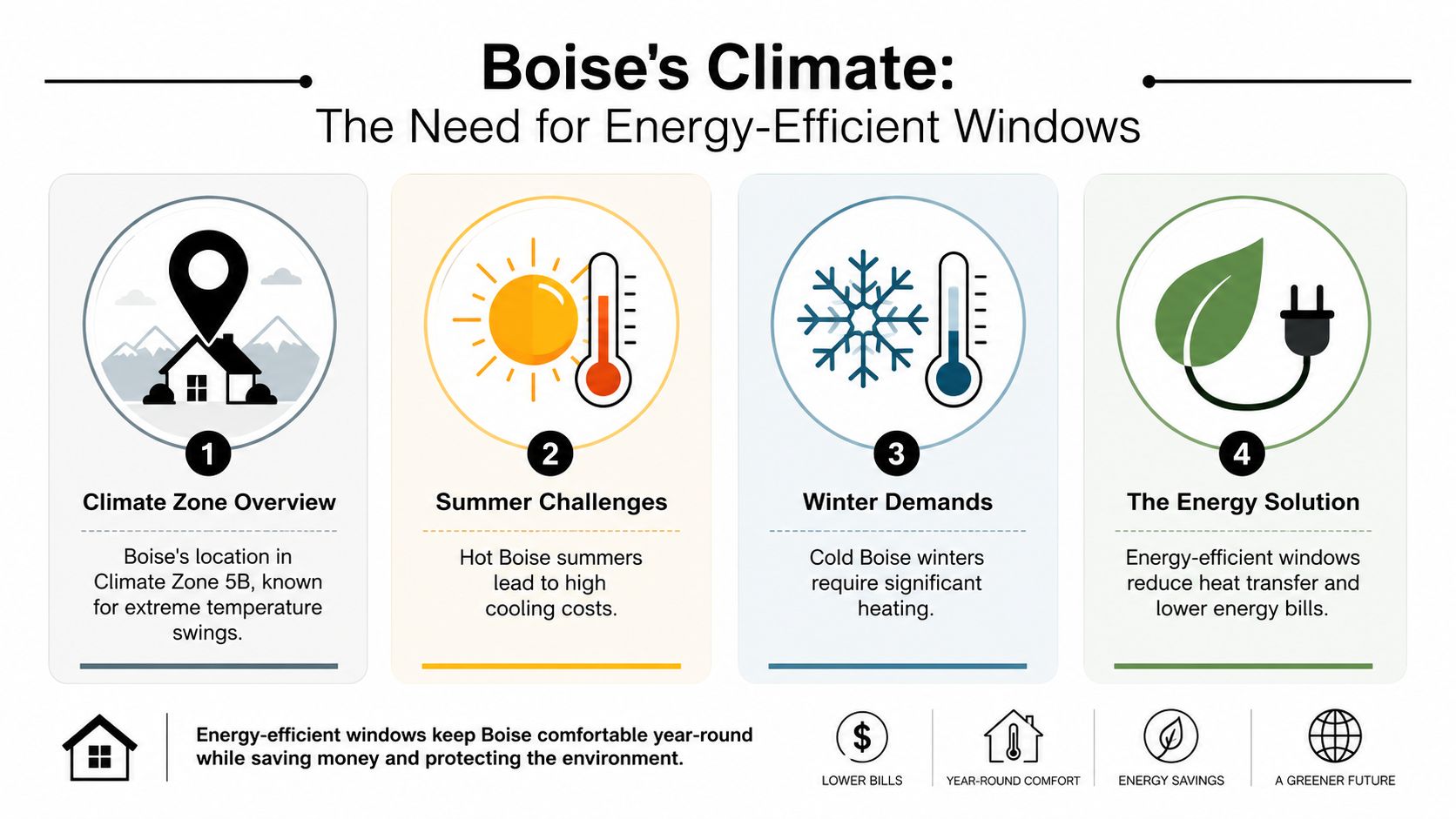
Boise asks more from a window than many homeowners realize. This isn't a mild, steady climate where one basic setup works everywhere. Windows here need to hold interior heat during cold periods and manage intense sunshine during warmer months.
Climate Zone 5B changes the window equation
Boise falls in Climate Zone 5B, a semi-arid zone with code requirements aimed directly at window performance. In this zone, windows need to control heat transfer and solar gain at the same time. According to Idaho window code guidance for Climate Zone 5B, windows in the Treasure Valley must achieve a U-factor of 0.30 or lower to comply with ENERGY STAR Northern climate zone standards, and Idaho Power recommends 0.27 or lower as a stronger target for many homes in the state.
That matters because a low-performing window doesn't just leak comfort in one season. It works against you year-round. Winter heat escapes through the glass and frame. Summer sun adds unwanted heat load, especially on exposed sides of the house.
For homeowners trying to diagnose the problem, this is the right place to start. If your utility bills feel high and the house still has uneven room temperatures, these common signs that windows are driving heating costs in Boise homes line up closely with what installers see in older Treasure Valley properties.
Code minimums are a floor, not the finish line
Meeting code is important, but code minimums don't automatically produce the best comfort result. They establish the baseline. Homeowners still need a window package that fits the exposure, layout, and sun patterns of the home.
From a practical standpoint:
| Window factor | Why it matters in Boise |
|---|---|
| Low U-factor | Helps keep indoor heat from escaping during cold weather |
| Controlled SHGC | Reduces unwanted solar heat gain during bright summer conditions |
| Low air infiltration | Cuts drafts around the unit and improves comfort near the opening |
A lot of old windows fail on all three. They don't insulate well, they admit too much solar heat, and they leak air around the sash or frame.
Practical rule: In Boise, a window shouldn't be selected on appearance alone. Performance ratings need to match the climate first.
That's why energy-efficient windows in Boise ID should be approached as a climate tool, not just a remodeling item.
Decoding Energy Efficient Window Features
Window labels decide a lot more than rebate eligibility. In Boise, they tell you whether a bedroom will feel cold in January, whether a west-facing living room will heat up by dinner, and whether the window package fits the way your house sits on the lot.
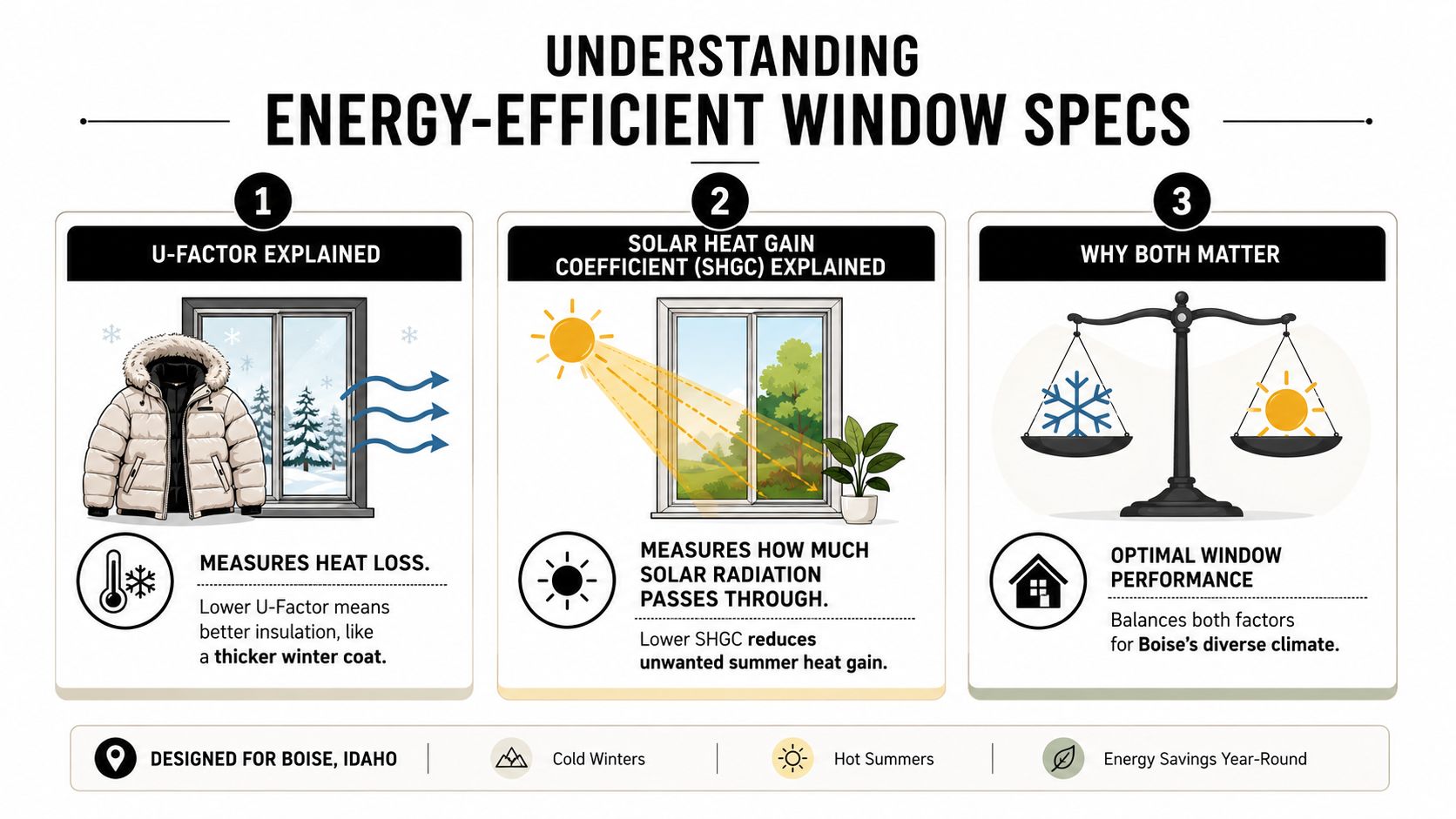
Read the label like a contractor
Start with U-factor. This measures how readily heat moves through the window. Lower numbers hold indoor heat better during Boise winters and usually improve comfort near the glass.
Next is SHGC, or Solar Heat Gain Coefficient. This measures how much of the sun's heat comes through the glass. In Boise, that number matters most on the sides of the house that take hard sun. A lower SHGC can help on west and south exposures, while the same glass choice may be unnecessary on a shaded north side.
That is the part many national articles skip. They explain the label, but they do not explain how the label should change by orientation.
A few other terms belong on every homeowner checklist:
- Low-E coating: A microscopically thin coating that reflects heat and helps control heat transfer.
- Argon gas fill: Gas sealed between panes to improve insulation.
- Air infiltration: The amount of outside air that leaks through the window assembly.
- Pane count: Double-pane and triple-pane describe how many layers of glass are in the unit.
For a broader local overview, this guide to energy-efficient window choices in Idaho homes helps homeowners connect those label terms to real product decisions.
What glass packages do
The question I hear all the time is whether double-pane is enough or if triple-pane is worth the extra cost. The honest answer depends on the room, the exposure, and what bothers you most now. Some homeowners want the lowest utility use they can get. Others care more about reducing cold glass, cutting street noise, or getting one problem room under control.
According to this Boise window performance reference, high-performance double-pane units with dual Low-E coatings and argon gas fill typically achieve U-factors between 0.25 and 0.30, while premium triple-pane configurations can reach U-factors as low as 0.15 to 0.22.
That gap is meaningful, but it does not make triple-pane the right answer for every opening. On a protected elevation, a good double-pane unit may deliver the better value. On an exposed side with winter wind or intense afternoon sun, spending more on the glass package can make the room feel noticeably steadier.
A practical breakdown looks like this:
- Double-pane with Low-E and argon: Often the best value for many Boise homes. It gives solid thermal performance at a more manageable price.
- Triple-pane with Low-E and argon: A stronger fit for homeowners who want better winter comfort, lower U-factor performance, and a more insulated feel next to the window.
- Cheap upgraded glass without the right full package: Usually falls short. One upgraded feature does not make an average window perform like a well-built, well-installed unit.
A well-specified double-pane unit can outperform a poorly chosen premium package because the numbers and installation fit the home better.
That is how we evaluate windows in the field. We look at the ratings, then we match them to the room, the sun exposure, and the budget. That approach gives Boise homeowners better comfort than chasing the highest spec on a brochure.
A Pro Tip Most Boise Window Guides Miss
A lot of Boise window advice gets one important thing wrong. It recommends one SHGC target for the whole house, as if every side of the home receives the same sun and creates the same comfort problem.
That shortcut sounds convenient. It usually leaves performance on the table.
Why one SHGC target for the whole house falls short
Local Boise guides often suggest a single SHGC range and move on. But DOE guidance on energy-efficient window selection by orientation supports a more precise approach. The guidance notes that local Boise recommendations often use a single SHGC range of 0.25 to 0.35, while west-facing windows may need SHGC 0.20 or lower to limit overheating, and north-facing windows can benefit from SHGC up to 0.40.
That difference matters because west sun in Boise is aggressive. A family room with broad west glass can feel uncomfortable even when the rest of the house is fine. On the other hand, treating a north-facing opening exactly the same way can mean giving up useful daylight and passive winter warmth for no real gain.
How orientation changes the recommendation
The better approach is to choose glass with the elevation in mind.
| Orientation | Typical concern | Better window thinking |
|---|---|---|
| West-facing | Harsh afternoon sun and overheating | Use lower SHGC glass to reduce summer heat gain |
| North-facing | Less direct summer sun | A somewhat higher SHGC can support winter light and passive warmth |
| South-facing | Strong sun exposure over the year | Balance matters more than a blanket low number |
| East-facing | Morning sun and moderate gain | Usually benefits from a measured middle-ground approach |
This is one of the clearest differences between generic advice and a well-designed window package. A whole-home window plan should respond to the house, not force every opening into one average specification.
West-facing glass and north-facing glass often shouldn't be treated as twins. In Boise, they live very different lives.
For homeowners shopping energy-efficient windows in Boise ID, this is the detail worth asking about during the estimate. If the recommendation is exactly the same for every room, the plan probably isn't finished.
Choosing the Right Window Style for Your Home
Performance ratings matter, but style still affects how a window works in daily life. Operation, ventilation, sightlines, and maintenance all change with the window type you choose.
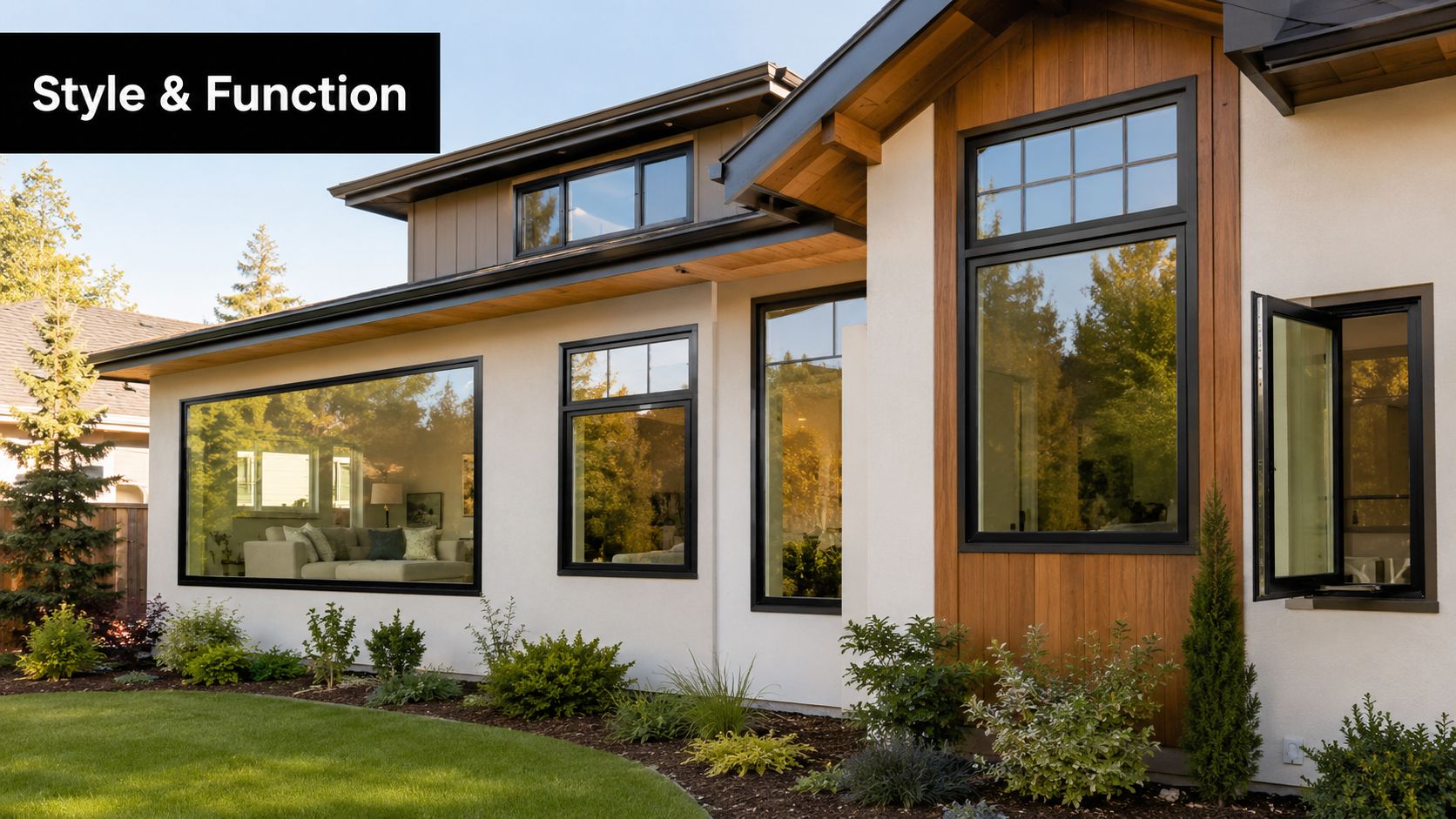
Match the style to the room
A good window plan usually mixes styles instead of forcing one model through the entire house.
- Double-hung windows work well in bedrooms, front elevations, and traditional home styles. They're familiar, easy to operate, and easy to clean.
- Casement windows are a strong fit for areas where you want a tighter weather seal and controlled ventilation. Kitchens and side-yard exposures often benefit from them.
- Picture windows are ideal where the goal is light and view, not ventilation. They're a natural fit for living rooms, stairwells, and openings that frame foothill views.
- Sliding windows make sense in wider horizontal openings where swing space is limited and simple operation matters.
Performance and appearance should work together
Style choice isn't only visual. It changes how the room feels to use.
A kitchen over the sink usually benefits from a window that's easy to open without awkward reaching. A family room with a view often wants the cleanest possible glass area. A bedroom may prioritize simple egress, privacy, and easy cleaning.
That's why the best replacements don't just copy what's already there. They improve the room.
A few practical pairings work especially well:
- Picture plus operable flankers: Gives you a large central view with side ventilation.
- Casement in hard-to-reach spots: Provides easier opening and operation than some alternatives.
- Double-hung on street-facing elevations: Keeps a classic look while improving comfort.
- Sliding patio doors near outdoor living areas: Helps connect indoor and outdoor spaces without eating up floor area.
The right style should make the room more comfortable to live in, not just more attractive from the street.
For many homeowners, the project becomes exciting rather than purely technical. New windows can sharpen the exterior of the home, but they also change how rooms breathe, how views feel, and how often blinds stay open.
Calculating Your Return on Investment in Boise
A Boise homeowner usually feels the payback before they finish calculating it. The west-facing living room stops overheating in late summer. The bedroom on the north side holds a steadier temperature on cold nights. The utility savings matter, but day-to-day comfort is what makes the project feel worthwhile right away.
What the savings can look like
Return on investment depends on what you're replacing, how the house is exposed, and how long you plan to stay. A 1980s Boise home with worn single-pane windows has a very different payoff than a newer home with decent double-pane units that were installed fairly well.
The National Fenestration Rating Council explains the ratings that drive energy performance, including U-factor and solar heat gain coefficient, and those labels are what I use to have a real payback conversation with homeowners instead of guessing from brochure language. In Boise, that matters because the best value often comes from matching the glass package to the elevation, not from putting the same window everywhere. South and west exposures usually deserve closer attention for solar gain control, while north-facing rooms often benefit most from stronger insulating performance. You can review those rating basics on the NFRC consumer page for window energy performance labels.
That orientation-specific approach is one of the easiest ways to protect your budget. If every opening gets upgraded to the most expensive package on the menu, the math can get stretched. If the package is tuned to how the house takes sun and wind, homeowners often get a better balance of comfort, efficiency, and cost.
For homeowners weighing the broader financial picture, this guide to window replacement ROI and home value helps frame the decision beyond utility bills alone.
Cost, rebates, and practical value
Installed cost still has to pencil out. Size, frame material, accessibility, trim work, and whether the project is a pocket replacement or full-frame install all change the number. Triple-pane can be worth it in some Boise homes, especially in loud areas or rooms that stay uncomfortable through winter, but it is not an automatic win on every elevation.
Tax credits can also help offset part of the investment. The ENERGY STAR guidance on federal tax credits for exterior windows and skylights outlines current federal incentives for qualifying products, which is a better source for this section than repeating code tables from the climate discussion.
The return also shows up in ways a utility bill doesn't fully capture:
- Quieter interior rooms
- Fewer hot and cold spots
- Less strain on heating and cooling equipment
- Better comfort near the glass in winter and summer
- Stronger resale appeal when the home feels updated and well cared for
Financing changes the equation too. Some homeowners want the fastest payback on paper. Others want to stop living with failing windows now, then spread the cost over time. Both are reasonable. The right choice depends on your house, your exposures, and whether your goal is the lowest utility bill, the best comfort upgrade, or a balanced middle ground.
The C and C Installation Experience
A Boise homeowner can pick a strong glass package and still end up disappointed if the install is off by a little. We see it in homes where the old window was replaced, but the room still feels drafty on a January morning or overheated by late afternoon sun. Good results come from the full system. The window, the measurements, the opening, the insulation, the seal, and the finish work all have to be handled correctly.
What a well-run window project looks like
The process should start in the home, not from a price sheet. During the consultation, we look at how each room behaves. A west-facing bonus room in Boise usually needs a different conversation than a north-facing bedroom or a south-facing living room with winter sun. That orientation detail often gets missed, and it affects both product selection and installation decisions.
A well-run project usually includes a few basic steps:
- In-home consultation with discussion about draft complaints, hot spots, glare, noise, and how the house sits on the lot.
- Field measurements taken at each opening so the ordered units match the existing conditions of the house.
- Room-by-room recommendations based on exposure, operation, appearance, and the homeowner's priorities.
- Installation planning so the crew protects floors, manages debris, and keeps the day predictable.
- Final walkthrough to check operation, finish details, and cleanup before the job is wrapped up.
That kind of process cuts down on surprises. It also helps avoid a common mistake. Ordering the same window package for every elevation when the home would perform better with more specific choices.
Why installation quality matters as much as the glass
Installation work decides whether the window performs the way it was designed to perform. If the opening is out of square, if insulation is skipped, or if sealing is rushed, even a premium unit can fall short. Homeowners feel that in the form of air leakage, sticky operation, uneven interior trim, or a room that never becomes as comfortable as expected.
The details around the frame matter a lot in Boise. Summer sun is hard on west and south exposures. Winter air finds weak spots fast. A crew that knows local conditions pays attention to fit, shimming, insulation, exterior sealing, and clean interior finish work because those steps affect comfort as much as the glass package itself.
Strong installation work usually shows up in a few visible ways:
- Protected interiors: Floors, furniture, and nearby surfaces are covered before removal starts.
- Clean removal and disposal: Old materials leave the site without turning the house into a mess.
- Accurate set and finish: Windows operate smoothly, lock properly, and sit cleanly in the opening.
- Clear communication: Homeowners know who is coming, what is happening that day, and what the home will look like when the crew leaves.
Clean installation is part of the product the homeowner is buying.
When the job is done right, the difference is easy to notice. Rooms feel calmer. Drafts near the glass drop off. The house feels tighter, quieter, and better put together.
Your Local Partner for Performance and Peace of Mind
The best window project solves more than one problem at once. It cuts discomfort, improves the look of the house, reduces the daily nuisance of drafts and overheating, and gives the homeowner more confidence in the property itself.
What homeowners should remember
For Boise homes, window selection works best when it's based on a few practical truths:
- Climate matters: Boise's conditions demand real thermal performance, not builder-grade shortcuts.
- Specifications matter: U-factor, SHGC, Low-E coatings, and argon fill aren't marketing terms. They directly shape comfort.
- Orientation matters: West-facing glass and north-facing glass shouldn't always get identical treatment.
- Installation matters: Even a premium unit can underperform if the opening, fit, and sealing aren't handled carefully.
Homeowners shopping for energy-efficient windows in Boise ID usually start with one symptom. A cold room. A hot room. High bills. Street noise. A complete solution is achieved by solving the whole system correctly.
Why local experience still matters
There's a difference between selling a window and knowing how a Boise home behaves through a full year. Local experience helps with product selection, room-by-room recommendations, and installation practices that reflect Treasure Valley conditions instead of generic national assumptions.
That's also where long-term support matters. Homeowners want to know who's standing behind the work, who answers the phone if there's an issue, and whether the company understands the homes in Boise, Meridian, Eagle, and the rest of the valley.
A well-run project should leave you with more than new glass. It should leave you with a house that feels more comfortable every day and a result you still feel good about years later.
If you're ready to compare options for your home, C & C Windows & Doors offers free in-home consultations, custom measurements, factory-trained installation, and energy-efficient window and patio door solutions built for Treasure Valley conditions. If you want straight answers on comfort, glass packages, style choices, financing, and what will work in your Boise home, they're a strong local team to call.