


If fog sits between the panes, the insulated glass unit has failed and needs replacement, not a cosmetic fix. A failed IGU can lose roughly 40% to 60% of its insulating value, while replacing the glass unit is usually more sensible than replacing the whole window when the frame remains sound.
A Treasure Valley homeowner often notices the problem at breakfast. The kitchen window looks hazy after a cold night, and the first assumption is ordinary morning condensation. Wipe the inside. Wipe the outside. If the milky film, droplets, or haze remains trapped inside the glass package, you're looking at window seal failure, not surface moisture.
The right decision isn't a simple repair-versus-replace price comparison. Check three thresholds instead: frame condition, window age, and the pattern of the fogging. Those three clues tell you whether to defog temporarily, replace the IGU, or install a complete new window.
For a closer look at the symptom itself, see this guide to fixing foggy windows between panes. The practical rule is straightforward: diagnose the failed component before paying to replace components that are still doing their job.
Table of Contents
- When Foggy Glass Means You Need to Decide
- What a Window Seal Actually Does and Why It Fails
- How to Diagnose a Real Seal Failure at Home
- Repair vs Replace Options Side by Side
- Energy and Comfort Cost of Leaving It Unfixed
- Matching the Fix to Your Window's Age and Frame
- Warranty Installation and Your Next Step in the Treasure Valley
When Foggy Glass Means You Need to Decide
A hazy pane in a Boise, Meridian, or Nampa home can mean two very different things. Condensation on the room-side surface comes from indoor humidity, often after cooking, showering, or a cold overnight temperature. Fog trapped between the panes means the sealed cavity has been breached.
Start with the wipe test
Run a clean, dry cloth across both faces of the glass. Surface moisture disappears or moves under the cloth. Internal haze doesn't. You may also see droplets, a silvery film, or white mineral residue that seems suspended inside the unit.
That distinction matters because the sealed cavity isn't accessible from either side. Exterior caulk won't reach it, and a homeowner can't wipe away moisture that has entered through the perimeter seal. Once humid air enters, the insulating gas fill has also been compromised, so the issue is performance-related as well as visual. The Insulated Glass Manufacturers Alliance provides industry information on insulated glass construction and certification.
Practical rule: If the fog remains after both sides are clean, stop treating the window like dirty glass. Treat it like a failed IGU.
Use three thresholds, not one price
Frame condition comes first. A sound frame can usually hold a replacement IGU securely. Rot, warping, corrosion, cracked vinyl, or movement around the sash changes the recommendation.
Window age comes next. A newer window with one failed glass unit often deserves a targeted glass replacement. An older window may have worn weatherstripping, failing balances, damaged hardware, or other problems that make a complete replacement more rational.
Fogging pattern finishes the diagnosis. A uniform haze across the pane usually points to a contained IGU failure. Moisture concentrated at the edges can point toward perimeter deterioration, frame movement, or installation stress.
You don't need to guess from the street or buy a do-it-yourself defogging kit before checking those clues. A careful visual inspection gives you a much better starting point, and the following sections explain what the seal does, why it fails, and which repair restores performance.
What a Window Seal Actually Does and Why It Fails
An insulated glass unit is a sealed assembly, not two panes set into a sash. Two or three panes sit around a spacer, while a desiccant controls moisture inside the cavity. A primary seal, commonly made with polyisobutylene, works with a secondary seal such as silicone or polysulfide to close the perimeter.
That barrier keeps humid air out and holds the insulating gas in place. Many units use argon, while some use krypton. The gas fill, pane spacing, glass coatings, and edge seal work together to deliver the window's intended thermal performance and lower U-factor.
Thermal cycling works the seal every day
Treasure Valley windows endure repeated temperature swings. Sun warms the glass, the glass expands, evening cooling makes it contract, and seasonal changes repeat that stress on a larger scale. Over time, the movement weakens the bond around the edge.
Ultraviolet exposure speeds deterioration of perimeter sealants, particularly on windows receiving strong afternoon sun. South- and west-facing elevations usually take more solar load and larger daily temperature changes, so their seals can fail sooner than sheltered units. This explanation of thermal cycling and UV-related seal stress aligns with common failure patterns in exposed elevations.
Installation problems can shorten service life as well. Incorrect glazing compounds, incompatible sealants, or a poorly fitted rabbet can place uneven pressure on the unit. Settling, impact, moisture damage, or frame warping can also shear the perimeter bond. This guidance on installation and structural stress contributing to seal failure helps explain why several windows may fail in one area.
What changes after the breach
Once the seal leaks, insulating gas escapes and humid air enters. The cavity may develop fogging or droplets, and the glass loses some of the thermal performance it had when manufactured. One cited benchmark shows a double-pane argon unit with an original U-factor of 0.28 degrading to about 0.35 to 0.40 after seal failure, as described in this explanation of U-factor changes in failed insulated glass.
A failed seal is therefore more than a cosmetic defect. The unit no longer provides its designed insulation, and drilling or defogging the cavity does not restore the original gas fill. Judge the next step by the frame's condition, the window's age, and whether the fogging is isolated or widespread. Those three thresholds point toward glass replacement or a full window replacement far better than price alone.
How to Diagnose a Real Seal Failure at Home
You can make a reliable first diagnosis without removing trim or taking the sash apart. Work through the glass, the room conditions, and the window's physical behavior in that order.
Five checks that separate fog from humidity
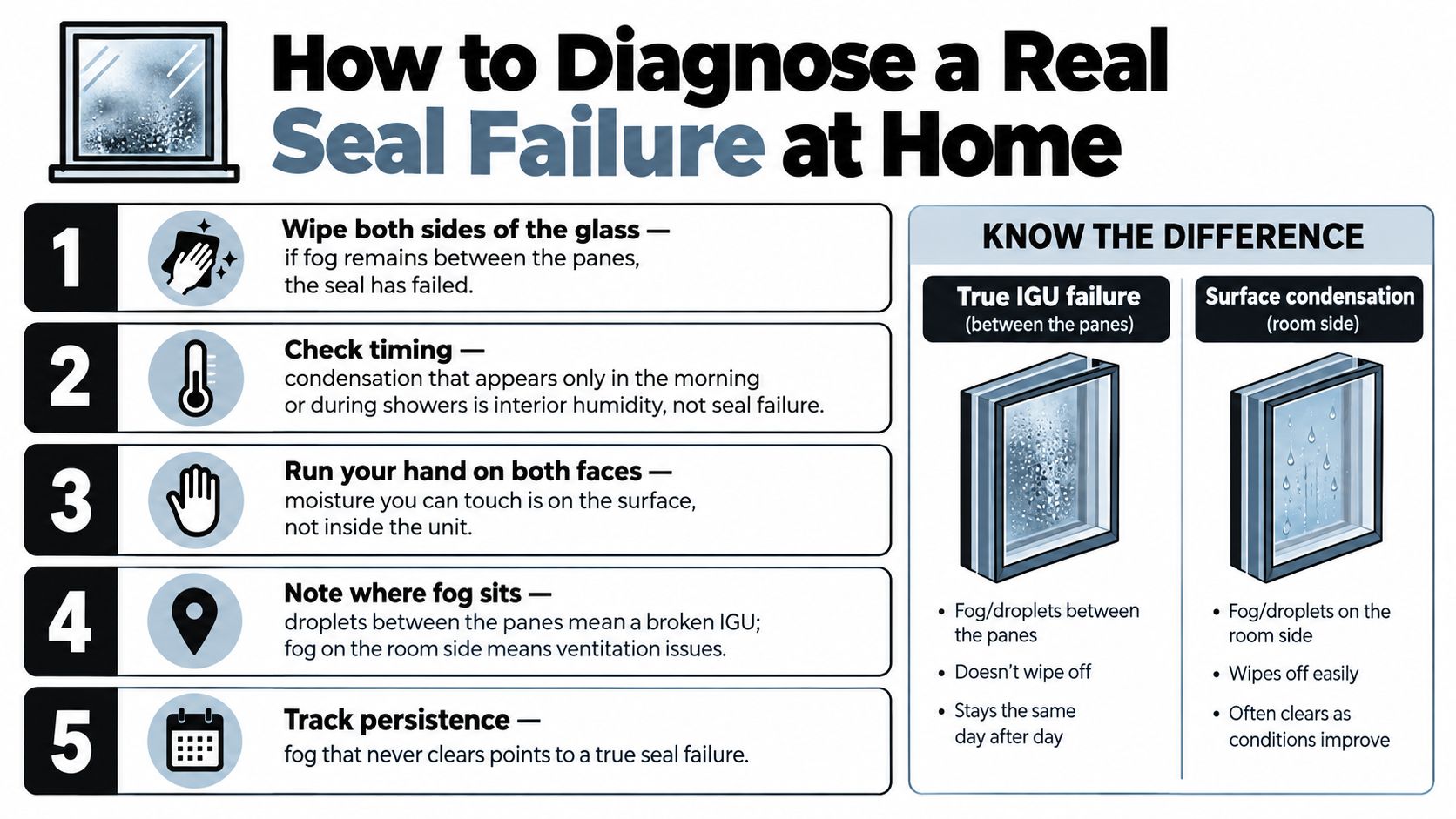
Wipe both faces. Clean the room side and exterior side. If the haze stays in the middle, the seal has failed.
Look at the residue. A silvery haze, droplets, or a white mineral film inside the unit indicates moisture has been trapped in the cavity. Don't confuse this with a smear that moves under a cloth.
Check the exposure. South- and west-facing windows deserve extra attention because stronger sunlight and temperature swings place more stress on the edge seal.
Feel for uneven temperature. On a winter morning, compare the problem unit with a neighboring window. A pronounced cold area near the frame can support the diagnosis, though it doesn't prove an IGU failure by itself.
Listen and operate. Run a hand near the sash interface for a draft and open the window carefully. A sticking sash, loose lock, or failing balance suggests the frame and hardware may need attention beyond the glass.
Don't mistake bathroom fog for a broken IGU
Condensation that forms on the room side after a shower or while cooking is a humidity problem. It may clear as ventilation improves or the room warms. That moisture is touchable, so it isn't trapped inside the sealed glass cavity.
Persistent internal haze behaves differently. It stays after the weather changes, remains after both surfaces are wiped, and often becomes more obvious at certain viewing angles. The diagnostic guidance for distinguishing internal fog from surface condensation reinforces the same threshold: moisture between panes means the sealed unit has failed.
Windows installed before 2005 with original IGUs are common candidates for inspection in Treasure Valley homes. That date alone doesn't decide the repair, but older original units deserve a closer look for multiple symptoms, frame movement, and worn hardware.
Repair vs Replace Options Side by Side
Use three thresholds before choosing a fix: frame condition, window age, and the visible fogging pattern. A sound frame and working sash usually justify replacing only the insulated glass unit, or IGU. A damaged frame, failing hardware, or widespread deterioration points to full-window replacement. Age then determines whether a new IGU is a sensible investment in the existing system.
| Option | Typical Cost (Installed) | What It Actually Fixes | Expected Lifespan | Best When |
|---|---|---|---|---|
| Defogging | $70 to $245 for seal-related fixes, based on InterNACHI guidance | Removes visible moisture but does not restore the insulating gas fill | Temporary and limited | You need short-term visual improvement |
| Perimeter seal or gasket work | About $70 to $245 for seal-related fixes, based on industry repair guidance | May address accessible edge leakage or drafts, not damage inside the cavity | Depends on the underlying failure | The glass is not fogged between panes |
| IGU-only replacement | Commonly about $150 to $500 per window | Replaces the failed sealed glass package while retaining the existing frame | Based on the new unit and existing frame | The frame, sash, and operation remain sound |
| Full-frame replacement | Varies widely by window, material, and installation scope | Replaces the glass, frame, sash, weatherstripping, and specified hardware | Depends on the complete installed system | The frame or several window components are failing |
Why defogging is usually the wrong permanent fix
Field defogging removes or vents moisture through drilled holes. It does not restore lost argon or krypton fill, and it does not recreate the original hermetic seal. The glass may look clearer while the window continues to insulate below its designed level. Guidance on foggy-window repair methods identifies IGU replacement as the durable option when the frame remains sound.
A perimeter reseal is a different repair. It can address an accessible edge or draft, but it cannot rebuild a failed sealed cavity. If moisture sits between the panes, replace the IGU rather than paying for a cosmetic treatment that leaves the insulation problem in place.
Age changes the recommendation. On a newer window with a good frame, IGU replacement preserves a serviceable system. On an older unit with warped components, worn hardware, or repeated failures, put the money toward a complete replacement. This guide to choosing window replacement versus repair provides additional context. My rule is direct: sound frame and operation mean replace the IGU; damaged frame or failing operation means replace the window.
Energy and Comfort Cost of Leaving It Unfixed
A failed IGU costs more than a clear view. Once the gas fill is lost and air replaces it, the glass insulates less effectively. That turns seal failure into an ongoing performance problem, not merely a cosmetic defect.
One failed window can also add to annual heating and cooling costs. The actual impact depends on the window, the room, the home's construction, and local weather. The reported energy cost impact of a failed window seal provides a useful benchmark, but your utility bills and the number of affected units matter more than any general estimate.
Comfort reveals the problem before the bill does
In winter, failed glass often feels cold even while the furnace runs normally. Your body notices the radiant chill near the window, and air movement at the sash or frame can make the room feel colder than the thermostat indicates.
Summer exposes the same weakness differently. A sunny failed unit can create a hot patch beside the glass, especially on south- and west-facing elevations during afternoon cooling. Persistent moisture around the unit may stain the sill, damage nearby finishes, and point to a problem that should not be left in place.
Treasure Valley homes see hot summers, freezing winters, strong sun, and repeated temperature swings. Those conditions increase the comfort penalty of weak insulating glass and keep stressing already-damaged seals.
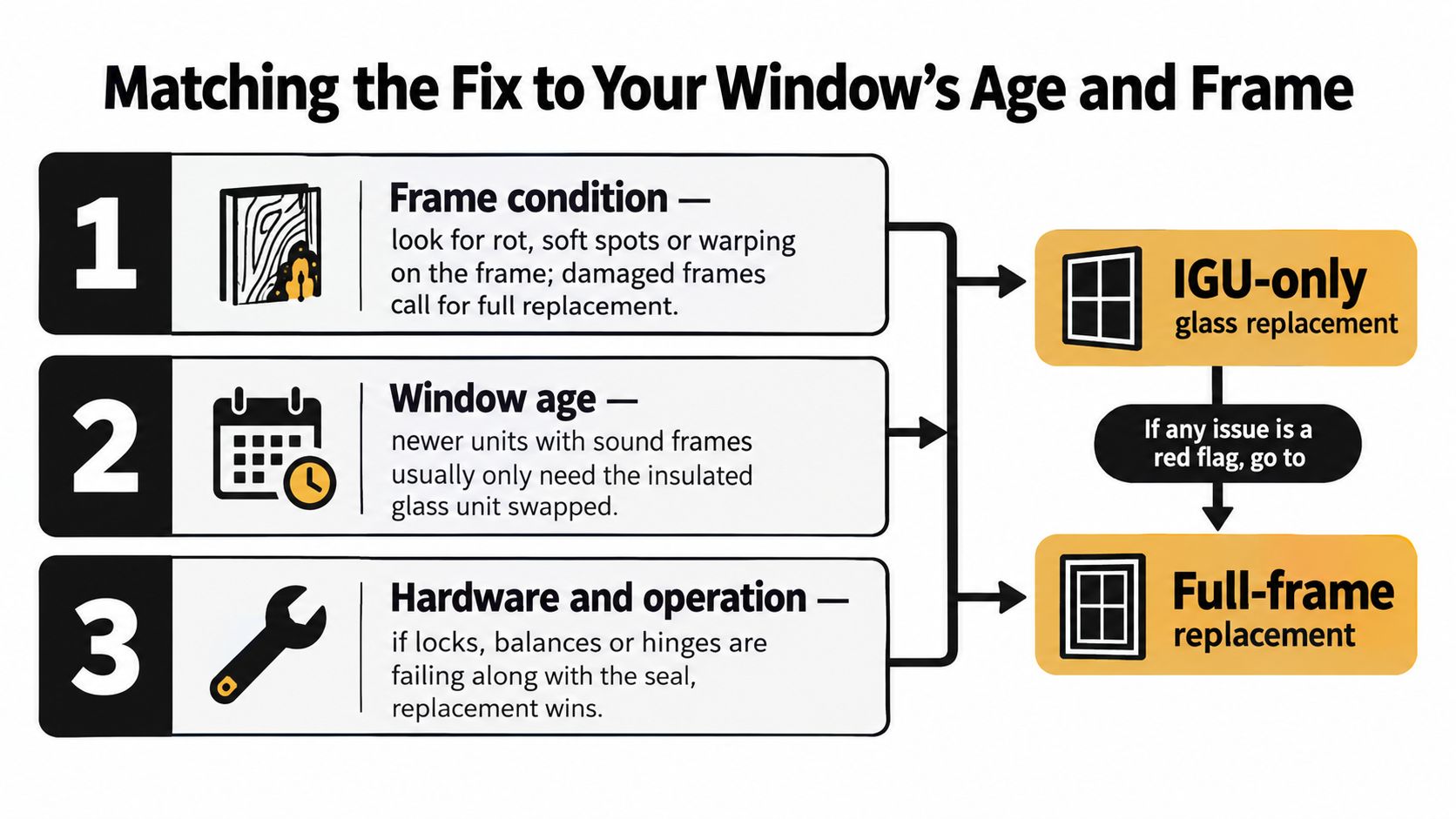
Treat IGU replacement as a performance repair, not a cosmetic upgrade. The sensible choice depends on three thresholds: a sound frame, a window age that justifies preserving the existing system, and a fogging pattern limited to the affected sealed unit. If the frame is failing, the window is near the end of its service life, or several units show the same problem, full replacement deserves serious consideration.
A proper assessment compares the failed glass with the complete opening, including the frame, sash, hardware, and installation. For homeowners facing unusually high utility costs, this discussion of whether windows may be contributing to high heating bills in Boise offers relevant local context.
Matching the Fix to Your Window's Age and Frame
A glass replacement only works as well as the frame holding it. On a service call, I inspect the opening before discussing glass specifications because a new IGU can't correct a rotten sill, a warped sash, or a frame that has lost its shape.
Threshold one is frame condition
Look closely at the contact points.
- Wood frames: Probe for soft spots, rot, swelling, and paint failure around the sill and corners.
- Aluminum frames: Check for corrosion, bent sections, and deterioration where the glass is seated.
- Vinyl frames: Look for cracks, bowing, warping, and joints that no longer sit square.
A failed frame disqualifies an IGU-only swap in practical terms. The new glass would inherit the same structural movement, drainage problem, or attachment weakness. If water damage has reached the surrounding wall, the glass decision should wait until the source and extent of that damage are understood.
Threshold two is age and history
Age doesn't automatically condemn a window. A well-maintained unit with a sound frame, reliable hardware, and one failed IGU can be a good candidate for targeted replacement.
History matters more than the calendar alone. Ask whether other units have fogged, whether the windows have been repainted or repaired, and whether the original installation left gaps or distortion. A cluster of failures points toward a broader system or installation issue rather than one isolated piece of bad glass.
Threshold three is the fogging pattern
Uniform haze across one pane usually indicates the IGU itself is the failed component. Moisture creeping around the edges, combined with sash movement or frame distortion, deserves a more cautious inspection because the surrounding structure may be contributing.
Decision flow: Frame bad means replace. Frame good but old with multiple issues means replace. Frame good with one failed unit means swap the IGU.
Treasure Valley freeze-thaw cycles are hard on marginal frames. If the frame flexes, leaks, or no longer holds the sash square, a glass swap can become money spent on a temporary improvement. When the evidence is mixed, full replacement is the safer recommendation because it restores the opening, not just the cavity between the panes.

Warranty Installation and Your Next Step in the Treasure Valley
Warranty paperwork matters, but homeowners often read only the glass coverage and overlook installation requirements. IGU warranties commonly cover seal failure for 10 to 20 years, according to the supplied industry guidance, but the exact terms depend on the manufacturer, product line, ownership rules, and installation conditions. Before authorizing work, find the original invoice, product label, and warranty document.
A warranty claim can also fail when an unauthorized alteration has been made. Drilling the unit for defogging, changing the glass package, or having an unqualified installer modify the assembly may complicate coverage. Ask who is responsible for the glass, labor, frame, and installation if the replacement unit later fails.
Workmanship determines whether the new unit lasts
A proper IGU installation requires more than sliding glass into an opening. The installer needs accurate measurements, intact glazing beads, correctly placed setting blocks, compatible materials, and a continuous perimeter seal. The sash must remain square, and the unit must sit without pressure points that can recreate the original failure.
Poor workmanship can look like a defective product within months. A new pane may fog again, leak air, bind in the frame, or show stress because the installer corrected the symptom without correcting the fit. That's why the contractor's installation process matters as much as the glass specification.
What to do before you call
Take clear photographs from inside and outside. Record which rooms have fogging, whether it appears between the panes, which windows face south or west, and whether any sash sticks or drafts. Gather the window age, manufacturer information, and warranty documents if they're available.
Pick up the phone sooner if you have multiple failed units, visible frame rot, persistent drafts, or windows more than two decades old. Those signs point toward a broader evaluation rather than a single-pane glass order. If one newer window has cosmetic fogging but the frame and operation are sound, you can schedule an assessment without treating the entire house as an emergency.
A Treasure Valley consultation should include measurements, an inspection of the frame and sash, a review of the failed glass pattern, and a comparison between IGU-only work and full replacement. C & C Windows & Doors provides in-home consultations, custom measurements, replacement windows, and installation for homes across Boise, Meridian, Eagle, Nampa, Caldwell, Kuna, Garden City, and Star.
C & C Windows & Doors can inspect the failed unit, compare an IGU-only replacement with full-frame options, and recommend glass suited to Treasure Valley conditions. Visit C & C Windows & Doors to arrange an in-home consultation and get a clear next step for your foggy or drafty windows.