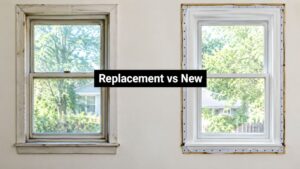

Most Boise double-pane window replacement projects land between roughly $600 and $1,200 per opening installed, and the reason they matter is simple: the Treasure Valley runs more than 5,000 heating degree days a year. If your January furnace runs constantly, rooms feel uneven, or an old window leaks cold air, the right replacement can improve comfort far more than another round of caulking.
A North End homeowner usually doesn't start searching for replacement windows because the glass looks dated. They notice the cold floor beside the bedroom wall, a furnace that seems unable to catch up, or frost forming on the inside of a west-facing window. Those symptoms point to a larger question: is the window losing heat through the glass, the frame, the perimeter seal, or all three?
This guide takes a practical Boise approach. It focuses on heating-season performance first, then west-facing solar gain, installation quality, operating style, cost, and the questions that separate a durable replacement from an attractive short-term fix.
Table of Contents
- Why Boise Homes Replace Windows in the First Place
- How Double-Pane Windows Actually Work
- Performance Numbers That Matter in the Treasure Valley
- The Replacement Project From Consultation to Install
- Cost, Energy Savings, and Realistic ROI
- Choosing the Right Window Style for Each Room
- How to Pick a Qualified Boise Window Installer
- Prep, Post-Install, and Homeowner FAQ
Why Boise Homes Replace Windows in the First Place
January exposes weak windows quickly. A homeowner may turn up the thermostat, add a rug, and re-caulk the trim, yet still feel a draft along the floor. In Boise, that discomfort isn't surprising. The Boise Air Terminal climate summary records 5,754 heating degree days annually at a 65°F base, while a nearby Boise 7 N station records 6,245 at the same base, according to the Western Regional Climate Center Boise climate summary.
That heating demand changes the replacement conversation. Boise homes need heat for a substantial part of the year, so a window that leaks air or transfers heat through an aging frame affects comfort during the season that matters most. The region's sharp swings, from winter cold near -10°F to summer heat above 100°F, also stress seals, frames, and weatherstripping. Canyon winds add another challenge, with gusts around 25 mph capable of finding every weak perimeter joint.
The warning signs homeowners tend to tolerate
Fogging between panes means the insulating glass seal has failed. Re-caulking won't restore the lost seal or refill the insulating space. A sash that sticks, a lock that no longer pulls the window tight, or a frame that feels cold to the touch also deserves more than cosmetic attention.
Common replacement triggers include:
- Persistent drafts: Cold air survives surface caulking because the leakage may be inside the frame or around the rough opening.
- Higher heating bills: Aging windows can add to the load placed on the furnace, particularly in rooms with several large openings.
- Interior frost or condensation: Cold glass and indoor moisture create a comfort and moisture-management problem.
- Faded furniture: Sun-exposed furnishings near foothills-facing or west-facing glass can lose color over time.
- Aging builder-grade units: Windows installed during the 1998 to 2008 building boom may lack the Low-E coatings, gas fills, and frame design available today.
Practical rule: Replace the window when the problem is structural, not merely when the caulk looks tired.
Window replacement is therefore a comfort, air-sealing, and resale decision. A new unit can improve how a room feels, reduce drafts, and modernize the home's exterior, but only if the glass package and installation address Boise's heating-heavy conditions. The cold floor in that North End bedroom is the starting point. The specification determines whether it stays cold.
How Double-Pane Windows Actually Work
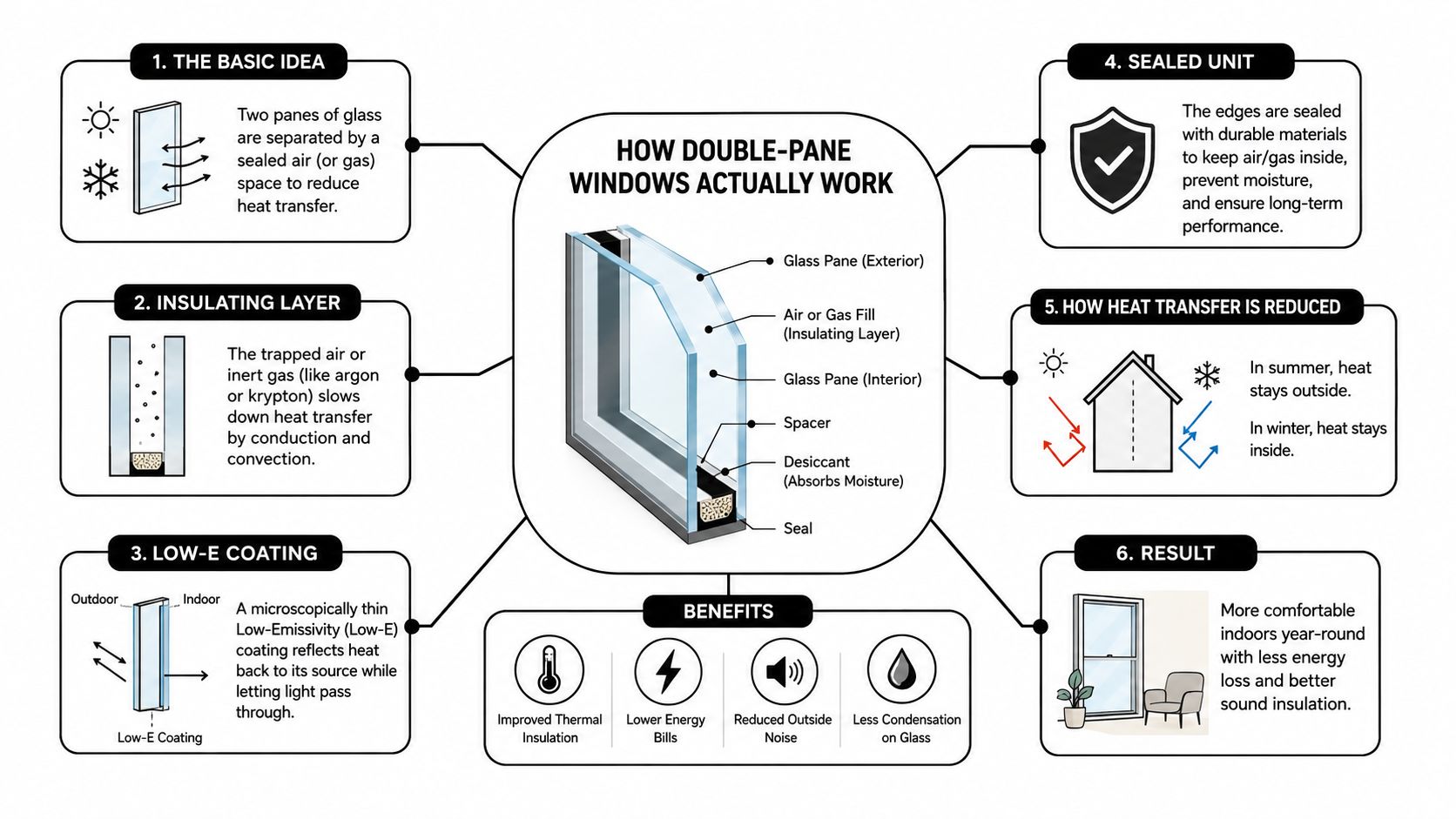
A double-pane window works like a thermos built into the wall. It uses two glass lites, a spacer around the perimeter, and a sealed insulating space between the panes. That sealed space slows heat transfer, while the frame holds the assembly square, supports the operating hardware, and connects the glass package to the home's air and water barrier.
The glass package and frame are separate parts of the performance equation. Vinyl, fiberglass, and clad-wood frames can produce different whole-window results even when they use similar insulated glass. Always ask for the rating of the complete window, not only the center-of-glass performance.
Three upgrades that earn their place
Low-E coating is a microscopically thin metallic layer applied to the glass. It reflects radiant heat toward the warmer side of the window, helping hold winter heat inside. A properly selected coating also limits solar heat gain during hot summer afternoons.
Argon or krypton fill replaces ordinary air inside the sealed unit. These gases are denser than air, so heat conducts through the cavity more slowly. For a Boise replacement, argon is often the sensible balance of performance and cost. Homeowners comparing gas-filled options can review this Idaho argon gas window guide before choosing a glass package.
Warm-edge spacers reduce heat loss around the glass perimeter. That edge is a common weak point, especially when an old spacer or seal has degraded. The spacer also helps maintain the insulated cavity and supports long-term seal integrity.
Triple-pane adds a third lite and another insulating cavity. It makes sense for a particularly cold room, a noisy exposure, or a homeowner prioritizing maximum insulation over a lighter, lower-cost unit. For many Boise openings, though, a well-built double-pane window with Low-E, argon, a capable frame, and careful installation delivers the better value.
Performance Numbers That Matter in the Treasure Valley
The label on a replacement window contains several ratings, but Boise homeowners should focus on four.
U-factor measures heat transfer through the complete window. Lower is better, and the ENERGY STAR window guidance notes that U-factor commonly ranges from 0.20 to 1.20. For most Treasure Valley homes, I recommend a whole-window U-factor at or below 0.30. ENERGY STAR's stricter Northern and North-Central criteria reach 0.27 or lower in the relevant bands.
Solar Heat Gain Coefficient, or SHGC, measures how much solar heat enters through the glass. Lower values reduce afternoon heat gain. For west-facing Boise rooms, a local Boise window replacement guide recommends 0.25 or lower, a useful target when July and August sun turns a bedroom or living room into a hot spot. South-facing glass also deserves careful selection, although the right value depends on shading and room use.
Air Leakage, or AL, indicates how much air passes through the operating assembly. Ask for a verified low rating, preferably below 0.2 cfm/ft², and pay equal attention to perimeter sealing during installation. Visible Transmittance, or VT, tells you how much visible daylight passes through. Choose enough VT for the room, but don't sacrifice winter performance just to maximize glass brightness.
A practical Boise comparison
| Window Type | U-Factor | SHGC | Air Leakage (cfm/ft²) | Best Use in Boise |
|---|---|---|---|---|
| Standard double-pane | Around 0.40 | Around 0.40 | Varies by product | Budget replacement where exposure is mild |
| Upgraded double-pane, Low-E plus argon | 0.20 to 0.30 | 0.25 to 0.40 | Under 0.2 preferred | Most Treasure Valley rooms |
| Triple-pane | Typically engineered below upgraded double-pane levels | Exposure-specific | Under 0.2 preferred | Cold rooms, noise-sensitive spaces, maximum efficiency |
The Boise energy-efficient window guide is useful for comparing full-window specifications rather than marketing labels. A code-minimum unit around U-0.40 and SHGC 0.40 may look acceptable on paper, but it leaves more conductive heat loss and west-facing solar gain to manage. Better ratings can reduce cold-floor sensation, limit temperature stratification, and make the furnace cycle less aggressively.
The Replacement Project From Consultation to Install
A professional replacement project has four working phases: consultation, measurement, manufacturing, and installation. The first visit should be more than a salesperson glancing at the glass and producing a quick quote.
During the in-home consultation, walk room by room. Point out drafts, fogging, hard-to-open sashes, and condensation. The installer should inspect frame condition, interior trim, sill condition, moisture around the opening, and the exterior cladding. Ask the installer to mark west-facing rooms and discuss whether those openings need a lower SHGC than the rest of the house.
Measurement comes before the order
Nominal window sizes aren't enough for older Boise homes. Rough openings can be out of square, especially after years of movement, remodeling, or moisture exposure. A careful measure verifies width, height, depth, sill condition, trim limitations, and the actual product dimensions before manufacturing begins.
Production typically runs two to four weeks after the measure. That timing can change with custom sizes, specialty colors, hardware, or a more complex installation, so get the expected schedule in writing.

Installation day should be controlled and clean
A standard retrofit averages 30 to 60 minutes per opening, while a whole-home project commonly finishes in one to two days, depending on the number of openings and the condition of the house. The crew should remove the old unit carefully, verify the opening, set the new window plumb and square, insulate the perimeter, seal the interior air barrier, and confirm drainage at the sill.
Before the crew arrives, clear furniture and decorations, remove window treatments, secure pets, and leave access to every opening. Have the lead installer review the first opening with you before the unit is permanently set. That simple check catches product, color, swing, and trim misunderstandings early.
Cost, Energy Savings, and Realistic ROI
The federal energy picture is meaningful but should be handled carefully. The U.S. Department of Energy says homes with single-pane or clear double-pane windows can see 10% to 30% year-round savings in annual heating and cooling energy use after upgrades, as reported in the DOE climate and energy material. Your result depends on the old window condition, air leakage, insulation, thermostat habits, and how many openings you replace.
For Boise homeowners, a practical planning range is $600 to $1,200 per opening installed. A full-home project often falls between $8,000 and $20,000, with size, frame material, trim work, glass package, and structural repairs driving the final quote. Those figures are planning anchors, not a substitute for a measured bid.
Consider a 1,800-square-foot home with fifteen openings. The homeowner might choose upgraded double-pane Low-E with argon throughout, reserve lower-SHGC glass for west-facing rooms, or pay more for triple-pane in the coldest or noisiest spaces. The right comparison isn't merely the cheapest window. It's the combination of winter comfort, installation quality, room exposure, and how long the homeowner expects to stay.
| Glass Package | Cost Per Opening | Estimated Annual Savings | Payback Window |
|---|---|---|---|
| Standard double-pane | $600 to $1,200 | Qualitatively lower | Longer |
| Low-E plus argon double-pane | Above standard package | Qualitatively stronger | Moderate |
| Triple-pane | Highest of the three packages | Qualitatively strongest in suitable rooms | Potentially longer upfront payback |
The DOE's savings range applies to annual heating and cooling use, not a guaranteed utility-bill reduction. In a heating-heavy climate, comfort often arrives before pure energy payback. A homeowner may value fewer drafts, more even room temperatures, less furnace runtime, and quieter bedrooms even when the utility-only return takes 12 to 25 years.
The federal 25C tax credit may also be relevant for eligible 2026 projects, but confirm current qualification, product certification, and installation requirements before counting it in the budget. Don't choose a weaker window solely to chase a tax benefit. Start with the U-factor, SHGC, air leakage, and installation details.
Choosing the Right Window Style for Each Room
Window style changes more than appearance. It affects ventilation, locking pressure, cleanability, frame-to-glass ratio, and the amount of operating hardware exposed to weather. In Boise subdivisions from the North End to Meridian and Eagle, the best choice usually follows the room's job.
| Style | Best Treasure Valley Room | Ventilation | Seal Performance |
|---|---|---|---|
| Double-hung | Bedrooms and traditional living spaces | Flexible, top and bottom sash | Good when properly adjusted |
| Casement | Kitchens and bathrooms | Strong directional airflow | Usually very tight when closed |
| Picture | West-facing living rooms and view walls | None | Excellent because it doesn't operate |
| Sliding | Wide openings, kitchens, and basements | Broad horizontal opening | Practical, but hardware and sash fit matter |
Double-hung windows remain the dependable bedroom default. Both sashes can move, and tilt-in cleaning is convenient where access is difficult. They suit older Boise homes and newer subdivision designs without forcing a major style change.
Casements work especially well over a kitchen sink or in a bathroom. The sash presses against the weatherseal when closed, and the crank operation gives you useful ventilation without lifting a heavy sash.
A picture window is the right tool when the view and insulation matter more than ventilation. West-facing living rooms benefit from a fixed unit with a carefully selected low SHGC. If the room still needs airflow, pair the picture unit with a smaller casement or awning instead of making the entire glass wall operable.
Sliders fit wide openings where swing clearance is limited, including spaces above counters and some basement layouts. For tall west-facing glass, I prefer a fixed picture unit with smaller operable sections. That arrangement reduces the amount of moving hardware and improves the comfort balance without giving up ventilation completely.
How to Pick a Qualified Boise Window Installer
The installer determines whether the window's laboratory rating survives contact with your wall. Start with credentials, then move to the proposal details.
Ask for proof of an Idaho Public Works contractor license and active Boise business registration. Request factory-training documentation for the specific brand being sold, whether that's Milgard, Ply Gem, Anlin, Marvin, Andersen, or another manufacturer. A company may have experience installing windows generally, but you want confidence with the exact product, flashing method, and warranty requirements.
Demand a bid you can audit
An itemized proposal should separate:
- Window units: Brand, series, frame material, glass package, U-factor, SHGC, and operating style.
- Installation labor: Removal, setting, shimming, insulation, air-sealing, flashing, and testing.
- Trim and finish work: Interior casing, exterior trim, sill extensions, paint, and drywall repair.
- Removal and disposal: Old windows, debris haul-away, and final cleanup.
- Structural repairs: Any rot, damaged framing, stucco work, or opening correction.
Get the warranty packet before signing. Glass, seal failure, frame, hardware, and labor may have different terms. Check whether labor coverage transfers to a future owner, especially if resale is part of your plan. Discuss financing before the final quote, not after the contract, so the monthly payment and total obligation remain clear.
Good installers don't hide the rough opening. They show you what they found, explain what the contract includes, and identify repairs before the first window comes out.
Ask who will measure and who will install. A salesperson who takes the measurement may not be the person leading the crew. Request local references in Boise, Meridian, or Eagle, and favor references you can verify over glossy brochures. C & C Windows & Doors publishes its approach to evaluating contractors in this Boise window company selection guide.
Walk away from door-to-door pressure, same-day decision demands, cash-only discounts, vague “lifetime” promises, and companies without a local address. A credible installer can show completed projects, explain the product warranty, and tell you how the crew handles out-of-square openings.
Prep, Post-Install, and Homeowner FAQ
Preparation prevents damage and keeps the crew moving. The day before installation, move breakables away from each opening and clear a 3-foot work zone inside the room. Remove blinds and curtains, plan for pets, identify security concerns, and decide whether you'll need a temporary window-covering solution overnight.
During installation, meet the lead installer at the first opening. Confirm the rough opening dimensions, operating direction, glass package, and interior finish before the unit is secured. Photograph each opening before removal and after completion. Photos give you a useful record for warranty questions and future remodeling.
The first days after installation
Leave the protective film in place for 7 to 10 days, unless the manufacturer provides different instructions. Avoid ammonia-based glass cleaners for 30 days. Test every sash, lock, screen, and crank within 48 hours. If a sash sticks, a lock fails to pull tight, or fogging appears between panes, notify the installer or manufacturer warranty contact immediately.
A six-month visual check is smart. Look at exterior sealant, weatherstripping, drainage paths, and the glass perimeter. Store the warranty packet with your closing documents rather than leaving it in the installation debris.
Three Boise homeowner questions
Do vinyl frames handle Boise winters? Yes. Quality vinyl frames are suitable for Boise's winter conditions and resist moisture and UV exposure better than unprotected wood. The whole-window rating and installation still matter more than the material label alone.
How long does whole-home replacement take? Plan for two to four days, depending on the siding type and project complexity. Stucco generally demands more careful exterior work than wood siding.
Is a permit required? Installers usually handle permitting under Boise's residential replacement rules, but confirm the responsibility before work begins. Put the answer in the contract so there's no confusion about inspection or closeout requirements.
For a Boise replacement, the next step should be a measured evaluation, not an online guess. Have an installer inspect the coldest rooms, identify west-facing exposure, and quote the complete window assembly with installation included.
C & C Windows & Doors provides free in-home consultations, custom measurements, and locally installed double-pane replacement windows for Boise and Treasure Valley homes. Visit C & C Windows & Doors to schedule an evaluation focused on U-factor, west-facing SHGC, air-sealing, and the installation details your home needs.