
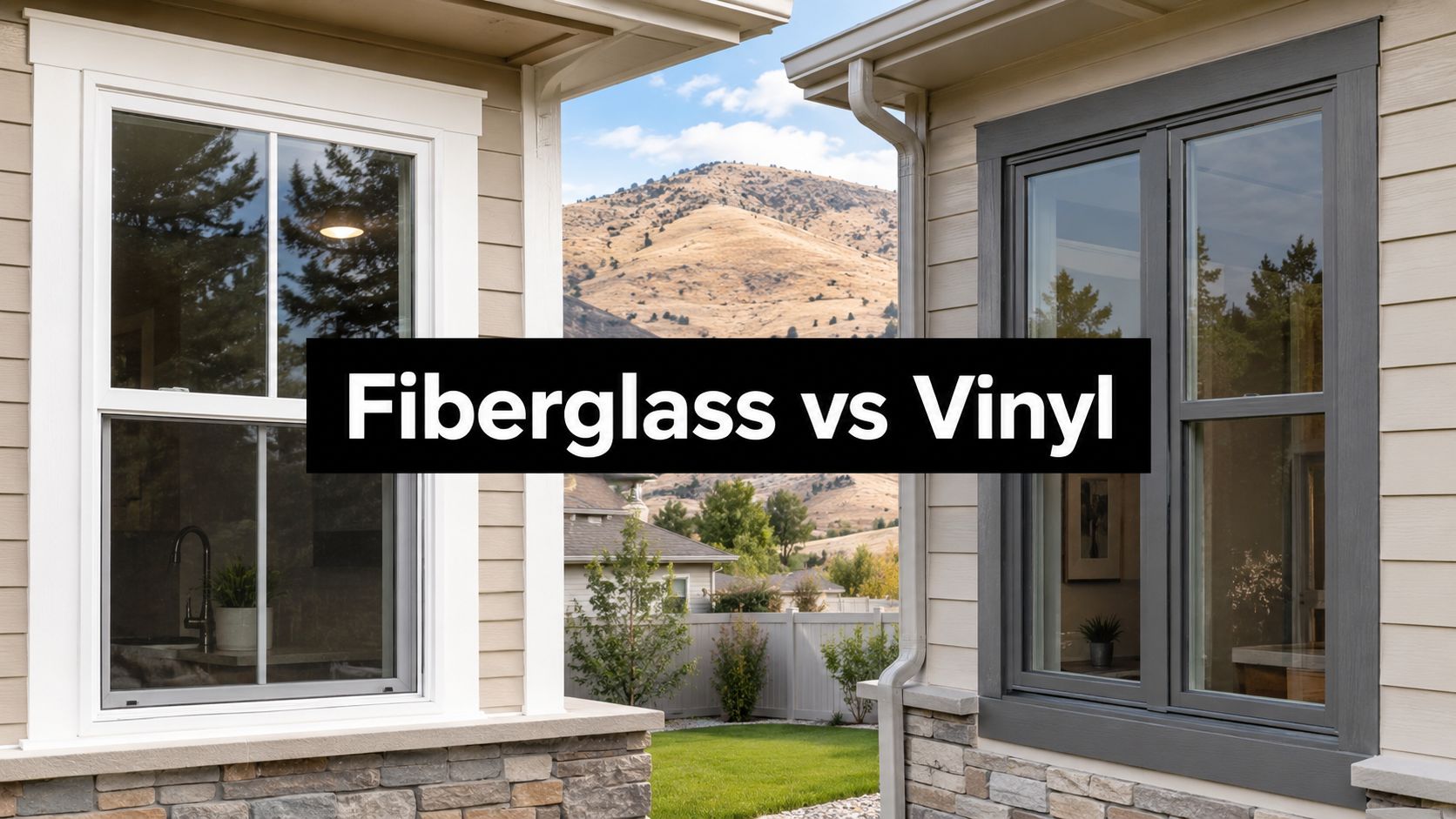
Most Idaho window advice starts with a verdict: fiberglass is superior, vinyl is cheaper, so choose based on your budget. That's too blunt for the Treasure Valley. The frame matters, but the glass package, whole-window rating, installation, orientation, and how long you'll own the house usually matter more.
For Boise, Meridian, Eagle, Nampa, Caldwell, Kuna, Garden City, and Star homeowners, the useful question is not "fiberglass or vinyl?" It's which complete window meets the home's climate and exposure requirements without paying for performance you won't use. A well-built premium vinyl window with the right Low-E glass can be a smarter purchase than an entry-level fiberglass unit. A carefully specified fiberglass window can be the better long-term choice for large west-facing openings or a forever home.
This guide gives you the practical answer, including a comparison table early, a cost and lifespan analysis, three homeowner scenarios, and a final checklist you can take into an in-home consultation.
Table of Contents
- Why the Fiberglass vs Vinyl Question Is the Wrong One for Idaho
- Energy Performance Basics Treasure Valley Buyers Must Understand
- Fiberglass vs Vinyl Side by Side in Idaho Conditions
- Cost, Lifespan, and the Breakeven Calculation
- Three Treasure Valley Homeowner Scenarios
- Installation Quality, Warranties, and Code Compliance
- The Treasure Valley Window Decision Checklist
- Frequently Asked Questions From Treasure Valley Homeowners
Why the Fiberglass vs Vinyl Question Is the Wrong One for Idaho
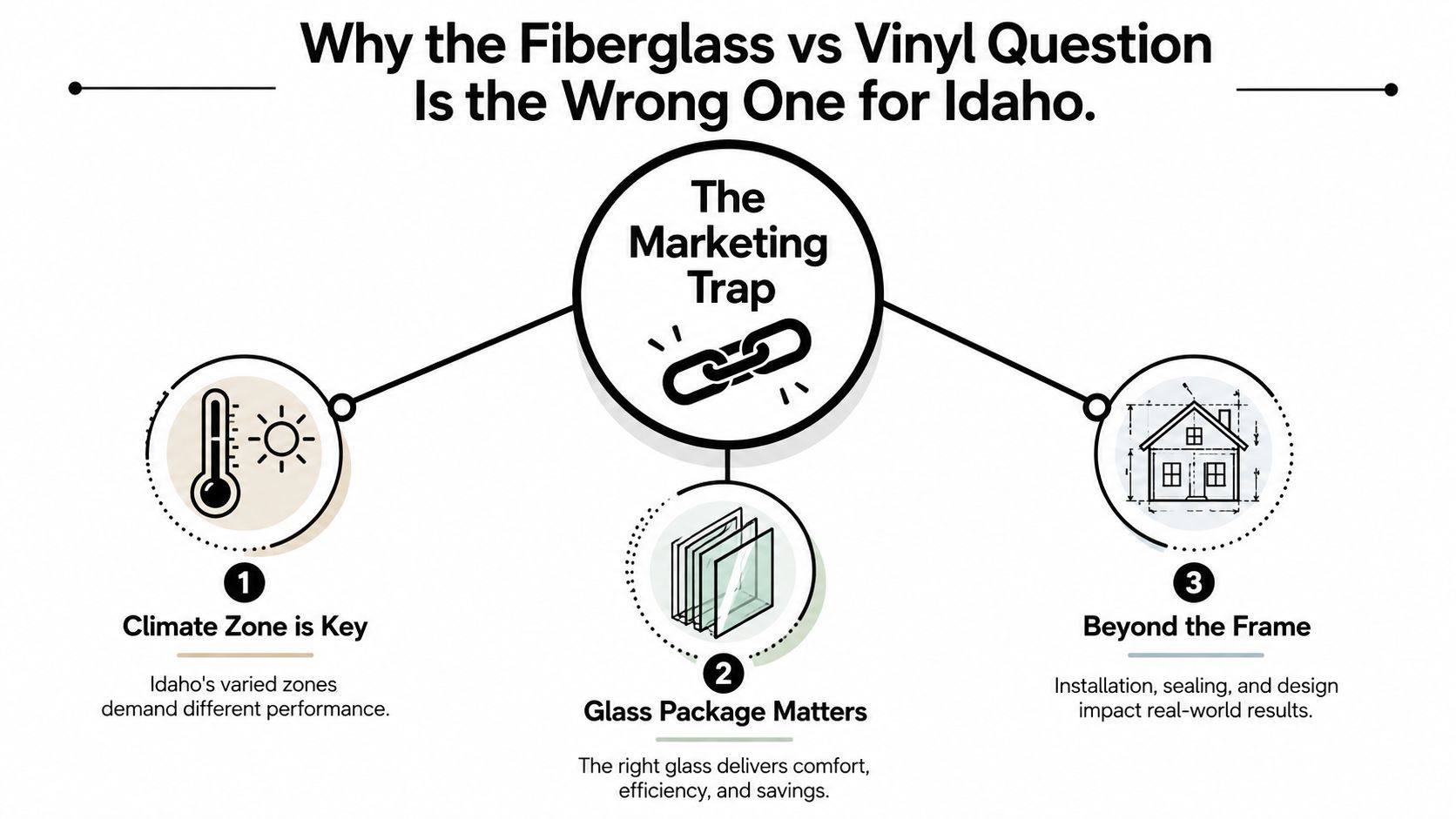
Fiberglass versus vinyl is the wrong starting point for most Idaho homeowners. The frame label does not tell you how the complete window will handle winter cold, summer sun, air leakage, or installation conditions.
Idaho spans multiple climate zones, so the performance target changes with location. ENERGY STAR Version 7.0 sets climate-specific requirements, including a U-factor of 0.30 or lower for much of Idaho's southern area and 0.27 or lower in colder northern areas, as noted earlier. Idaho code guidance also evaluates area-weighted whole-window U-factor and SHGC, rather than judging the frame material alone, according to the Idaho residential energy code guidance.
Treasure Valley buyers should compare the finished unit. Glass, spacers, sash construction, and installation can determine whether a window performs as promised. A premium vinyl window with well-selected glazing can outperform a poorly specified fiberglass unit. Fiberglass earns its premium when the opening is large, exposed, or expected to serve the home for decades.
Start with the window, not the frame
Request the exact NFRC label for the proposed product. Compare its U-factor, SHGC, visible transmittance, and air leakage, then match the glass package to the room's direction, use, and climate exposure.
A shaded north-facing bedroom has different needs from a west-facing living room that takes afternoon sun. A large picture window also places greater structural demands on the frame than a small bathroom window. Your ownership timeline matters too. A long-term homeowner may value dimensional stability more than someone preparing the property for resale.
Practical rule: Compare complete, certified window assemblies first. Choose the frame material second.
For Idaho, the clear verdict is simple: specify the climate zone, orientation, glass package, and installation first. Choose fiberglass or vinyl only after those decisions are settled.
Energy Performance Basics Treasure Valley Buyers Must Understand
The NFRC label deserves your attention before frame color, grids, or brand names. It shows how the complete window assembly handles heat, sunlight, daylight, and air movement. Ask for the exact label for the proposed unit, not a brochure describing a product family.
The four numbers on the label
| Metric | Good | Better | Best | North-Central ENERGY STAR 7.0 |
|---|---|---|---|---|
| U-factor | 0.30 or lower | 0.27 or lower | 0.25 or lower | 0.25 or lower |
| SHGC | 0.40 or lower | 0.35 or lower | 0.30 or lower | 0.40 or lower |
| Visible transmittance | Balanced for the room | Higher daylight with solar control | Selected by orientation | Product-specific |
| Air leakage | 0.30 cfm/ft² or lower | Lower than 0.30 cfm/ft² | Lowest tested rating available | Product-specific |
The North-Central threshold shown above calls for a U-factor of 0.25 or lower and an SHGC of 0.40 or lower. Use those values as a comparison framework, then confirm the exact product label. Requirements and performance can vary with location and product configuration.
U-factor measures heat transfer through the whole window. Lower is better for winter comfort. SHGC measures solar heat entering through the glass. A lower SHGC helps limit unwanted afternoon heat in west-facing rooms. A higher value can make sense for a carefully shaded opening that benefits from winter sun.
Visible transmittance shows how much daylight passes through the glazing. Air leakage shows how much air passes through the tested assembly. A strong U-factor will not prevent drafts if installation leaves gaps around the frame.
How Low-E and gas fills affect the result
Low-E coatings manage radiant heat through the glass. Depending on the design, they help retain indoor heat during winter and reduce unwanted solar gain during summer. Soft-coat Low-E generally supports stronger insulating performance, while hard-coat Low-E suits certain applications where added durability matters. Have the installer identify the coating and connect it to the room's orientation.
Argon fills create an insulating space between panes. Krypton appears in some premium assemblies, but it is uncommon and rarely justifies extra cost for a typical Treasure Valley replacement without a specific design reason.
Double-pane Low-E glass with argon can substantially outperform older Idaho windows. Triple-pane glass can improve insulation, comfort, and sound control, but the added cost belongs on rooms where those benefits matter, not automatically on every opening.
For selection guidance by Idaho climate and window type, read this Idaho energy-efficient window guide.
If the glass package is wrong, the frame choice won't save you.
Fiberglass vs Vinyl Side by Side in Idaho Conditions
Fiberglass and vinyl behave differently under the temperature swings common across southern Idaho. The difference becomes more noticeable in large openings, dark exterior colors, direct sun, and homes where the owner expects the windows to remain in service for decades.
| Factor | Fiberglass | Vinyl | Idaho Edge |
|---|---|---|---|
| Thermal movement | Low expansion and strong dimensional stability | Moves more with temperature changes | Fiberglass |
| Initial cost | Higher installed price | Lower installed price | Vinyl |
| Typical service life | Around 40 to 50 years | Roughly 20 to 40 years, depending on grade and conditions | Fiberglass |
| Insulating potential | Commonly lower whole-frame U-factors in premium designs | Strong performance with quality multi-chamber construction | Fiberglass, with a smaller gap in premium vinyl |
| Exterior finish | Can be painted or factory-finished in more premium systems | Low maintenance, but finish options vary | Fiberglass |
| Large units | Strong frame supports larger glazed areas | Good options, but design limits vary | Fiberglass |
| Maintenance | Low | Very low | Vinyl |
| Best value use | Long ownership, large exposures, premium remodels | Budget control, shorter ownership, standard openings | Depends on the home |
Thermal movement is the Idaho-specific difference
Fiberglass has a much lower coefficient of thermal expansion than vinyl and tracks the movement of glass more closely. One technical comparison cites fiberglass at approximately 8.5 × 10^-6/°C, compared with vinyl at roughly 3.33 × 10^-5 in/in per °F. The same comparison notes that a 10-foot vinyl frame can move as much as a quarter inch across seasonal swings, as described in this technical window-frame comparison.
That movement matters most when a window sees direct afternoon sun, large temperature changes, or repeated freeze-thaw stress. A west-facing opening in Eagle or a wind-exposed home in Nampa may benefit from fiberglass's stability. A shaded bedroom with a moderate-sized opening may not justify the added expense.
Where each material earns its place
Fiberglass is the stronger choice for large operable windows, dark exterior finishes, broad west-facing openings, and long ownership timelines. Its rigidity also supports narrow sightlines and premium architectural proportions.
Vinyl wins on initial affordability and installer familiarity. Quality multi-chamber vinyl can provide strong insulation, and many Treasure Valley crews have extensive experience installing it. The quality range is wide, though. Reinforced premium vinyl and entry-level vinyl shouldn't be treated as the same product.
Neutral technical comparisons commonly place premium fiberglass whole-window U-factors around 0.15 to 0.25, while quality multi-chamber vinyl often falls around 0.27 to 0.32, according to this fiberglass and vinyl performance comparison. Specific results depend on the sash, glazing, spacer, and size.
In matched glass packages, the frame material usually decides comfort at the edges, long-term appearance, structural feel, and durability more than it decides the energy bill.
Cost, Lifespan, and the Breakeven Calculation
Fiberglass costs more upfront. Idaho homeowners should evaluate that premium against window size, sun exposure, and the time they expect to own the house, not assume energy savings will repay it automatically.
Installed vinyl windows commonly fall around $300 to $800 per window, while fiberglass commonly falls around $500 to $1,500 per window, according to this frame-material cost and lifespan comparison. Size, style, glass, trim, siding, access, and installation conditions can change the quote substantially. A per-window range is a planning tool, not a bid.
| Cost Factor | Vinyl, Premium | Fiberglass |
|---|---|---|
| Typical installed range | About $300 to $800 per window | About $500 to $1,500 per window |
| Typical lifespan | Roughly 20 to 40 years | Around 40 to 50 years |
| Upfront cost | Lower | Higher |
| Replacement risk during long ownership | More likely within a long ownership period | Less likely during the same period |
| Best financial fit | Shorter ownership or tight initial budget | Long ownership and durability-focused projects |
For a 1,800-square-foot home with 15 windows, the lower end of those documented ranges produces a starting project cost of $4,500 for vinyl and $7,500 for fiberglass. At the upper end, the totals reach $12,000 for vinyl and $22,500 for fiberglass, before project-specific complications. These figures use published per-window ranges rather than a local bid.
What the lifespan changes
Fiberglass typically remains in service for 40 to 50 years, compared with vinyl at approximately 20 to 40 years, depending on grade and conditions, according to the same window material comparison. That range does not predict the life of every unit. It shows why replacement risk differs between the materials.
A homeowner planning to sell within a few years may not recover fiberglass's higher entry cost. Quality vinyl with the right glass package is usually the better financial choice for a shorter ownership timeline, especially in a moderate-exposure opening.
Long-term owners have a stronger case for fiberglass when large west-facing windows, dark exterior colors, or repeated seasonal movement place more stress on the frame. The benefit is durability and reduced replacement risk, not a guaranteed reduction in utility bills.
The claimed breakeven point of years 18 to 22 should not be treated as a universal Idaho calculation. A responsible estimate requires documented energy modeling, actual bids, current utility rates, and a defined replacement scenario. Existing window condition, heating system, air leakage, glass package, and installation quality all affect the result.
For a fuller service-life discussion, review this Idaho replacement-window lifespan guide. For most Treasure Valley projects, choose vinyl for a tighter budget or shorter ownership plan. Choose fiberglass when the opening is large, the exposure is demanding, and avoiding another replacement matters more than the initial premium.
Three Treasure Valley Homeowner Scenarios
The same product comparison can produce three different correct answers. The address, window exposure, and ownership plan change the recommendation.
The stay-forever Meridian owner
A homeowner in a 1990s Meridian house has broad west-facing windows in the family room. Afternoon sun heats the room, and the homeowner plans to stay long term. The right move is premium fiberglass with a carefully selected Low-E glass package, potentially triple-pane if the structure, budget, and performance goals support it.
The reason isn't that fiberglass magically solves solar gain. The glass must control SHGC, and the installation must seal the opening correctly. Fiberglass earns the premium because the large frame will face direct sun and repeated seasonal movement for many years.
Recommendation: Choose fiberglass when the opening is large, the exposure is harsh, and the ownership timeline is long.
The Caldwell or Nampa budget remodel
A buyer is improving a starter home and expects to sell within several years. The project needs better comfort and curb appeal without pushing the budget into a premium category. High-quality vinyl with Low-E glass and argon is the practical answer.
The buyer should still demand a complete NFRC label, a credible air-leakage rating, and documented installation details. A well-specified vinyl unit can meet the needed performance class without charging the homeowner for fiberglass longevity they may never use.
Recommendation: Choose premium vinyl when the budget is controlled, openings are conventional, and resale is closer than long-term occupancy.
The Foothills performance-focused build
A homeowner building near the Boise Foothills wants low U-factor performance, reduced outdoor noise, and larger glazed areas. Here, fiberglass deserves serious consideration because its structural strength can support large designs with a refined frame profile.
Triple-pane glazing, laminated options where appropriate, gas fill, spacer design, and professional installation still drive the result. Fiberglass is the better frame platform for this premium brief, but the buyer shouldn't approve it without reviewing the whole-unit rating.
Recommendation: Choose fiberglass for a high-performance build when large glass areas, structural rigidity, and long-term finish quality justify the premium.
Installation Quality, Warranties, and Code Compliance
A strong window can underperform when the installer misses the opening preparation. Idaho's code requires windows, skylights, and sliding glass doors to meet an air-infiltration limit of 0.3 cfm per square foot or less, tested under recognized standards and supported by manufacturer labeling, according to the Idaho air-infiltration code language.
Whole-window ratings remain central. The 2023 Idaho residential energy code summary lists fenestration U-factors of 0.32 on one code path and 0.30 on another, showing the direction of code requirements toward lower heat transfer, as documented in the 2023 Idaho code summary.
Inspect the installation method
Ask how the crew will integrate the replacement with the existing wall assembly. Stucco, brick, and lap siding each create different flashing and trim conditions. The installer should explain sill protection, side flashing, head flashing, shimming, backer rod, sealant, and interior air sealing in language you understand.
A proper installation should also address drainage. True sloped sills, correctly placed flashing, and sealed transitions help move water out rather than trapping it behind the replacement unit.
Collect these documents before signing:
- Exact product label: Confirm U-factor, SHGC, visible transmittance, and air leakage.
- Written scope: Identify full-frame or insert work, trim, flashing, disposal, and interior repair.
- Warranty terms: Separate manufacturer coverage from labor coverage, and check transfer rules.
- Glass exclusions: Ask whether seal failure, accidental breakage, grids, and hardware have different terms.
- Payment and change-order policy: Require added work to be documented before it begins.
For questions to ask a local installer, use this guide to choosing a window company in Boise.
Ask the crew lead three questions on installation day:
- How will you protect and flash this opening?
- Where will you place the interior and exterior air seals?
- What will you test or inspect before the trim goes back?
The Treasure Valley Window Decision Checklist
Use this checklist during an in-home consultation. It keeps the decision tied to the home instead of the salesperson's preferred frame material.
1. Identify the exposure and climate conditions
Start with the room, not the brochure. North-facing windows generally prioritize heat retention and low U-factor. West-facing windows need careful solar-gain control because afternoon sun can create overheating and glare. A colder Boise Bench location or a more exposed property may justify a higher performance package than a sheltered opening in another part of the valley.
2. Match the glass to the opening
Ask whether the proposed unit uses Low-E glass, argon fill, and a spacer system suited to the target performance. Compare whole-window U-factor and SHGC, not center-of-glass numbers. For a premium project, evaluate triple-pane glass where comfort, sound control, and long ownership justify the cost.
3. Choose the frame by the actual stress
Choose fiberglass when the home has large openings, strong western exposure, dark finishes, demanding architectural proportions, or a long ownership plan. Choose premium vinyl when the openings are conventional, the budget matters, and the complete unit already meets the required performance target.
Decision test: If two products have the same certified glass performance, pay for fiberglass only when its stability, strength, finish, or lifespan solves a problem in your home.
4. Set the budget tier before comparing brands
A premium vinyl unit can be a better purchase than budget fiberglass if it offers stronger glazing, better air control, and a more reliable installation. Conversely, a premium fiberglass system may earn its price in a large remodel where replacing the windows again would be disruptive.
5. Filter the choice through your timeline
If you expect to stay ten or more years, examine fiberglass's long service life and dimensional stability closely. If you expect to sell within five years, prioritize visible condition, reliable operation, whole-unit energy ratings, and a warranty that supports the resale story. Don't pay for decades of frame longevity if you won't own the property long enough to benefit.
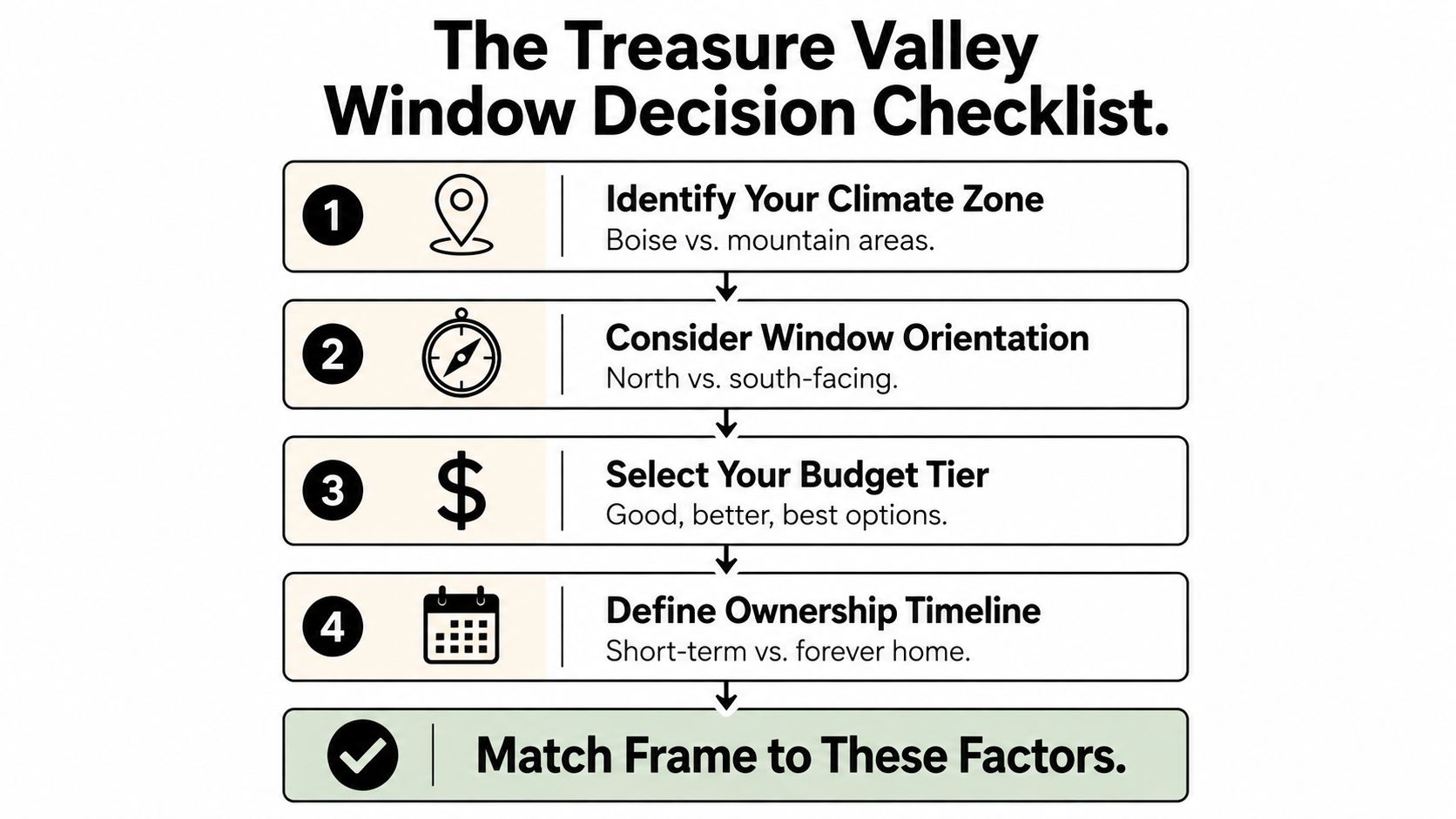
Bring the checklist, the NFRC labels, and the written warranty to every consultation. The right answer should become narrower as the installer accounts for orientation, opening size, climate conditions, and your ownership plan.
Frequently Asked Questions From Treasure Valley Homeowners
Do fiberglass windows add more resale value in Boise?
Not automatically. Buyers notice clean operation, quiet rooms, good appearance, fewer drafts, and a credible installation record. Fiberglass can support a premium remodel, especially with large openings and a refined finish, but a high-quality vinyl window with stronger glass performance may create a better value story than a cheaper fiberglass product.
Resale value comes from the complete project. Keep the product labels, warranty, invoice, and installation scope so the next buyer can verify what was installed.
Will either material block traffic noise near I-84 or the airport?
Frame material alone won't deliver a reliable noise result. Glass thickness, laminated glass, airspace, sash design, and installation sealing play the central roles. A replacement window can make a room feel quieter, but no standard window should be sold as a complete solution for every aircraft, freeway, or river-corridor sound.
Ask the installer to specify the acoustic glass configuration rather than promising a generic noise reduction result. Compare the complete assembly and pay attention to gaps around the window.
Is triple-pane glass worth the upgrade?
Triple-pane makes the most sense when winter comfort, low U-factor performance, or sound control matters enough to justify the added project cost. It can be especially appropriate for a long-term owner, a large exposed opening, or a performance-focused new build.
A well-built double-pane Low-E unit with argon can still be the smarter value for a shorter ownership timeline or a home with moderate exposure. Compare certified whole-window ratings and the actual installed price. The extra pane should solve a defined problem, not just make the proposal sound more advanced.
Can premium vinyl beat budget fiberglass?
Yes. This is the answer many material-first comparisons avoid. Premium vinyl can be the better purchase when it includes a stronger glass package, lower whole-window U-factor, dependable air control, and a capable installation team. Fiberglass is not a substitute for poor glazing or careless flashing.
For a homeowner comparing a premium vinyl line with a budget fiberglass product, judge the NFRC label, construction, warranty, hardware, and installation scope in that order. In Idaho, the complete certified window matters more than the word printed on the frame.
C & C Windows & Doors provides custom measurements, energy-focused window and patio-door options, Low-E and argon packages, optional triple-pane glass, and installation services across the Treasure Valley. Visit C & C Windows & Doors to request a consultation and compare fiberglass and vinyl options against your home's orientation, budget, and ownership timeline.