
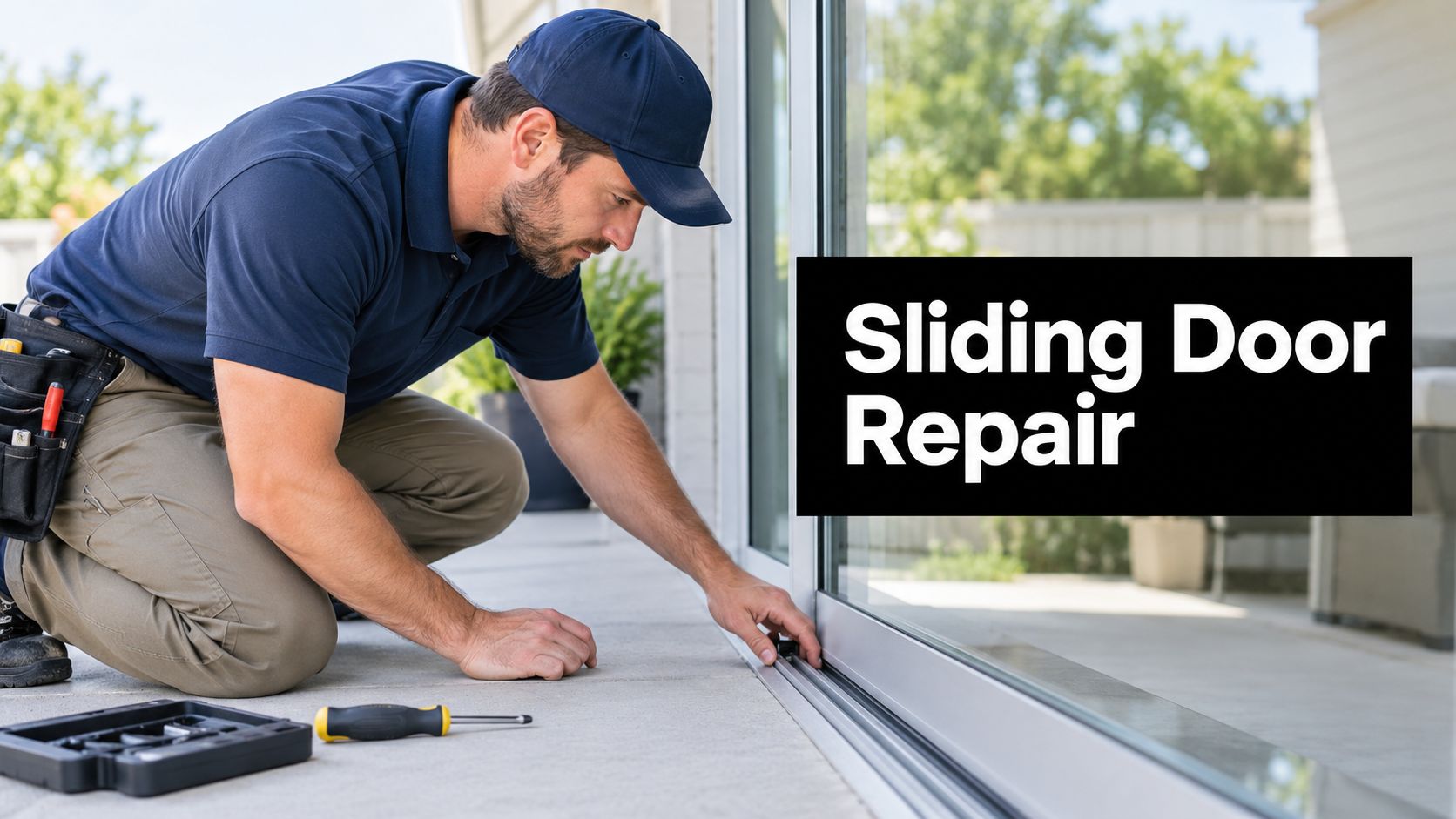
Most Meridian sliding glass door repairs land between $150 and $800, with the average job around $400, and rollers, tracks, and locks are almost always repairable in a single visit. A Meridian homeowner usually doesn't need a new patio door just because it grinds, sticks, leaks air, or won't latch.
The trouble often starts on a cold January morning. You slide the door open to let the dog out, hear a gritty crunch from the lower track, and then have to shoulder the panel closed against a Treasure Valley wind. Or the handle moves, the latch doesn't catch, and a narrow draft slips through the meeting stile.
These problems rarely arrive overnight. Worn rollers, packed dirt, damaged seals, swollen weatherstripping, and tired lock mechanisms usually become noticeable only after they've been working poorly for a while. After diagnosing hundreds of patio doors around Meridian, I've found that the useful question isn't, “Can this door be fixed?” It's, “Which part has failed, and is the rest of the door still worth saving?”
Table of Contents
- When Your Meridian Patio Door Stops Cooperating
- The Five Usual Suspects Behind a Sliding Glass Door Problem
- A Same-Day DIY Triage Before You Schedule Service
- Repair vs Replacement for Meridian Homeowners
- Why a Local Treasure Valley Team Makes the Difference
- What Happens During a Professional Repair Visit
- Meridian Sliding Glass Door Questions Worth Answering
When Your Meridian Patio Door Stops Cooperating
A homeowner in northwest Meridian recently described the familiar sequence. The patio door had become harder to move over several weeks, but it still opened, so the family kept using it. Then a winter wind arrived. The panel dragged across the sill, the lock missed its receiver, and the door sat partly open until someone forced it into position.
That pattern points to a decision rather than an emergency replacement. A technician first separates an operating problem from a glass or frame problem. If the panel rolls badly but the frame is square and the glass is intact, rollers, track work, or adjustment usually solve it. If the insulated glass is fogged, the frame is distorted, or the panel cannot maintain a seal, the conversation changes.
The practical cost question
A $150 to $800 repair range, with an average around $400, is reported in a 2026 sliding glass door repair cost survey. That range covers the ordinary service decisions homeowners face, including roller replacement, track correction, lock work, and seal-related repairs. Full replacement commonly costs $800 to $2,500 or more, according to the same cost reference.
Rollers, tracks, and locks are generally single-visit repairs when the correct parts are available. Glass replacement is different. A failed insulated glass unit may need measuring and ordering before installation, while a complicated repair can require more on-site time. A Meridian service call should identify that difference before anyone removes the door.
Practical rule: If the door is difficult to move but the glass and frame look sound, start with repair. If the door is difficult to move and also fogged, cracked, warped, or impossible to seal, price both repair and replacement.
This guide gives you a same-day way to narrow down the problem. You'll know when a nylon brush and vacuum are enough, when adjustment is unlikely to help, and when the sensible next step is a professional inspection.
The Five Usual Suspects Behind a Sliding Glass Door Problem
Most patio-door failures fall into five areas. Each produces a different symptom, and that symptom often tells you whether the job belongs in the repair category or needs a measured replacement decision.
| Failure Point | Symptom Homeowner Notices | Typical Meridian Cause | Repair or Replace? |
|---|---|---|---|
| Rollers | Grinding, dragging, uneven movement | Worn wheels, seized bearings, or flat spots | Usually repair |
| Tracks | Scraping, resistance, visible grooves or bends | Grit, pet hair, standing water, or damaged aluminum | Clean or repair, replace only when badly damaged |
| Glass | Cracks, cold surface, or fog between panes | Impact, thermal stress, or failed insulated seal | Glass replacement may be required |
| Weatherstripping | Drafts, rattling, or visible daylight | Brittle pile, torn fins, or compressed seals | Usually repair |
| Locks and handles | Handle moves without latching, loose grip, failed deadbolt | Worn mortise parts, stripped hardware, or misalignment | Usually repair |
Rollers and tracks carry the operating load
The lower rollers take the weight of the moving panel. When bearings become contaminated or a wheel develops a flat spot, the door feels heavy and makes a gritty sound. Replacement assemblies may use steel housings, permanently lubricated ball bearings, and corrosion-resistant finishes. Some heavy-duty assemblies are rated to support up to 500 pounds per door with two rollers, as shown in this patio-door roller assembly specification.
A dragging panel can also point to an out-of-plane track. Adjustment screws can raise or lower a wheel, but they won't restore a damaged wheel profile or a track edge that has been bent. Meridian dust, pet hair, and moisture make that lower channel especially important to inspect.
Glass and seals require a different diagnosis
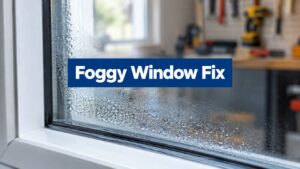
Fog between panes isn't dirt trapped on the surface. It usually means the insulated glass seal has failed, which places the job in a glass replacement category rather than a roller or lock repair. This sliding glass door repair guide distinguishes fogged insulated glass from ordinary operating problems.
Weatherstripping can often be refreshed without replacing the panel. A brittle pile seal or torn fin allows air movement even when the door rolls smoothly. The lock and handle may also be serviceable, but a latch that misses because the frame has shifted needs more than a new handle.
A Same-Day DIY Triage Before You Schedule Service
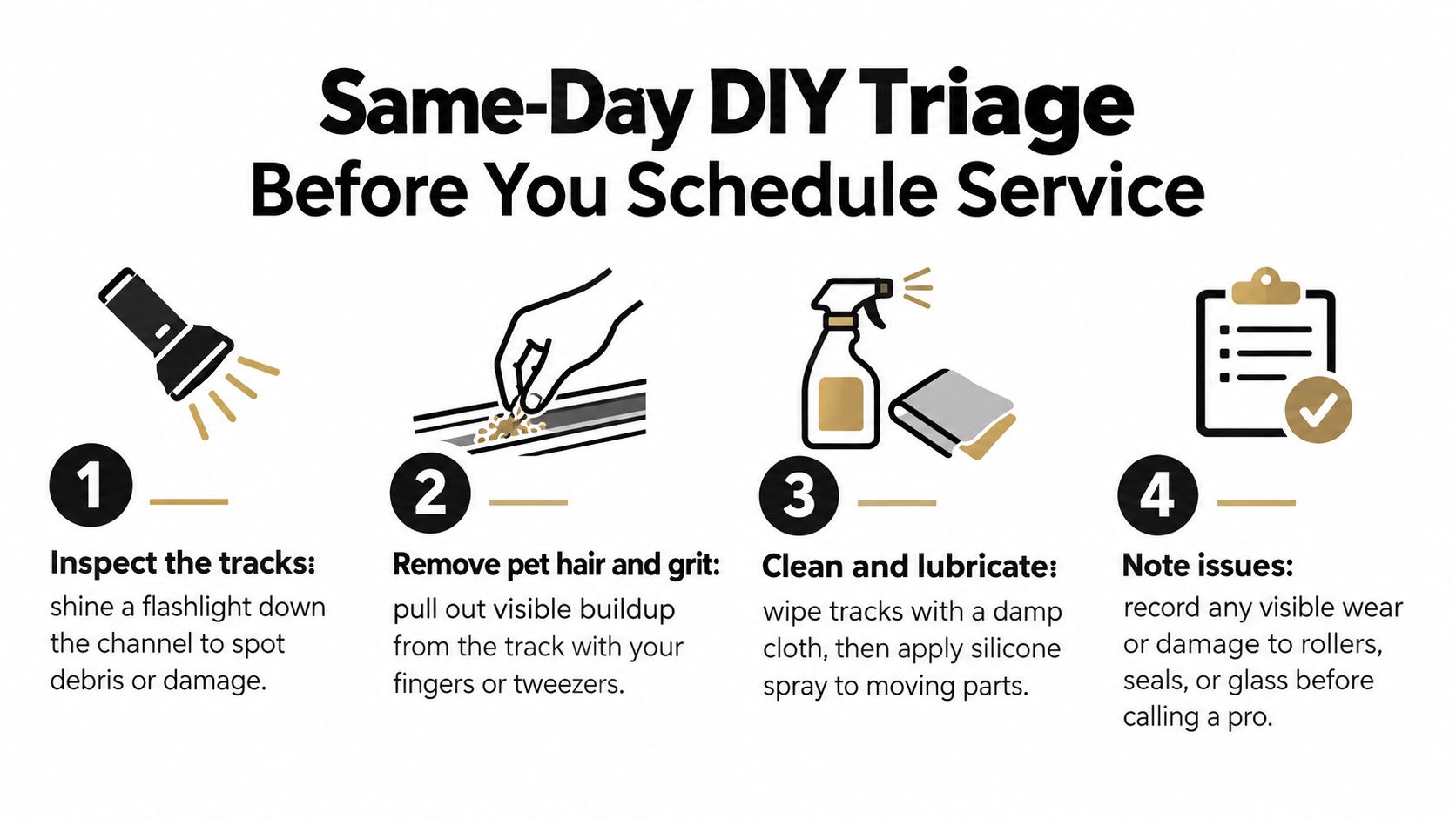
Start with the track, not the adjustment screws. Put on gloves, open the panel as far as it will go, and use a flashlight to inspect the entire lower channel. Look for grit, pet hair, small stones, paint buildup, standing water, and sharp sections of bent aluminum.
Pull out loose debris with your fingers or tweezers, use a stiff nylon brush on packed dirt, and vacuum the corners. Wipe the channel with a damp cloth, let it dry, then use a silicone spray intended for moving door components. Avoid forcing a heavy panel across a damaged track, and don't use a thick grease that can collect more grit.
Check the rollers without removing the panel
With the door closed, hold the inside handle and gently lift the moving panel. If it lifts more than half an inch, the rollers are likely worn, broken, or no longer supporting the panel correctly. Don't keep turning adjustment screws after the wheel has a flat spot or the track edge is damaged. That only raises the panel temporarily and can create a poor seal at the head.
A troubleshooting guide places roller replacement around $20 to $60 and 30 to 60 minutes, while bent-track parts may run $60 to $140, as outlined in this sliding glass door troubleshooting guide. Those figures are component guidance, not a promise of a complete Meridian service invoice.
Test the lock, seal, and glass
Move the lock by hand with the door open. Then close the panel gently and see whether the latch meets the receiver without lifting, pushing, or slamming the handle. Look for daylight around the meeting stile and run your hand near the frame to identify a draft. You can also review practical methods for locating household drafts in this guide to stopping drafts around windows.
Check the glass in changing light. A crack, a foggy area between panes, or moisture inside the unit is not a cleaning job. Stop before glass removal, structural adjustment, or work on warranty-covered parts. Those tasks belong with a qualified Treasure Valley technician.
Repair vs Replacement for Meridian Homeowners
Repair makes sense when the frame remains straight, the glass is serviceable, and one or two hardware components have failed. A roller swap, track correction, lock replacement, or weatherstripping refresh can restore smooth operation without disturbing the opening or interior trim.
Replacement earns consideration when the door has several major problems at once. A warped frame, persistent insulated-glass fogging, poor drainage, repeated hardware failure, and an inability to maintain a seal can make another small repair a false economy. A replacement also lets the homeowner address the door's overall energy performance instead of treating one symptom at a time.
| Factor | Repair | Replacement |
|---|---|---|
| Typical cost | $150 to $800, average around $400 (Angi cost survey) | Commonly $800 to $2,500 or more (Angi cost survey) |
| Best fit | Sound frame with worn rollers, tracks, seals, or locks | Warped frame, failed glass, repeated failures, or poor overall performance |
| Timing | Often one visit for hardware work | Measurement, ordering, and installation may require separate stages |
| Energy goal | Improves leakage and operation when the frame and glass remain sound | Allows selection of a new performance-rated door |
| Main trade-off | Lower upfront cost, existing design remains | Higher investment, broader comfort and security upgrade |
Use the whole-door test
A practical threshold is to compare the condition of the complete assembly, not just the loudest component. If three or more major components are failing, or if a replacement part costs more than half the price of a new door, replacement deserves a serious estimate. That doesn't make replacement automatic, especially if the frame is still square and the glass is clear.
For new performance targets, ENERGY STAR Most Efficient criteria list a sliding-door U-factor of 1.05 W/m²·K, or 0.18 Btu/h·ft²·°F, or lower, or an Energy Rating of 40 or higher, according to this ENERGY STAR sliding-door rating reference. A repair may be the right operating fix, but it can't turn an old, poorly performing glass unit into a modern assembly.
Homeowners comparing a broader project can review sliding door replacement options in the Treasure Valley before deciding whether a targeted repair still fits the home's long-term plans.
Why a Local Treasure Valley Team Makes the Difference
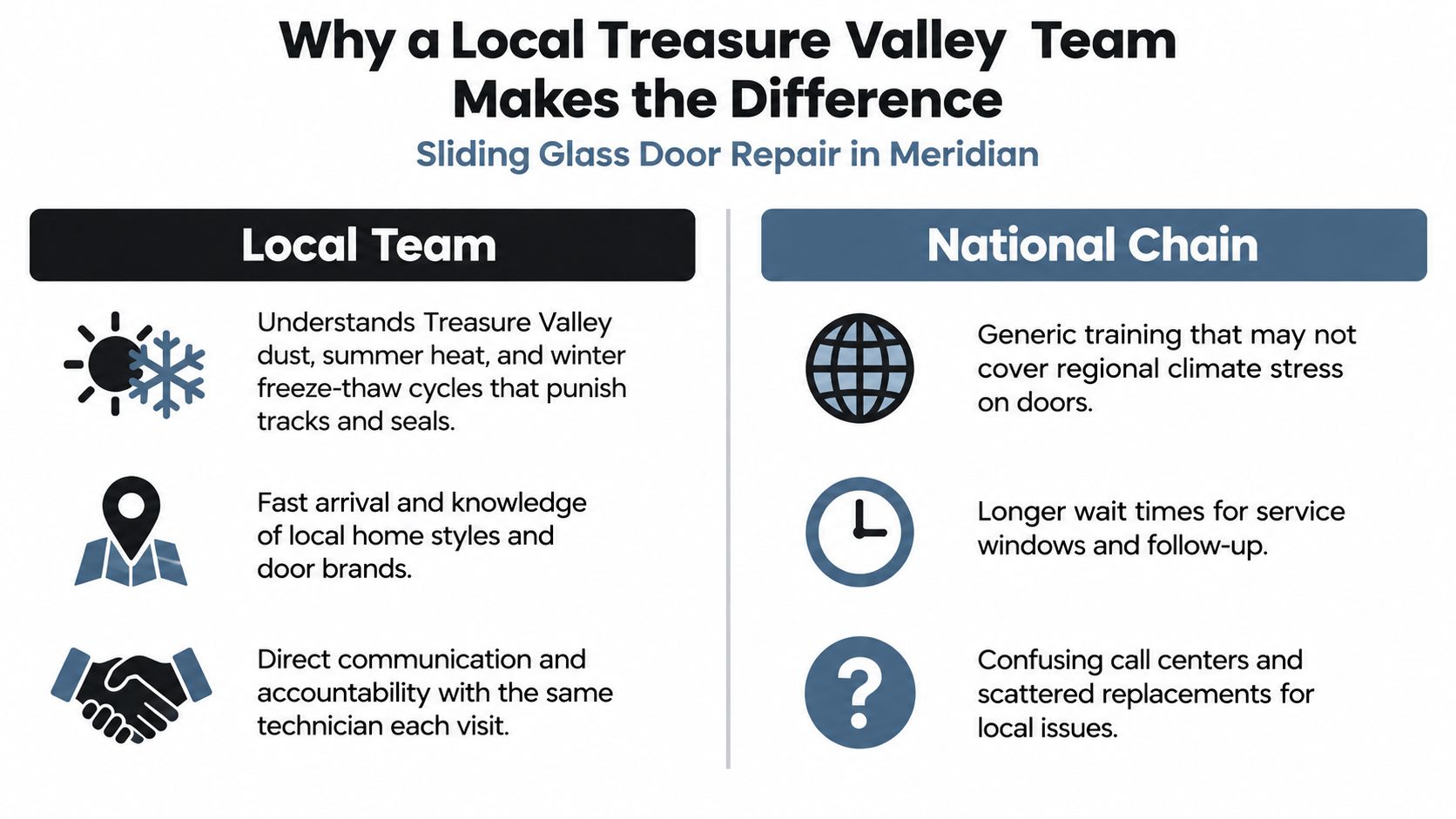
Meridian doors deal with more than ordinary household use. Fine dust works into tracks, summer heat dries and hardens exposed seals, and winter freeze-thaw cycles punish weak drainage and contaminated bearings. A technician who sees those conditions regularly can interpret the symptom instead of treating every sticky door as an adjustment problem.
Local knowledge also affects parts and scheduling. Doors installed in Meridian, Eagle, Star, Nampa, and Boise subdivisions often share hardware families, but the exact roller height, wheel material, lock body, and seal profile still matter. A truck stocked with common rollers, locks, and weatherstripping can prevent a second visit, while an unusual glass unit may still need a careful measurement and order.
Accountability matters after the repair
A local office gives the homeowner a direct place to ask about a loose latch, a returning draft, or a warranty question. That matters more than a polished appointment window if the same issue returns after the technician leaves. Ask who covers labor, which parts carry coverage, and whether the written warranty identifies the local company responsible for follow-up.
Financing can also be relevant when a door requires glass, frame, and hardware work together. A homeowner should compare the total project cost, payment terms, and expected service life rather than choosing a temporary fix solely because it avoids a larger conversation.
For background on local installation and service considerations, see this overview of a Treasure Valley window company. C & C Windows & Doors offers sliding and bi-fold patio doors, custom measurements, and energy-focused door options for homes in the area.
A local technician can't make a damaged frame serviceable, but can often identify that fact before a homeowner spends money on parts that won't solve the underlying problem.
What Happens During a Professional Repair Visit
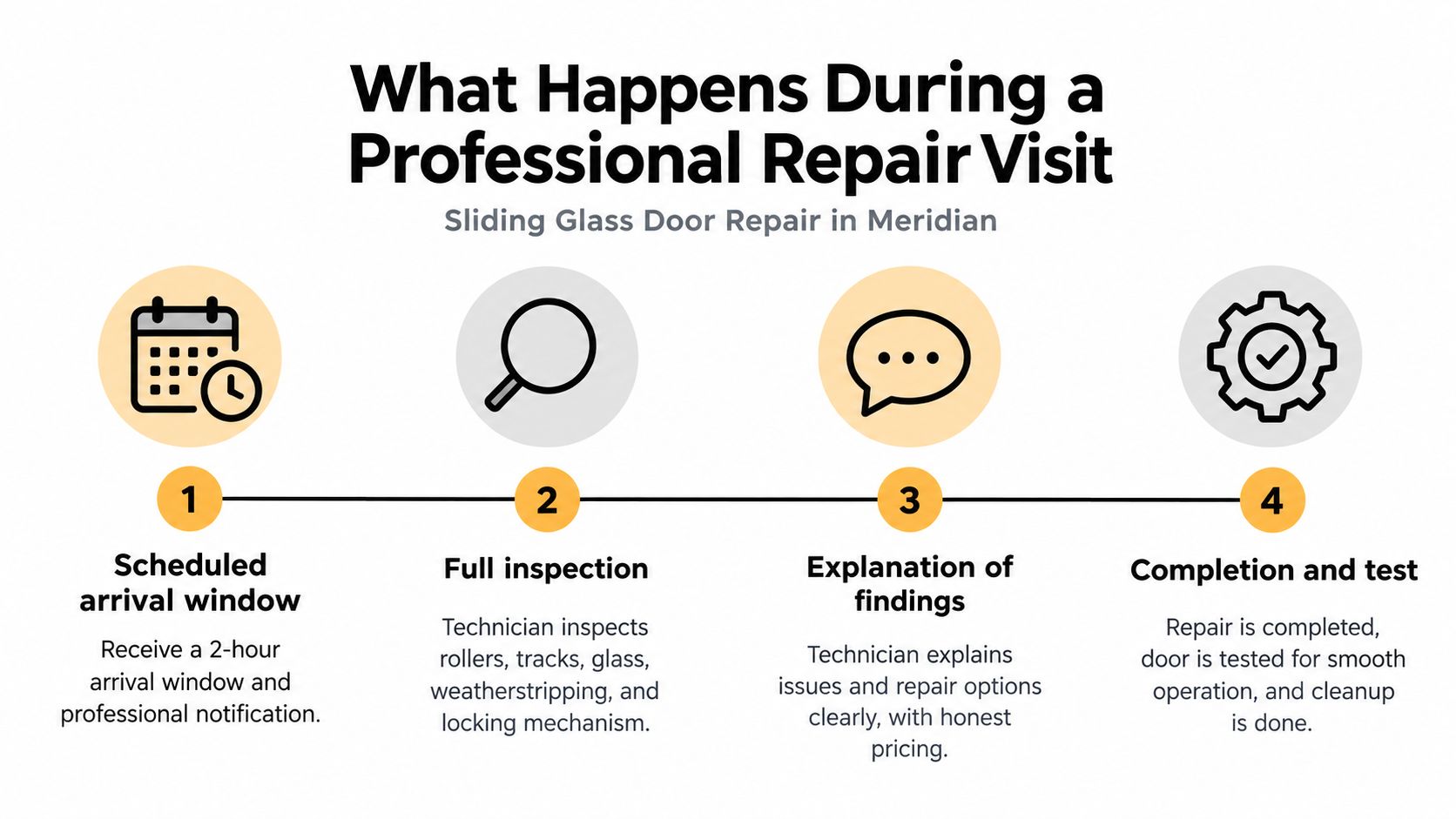
A well-run appointment begins with a scheduled arrival window and a complete inspection. The technician should examine the rollers, lower and upper tracks, glass edges, weatherstripping, handle, lock body, receiver, and the frame's relationship to the opening. A door that sticks at one point in its travel may need a different solution from one that drags everywhere.
The explanation should happen before the work starts. You should see which parts have failed, understand whether cleaning or adjustment can help, and receive a price for the recommended repair before approving it. That process protects the homeowner from paying for a roller replacement when the problem is a crushed track.
The work itself
Many hardware repairs finish in one to three hours, depending on access, condition, and parts, as described in the provided Meridian repair service guidance. A technician may remove the panel, replace both roller assemblies when appropriate, clean the track, reset the height, align the lock, and install fresh weatherstripping. Glass work follows a different path if a sealed unit must be measured and ordered.
The final test should include repeated open-and-close cycles, a latch check, and a review of the seal contact. The technician should remove old hardware, vacuum the work area, and explain any maintenance that will protect the repair. A written summary should list the work performed, parts used, and warranty terms.
Payment is normally handled on site, but the important detail is the paper trail. Keep the invoice, part description, and warranty information together. If the door starts dragging again, those details help the local office determine whether the issue involves the original repair or a separate component.
Meridian Sliding Glass Door Questions Worth Answering
How fast can a stuck door be serviced?
Roller, track, and lock problems are often suitable for a same-day or single-visit repair when the needed hardware is available. A technician still needs to inspect the door first, because a damaged track or distorted frame can turn a simple adjustment into a parts or replacement decision. Glass replacement usually requires more planning than hardware work, especially when the insulated unit must be measured and ordered.
Can new weatherstripping reduce comfort problems?
Yes, when the existing seal is brittle, torn, compressed, or visibly separated from the frame. Weatherstripping won't correct a warped frame, failed insulated glass, or a panel that no longer reaches the lock receiver. In a Meridian home, test the seal after the repair on both a cold morning and a hot afternoon, because air leakage and solar heat can feel different across the seasons.
Residential heating and cooling energy use attributed to windows and doors is about 25% to 30%, while glass can account for roughly 66% of total heat loss in a standard glazed unit, according to this sliding glass door energy-loss reference. Those figures explain why a drafty patio door deserves attention, but they don't identify which component needs replacement.
When does replacement beat another roller swap?
Replacement becomes more compelling when the frame is warped, the glass seal has failed, several major components are failing together, or repairs keep addressing symptoms without restoring comfort and security. For a new unit, compare U-factor, Solar Heat Gain Coefficient, drainage design, locking hardware, and glass configuration.
Independent rating information describes double-pane Low-E argon units reaching about 0.25 U-factor with 0.25 to 0.40 SHGC, while triple-pane Low-E argon units can reach about 0.18 U-factor with 0.20 to 0.35 SHGC. The same patio-door energy-rating reference describes argon as improving insulation by roughly 20% versus air-filled units. Ask for the actual rating of the proposed door rather than relying on a general label.
What should a service warranty cover?
Get the terms in writing. The document should identify the parts covered, labor coverage, exclusions, and the process for reporting a problem. Hardware and glass may have different manufacturer terms, and a warranty shouldn't be assumed to cover damage caused by a bent track, misuse, or later structural movement.
Is financing available for a larger door project?
Financing may be available for replacement work, but approval, interest, and repayment terms depend on the lender and the homeowner's agreement. Ask for the cash price and financed price separately, then compare the complete project scope. That's especially important when an HOA requires a particular patio-door appearance or when the project includes glass, frame, trim, and disposal.
A professional evaluation is the fastest way to settle the repair-versus-replacement question. C & C Windows & Doors offers free estimates, same-week scheduling across Meridian, Eagle, Boise, and Nampa, and factory-trained technicians who carry common rollers, locks, and sealed units for local service needs.
If your Meridian patio door grinds, leaks, fogs, or refuses to latch, schedule a free estimate with C & C Windows & Doors for a clear repair or replacement recommendation. Their Treasure Valley team handles patio-door inspections, energy-focused upgrades, and careful installation so you can fix the immediate problem without guessing about the long-term solution.