
Your patio door usually doesn't fail all at once. First it feels a little heavier. Then it starts scraping, skipping, or needing a hip check to close. After that, you notice a draft at the bottom, dust packed into the track, or a lock that no longer lines up cleanly. That's the point where most Boise homeowners start asking the same question. Is this a simple fix, or is it time to replace the whole unit?
That question matters because sliding doors sit at the intersection of comfort, security, and energy performance. In Treasure Valley homes, they also take a beating from dust, seasonal temperature swings, and the small alignment changes that show up over time in real houses. A smart decision starts with diagnosis, not guesswork.
Here's the short version. Some doors need cleaning, roller adjustment, or targeted hardware repair. Others are telling you the frame, seals, or full assembly has reached the point where another patch won't hold for long. If you're searching for a sliding door installer in Boise, the most useful place to start is learning how to tell the difference.
Table of Contents
- Why Your Sliding Patio Door Is Sticking
- A Homeowner's Troubleshooting Checklist
- Sliding Door Repair vs Replacement The Boise Cost and Value Breakdown
- When to Hire a Professional Sliding Door Installer
- Choosing the Right Door for Idaho's Climate
- Simple Maintenance to Extend Your Door's Life
- Frequently Asked Questions
- Can I replace just the glass in an old sliding door?
- Is re-rolling a patio door enough?
- What kind of warranty should I ask about?
- Are bi-fold or multi-slide doors better than a traditional sliding door?
- Will a new sliding door help with drafts and comfort?
- How do I know I need a full replacement instead of another repair?
Why Your Sliding Patio Door Is Sticking
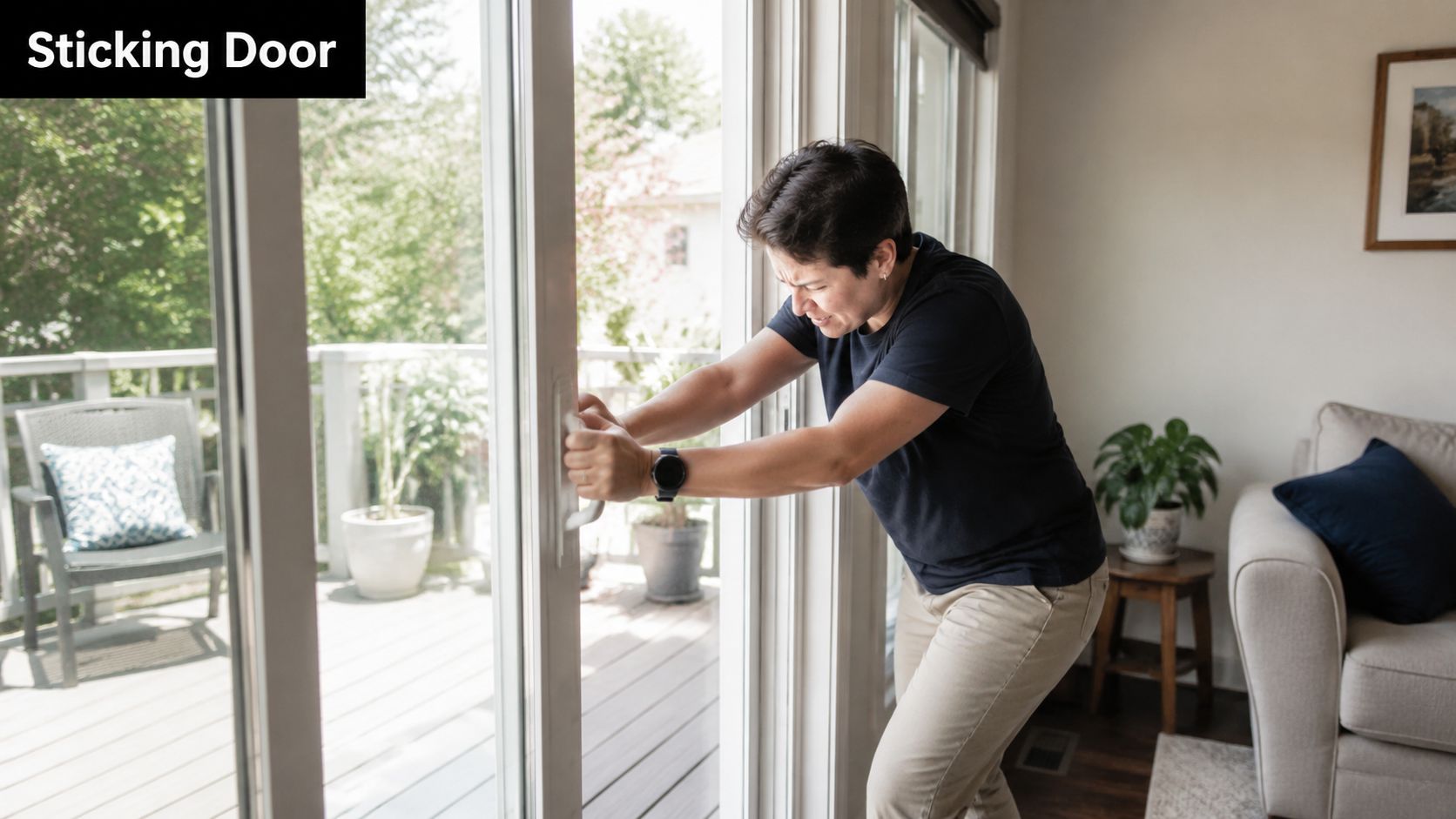
Most sticking sliding doors come back to three failure points. The rollers stop carrying the panel correctly, the track stops guiding the panel correctly, or the frame is no longer square enough for the door to move the way it should.
Rollers usually fail first
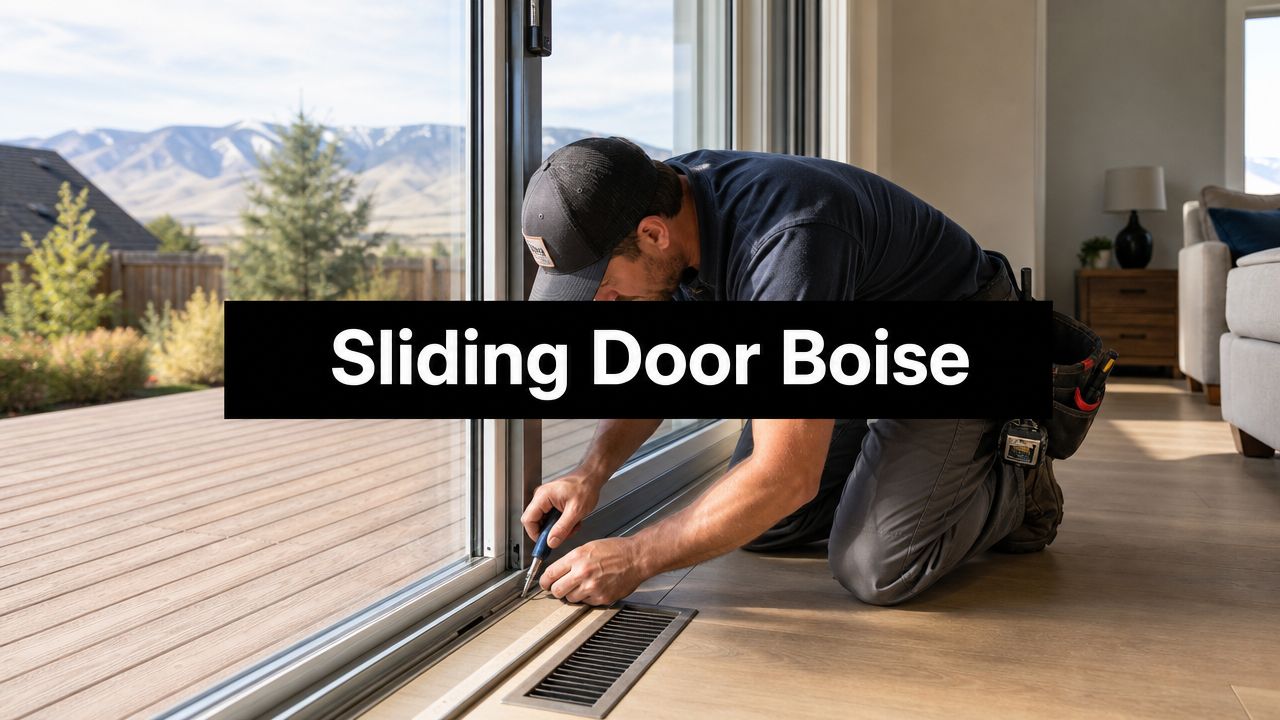
The rollers underneath the active panel are responsible for the door's movement. When they wear down, seize up, or fall out of adjustment, the door starts dragging instead of gliding. Homeowners often describe it as a grinding feel or a heavy spot halfway through the slide.
That doesn't always mean the whole door is bad. It often means the moving parts underneath it aren't doing their job anymore.
Tracks collect damage you can't ignore
Boise-area homes collect dust and grit fast. Once fine debris builds up in the track, every open and close acts like sandpaper. Over time, that can roughen the track, flatten roller movement, and make the panel feel jerky.
A dirty track causes one kind of resistance. A dented or worn track causes another. The difference matters because cleaning helps one, but not the other.
Practical rule: If the door improved briefly after cleaning but quickly went back to dragging, debris probably isn't the only problem.
Frame movement changes everything
Some doors aren't sticking because of the door at all. The opening has shifted. Houses move a little over time, and large glass openings tend to reveal it. If the panel looks tighter at the top than the bottom, won't latch cleanly, or rubs one side of the jamb, you may be dealing with a frame issue rather than a roller issue.
That's where quick fixes usually disappoint. New rollers inside an out-of-square opening can still leave you with a door that binds, leaks air, or won't lock consistently.
A failing patio door is rarely random. It's mechanical. If you identify whether the problem is rollers, track, or frame alignment, you can usually tell whether you're looking at a maintenance job, a repair call, or a full replacement.
A Homeowner's Troubleshooting Checklist
Before calling for service, do a simple inspection. You don't need specialty tools. You need a vacuum, a rag, good light, and a few slow test passes of the door.
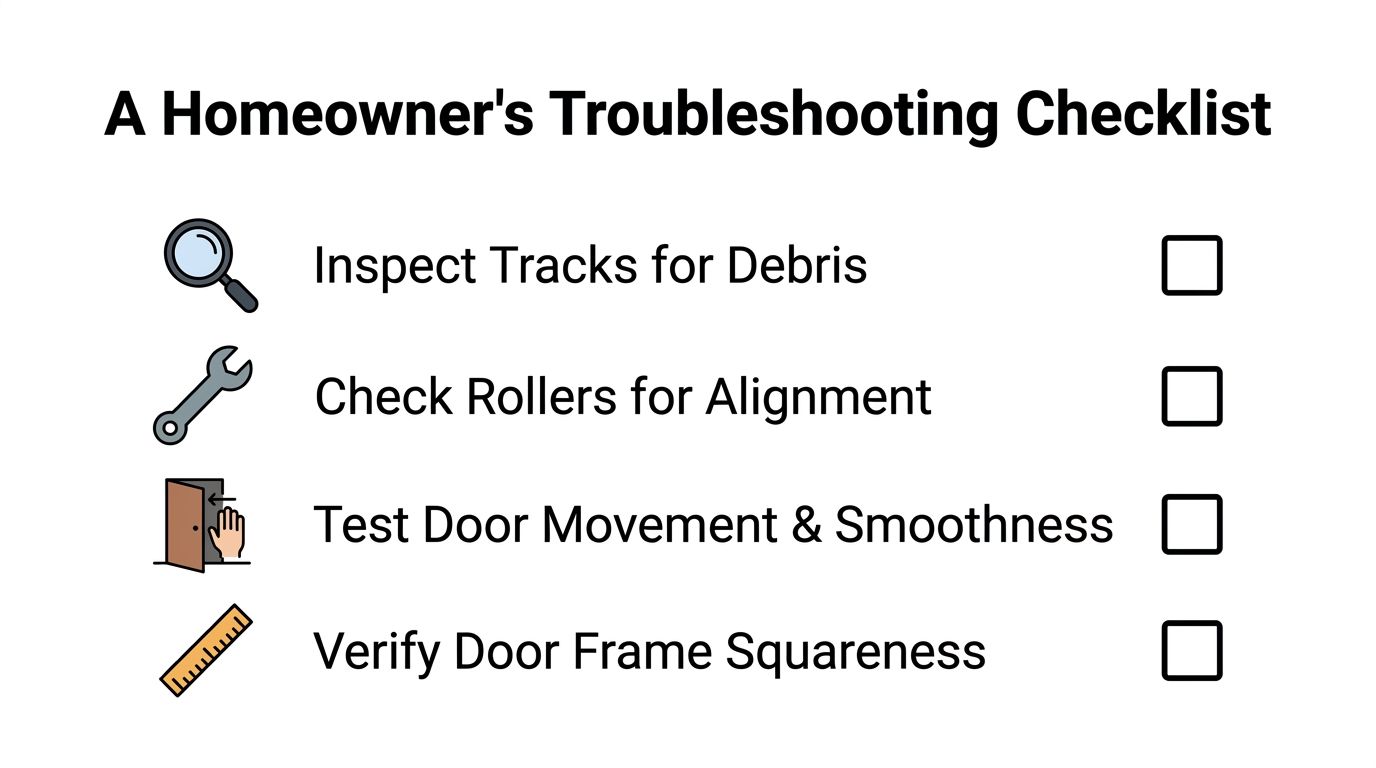
Boise homeowners benefit from a real diagnostic process because sliding door problems often come from different failure points such as rollers, tracks, weatherstripping, and frame settlement, and local dust and freeze-thaw cycles can speed up track and roller wear, as noted by Boise-area sliding door repair guidance.
Start with the track
Open the panel and look closely at the lower track.
- Vacuum loose grit: Remove dust, pet hair, leaves, and packed dirt from corners and along the running path.
- Wipe for residue: Sticky buildup from old lubricant or grime can create drag that feels mechanical when it's really contamination.
- Inspect for dents: A bent section of track can interrupt roller travel every time the wheel hits that spot.
If the track is dirty, the door may improve right away. If you feel the same bump or hitch in the same location after cleaning, that points more toward damaged track or roller wear.
Test how the door moves
Now slide the panel slowly with one hand, then a little faster.
What you're feeling matters more than force.
- A smooth but heavy door often suggests roller wear or poor adjustment.
- A rough, chattering door can indicate debris, track damage, or a flat-spotted roller.
- A door that jumps or skips usually means one side isn't tracking correctly.
Listen too. Grinding sounds are useful clues. So are little clicks that repeat in the same place.
A sliding door should feel supported through the full travel path. If it feels fine for the first part of the movement and then suddenly drops or binds, one side is often carrying load poorly.
Check alignment and reveal
Stand back and look at the gaps around the moving panel.
Use the frame as your reference. Does the spacing look even from top to bottom? Does the latch side meet the jamb cleanly when closed? Does the lock engage without lifting or shoving the panel?
A door that only locks when you pull it hard into position usually has an alignment problem, not just dirty hardware.
Look at weatherstripping and seals
This part gets overlooked because it doesn't make the door stick directly. But failed weatherstripping often shows up alongside the same age and wear issues that affect operation.
Check for:
- Cracked or flattened material
- Visible daylight around the perimeter
- Drafts at the meeting stile or bottom rail
- Dust infiltration inside the track pocket
When seals fail, comfort drops fast, even if the panel still moves.
Decide which bucket your problem fits
A simple way to sort what you found:
| Symptom | Most likely issue | What it usually means |
|---|---|---|
| Dirty track, door improves after cleaning | Surface contamination | Minor maintenance |
| Grinding, skipping, or rough rolling | Roller or track wear | Repair evaluation |
| Uneven gaps, poor latch alignment, visible racking | Frame or opening issue | Professional inspection |
| Drafts and worn seals with older hardware issues | System-wide deterioration | Replacement may make more sense |
A lot of homeowners save money. Not by forcing a DIY fix, but by avoiding the wrong fix.
Sliding Door Repair vs Replacement The Boise Cost and Value Breakdown
The biggest mistake I see is treating every bad patio door like the same project. It isn't. Cleaning a neglected track, replacing worn hardware, and removing an aging unit for a full new installation are three very different decisions.
For Boise homeowners, a useful cost baseline for a full new install is the projected 2026 sliding door installation range of $1,021.24 to $2,042.48, including materials and professional labor, according to this Boise sliding door cost report. That figure is helpful because it frames replacement as a meaningful home upgrade, not a minor patch job.
Repair vs replacement decision matrix
| Factor | DIY / Minor Repair | Professional Repair | Full Door Replacement |
|---|---|---|---|
| Best use case | Dirty track, basic cleaning, light maintenance | Worn rollers, hardware issues, localized track problems | Failed frame, chronic sticking, major draft or seal issues |
| Upfront cost | Lowest | Mid-range, depends on parts and labor | Highest upfront investment |
| Boise benchmark | No fixed market figure cited | No fixed market figure cited | Full install baseline is $1,021.24 to $2,042.48 in projected 2026 Boise pricing, including labor and materials |
| Energy performance impact | Minimal | Limited unless seals and frame are still strong | Highest potential improvement when the old unit has poor sealing or outdated glass |
| Security improvement | Usually minor | Moderate if lock and alignment are corrected | Strongest option when frame, latch alignment, and full assembly are updated |
| How long the result tends to hold | Depends heavily on underlying condition | Good if the rest of the unit is sound | Best long-term path when multiple parts are failing |
| Risk of repeat problems | High if diagnosis is wrong | Moderate | Lowest when the underlying cause is the full unit |
When repair is the right call
Repair makes sense when the door is structurally sound and the problem is isolated. Good candidates include a track packed with debris, rollers that need service, or hardware that no longer adjusts properly.
That's especially true if the frame is square, the glass is still performing acceptably, and the lock side still lines up. In that situation, a targeted repair can restore function without putting money into parts of the system that are still fine.
When replacement gives better value
Replacement starts making more sense when the door has stacked problems. Not one issue. Several.
Examples include:
- Persistent drafts even after minor repairs
- Locking problems tied to alignment, not just the latch
- Visible frame wear or signs the opening is out of square
- Aging glass and worn seals paired with poor operation
At that point, another repair can feel cheaper only because it postpones the larger decision. If comfort, security, and smooth operation have all slipped, the fundamental comparison isn't repair versus replacement. It's temporary relief versus a reset of the whole assembly.
If two or three systems are failing at once, rollers, seals, alignment, replacement usually becomes the cleaner long-term answer.
Homeowners comparing project scopes can also review what a full sliding patio door replacement in Boise typically involves so they're not comparing a repair call to a complete unit swap as if they were the same service.
What usually doesn't work
There are a few common dead ends.
One is over-lubricating a dirty track. That often turns dust into paste. Another is adjusting rollers repeatedly on a frame that has already moved out of alignment. The third is replacing visible hardware while ignoring failed weatherstripping and air leakage.
Those fixes can create a short-lived improvement. They rarely create a reliable door.
When to Hire a Professional Sliding Door Installer
Some patio door problems cross the line from inconvenient to technical very quickly. Once you're dealing with frame movement, failed seals, or a unit that won't close square, professional installation and repair work stop being optional.
In the Boise market, established installers often have multi-decade track records, with some local businesses noting over 25 years in sliding door installation and replacement, and they commonly compete on measurement accuracy, scheduling reliability, and installation quality while offering options like double- or triple-pane Low-E glass and argon-filled glass suited to Idaho's climate, according to local sliding door service information for Boise-area homes.
Situations that need a pro
Hire a professional when you see any of the following:
- The panel is out of square: If the reveal is uneven, the latch doesn't meet cleanly, or the panel drags one corner, measurements and adjustment need to be exact.
- The frame shows damage: Rot, movement, or fastener failure around the opening changes the job from hardware service to opening correction.
- Drafts continue after basic fixes: Air leakage often points to seal failure, installation defects, or a worn-out unit, not just a dirty track.
- Glass performance matters now: If your goal is comfort as much as operation, product specification starts to matter as much as labor.
What separates a real installer from a basic fix-it call
A proper sliding door installer in Boise doesn't just swap parts. They verify the opening, measure the unit correctly, check sill condition, make sure the frame is plumb enough to perform, and seal the replacement so weather and air don't keep finding a path inside.
That's also why local market competition tends to center on service quality instead of simple availability. Homeowners care whether the installer shows up on schedule, measures accurately, and leaves the site ready to use.
One local option for homeowners comparing service providers is C & C Windows & Doors in the Treasure Valley, which offers factory-trained installation and local replacement work. The key point is broader than any one company. On sliding doors, precision beats speed every time.
The hidden cost of poor installation
A badly installed new patio door can still drag, leak, and lock poorly. New product doesn't rescue weak measuring or careless shimming.
That matters most on large glass openings, where small installation errors show up immediately in operation. If the bottom line of the project is smooth movement, clean lock engagement, and a weather-tight seal, the installer matters as much as the door itself.
Choosing the Right Door for Idaho's Climate
A sliding patio door that looks good in a showroom can still be the wrong fit for a Boise home. Treasure Valley conditions ask more from a door than appearance. You need a unit that handles hot sun, winter cold, air leakage, and year-round use across a wide glass opening.
For Boise's high-desert climate, door performance depends heavily on U-factor, solar heat gain, and air leakage, and a properly specified door with the right Low-E coating, gas fills, and installation quality can outperform a more expensive style-first upgrade, according to Boise-area guidance on door performance and selection.

What the performance terms actually mean
These labels matter because they affect daily comfort.
- U-factor is about how well the door resists heat loss. Lower is generally better when you want the interior side of the door to feel less cold in winter.
- Solar heat gain tells you how much solar heat passes through the glass. That matters when afternoon sun hits a big patio opening.
- Air leakage speaks for itself. If outside air keeps finding its way in, the door won't feel comfortable no matter how nice the frame looks.
Features worth asking about
If energy performance is part of the goal, ask about these details during a consultation:
- Low-E glass coatings that help manage radiant heat
- Argon-filled glass packages for better insulation
- Tighter weather sealing around the active panel
- Frame design that supports a clean, lasting seal
- Installation quality at the sill and perimeter
If you're comparing broader product and installation options in the local market, Boise window and door replacement services can give you a reference point for what's available beyond off-the-shelf units.
A premium-looking door isn't automatically the right door. In Boise, the better choice is often the one that seals well, handles sun exposure intelligently, and fits the opening correctly.
What works better than a generic upgrade
A lot of homeowners start by focusing on pane count or style alone. That's understandable, but incomplete. A well-specified sliding door with the right glass package and careful installation often delivers more everyday comfort than a more expensive upgrade chosen mainly for appearance.
That matters if your actual goals are fewer drafts, less solar heat buildup, steadier indoor temperatures, and better sound control near the patio.
Simple Maintenance to Extend Your Door's Life
Once a sliding door is operating correctly, maintenance is what keeps it that way. In Boise, the biggest enemies are simple. Dust in the track, neglected rollers, and weatherstripping that gets ignored until drafts become obvious.
A practical routine that works
Use a light, repeatable schedule instead of waiting for the door to feel bad again.
- Clean the lower track regularly: Vacuum grit out of corners and wipe the running surface so rollers aren't grinding debris into the track.
- Check movement by feel: Slide the panel slowly. If it starts to feel rough or heavier than normal, address it early instead of forcing it.
- Inspect weatherstripping seasonally: Look for cracks, flattening, or loose sections after hot weather and before colder months.
- Keep drainage paths clear: If the sill or track area is designed to shed moisture, don't let dirt block that path.
What homeowners usually miss
The most common maintenance mistake is adding lubricant to a dirty track. Clean first. Lubrication over dust usually creates more drag, not less.
The second mistake is ignoring small alignment changes because the door still technically closes. A door that needs extra force today often becomes a hardware and seal problem later.
Boise-area market listings show installers compete heavily on measurement accuracy, scheduling, and on-site coordination across the Treasure Valley, which reflects how much homeowners value reliable service and correct setup over simple product access, as seen in Treasure Valley sliding door installation listings. That same principle applies after installation. Doors last longer when they start correctly and get maintained before problems stack up.
Frequently Asked Questions
Can I replace just the glass in an old sliding door?
Sometimes, but glass-only replacement doesn't solve most operation problems. If the actual issue is rollers, frame movement, failed weatherstripping, or latch alignment, new glass won't fix the reason the door sticks or leaks. Glass replacement makes more sense when the frame and hardware are still in good shape and the problem is isolated to the insulated glass unit.
Is re-rolling a patio door enough?
It can be, if the frame is square and the track is still serviceable. Re-rolling tends to help when the panel is structurally sound and the drag is coming from worn roller assemblies. It usually doesn't hold up as a long-term answer when the opening has shifted or multiple components have aged out together.
What kind of warranty should I ask about?
Ask two separate questions. One for the product warranty and one for the installation warranty. Those are not the same thing. You want to know who covers hardware, glass, seals, and labor if the door develops an operational issue after installation.
Are bi-fold or multi-slide doors better than a traditional sliding door?
Better for some remodels, not automatically better for every home. Traditional sliding doors usually make the most sense when you want a familiar footprint, reliable operation, and a straightforward replacement path. Larger opening systems can be attractive, but they place more demands on structure, layout, and budget.
Will a new sliding door help with drafts and comfort?
Yes, if the old door has worn seals, air leakage, or outdated glass and the new unit is specified and installed correctly. The improvement comes from the whole assembly working together, not from one feature alone.
How do I know I need a full replacement instead of another repair?
Look at the pattern, not one symptom. If the door sticks, leaks air, won't latch cleanly, and shows visible wear in the frame or seals, you're likely past the point where another small repair makes sense. A single bad part is a repair problem. Multiple failing systems usually point to replacement.
If your patio door is sticking, dragging, leaking air, or no longer feels right, C & C Windows & Doors can evaluate whether a targeted repair or full replacement makes more sense for your Boise-area home. A solid consultation should focus on the underlying cause of the problem, the condition of the opening, and the door features that fit Treasure Valley weather, not just the quickest patch.