
You're probably looking at a drafty living room, a sticky patio door, or a window that rattles every time Boise wind comes through the Treasure Valley. That's the reason people start searching for Pella Windows Boise. They want a cleaner look, sure, but they mainly want a home that feels tighter, quieter, and easier to live in through cold snaps, hot afternoons, and the long shoulder seasons in between.
Pella is worth a serious look because it's not a newcomer chasing a trend. The company began in 1925 as the Rolscreen Company, and in 2025 it marked 100 years in business, which tells you a lot about its staying power in the U.S. window-and-door market. Its Boise-area presence is also real, not theoretical, with a showroom in Eagle that serves Boise, Meridian, Nampa, Caldwell, Eagle, Middleton, Star, and Kuna, plus a separate Boise listing in local directories for windows, patio doors, and entry doors. For homeowners who want a known brand with local access, that matters.
Table of Contents
- Why Boise Homeowners Consider Pella Windows
- Pella Window Series Available in the Treasure Valley
- Performance Features That Matter for Idaho's Climate
- What to Expect from Local Installation in Boise
- Understanding Cost Drivers and Financing Options
- Warranties and Post-Purchase Service Realities
- How to Evaluate Local Dealers and Installers
- Next Steps to Get Your Pella Window Quote
Why Boise Homeowners Consider Pella Windows
A Boise homeowner usually doesn't start with brand loyalty. They start with a problem. The upstairs room gets cold in January, the west side bakes in July, and the old windows seem to leak comfort as fast as the furnace or AC can make it.
That's where a brand like Pella gets into the conversation. It has the kind of long-running presence that gives buyers some confidence that the company won't disappear after the sale. Pella's history page shows a company founded in 1925 and renamed Pella Corporation by 1992, with a 100-year milestone in 2025. Those are not cosmetic details, they're the kind of signals people look for when they're spending real money on a house upgrade. Pella's history
Why the local footprint matters
Boise buyers also care about whether a product is available nearby, not just online in a brochure. Pella's Eagle showroom listing says it serves the wider Treasure Valley, while a separate Boise directory listing places a Pella location at 5626 W State St, Boise, ID 83703. That split tells you something practical, the brand is present locally, but the buying experience may involve more than one location depending on whether you're dealing with showroom selection or a service-oriented listing. Eagle-area showroom and service territory
For most homeowners, that means the conversation starts with access and trust, then moves quickly to ownership risk. A showroom can make products look polished. A local installer has to make them work through Boise winters, dry summers, and the inevitable service call years later.
Practical rule: if a window company looks strong in the showroom but vague after the sale, treat that as a warning sign, not a minor detail.
Pella Window Series Available in the Treasure Valley
The right Pella choice in Boise isn't about picking the fanciest trim package. It's about matching the opening style to the house and the climate. A good installer should help you decide whether a room needs easy ventilation, a clean fixed view, or a patio door that doesn't eat up floor space.
Start with the window type that fits the room
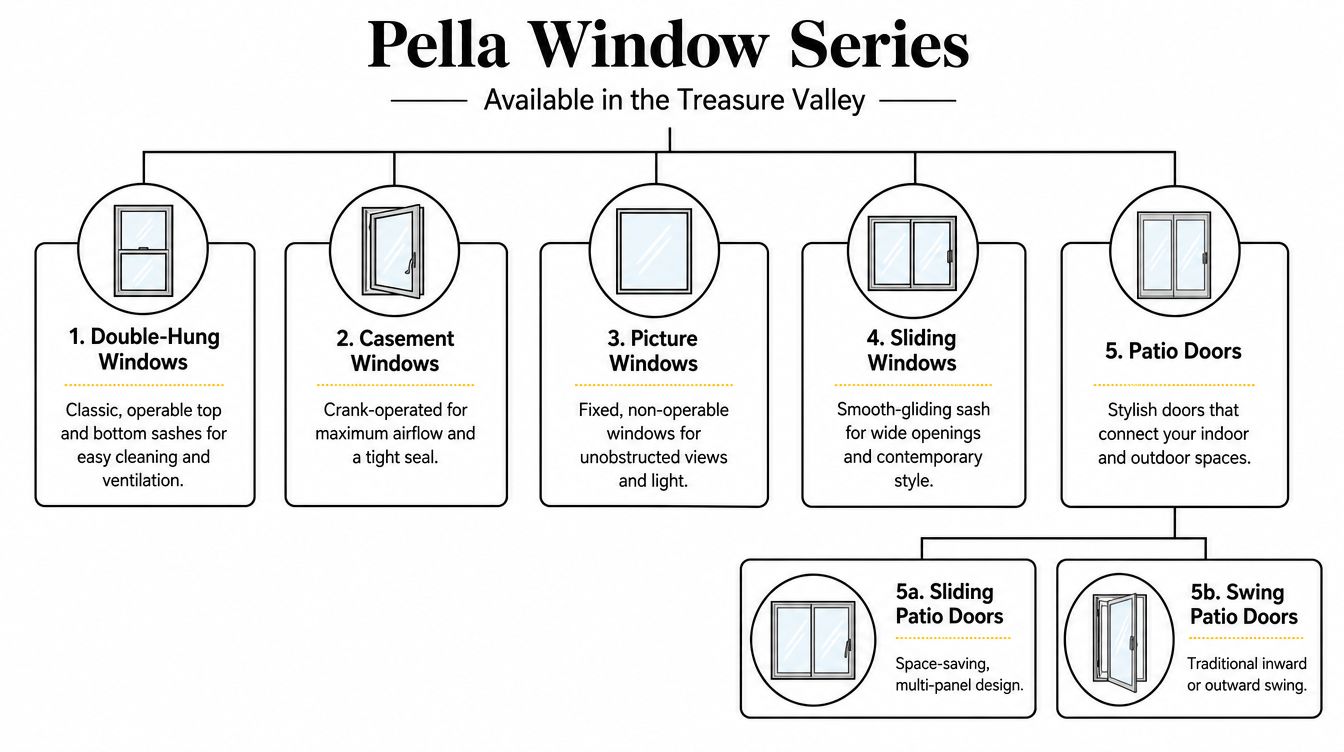
Double-hung windows make sense when you want classic style and easy cleaning. Casement windows are the better call when airflow and a tighter closing feel matter more. Picture windows belong where you want light and a clear view, not operability. Sliding windows are a practical fit for wider openings and a more contemporary look. For patio connections, sliding patio doors save space, while swing patio doors give you the more traditional entry feel.
What I'd prioritize in Boise
In our climate, I'd care less about a catalog description and more about the actual construction details behind it. Slim sightlines are nice, but they shouldn't come at the cost of fit or seal quality. Composite-reinforced sashes, secure low-profile locking, and true sloped sills are the kind of features that matter because they support drainage, closing consistency, and long-term durability.
That's the point most homeowners miss. A window series is not just a style choice, it's a performance choice. If you're replacing windows in a house that fights winter drafts or summer heat gain, don't let anyone sell you on appearance alone.
Use the room to narrow the choice
- Bedrooms and living rooms: choose operable units if you plan to use natural ventilation.
- Street-facing rooms: favor tighter-sealing designs and privacy-friendly glazing.
- Great rooms and view walls: fixed picture windows usually make the most visual sense.
- Patio transitions: prioritize door operation, traffic flow, and how the opening affects furniture placement.
A Boise buyer doesn't need every series. They need the right mix for the house, and that usually means fewer product categories, chosen more carefully.
Performance Features That Matter for Idaho's Climate
Boise homes don't need marketing fluff, they need windows that hold up when the weather swings hard. Pella's published performance documentation shows standard windows tested to a minimum 20 psf design pressure, and its performance summary lists a maximum air leakage limit of ≤ 0.3 cfm/ft² for windows and sliding doors. Pella performance documentation
Those two numbers matter because they speak to different problems. Design pressure is about resisting wind-driven stress, which helps with deflection and seal durability over time. Air leakage is about comfort, because uncontrolled leakage is what creates drafts, uneven room temperatures, and the feeling that you're paying to heat or cool the outdoors.
Glazing choice changes more than the sales pitch
Pella's acoustic data make one thing clear, glass package matters. In the Lifestyle Series, a tested 47" × 59" window with dual-pane 3 mm / 3 mm glass reached STC 27 / OITC 22, while a triple-pane 5 mm / 5 mm / 5 mm configuration reached STC 31 / OITC 26. In the Reserve Traditional Hung data, a 45" × 65" clad double-hung with 3 mm + 6 mm laminated glass reached STC 35 / OITC 30. Pella acoustic test data
| Glazing Configuration and Acoustic Performance | |||
|---|---|---|---|
| Glazing Type | STC Rating | OITC Rating | Best For |
| Dual-pane 3 mm / 3 mm | 27 | 22 | General residential comfort where noise is moderate |
| Triple-pane 5 mm / 5 mm / 5 mm | 31 | 26 | Better sound control and stronger comfort expectations |
| 3 mm + 6 mm laminated | 35 | 30 | Homes near arterials, rail corridors, or busy commercial areas |
What I'd actually recommend
If your home is in a quieter pocket and the current problem is mostly comfort, a well-specified dual-pane package may be enough. If you're near traffic, school pickup lanes, or other constant noise sources, laminated or triple-pane options make more sense because the data show measurable gains in sound control.
Don't overbuy the wrong feature. A lot of homeowners spend on a glass upgrade they can't feel, then skip the installer quality that would've solved half the problem.
What to Expect from Local Installation in Boise
A window purchase goes wrong most often at the install stage, not the showroom stage. That's why local accountability matters so much in Boise. If the measurement is sloppy, the prep is rushed, or the finishing work is lazy, even a good product can perform badly.
The process should feel orderly, not improvised
A proper local install starts with an in-home consultation, then moves to precise measurements, product ordering, delivery, installation, and a final walkthrough. The estimator should ask how you use the room, what problems you're trying to solve, and whether you care more about noise, comfort, appearance, or security. If they skip those basics, they're guessing.
The installation itself should be clean and controlled. Old units come out, openings are checked, the new windows or doors are fit carefully, and the crew should leave the site free of debris. If you want a plain-language version of that process, this step-by-step installation guide lays out the kind of sequence a homeowner should expect from a professional job.
If the crew rushes the measurement, the whole project gets expensive in the worst possible way.
Permits, scheduling, and on-site behavior
Some projects need permits, some don't, and that depends on scope and local requirements. A good installer won't dodge the question. They'll tell you what applies, what doesn't, and who handles it.
On install day, pay attention to small signs. Did the crew protect floors? Did they confirm the openings before setting units? Did they explain how the locks, sashes, or door hardware work before leaving? Those details tell you whether the company treats installation as a craft or just a delivery event.
Red flags you shouldn't ignore
- Vague measurement language that never gets specific.
- No discussion of cleanup or disposal.
- A final walkthrough that feels rushed.
- Confusion about warranty activation after the work is done.
A clean install isn't a bonus. It's the price of admission.
Understanding Cost Drivers and Financing Options
Pella quotes can vary a lot from one Boise house to another because the job itself varies. A simple replacement in an easy-access opening is not the same as a custom-sized project with upgraded glass, patio access, or tricky finishing work. The product series, glazing package, and labor complexity all move the number.
What pushes the price up
Premium series cost more because the materials, finishes, and configuration options are more involved. Bigger openings, custom shapes, and patio door work also take more time and care. If you ask for upgraded performance glass, you're paying for more material and a more specialized build.
The honest question is not, “Can I spend less?” It's, “Which upgrades will I feel every day?” If the answer is better comfort, less noise, and less maintenance, then the premium can be justified. If the upgrade is mostly about a spec sheet, I'd slow down and reassess.
Local financing can help a whole-home project make more sense without forcing you into a rushed decision. If you're comparing payment structures and timing, this financing overview is a useful starting point for understanding how homeowners often approach larger replacement jobs.
Compare quotes the right way
Don't compare two proposals just by total price. Break them down by product line, glass package, install scope, cleanup, and warranty handling. One quote can look cheaper while excluding the parts of the job that matter most.
A better comparison looks like this:
- Product spec: same series, same glass package, same hardware.
- Install scope: removal, fit, sealing, trim, cleanup.
- Warranty handling: who backs the labor, who handles service calls.
- Financing terms: whether the payment plan supports the project, not just the monthly number.
That's how you avoid getting trapped by a low headline price that becomes expensive later.
Warranties and Post-Purchase Service Realities
Most homeowners think they're buying windows. What they're really buying is future support. If a seal fails, a door sticks, or a service question comes up two winters from now, the value of the purchase shows up in how quickly someone answers the phone and fixes the problem.
The hard part is what happens after install
Pella's public customer-review footprint shows recurring complaints around support follow-through, repair delays, and confusion about coverage, especially around leaks, seal failures, replacement parts, and labor versus parts responsibility. That's the ownership issue Boise buyers should care about most, because a showroom doesn't solve a future service dispute. Pella customer reviews on BBB
The smartest question isn't, “Do you have a warranty?” It's, “Who services the warranty, and how long does that process take?” If the answer is vague, the warranty is weaker than it sounds.
Ask these questions before you sign
- Who handles the claim: dealer, installer, or manufacturer.
- What's covered: glass, frames, hardware, seals, labor.
- How transferability works: whether a future buyer gets any coverage.
- What maintenance is required: and what happens if you miss it.
- How repair scheduling works: who shows up, and who pays for what.
Straight answer: a strong product with weak service support is still a bad ownership experience.
A local installer can matter more than the brand badge. A dealer that answers the phone, documents the job, and stands behind the labor gives you a much cleaner path if something goes wrong. That's why buyers should look past the brochure and think like owners, not just shoppers.
How to Evaluate Local Dealers and Installers
A Boise homeowner should judge the installer before they judge the window color. The crew doing the work is the one you will deal with if a sash sticks, a seal fails, or a service issue shows up after the sale. Local expertise matters because Idaho homes, weather, and scheduling realities are not the same as a generic national script.
If you want a practical checklist for choosing the right company, read our guide on how to choose a window company in Boise Idaho. That is the level of detail buyers should demand before they sign anything.
What a serious installer should prove
Start with training. Ask whether the team is factory-trained, how long they have worked in the Treasure Valley, and whether they can point to local references in Boise, Meridian, and Eagle. Then ask how they handle installation details that protect performance, because a premium product still depends on careful fit and finish.
Ask who owns the job after the check clears. Who answers the service call? Who documents warranty activation? Who handles the labor if something needs adjustment later? Those are not picky questions, they are the questions that tell you whether the dealer plans to stand behind the work.
A local option homeowners often compare is C & C Windows & Doors, a Treasure Valley installer that works with replacement windows and patio doors, offers free in-home consultations, custom measurements, and debris-free installations. That kind of local service structure matters when you are buying a high-ticket product that has to hold up for years, not just look good on install day.
Use a simple vetting checklist
- Factory training: confirm the crew knows the product line they are installing.
- Local references: ask for recent Boise-area jobs, not generic testimonials.
- Responsiveness: call before signing and see how quickly they answer.
- Process clarity: measure, order, install, clean up, and warranty should all be explained.
- Labor accountability: know who stands behind the install itself.
- Service follow-through: ask how repair requests are logged and who keeps you updated if something needs attention later.
If an installer cannot explain the job in plain English, do not hire them. A good window installed badly becomes your problem. A solid installer gives you one point of contact, clear labor responsibility, and a cleaner path if a warranty issue shows up after the sale.
Next Steps to Get Your Pella Window Quote
If you're serious about replacing windows in Boise, walk into the estimate process with a short list. Know which rooms bother you most, whether noise or drafts are the bigger issue, and whether you care more about style, performance, or both. Bring photos, take rough measurements if you have them, and ask for a proposal that spells out product, install scope, and service support.
Then compare quotes the way an owner should, not the way a shopper does. Look at warranty handling, installation accountability, and how clearly the dealer explains what happens if something needs attention later. That's where the difference shows up.
If you want a local partner that understands Treasure Valley homes and can quote the project without the runaround, contact C & C Windows & Doors for a straightforward estimate. They handle Pella window solutions in the area, and the right conversation now can save you a lot of frustration after the install.