
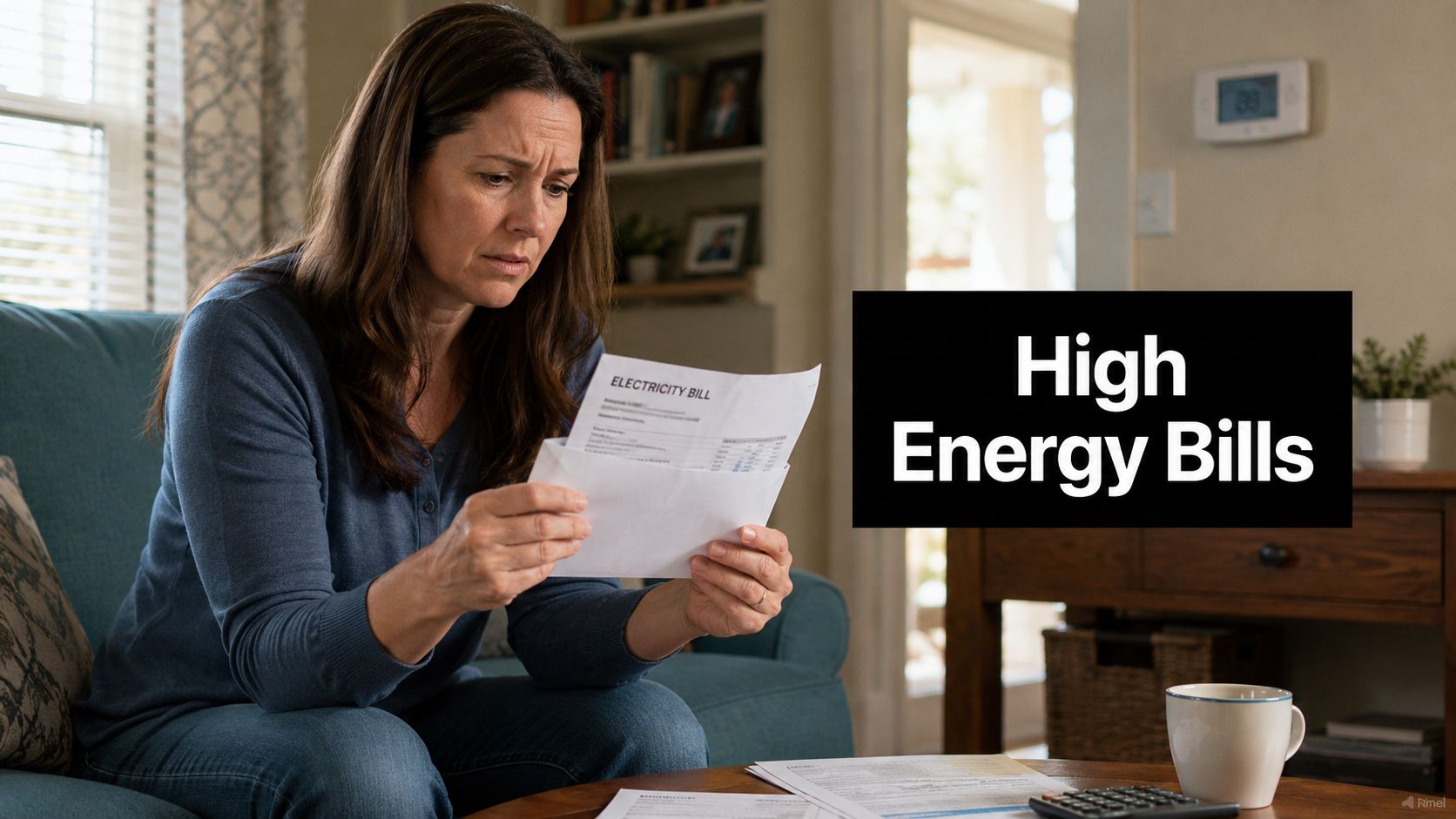
You open the bill and feel the stomach-drop moment right away. The amount is higher, your usage doesn't look wildly different, and you're left wondering whether the utility made a mistake, the weather was brutal, or your house is leaking money through the walls.
For a Treasure Valley homeowner, that reaction makes sense. A high bill can come from the rate you're paying, the fees bundled into the bill, or the home itself working harder than it should. The trick is not guessing. It's separating the bill into parts, then checking the house layer by layer, the same way a contractor traces a draft before he starts tearing into drywall.
Table of Contents
- A Treasure Valley Homeowner Opens an Unexpectedly High Bill
- The Four Real Parts of Every Electricity Bill
- What Your Home Itself Could Be Doing Wrong
- A One-Afternoon Diagnostic Checklist for Your Home
- What Each Fix Saves in Real Numbers
- Boise and Treasure Valley Climate Specific Considerations
- Your Next Steps and Local Service Options
A Treasure Valley Homeowner Opens an Unexpectedly High Bill
A Boise homeowner opens a winter bill and stops for a second. The furnace settings look familiar, the family habits have not changed, and the total at the bottom still feels wrong. That is the moment many people start asking why are my energy bills so high, hoping there is one neat answer.
The answer usually has more than one part. Sometimes the bill rises because the price per unit of electricity moved up, even if the home used about the same amount of power. In Great Britain, Energy UK says higher bills are tied to volatile global gas markets and policy costs recovered through electricity bills, and it cites UK Energy Research Centre research showing that around two-thirds of the increase in energy bills between 2021 and 2025 came from wholesale gas spikes linked to international events (Energy UK). In the U.S., the average residential electricity rate reached 18.83 cents per kWh in April 2026, which was 7.3% higher than one year earlier and 42.2% higher than April 2020 (U.S. Energy Information Administration).
That is only one side of the bill. A house can also waste power through leaks, weak insulation, duct loss, or equipment that has to run longer than it should. Grist reported that the average residential energy bill in 2025 was roughly 30% higher than in 2021, which shows this is not just a short weather swing. It is a longer trend, and homeowners feel it in different ways depending on their utility, their house, and the way they use it.
The first question is not, “Why is the bill high?” It is, “Did the bill go up because of the price, the house, or both?”
A good diagnosis starts there. Separate the cost of the power from the way the home uses it, and you are less likely to chase the wrong fix.
The Four Real Parts of Every Electricity Bill
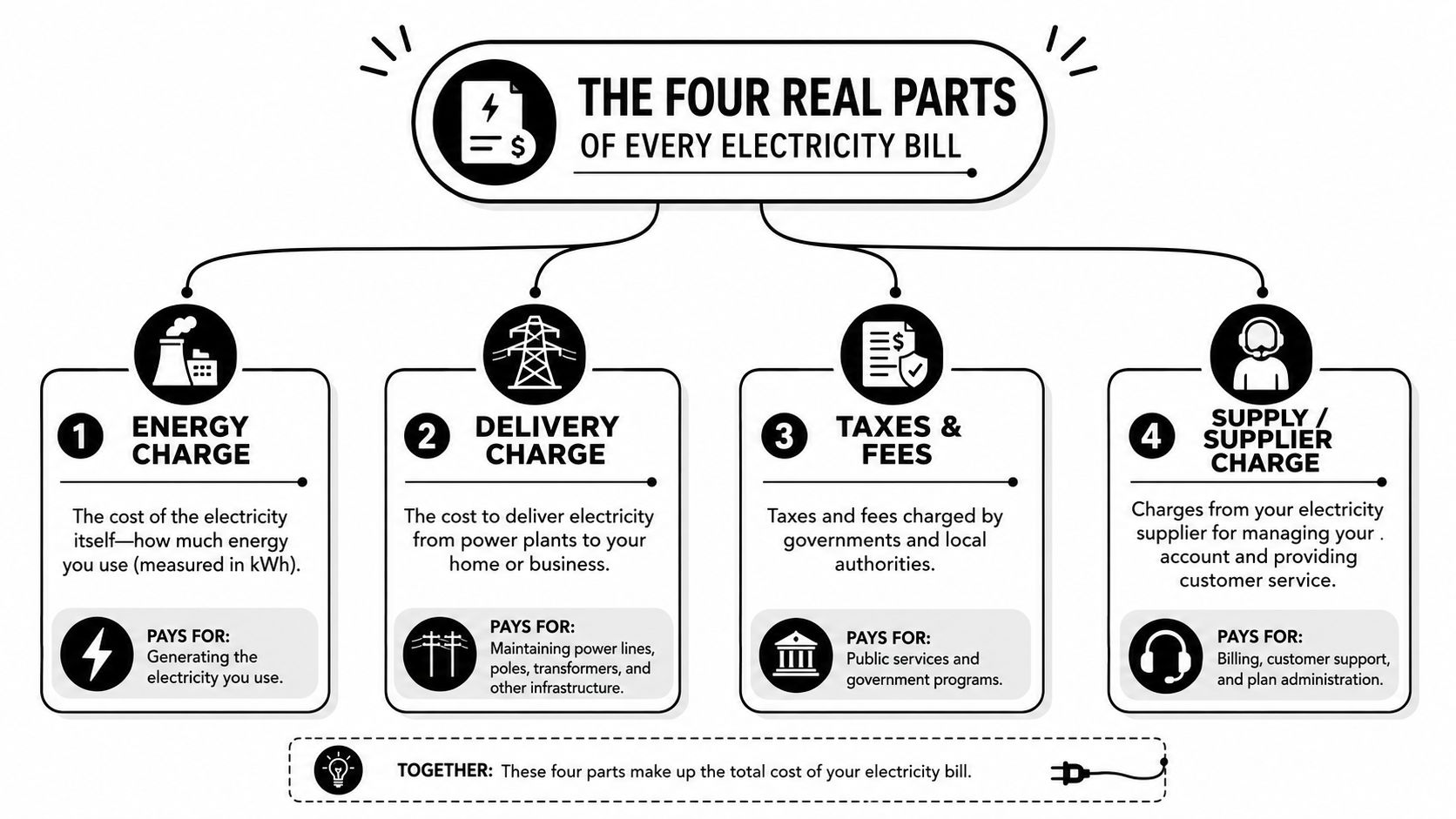
Think of an electric bill like a restaurant check. The meal itself has a cost, the kitchen has overhead, the server and dining room have a cost, and then there's tax. If two neighbors order the same dinner but one sits in a room with extra fees and a different tax structure, they won't leave with the same total.
The U.S. Energy Information Administration says residential electricity prices are shaped by the cost of generating power, the cost of transmitting and distributing it, utility operating and maintenance costs, and state and local taxes and fees (EIA). That's why two homes using the same amount of electricity can still get very different bills. The kWh usage can match, but the price structure doesn't.
Energy use is only one piece
The first line item is the electricity itself, the part that covers generating or purchasing power. That's the part homeowners usually focus on, because it feels like the most obvious explanation. But it's not the whole bill.
Delivery matters too. Wires, poles, transformers, billing systems, and maintenance all get paid for somehow. In many places, the electric bill carries those costs in a way that doesn't look dramatic on the page, but still adds up in the total. The bill can rise even when the home's thermostat settings stay the same.
Why your neighbor may pay less or more
The same house on the same street can face a different total because utilities don't all price the bill the same way. One utility may spread more cost into delivery, another may lean heavier on fees, and another may change how those charges are recovered over time. That's why a smart first move is reading the bill line by line instead of assuming the whole increase came from your usage.
If the price per kWh changed, your bill can rise without you turning a single knob in the house.
That's the part many homeowners miss. A bill diagnosis starts with the statement itself, not the furnace filter.
What Your Home Itself Could Be Doing Wrong
Once you understand how the bill is built, the next question is whether the house is making the utility charge more by wasting conditioned air. Drafts, weak insulation, leaky ducts, and older equipment can all make a system run longer than it should, which raises kWh use and puts extra wear on the equipment. The EPA has also modeled how sealing leaks and adding insulation in key areas can trim heating and cooling costs and reduce air infiltration when the attic, foundation, windows, and doors are addressed. That is why a bill review and a home check need to happen together, especially in Treasure Valley houses that face hot afternoons, cold snaps, and a lot of temperature swing in between (EPA via EIA consumption page).
Start with the envelope
A leaky house behaves like a cooler with a cracked lid. The furnace or air conditioner keeps sending conditioned air into the home, but the shell cannot hold onto it for long. The result is rooms that never feel quite right, temperatures that drift, and equipment that cycles more often than it should.
Windows and doors are part of that shell, but they are only part of it. Attics, crawl spaces, rim joists, and floor assemblies can matter just as much. If the house feels drafty near the floor, if one bedroom is always harder to keep comfortable, or if the HVAC seems to run all the time, the building shell deserves attention before you blame the utility.
For homeowners seeing cold glass, visible gaps, or tired frames, this guide to signs your windows need replacing in Idaho is a useful place to compare symptoms.
Ducts and HVAC losses hide in plain sight
Duct leakage is a classic hidden waste point. In a field study of California homes, measured duct leakage averaged 7.7% of system fan flow, which was 28% above the state's 6% tight-duct target, and many residential systems historically leak 20% to 30% of fan flow (EIA residential consumption). That means the system can be paying to condition air that never reaches the rooms you live in.
Dirty filters, poor commissioning, refrigerant problems, and simple aging also matter. A furnace or air conditioner does not have to be dead to waste money. It only has to run longer than it should, or struggle to move air the way it was meant to.
New loads can be legitimate, not wasteful
Some bills go up because the house added real electric demand. EV charging, heat pumps, extra laundry, a well pump, or an electric water heater can change the math on a home even when nothing is broken. That is why a high bill is not always a sign of neglect.
Sometimes the house is doing more work than it used to do. A family that added a heat pump or started charging a vehicle at home may see the meter move faster for a real reason, and that is a different diagnosis from a drafty attic or a failing duct run.
A One-Afternoon Diagnostic Checklist for Your Home
Start with the attic, because that's where a lot of easy-to-miss problems begin. Look for thin insulation, bare patches, and any places where air can move freely around penetrations. If the attic feels like a hard place to keep conditioned air in the living space below, the whole house pays for it.
Next, move room to room and stand near windows and exterior doors. Feel for temperature differences, look for daylight at edges, and check for obvious gaps around frames. If one area of the house feels drafty while the rest is fine, that often points to a local leak instead of a whole-house problem.
Then inspect any ductwork you can safely reach. Look for loose seams, disconnected sections, and tape that's failed. Dirty filters deserve attention too, because a restricted system works harder to move the same amount of air.
Here's a practical way to think about the walk-through:
- Check the attic first: Missing insulation or obvious air pathways can make the HVAC work overtime.
- Feel windows and doors by hand: Drafts at the edges usually mean air sealing is due.
- Look at accessible ducts: Any visible leakage is worth fixing because it wastes conditioned air.
- Replace the filter: A clogged filter can make a healthy system act sluggish.
- Review the last twelve bills: A clear summer-and-winter pattern helps separate weather from a sudden rate change.
If you want a structured local starting point, this Boise-focused home energy audit resource can help you think through the same questions a pro would ask.
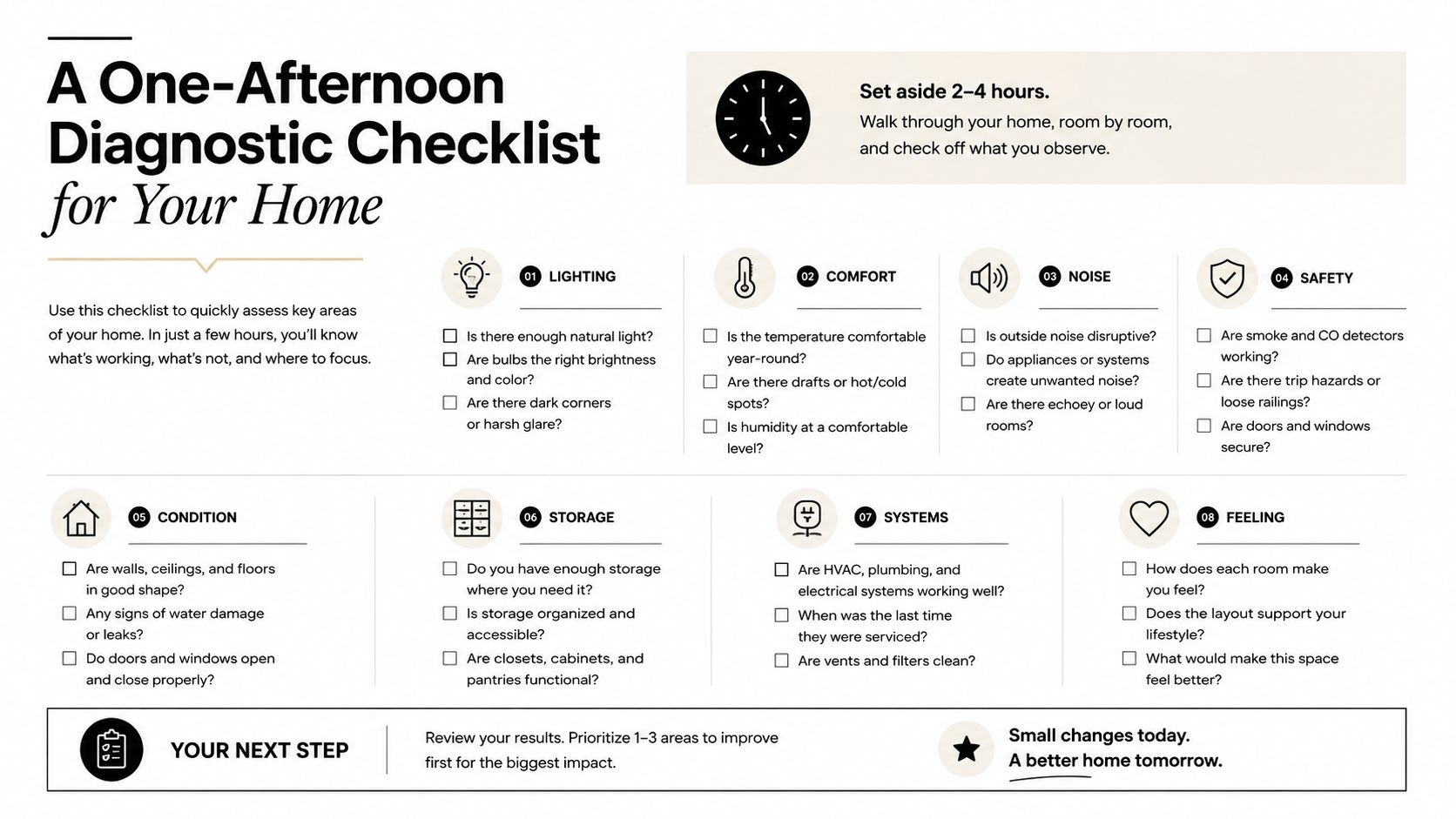
A good checklist doesn't guess. It finds the leak, the restriction, or the setting that's forcing the bill upward.
If the house passes the obvious tests and the bill is still high, then the utility rate structure deserves a closer look.
What Each Fix Saves in Real Numbers
Every fix sits in a different budget bucket. Some are low-cost and give relief fast, some take more effort but solve the biggest losses, and some make sense only when a worn-out part is already due for replacement. The right order is the one that improves comfort first, because comfort problems usually point to where energy is leaking out.
| Upgrade | Typical Annual Savings | Typical Payback | Best Fit |
|---|---|---|---|
| Air sealing | Qualitatively meaningful, especially in drafty homes | Often among the quickest returns | Homes with obvious leaks, cold floors, or rooms that drift |
| Attic insulation | Can reduce a major share of heating and cooling loss | Usually strong in older homes | Homes with thin or uneven attic coverage |
| Duct sealing | Helps recover air that never reaches living spaces | Often worthwhile when leakage is visible or suspected | Homes with rooms that never condition evenly |
| HVAC tune-up | Improves runtime and comfort when the system is otherwise sound | Usually lower-cost, lower-risk | Systems that are operating but seem sluggish |
| Full HVAC replacement | Highest cost, but can be justified when equipment is failing | Best when repair costs and inefficiency stack up | Old systems with repeated breakdowns |
| Window and patio door upgrades | Strong comfort and envelope gains, especially for drafts and solar gain | Best when frames, glass, or seals are worn | Homes with aging windows, noisy rooms, or weak north and west exposures |
For sealing and insulation, the useful lesson from the EPA via EIA consumption page is simple. The biggest savings usually come from stopping conditioned air from slipping out through the shell of the house. That matters more than chasing small plug loads or swapping one lamp at a time.
Why windows and doors belong in the conversation
Windows and patio doors do not always drive the whole bill higher on their own, but they can make every other system work harder. If afternoon sun cooks a room or a tired frame leaks heat, the HVAC has to keep correcting that room all day. A worn seal, outdated glass, or a sash that does not close tightly can turn one room into a constant load on the system.
A home that needs replacement windows is not only buying a different look. It is buying a tighter envelope, steadier room temperatures, and less demand on the equipment that heats and cools the house.
How to think about the money
The best fix is the one that closes the largest loss first. If the attic is thin and the house feels drafty, start there. If the windows are failing and the rooms near the glass are uncomfortable, that is a real envelope problem too. If the ducts are leaking and the system runs long cycles, fix the air delivery before replacing equipment that is still mechanically sound.
Boise and Treasure Valley Climate Specific Considerations
Treasure Valley weather makes weak points show up fast. Hot, dry summers push cooling systems hard, while cold winter nights and inversions make heat loss feel more obvious indoors. A house that seems “fine” in a mild climate can feel expensive here because the same leak or thin layer of insulation gets punished on both ends of the season.
West-facing windows are a common pressure point in this region. Afternoon sun loads those rooms harder, and aging glass or worn frames can make them feel uneven long before the rest of the house seems distressed. That's why a home can look normal on a spring day and still be throwing money away once the summer sun hits.
Orientation matters more than people think
A room with glass facing the afternoon sun behaves differently from a shaded room on the same floor. If that room always runs warmer, the cooling system has to chase it down all evening. If the same room also leaks air in winter, the cost shows up twice a year instead of once.
In this climate, comfort problems usually show up first at the edges of the house, not in the middle.
That's why an Idaho homeowner shouldn't treat every energy complaint as a generic insulation issue. Sometimes the fix is in the attic. Sometimes it's in the windows. Sometimes it's both.
Local homes need local priorities
A Treasure Valley home benefits most when the envelope and the HVAC are treated as one system. Tightening the building shell reduces the load on the equipment, and that can make the whole house easier to condition. For many homeowners, that's the difference between a house that feels steady and one that always seems to be catching up.
This is also where premium window and door replacements can make sense. C & C Windows & Doors installs energy-efficient replacement windows and patio doors for Treasure Valley homes, including options with Low-E coatings, argon gas fills, and optional triple-pane glass. Those features matter because they're aimed at the same summer and winter losses that make bills feel out of line here.
Your Next Steps and Local Service Options
Start with the no-cost moves first, then move to the fixes that address the biggest losses. Change the filter, check the thermostat schedule, and compare this month's bill with the same month last year. If the bill still feels wrong, inspect the attic, the windows, the doors, and any accessible ductwork before you spend money on bigger equipment.
If the house is drafty, uneven, or hard to keep comfortable, air sealing and insulation usually deserve attention before a full system replacement. If the windows and patio doors are worn, foggy, or leaky, those are real load drivers too, not just cosmetic issues. For Treasure Valley homeowners who want a local starting point, this local window company resource can help frame what to ask during an estimate.
The goal is simple. Fix the bill structure you can't control, then tighten the house so it stops wasting the energy you pay for.
If your bill has been climbing and your home feels drafty, C & C Windows & Doors can help you look at the parts of the house that affect comfort and energy use most, especially windows and patio doors. Visit C & C Windows & Doors to explore energy-efficient replacement options for Treasure Valley homes and start turning a high bill into a clearer plan.