The Idaho Power window rebate isn't a single homeowner cash-back program. Most qualifying Treasure Valley households are looking at income-qualified weatherization worth up to $6,000, while commercial and multifamily projects use separate per-square-foot incentives.
That distinction matters when a Boise or Meridian homeowner receives a glossy quote promising a “$500 Idaho Power rebate” and starts counting on a check. In practice, the right answer depends on your customer class, income eligibility, building type, heating system, and window performance ratings. A detached single-family home generally doesn't qualify for the same commercial or multifamily window rate shown in a contractor's marketing.
Table of Contents
- What the Idaho Power Window Rebate Actually Covers
- Three Program Tracks Homeowners Confuse
- U-Factor, SHGC, and ENERGY STAR 7.0 Explained
- Window Performance Tiers and Per-Square-Foot Incentives
- Application, Pre-Approval, and Required Documentation
- A Treasure Valley Window Replacement Walkthrough
- Practical Tips Before You Sign the Contract
What the Idaho Power Window Rebate Actually Covers
Idaho Power's window assistance falls into different program categories rather than one universal residential rebate. The commercial building-shell program lists premium windows at $2.50 per square foot, while the income-qualified weatherization program offers eligible households up to $6,000 in free energy-efficiency upgrades, which may include new windows and doors. Those are different programs with different applicants, paperwork, and payment structures. See the Idaho Power commercial building-shell incentive details and the income-qualified weatherization requirements.
Start with the building type
A single-family detached homeowner should first ask whether the household qualifies for weatherization assistance. This path is based on household eligibility and whole-home efficiency needs. Windows can be included, but the program isn't a standard check for any homeowner who replaces aging glass.
A commercial property owner or small-business operator may qualify for a building-shell retrofit incentive. The payment is tied to the project and measured window area, not the number of windows installed. Idaho Power also requires pre-approval for projects with estimated incentives of $2,000 or more, so signing a contract before confirming the program can create an avoidable problem.
A multifamily owner or manager follows another path. Low-rise multifamily buildings with electrically heated space use performance tiers based on U-factor, with better-performing windows receiving higher rates. That structure doesn't automatically transfer to a detached Boise house.
The practical rule: Never accept a rebate figure from a window quote until the contractor identifies the Idaho Power program, the eligible customer class, and the exact window ratings.
C & C Windows & Doors can screen a Treasure Valley project, identify the likely program category, match products to the applicable requirements, and coordinate the paperwork. The installer still needs Idaho Power's current approval, and the customer should keep copies of every submitted document.
Three Program Tracks Homeowners Confuse
A reader in Boise, Meridian, Eagle, Nampa, or Caldwell can usually identify the relevant path by answering one question first: Is this a detached home, a commercial building, or a multifamily property?
| Track | Eligible Customer | Incentive Structure | Typical Value |
|---|---|---|---|
| Weatherization Assistance | Qualifying low- and near-low-income households | Free whole-home efficiency upgrades, potentially including windows and doors | Up to $6,000 |
| Commercial retrofit | Businesses and commercial building owners | Premium windows at $2.50 per square foot | Project-based, measured by eligible area |
| Multifamily incentive | Low-rise multifamily buildings with electrically heated space | Tiered window rates based on U-factor | $0.25, $0.50, or $1.00 per square foot |
Track one, income-qualified weatherization
This is the path most relevant to a qualifying homeowner. Idaho Power describes the assistance as free energy-efficiency upgrades, and windows or doors may be included when they fit the home's needs. The household generally isn't waiting for a normal retail rebate after buying replacement windows. Instead, the program determines eligibility and coordinates qualifying improvements.
The contractor's role is to document the work, install approved products, and support the program process. The household signs eligibility and project documents rather than treating the upgrade like a coupon applied to a retail invoice.
Track two, commercial retrofit
Commercial customers receive a measured incentive for eligible building-shell improvements. The $2.50 per-square-foot premium-window rate belongs here, not in a typical single-family replacement quote. Idaho Power says non-lighting retrofit applications must be submitted within 90 days of project completion, and larger estimated incentives require pre-approval through the commercial process.
Track three, multifamily performance tiers
Multifamily buildings with electrically heated space qualify according to window performance. The owner or manager signs project documentation, supplies product specifications, and coordinates installation and inspection. The most common mistake is a detached homeowner seeing a multifamily rate and assuming the same payment applies to a personal residence. It doesn't.
U-Factor, SHGC, and ENERGY STAR 7.0 Explained
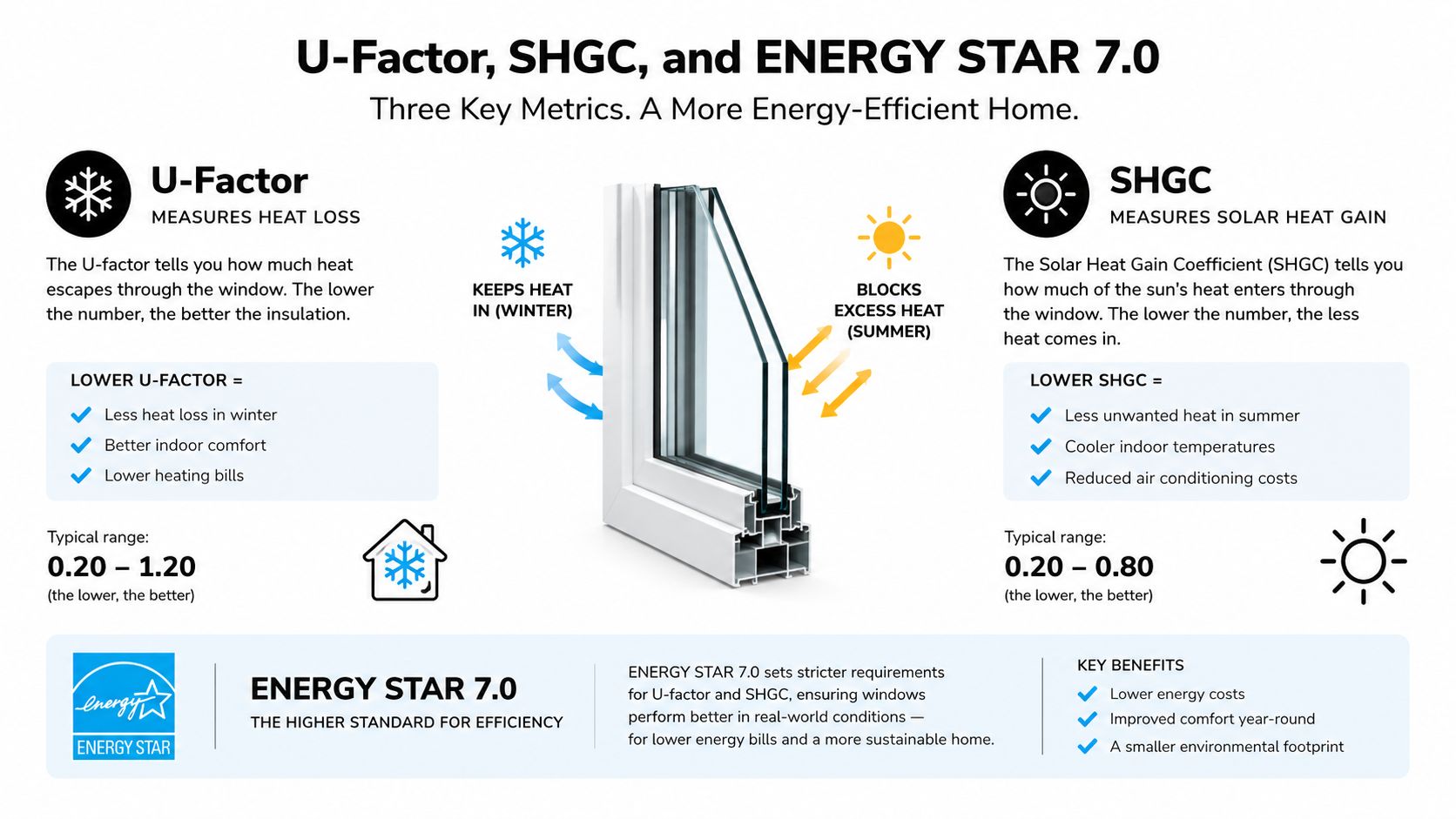
Window labels contain the numbers that matter more than the brand name. U-factor measures how readily heat moves through the window assembly. Lower is better, especially during cold Treasure Valley weather, because less heat escapes through the glazing.
SHGC, or solar heat gain coefficient, describes how much solar heat enters through the window. A lower SHGC can help limit unwanted summer heat, while the appropriate value depends on orientation, shading, and the room's comfort needs. Don't choose a window solely because one number looks impressive. The complete product specification must fit the project and the applicable Idaho Power tier.
ENERGY STAR 7.0 is a certification standard used to identify qualifying efficient products. It helps confirm that a window meets an established efficiency line, but it doesn't replace the need to read the actual NFRC-rated U-factor and SHGC on the quote.
How the multifamily tiers work
For qualifying low-rise multifamily buildings with electrically heated space, Idaho Power lists these window rates:
- Tier 1: U-factor greater than 0.27 and less than 0.30, $0.25 per square foot
- Tier 2: U-factor greater than 0.24 and less than or equal to 0.27, $0.50 per square foot
- Tier 3: U-factor less than or equal to 0.24, $1.00 per square foot
The rate rises as the U-factor falls. A window at 0.27 may land in a different tier from one at 0.24, even if both look identical from the street. That's why a contractor should place the exact U-factor and SHGC beside each product line before you sign.
For a plain-language look at efficient window specifications, review this Idaho energy-efficient window guide. Product selection should start with the program requirements, then move to appearance, operation, glass package, and budget.
Window Performance Tiers and Per-Square-Foot Incentives
The word premium doesn't tell you enough. A premium window may have strong ratings, but Idaho Power's incentive decision depends on the qualifying program and the documented performance values. ENERGY STAR 7.0 certification can support product selection, while a triple-pane package may provide a lower U-factor, but neither label alone guarantees payment.
| Performance Tier | U-Factor | SHGC | Incentive Range | C & C Product Match |
|---|---|---|---|---|
| Tier 1 multifamily | Greater than 0.27 and less than 0.30 | Confirm on product documentation | $0.25 per square foot | Efficient double-pane option when the documented rating fits |
| Tier 2 multifamily | Greater than 0.24 and less than or equal to 0.27 | Confirm on product documentation | $0.50 per square foot | ENERGY STAR 7.0 configuration with qualifying glass |
| Tier 3 multifamily | Less than or equal to 0.24 | Confirm on product documentation | $1.00 per square foot | Higher-performance or triple-pane configuration |
| Commercial premium window | Program-defined premium specification | Confirm on product documentation | $2.50 per square foot | Commercially specified window package |
Read the quote, not the sales label
A quote should show the window model, U-factor, SHGC, glass package, eligible square footage, and program track. If it only says “energy efficient” or “premium,” you can't verify the incentive category.
C & C Windows & Doors offers configurations that may include Low-E coatings, argon gas fills, and optional triple-pane glass. The important question isn't whether the window sounds high-end. It's whether the exact NFRC-rated product satisfies the applicable Idaho Power requirements and whether the paperwork names those values.
Low-e storm windows are separately listed at $1 per square foot when emissivity is 0.22 or lower and solar transmittance is greater than 0.55, according to Idaho Power's multifamily program material. That option shows why coatings and solar performance can matter alongside the main window frame and pane count.
Application, Pre-Approval, and Required Documentation
Rebate paperwork should follow the project timeline. Don't install first and hope the utility accepts a folder of receipts later.
Before installation
Start with the correct Idaho Power application for the property type. For a commercial project with an estimated incentive of $2,000 or more, obtain pre-approval before work begins. The application should identify the property, project scope, estimated eligible area, and proposed products.
Your itemized quote should list each window or window group with its U-factor and SHGC. A generic proposal without performance data leaves the utility and customer unable to verify which tier applies.
During the project
Keep proof of ownership or the required property authorization with the application file. The installer should also retain product specification sheets and NFRC documentation that correspond to the exact windows installed. Don't substitute a similar-looking model without updating the paperwork.
A home energy review can identify whether window replacement is the right measure alongside air sealing, insulation, or other improvements. C & C Windows & Doors explains the inspection process through its Boise home energy audit resource.
After installation
The post-installation file should include the final invoice, installed product details, and any required completion documentation. Idaho Power says non-lighting retrofit applications must be submitted within 90 days of project completion, so the contractor should track that deadline rather than leaving it to the homeowner.
Finally, schedule the final inspection when the program requires one. The incentive isn't complete when the crew leaves. It's complete when Idaho Power has the required documents, verifies the work, and accepts the project.
A Treasure Valley Window Replacement Walkthrough
Consider a representative Boise project in the North End. The homeowner has older windows, wants better winter comfort, and receives a proposal that mentions utility savings. Before discussing payment, the installer asks whether the home qualifies for income-qualified weatherization. If it doesn't, the homeowner isn't promised a commercial-style cash rebate just because the property is in Idaho Power territory.
The consultation then moves to product specifications. The proposal identifies the selected window series, operation type, glass package, U-factor, SHGC, and estimated glass area. The homeowner reviews the scope, confirms the contract terms, and keeps the product documentation instead of relying on a verbal statement that the windows are “rebate eligible.”
Installation day
The crew removes the existing units, checks the openings, installs the replacement windows, and leaves the work area clean. The final invoice should match the installed products and the signed scope. If the project uses a program requiring inspection, the installer should prepare the completion file and request the inspection rather than assuming the invoice closes the process.
For a detailed description of the installation sequence, review this window installation walkthrough. It's useful before signing because it clarifies what the crew does, what the homeowner should inspect, and which documents should remain after completion.
The homeowner's final file includes the signed contract, itemized invoice, product ratings, ownership documentation, and inspection paperwork. If the customer qualifies for weatherization, the program's payment structure differs from a commercial incentive. If the customer doesn't qualify, the replacement remains a private home-improvement purchase unless another current program applies.
Practical Tips Before You Sign the Contract
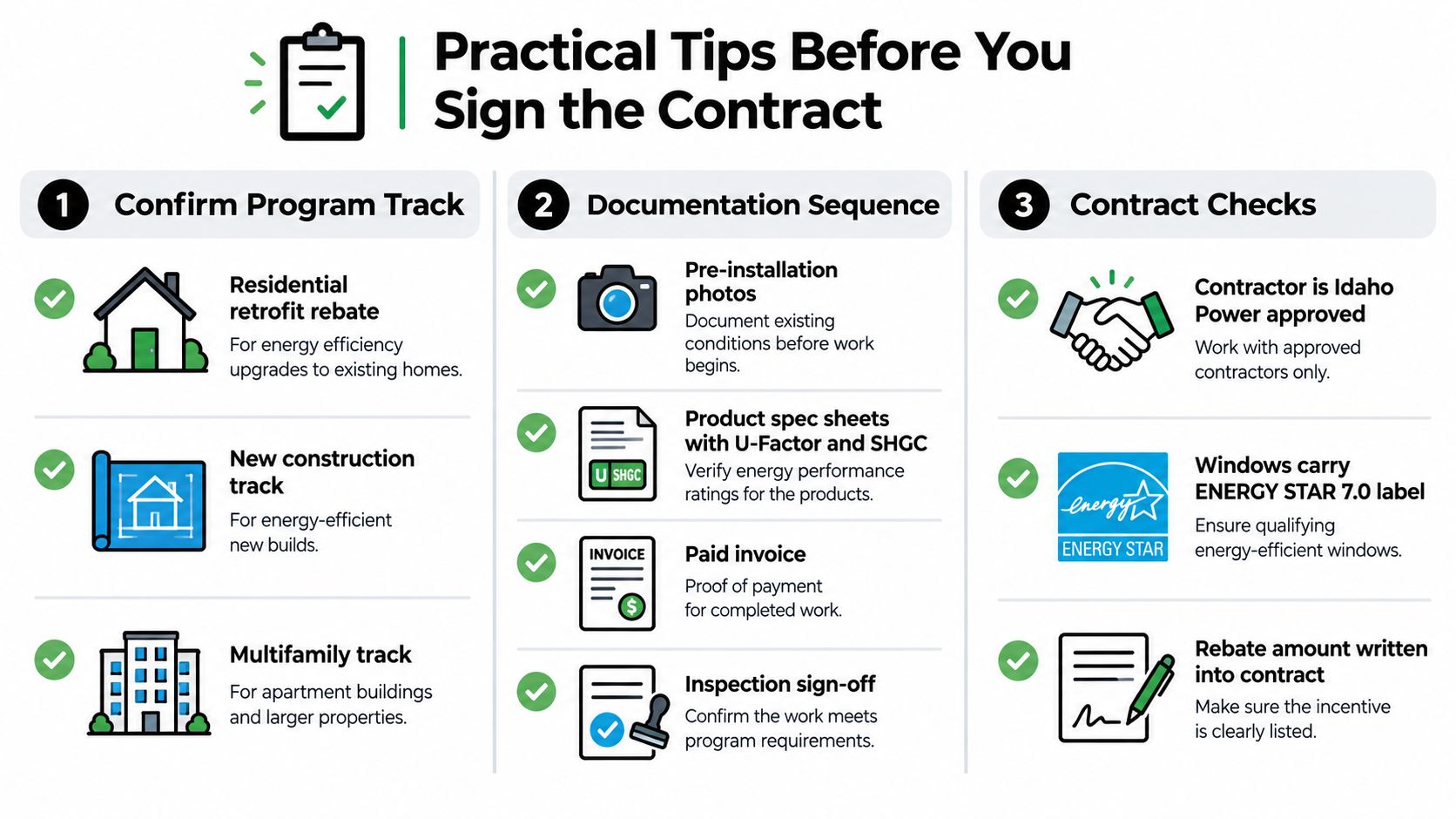
The safest approach is simple: classify the property before pricing the rebate. A qualifying household may follow weatherization. A commercial building may use a per-square-foot building-shell incentive. A multifamily property with electric heat may use the U-factor tiers. Those tracks shouldn't be blended into one promise.
Put these checks in writing
- Confirm the program: Ask the contractor to name the exact Idaho Power track and explain why the property qualifies.
- Verify the window data: Require the U-factor, SHGC, product model, glass package, and ENERGY STAR 7.0 status on the quote.
- Check the paperwork owner: The contract should state whether the installer submits pre-approval, final documents, and inspection requests.
- Protect the timeline: For applicable non-lighting retrofit projects, submit the application within 90 days of completion, as Idaho Power requires.
- Keep the evidence: Retain the contract, paid invoice, product specification sheets, NFRC certificates, photographs, and inspection sign-off.
- Resolve inspection first: Don't treat the project as rebate-complete until Idaho Power confirms the required inspection has passed.
The old federal-style incentive referenced in Idaho Power's 2023 Fall Energy Efficiency Guide also illustrates why program dates matter. That guide listed exterior windows and lights at a 30% credit up to $600, doors at 30% or $250 per door up to $500, and insulation and air sealing at a 30% credit up to $1,200. Those figures belong to that historic guide, not an evergreen promise for today's homeowner, so current eligibility must be verified before signing.

The blunt answer is that most ordinary single-family homeowners shouldn't expect a standard Idaho Power check for replacement windows. Start with income-qualified weatherization, demand written performance values, and reject any quote that hides the program category or leaves the paperwork responsibility vague.
C & C Windows & Doors provides Treasure Valley consultations, custom window measurements, energy-efficient product specifications, and installation support for Boise, Meridian, Eagle, Nampa, Caldwell, Kuna, Garden City, and Star. Visit C & C Windows & Doors to discuss your window project, verify which Idaho Power path may apply, and get a quote that identifies the performance data before you commit.