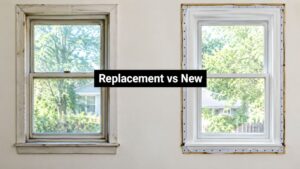

A homeowner in a 1990s subdivision near Meridian notices the same problems every winter. Cold air crosses the living room, condensation keeps returning between the panes, and the bedroom over the garage never feels comfortable. The first instinct is often to blame the windows, but Boise homes can also lose substantial comfort through an under-insulated attic, leaky ducts, or gaps around recessed lights and plumbing penetrations.
That's why vinyl window replacement in Boise shouldn't begin with a sales pitch or a promise of effortless savings. It should begin with a diagnosis. If the windows have failed seals, damaged frames, or obvious air leakage, replacement can be the right investment. If the windows are sound but the attic and ductwork are weak, air sealing and insulation may deserve attention first.
Table of Contents
- Why Boise Homeowners Are Replacing Windows Right Now
- What Makes Vinyl the Right Frame for Treasure Valley Homes
- Boise's Climate Zone and What It Means for Window Specs
- What Vinyl Window Replacement Actually Costs in Boise
- From Consultation to Debris-Free Installation Day
- Financing, Warranties, and How to Vet a Boise Installer
- Your Boise Homeowner Window Replacement Checklist
Why Boise Homeowners Are Replacing Windows Right Now
January exposes bad windows quickly. A failed insulated glass seal leaves a permanent haze or fog between the panes, not on the room-facing surface. Wiping the glass won't fix it because the insulating space has lost its seal. That's a window problem, and replacement glass or a complete replacement unit may be justified depending on the condition of the frame.
Other signs are harder to dismiss:
- Cold drafts: Air movement around the sash or frame points to failed weatherstripping, poor installation, or a deteriorated unit.
- Visible daylight: Light around the frame means the opening isn't sealed correctly.
- Soft or crumbling sills: Probe suspicious wood carefully. Deteriorated material can indicate long-term water intrusion.
- Persistent cold rooms: A room over a garage may have weak floor insulation or duct problems, not just poor windows.
- Difficult operation: Sashes that bind, refuse to lock, or won't stay open often signal worn balances or frame distortion.
Practical rule: If the glass is fogged, the frame is soft, or you can feel air entering around the opening, a window contractor should inspect the assembly, not just quote a new pane.
The gas bill also deserves context. A cold living room and higher heating use can result from windows, but attic insulation and duct leakage often affect the whole house. If every room feels chilly, start with an energy assessment and inspect the attic before assuming every window needs replacement. If one side of the home feels cold, especially around visibly damaged openings, the windows become more likely suspects.
Replacement makes the most sense when the existing units are visibly failing, the home is more than two decades old, or the project already includes remodeling for resale. New windows can also improve operation, reduce exterior noise, and refresh curb appeal. Those benefits matter even when a different efficiency project would produce a faster energy payback.
Boise-focused guidance places the area at roughly 5,000 to 6,000 heating degree days, which indicates meaningful annual heating demand and helps explain why insulated replacement windows remain a common upgrade in the Treasure Valley. ENERGY STAR's climate-zone finder is the appropriate reference for matching window performance to local conditions.
What Makes Vinyl the Right Frame for Treasure Valley Homes
For most Boise replacement projects, vinyl is the sensible default. Modern multi-chambered PVC frames create insulating air spaces, resist routine moisture exposure, and don't require the recurring painting that wood demands. Welded corners also create a continuous frame connection, which is preferable to mechanically fastened joints where wind-driven rain and seasonal movement can test the assembly.
Fiberglass is the strongest alternative when dimensional stability and a narrow frame are priorities. It handles temperature changes well and can provide a refined appearance, but the installed price is usually higher. Wood-clad windows offer the natural interior character many homeowners want, especially in a high-end remodel, but exterior cladding doesn't eliminate the need to monitor the wood interior, finishes, and drainage.
Aluminum is the material I'm most cautious about in a cold Boise replacement. Metal conducts heat readily, so an aluminum frame can create colder interior surfaces and undermine the comfort gains homeowners expect from improved glass. It may make sense for a specific architectural design, but it isn't the practical starting point for a heating-dominated climate.
| Frame Material | Cold-Weather Performance | Maintenance | Typical Boise Installed Cost | Best Fit |
|---|---|---|---|---|
| Vinyl | Strong insulation when the whole unit has a low U-factor | Low routine maintenance | Get a written local quote | Most replacement projects |
| Fiberglass | Very stable through seasonal temperature changes | Low maintenance | Get a written local quote | Narrow frames and premium performance |
| Wood-clad | Good potential performance with careful detailing | Higher maintenance | Get a written local quote | Character homes and design-led remodels |
| Aluminum | Conductive unless extensively thermally improved | Low surface maintenance | Get a written local quote | Specific commercial or architectural uses |
The frame alone doesn't determine the outcome. Glass package, spacer design, weatherstripping, drainage, and installation all matter. A well-designed vinyl unit with low-emissivity glass and argon can outperform a more expensive frame that is poorly sized or badly installed.
My practical view is straightforward. Vinyl often delivers roughly 80 percent of fiberglass's performance at a noticeably lower installed cost, making it the right answer for most Treasure Valley homeowners. That comparison is a judgment about typical project value, not a universal laboratory rating. Choose fiberglass or wood-clad when the design, frame profile, or long-term material preference justifies the added expense.
Boise's Climate Zone and What It Means for Window Specs
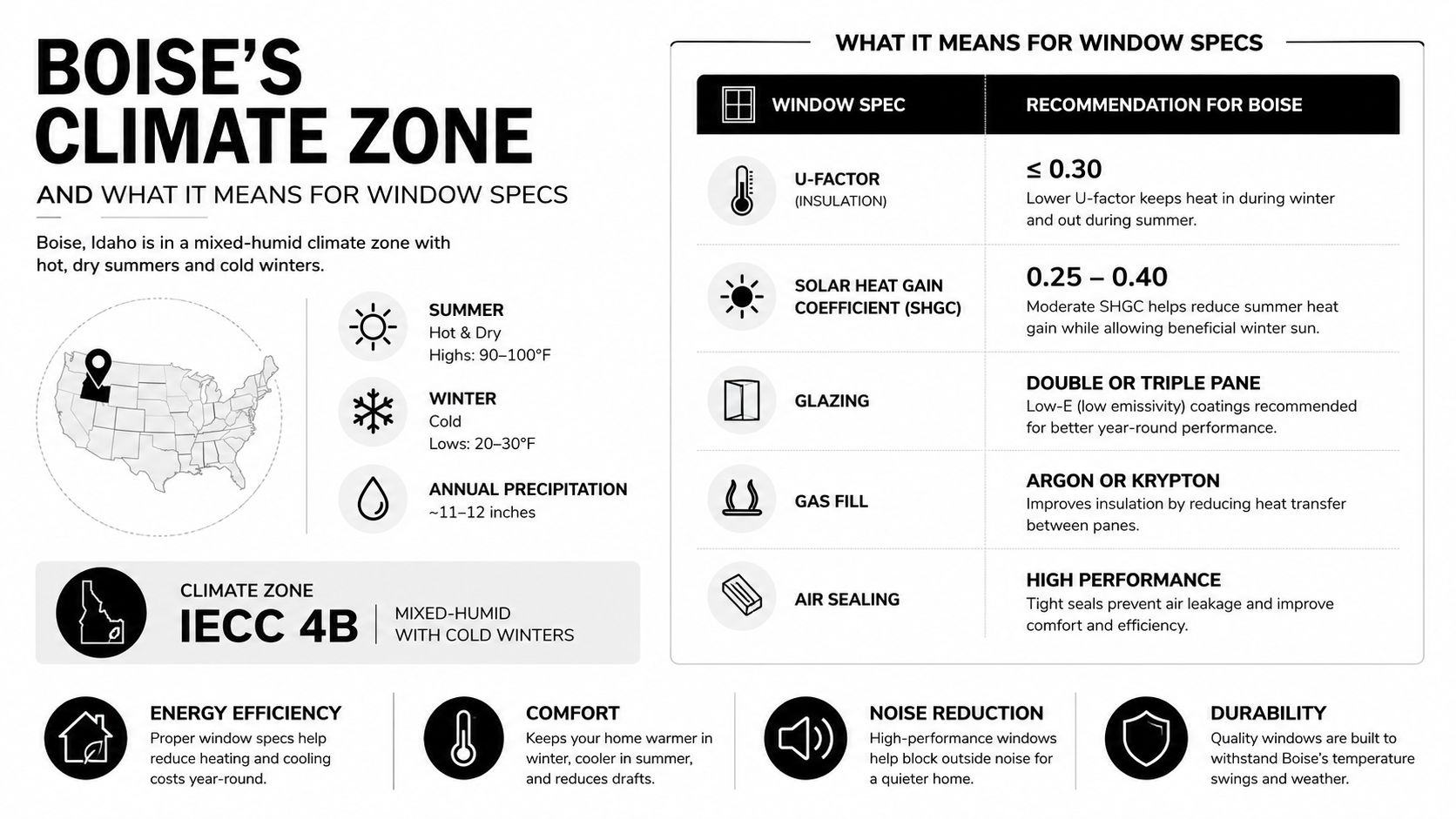
In a Boise winter, a window can feel cold even when the furnace runs normally. That makes the product label and the installation details equally important. Boise and the Treasure Valley are generally treated as IECC Climate Zone 5, so replacement units should be selected for a heating-dominated climate. Use ENERGY STAR's climate-zone reference to confirm the applicable guidance before comparing quotes.
U-factor measures heat transfer through the complete window. Lower numbers reduce conductive heat loss, but the target must match the product category and specification being used. ENERGY STAR Version 7.0 lists a U-factor of 0.24 or lower for North-Central climates. Its ENERGY STAR Version 7.0 residential window specification also reinforces the point that the rated assembly matters, not the glass alone.
Read the whole NFRC label
The NFRC label reports U-factor and Solar Heat Gain Coefficient for the complete unit, including the frame and spacers. Do not approve a quote only because it promises low-E glass. Check the frame, sash, spacer, and operating style as one system.
Air leakage deserves its own line of review. ENERGY STAR and NFRC rating practices treat it separately from U-factor, and many cold-climate buyers look for 0.30 cfm per square foot or lower. The NFRC certification information for an ENERGY STAR-rated unit shows how that rating is listed independently.
Casement windows generally test tighter than double-hung windows because the sash compresses against a continuous seal. Choose casements when draft control is the priority and the room layout suits their outward operation.
Choose the glass for the exposure
Low-E coatings reduce heat transfer and manage solar gain. For Boise, favor a cold-climate package that holds heat indoors, then review Solar Heat Gain Coefficient for south- and west-facing windows exposed to strong summer sun. Argon fills improve the insulating space between panes, while warm-edge spacers reduce heat flow around the glass perimeter.
The right specification cannot fix a careless installation. Gaps at the rough opening can create drafts, moisture movement, drainage problems, and condensation even when the unit has strong ratings. If several windows are uncomfortable, compare replacement with attic insulation and air sealing first. Those upgrades can deliver faster payback when the frames are sound and the main problem is leakage through the home's envelope.
For a homeowner-focused explanation of these choices, see this guide to windows for Idaho winters.
What Vinyl Window Replacement Actually Costs in Boise
A trustworthy Boise quote should show more than a single total. The price changes with the opening size, operating style, frame color, grid pattern, glass package, and installation method. A retrofit insert may preserve more of the existing frame, while a full-frame replacement exposes the rough opening and can address hidden deterioration, insulation gaps, and flashing problems.
Second-story access can also affect labor. Large picture windows, specialty shapes, and openings above porches require more handling and protection than standard ground-floor units. Ask the installer to separate product, labor, disposal, exterior trim, interior trim, structural repairs, and any permit responsibility.
| Window Type | Builder-Grade Vinyl | Mid-Range Vinyl | Premium Triple-Pane Vinyl |
|---|---|---|---|
| Standard opening | Lower quote, basic options | Balanced performance and appearance | Higher performance package |
| Larger or specialty opening | Cost rises with size and access | More configuration choices | Premium glass and hardware options |
| Best use | Tight budget and sound openings | Most whole-home replacements | Comfort-focused upgrades and demanding exposures |
The supplied Boise pricing material identifies wide-ranging savings estimates and notes that results depend on the starting condition of the windows, the age of the home, and installation quality. That's more useful than pretending every homeowner receives the same payback. The Idaho vinyl window cost guide can help you organize quote questions, but the final number still needs to come from measured openings and a written scope.
Build the payback estimate honestly
Start with the actual problem window. Compare the annual heating cost associated with the current opening against the proposed unit, then account for weatherization work that might deliver a faster return. Don't count the entire gas bill as window-related unless an energy assessment supports that conclusion.
Historical ENERGY STAR analysis listed Boise, identified as ID_Boise, with estimated energy-savings values of 12.62 in Phase 1 and 63.12 in Phase 2, alongside additional figures of 4.17 and 33.18 in the same dataset. Those figures come from a 2008 ENERGY STAR windows, doors, and skylights analysis, so treat them as historical context rather than a promise for a current home.
More recent Boise-oriented guidance estimates that replacing older single-pane windows with double-pane low-E units can produce 25% to 30% annual energy savings, while triple-pane low-E and argon packages are estimated at 50% to 60% in the same market context. Those figures are estimates, not guaranteed outcomes, and the source itself emphasizes that baseline condition and installation quality change the result.
Incentives also changed. Recent 2026 guidance states that the federal 25C window credit expired at the end of 2025, and there is no Idaho statewide window rebate program. Current Boise window efficiency guidance also points income-qualified homeowners toward Idaho Power weatherization resources. Verify current utility eligibility before including any rebate in your math.
From Consultation to Debris-Free Installation Day
A professional project begins before anyone removes a sash. During the consultation, the installer should inspect the existing frame, exterior trim, interior finish, sill condition, operation, glass seals, and signs of water entry. A measurement appointment should then confirm every opening individually, including out-of-square conditions and clearance for the selected operating style.
The written proposal should identify whether the job is retrofit or full-frame, which glass and spacer package is included, who handles trim, how damaged framing is priced, and what happens to the old units. Manufacturing and delivery take planning, so don't schedule the crew until the products, measurements, and scope are confirmed.
The opening decides the lifespan
Water management is not optional. A sill should direct incidental water toward the exterior rather than trapping it behind a fully sealed bottom edge. One recognized installation standard calls for a discontinuous sill bead with two 2-inch voids near the ends, or an approved weep or wicking method, so water can escape. The masonry installation guidance provides the mechanical detail.
The installer should set the unit plumb, level, and square, then use appropriate shims so the frame doesn't twist under fastening. The same guidance describes shims every 16 inches on the sill and every 24 inches on the jambs, and warns that fasteners through the sill can compromise drainage.
Low-expansion window foam belongs around the perimeter where specified. Fiberglass batt stuffed into the gap doesn't provide the same controlled air seal and can compress unevenly. Exterior self-adhering flashing should overlap in a shingle-style sequence so upper layers shed water over lower layers, not behind them.
What a clean install looks like
The crew should protect floors and furniture before removing stops or sashes. Old fasteners, stops, and debris should be extracted rather than buried behind the replacement unit. At the end of each opening, the installer should verify operation, locks, reveal, sealant joints, trim, and drainage paths.
A debris-free day includes drop cloths, controlled removal, vacuum extraction, and full haul-away. Ask to see the sill and flashing before interior trim covers them. A clean room is good housekeeping, but it isn't proof of good installation. The hidden work matters more.
Installation warning: A bead of exterior caulk can't correct a missing sill drainage path, a twisted frame, or an opening that was never flashed correctly.
Before the crew leaves, operate every sash and lock, inspect the visible sealant, look for damaged screens, and confirm that the project manager records outstanding touch-ups. Don't accept “the trim will hide it” as an answer to a drainage or alignment question.
Financing, Warranties, and How to Vet a Boise Installer
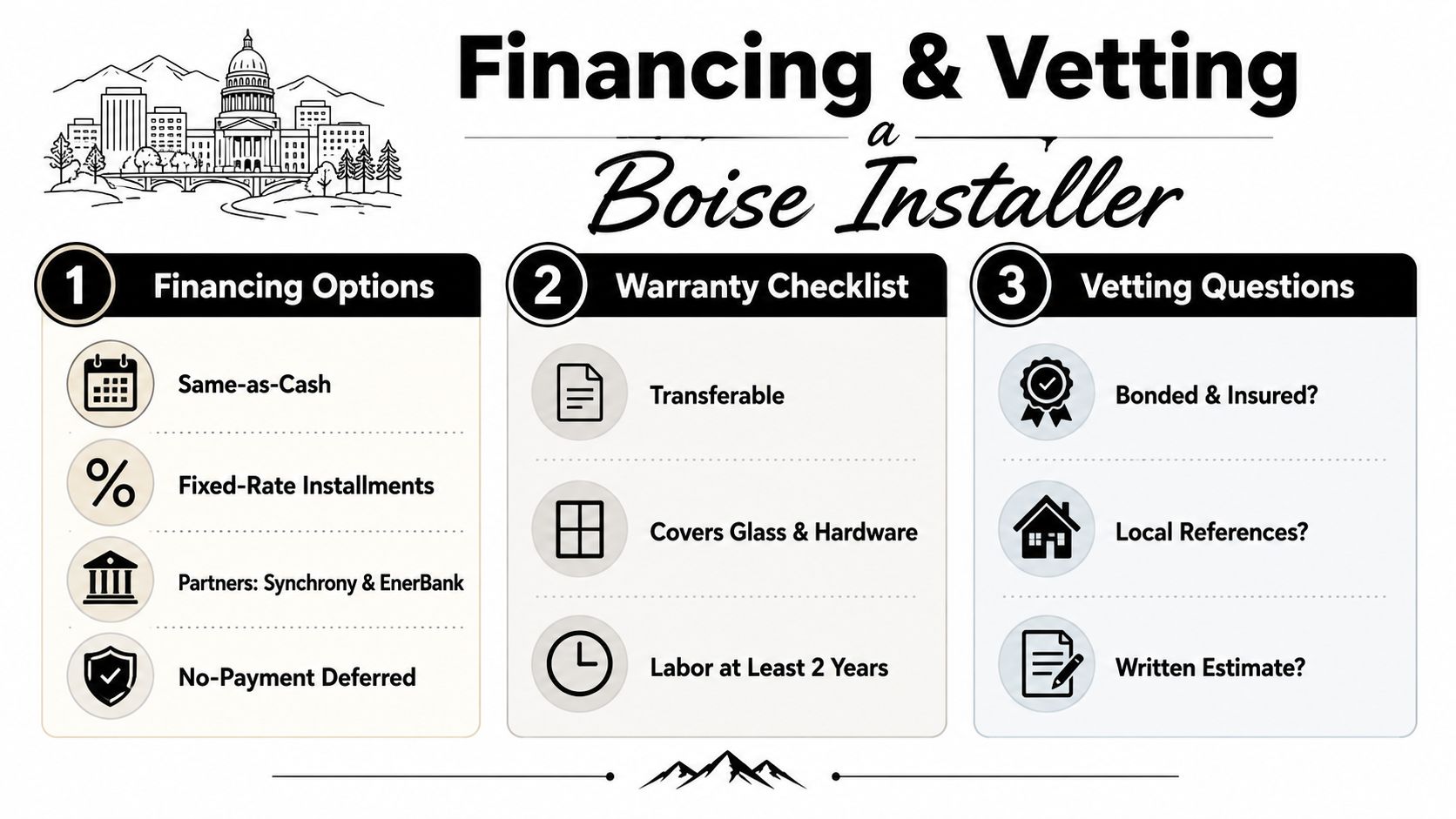
Financing should match the project, not drive it. Same-as-cash terms can work when the homeowner already has a reliable payoff plan. Fixed-rate installments through partners such as Synchrony or EnerBank create predictable payments, while a HELOC may offer flexibility for a larger remodel but puts the borrowing against home equity. Cash remains the simplest option when it doesn't compromise emergency reserves.
Read the warranty in separate pieces. The frame warranty may cover material defects, while the glass warranty may address seal failure or breakage under different conditions. Hardware coverage can have its own exclusions, and labor may be covered for a limited period rather than for the full product term. Transferability matters if you expect to sell.
Questions worth asking
- Who measures the openings? Confirm that the person responsible for ordering the units performs or reviews the final measurements.
- Who installs the windows? Ask whether the crew is in-house or subcontracted and who handles warranty service.
- What does the sill detail include? Require a clear answer about drainage, shims, perimeter insulation, and flashing.
- Which ratings appear on the NFRC label? Ask to see the complete-unit U-factor and Solar Heat Gain Coefficient.
- What happens if hidden damage appears? Get repair pricing and approval procedures in writing.
Verify the contractor's Idaho licensing status, liability insurance, workers compensation coverage, and lead-safe credentials when applicable. Request local references from Boise, Meridian, or nearby Treasure Valley communities within the recent period stated in the company's own references. Ask for written proof of product certification rather than relying on a brochure.
For a broader contractor screening process, use this guide on choosing a window company in Boise. C & C Windows & Doors is one local option that offers custom measurements, energy-efficient replacement windows, patio doors, and debris-free installation, with financing through Synchrony. Compare its written scope and warranty terms with other bids instead of accepting any company's claims without documentation.
Your Boise Homeowner Window Replacement Checklist
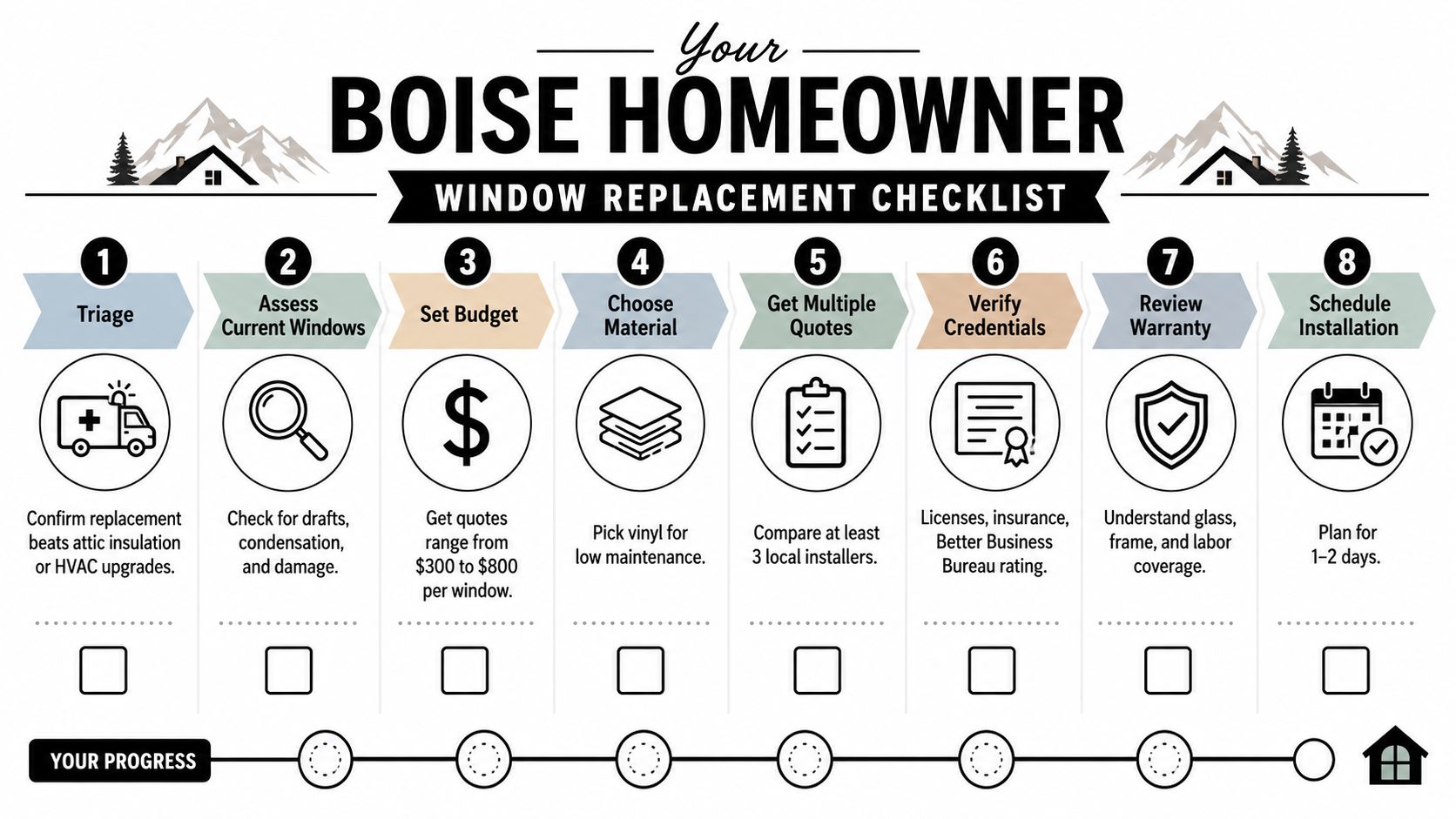
Use this sequence before signing a contract.
- Triage the problem. Decide whether failed windows are causing the discomfort, or whether attic insulation, air sealing, or duct leakage deserves priority.
- Inspect each opening. Record drafts, fogging between panes, soft sills, damaged frames, poor operation, and visible daylight.
- Set a realistic budget. Get quotes based on measured openings, not a generic per-window promise. Ask for separate product, labor, trim, disposal, and repair lines.
- Select the frame and glass together. Vinyl is the practical default for most Boise homes, but compare the complete NFRC label, not just the frame material.
- Confirm climate performance. Look for a low U-factor suited to Climate Zone 5, appropriate solar-gain control, and an air-leakage rating at or below the relevant target.
- Vet the installer. Check licensing, insurance, lead-safe credentials where applicable, certification documentation, references, and whether the crew is in-house.
- Put the scope in writing. Include retrofit or full-frame method, sill drainage, shimming, flashing, foam, sealant, trim, permits, protection, cleanup, and haul-away.
- Plan the final walkthrough. Inspect drainage, flashing, frame alignment, locks, screens, sash operation, interior trim, and exterior joints before closing the job.
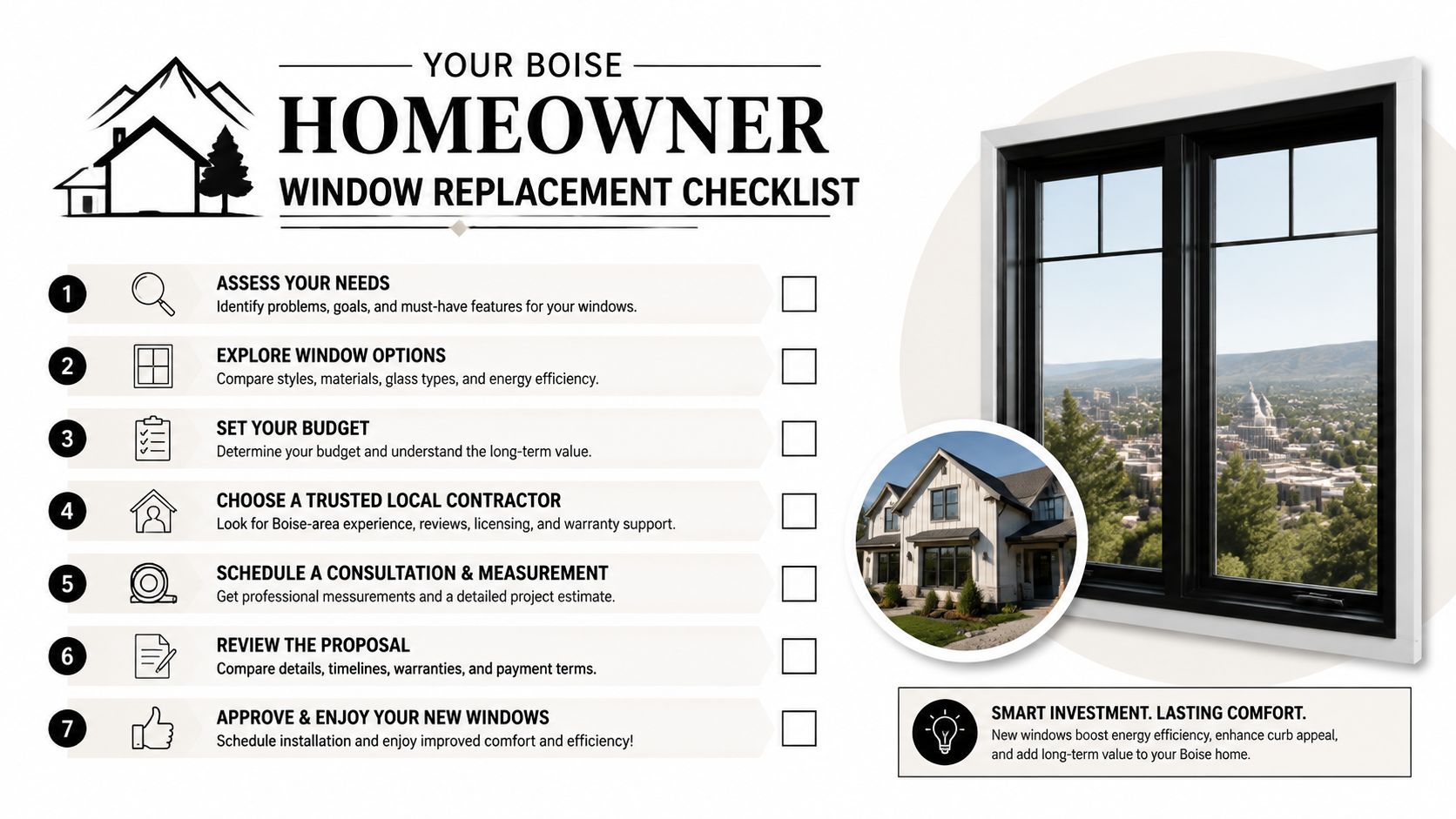
Don't let a contractor rush the decision because winter is uncomfortable. Replace windows when the assemblies are failing, the opening is part of a larger renovation, or comfort and operation justify the work. If the units are sound, start with the attic and air leakage because window replacement isn't automatically the fastest energy upgrade.
If your Boise or Treasure Valley windows are drafty, fogged, difficult to operate, or due for a remodel, C & C Windows & Doors provides free in-home consultations, custom measurements, energy-efficient vinyl options, and meticulous debris-free installation. Schedule an evaluation and ask for a written recommendation that distinguishes window failure from insulation and air-sealing problems.