A realistic Kennewick window replacement cost is about $600 to $1,050 per window installed, while full-frame work, premium glazing, custom sizing, or a whole-house project can push the total well above that baseline. A single standard replacement may cost $400 to $900, but the installation scope matters more than the sticker price.
That distinction changes how you should compare estimates. A low quote may cover only an insert window, while a higher quote may include tear-out, disposal, new trim, flashing, custom measurements, and a more efficient glass package. The useful number is the installed cost after eligible rebates and credits, not the product price printed on a showroom tag.
Table of Contents
- What Kennewick Homeowners Pay Per Window
- The Cost Drivers Behind Every Quote
- Real Estimate Scenarios for Kennewick Homes
- Rebates and Tax Credits That Reshape the Net Price
- Energy Savings ROI and Payback Windows
- Permits, Timing, and Warranty Options in Kennewick
- Your Next Step Toward a Same-Day Accurate Quote
What Kennewick Homeowners Pay Per Window
For the Kennewick and Tri-Cities market, a defensible starting point is $600 to $1,050 per opening installed, based on the Yakima, Pasco, Richland, and Kennewick regional benchmark in Washington replacement-window cost data. That figure describes a standard installed project, not necessarily a premium full-frame renovation.
Material choice broadens the range. Washington estimates place vinyl double-hung windows near $400 to $800, fiberglass near $600 to $1,100, and aluminum-clad wood near $900 to $1,600 per opening. Those categories overlap because glass, access, removal, framing repairs, and finish work can affect the invoice as much as the frame material. Homeowners comparing regional pricing can also review this window replacement cost guide for Idaho for a broader frame comparison.
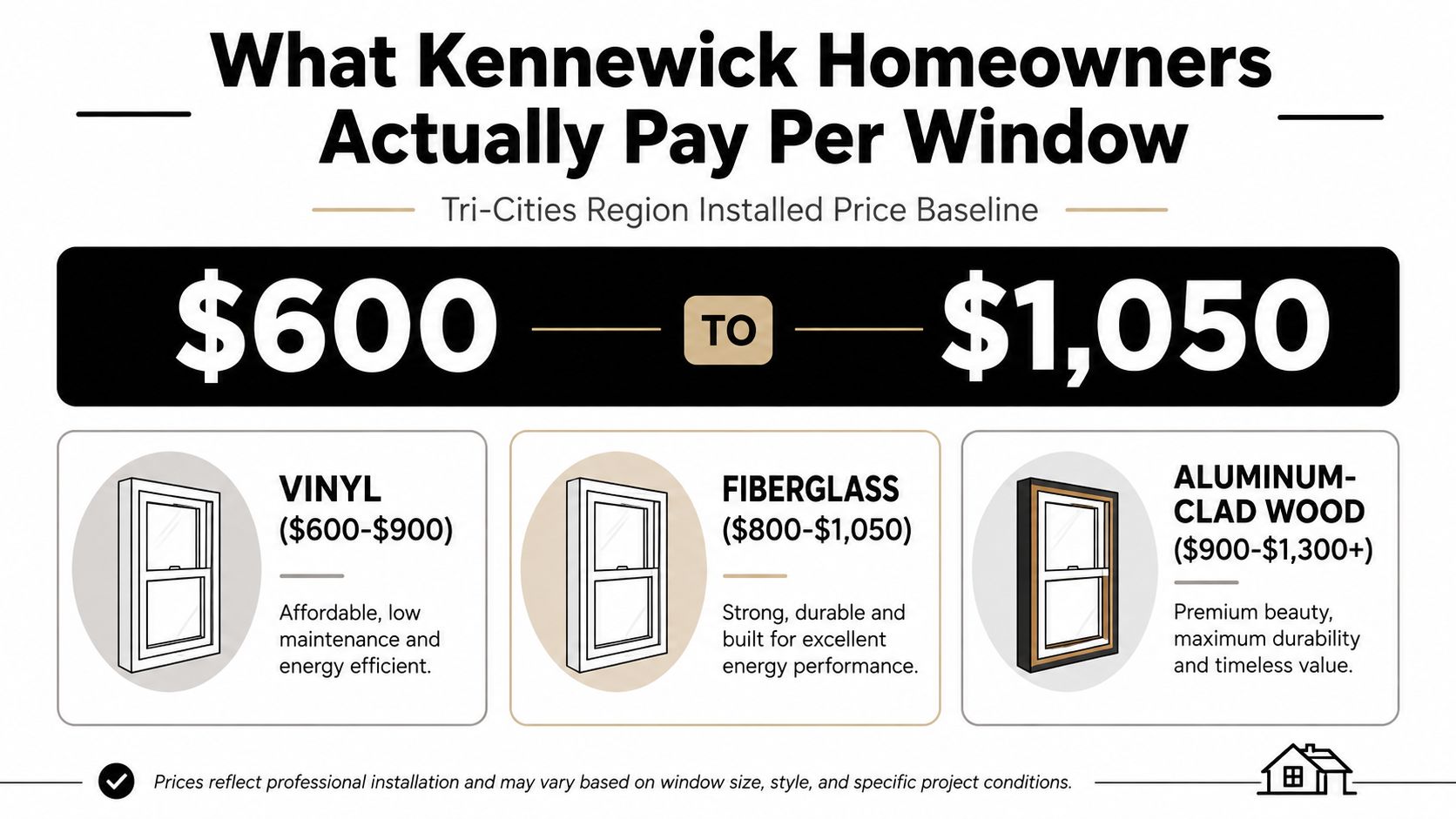
Installed price is the number that matters
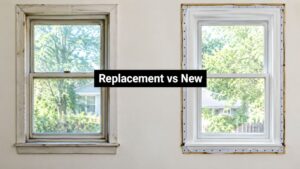
An insert replacement keeps the existing frame. The installer removes the sash, prepares the opening, sets the replacement unit, insulates around it, seals the exterior, and completes the interior finish. Labor and trim disruption stay lower when the original frame is sound and the replacement size is readily available.
A full-frame replacement removes the window to the rough opening. That process can reveal rot, failed flashing, uneven framing, or interior and exterior finish work that an insert leaves in place. Custom sizing adds measuring, manufacturing, and installation time.
The final quote should also show whether rebates or credits apply. A product price alone does not show the homeowner's net cost after labor, disposal, full-frame work, or eligible incentives.
Practical rule: Ask whether every price is quoted per opening, installed, and inclusive of disposal and finish work. Otherwise, you are comparing products rather than complete projects.
Homeowners weighing frame options can review this guide to vinyl versus wood windows before requesting bids.
The Cost Drivers Behind Every Quote
Four variables set the installed price of a Kennewick window: frame material, glazing, installation scope, and labor complexity. Material selection gets attention, but the work required around the opening often determines whether a quote sits near the low or high end of the regional range.
Frame material and glazing
Vinyl is usually the budget-conscious option. It needs little maintenance and can keep the project near the lower end when the opening is standard, the existing frame is sound, and little repair is required.
Fiberglass costs more than entry-level vinyl and provides a rigid frame with a different appearance. Aluminum-clad wood occupies a higher tier because it combines exterior cladding, a wood interior, and more involved finishing. Washington benchmarks place these broad installed categories at $400 to $800 for vinyl double-hung, $600 to $1,100 for fiberglass, and $900 to $1,600 for aluminum-clad wood per opening. Those ranges include installation, so they are not simple material surcharges.
Glass also changes the quote. Standard double-pane glass provides the basic reference point. Low-E coatings, gas fills, and triple-pane assemblies raise the unit price, while improving comfort, reducing conductive heat loss, and softening outside noise. Premium assemblies can reach $2,500 per opening in some Kennewick estimates when removal, disposal, and finish carpentry are included. Homeowners can review regional window cost guidance for a breakdown of the factors that shape installed pricing.
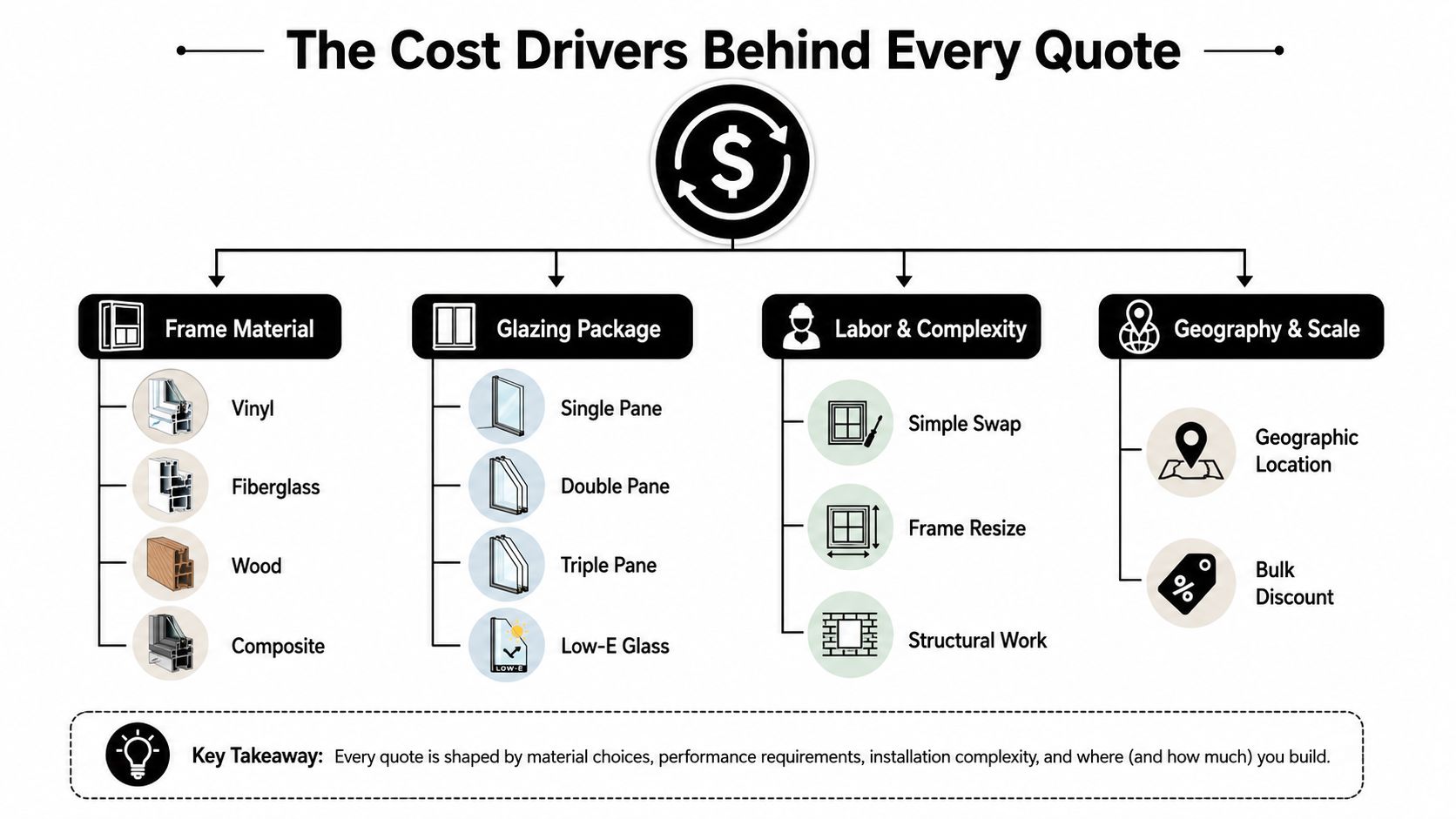
Installation type and labor
An insert replacement is generally the simpler path because the existing frame remains. A full-frame tear-out reaches the rough opening and may expose conditions that change the final price:
- Frame condition: Rot, water damage, or deteriorated framing may require repair before the new unit is installed.
- Opening size: Custom sizing adds measurement, manufacturing, and installation time.
- Trim and capping: Interior casing, exterior trim, metal capping, and paint-ready finishing can turn a quick replacement into finish carpentry.
- Access: Upper-story windows, tight side yards, landscaping, and difficult delivery routes increase handling time.
- Disposal: Old windows, packaging, and construction debris must be hauled away or assigned clearly to the homeowner.
Frame choice also affects long-term maintenance and appearance. A homeowner comparing vinyl and wood window options should weigh those ongoing trade-offs alongside the initial quote.
Ask which work is included in the price for each opening. A $600 installed estimate and a $1,050 installed estimate may both be reasonable when they cover different scopes.
Real Estimate Scenarios for Kennewick Homes
A failed single window and a whole-house upgrade require different budgets. The scenarios below separate opening count, glazing, and installation scope so you can compare like with like.
| Project Size | Typical Opening Range | Glazing Tier | Installed Cost Range |
|---|---|---|---|
| Single insert replacement | $400 to $900 | Standard double-pane or basic low-E | $400 to $900 |
| Partial-home project, 6 to 8 windows | $400 to $900 per opening | Mid-tier fiberglass with argon low-E glass | $2,400 to $5,400 |
| Premium whole-house project, 10 to 15 openings | $600 to $1,050+ per opening | Composite frames, triple-pane glazing, full-frame tear-out | $6,600 to $17,100 |
One-window replacement
The single-window range fits a drafty or failed unit with a serviceable existing frame. Removal, setting, insulation, exterior caulking, and basic cleanup may be included. Hidden structural repairs, extensive interior trim work, and opening enlargement usually require separate pricing.
A Kennewick estimate published under a construction-company source places this standard replacement scenario at $400 to $900. Treat that figure as a local reference point, not a guaranteed bid, and verify the installation scope in writing through local replacement-cost estimates.
Partial-home replacement
Replacing six to eight windows can target rooms with the worst drafts, failed seals, or street noise without disturbing every opening. The supplied scenario totals $2,400 to $5,400 with mid-tier fiberglass frames and argon low-E glass. Insert installation may stay near the lower end, while full-frame work, damaged framing, or custom sizing can raise the total.
Check whether the proposal includes haul-away, interior trim, exterior capping, caulking, and disposal. Excluded finish work can make a low initial quote misleading.
Premium whole-house work
A project covering 10 to 15 openings can total $6,600 to $17,100. Composite frames, triple-pane glass, custom openings, difficult access, and full-frame tear-out push pricing upward, while standard sizes and insert installation reduce labor.
Request an opening-by-opening schedule showing dimensions, window model, glazing, installation method, and finish package. That detail makes scope changes and the final net cost easier to track.
Rebates and Tax Credits That Reshape the Net Price
The contract total is only the starting point. For qualifying Washington installations, utility incentives may provide $180 per contractor-installed window for a U-Factor from .29 to .23, or $225 per window for a U-Factor of .22 or below, according to Washington contractor rebate guidance.
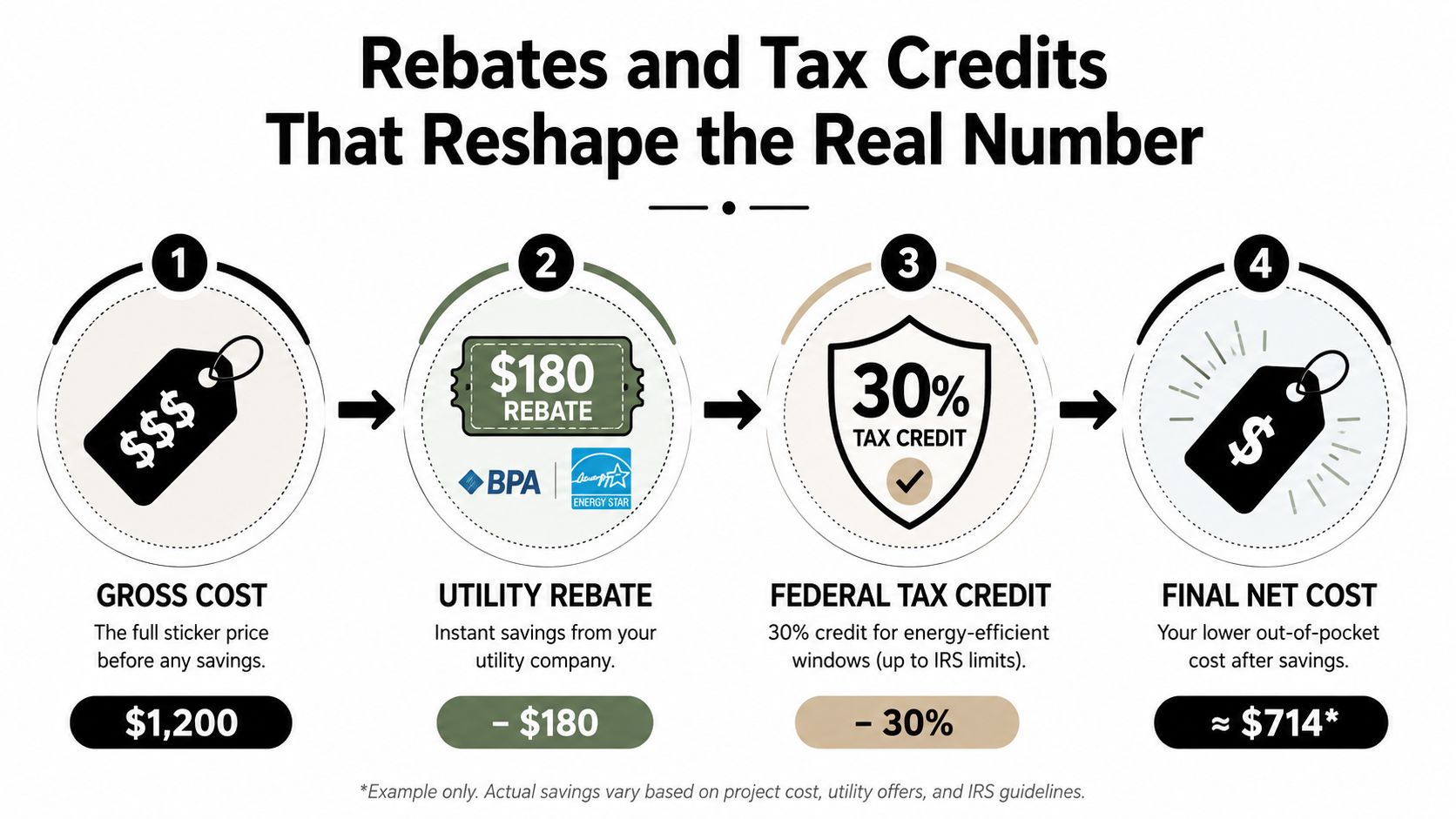
Confirm the utility incentive first
Check the U-Factor on the window certification or manufacturer documentation before signing the order. The installed product must meet the applicable performance tier, and the contractor must follow the program's installation and paperwork requirements.
For a 10-window project, qualifying incentives could total $1,800 at $180 per window or $2,250 at $225 per window. That calculation assumes every opening qualifies and the program approves the installation. Your installer should verify both points.
Then calculate the federal credit
The federal Energy Efficient Home Improvement Credit covers qualifying exterior windows and skylights at 30% of eligible product cost, up to $600 in one taxable year. The products must meet ENERGY STAR Most Efficient criteria, as explained in ENERGY STAR's federal tax-credit guidance and the current 26 USC 25C statute.
Consider a 10-window project with a gross installed price of $11,400. If every window qualifies for the $180 utility incentive, the rebate is $1,800, reducing the project cost to $9,600. If the eligible product-cost portion supports the full federal limit, the credit may reduce tax liability by $600, producing a potential net economic cost of $9,000.
The federal credit is not a point-of-sale discount. Product eligibility, documentation, tax circumstances, and filing requirements determine whether you can claim it. A practical explanation appears in this guide to the window replacement tax credit.
Keep the invoice, product certification, U-Factor records, contractor paperwork, and rebate confirmation. Ask who submits the utility application and when the payment should arrive.
Energy Savings ROI and Payback Windows
Window efficiency affects comfort and operating costs, but the return is not guaranteed. Standard double-pane, low-E argon, and triple-pane packages perform differently based on the home's existing windows, air leakage, shading, HVAC equipment, occupancy, and installation quality.
A tighter assembly limits heat transfer through the opening. Low-E coatings manage radiant heat, gas fills improve the insulating space between panes, and triple-pane construction adds another glass layer and sealed space. Homeowners may notice fewer drafts and less outside noise before a change appears clearly on a utility bill.
Use payback as a planning tool
A premium package can add $1,000 to $2,000 per opening, as noted in the regional cost scenarios above. That added cost can make sense for an uncomfortable opening, a traffic-facing room, or a project already requiring full-frame replacement.
Calculate payback from the project scope, not the window label:
- Record current heating and cooling costs.
- Mark openings with drafts, condensation, failed seals, or noticeable noise.
- Separate necessary replacement work from the optional efficiency upgrade.
- Subtract qualifying utility rebates and the potential federal credit from the added premium.
- Treat projected utility savings as variable, not guaranteed.
The Tri-Cities climate brings hot summers and cool winters, so cooling control and winter comfort both affect the decision. A low-E argon package often provides a practical balance. Triple-pane glass carries a higher upfront cost and fits better when noise reduction, major comfort differences, or a high-performance envelope justify it.
The clearest comparison is the net upgrade cost after incentives. A larger rebate or tax credit lowers the amount that savings must recover, while full-frame labor and repair work can lengthen the payback period.
Better glass cannot compensate for poor installation. Air sealing, insulation around the frame, flashing, and exterior caulking determine whether the rated assembly performs in the wall.
Permits, Timing, and Warranty Options in Kennewick
Permit requirements can affect the final window replacement cost, schedule, and scope. Kennewick's permit estimate system includes categories for window and residence alteration work, as shown on the City of Kennewick permit estimate page. The page does not establish one universal fee for every project, so confirm the current requirement and charge for the specific property.
Confirm the permit path
Ask the contractor whether the proposed work needs a permit and who will submit it. Replacing a window within the existing opening may follow a different review path from changing the opening size, altering structural framing, or completing wider exterior work.
Full-frame replacement deserves particular attention. Removing the frame can expose damaged sheathing, framing, or flashing, and those discoveries may change both the work description and the estimate. Have the contractor explain whether the quoted price includes permit handling, inspection coordination, and repairs identified after tear-out.
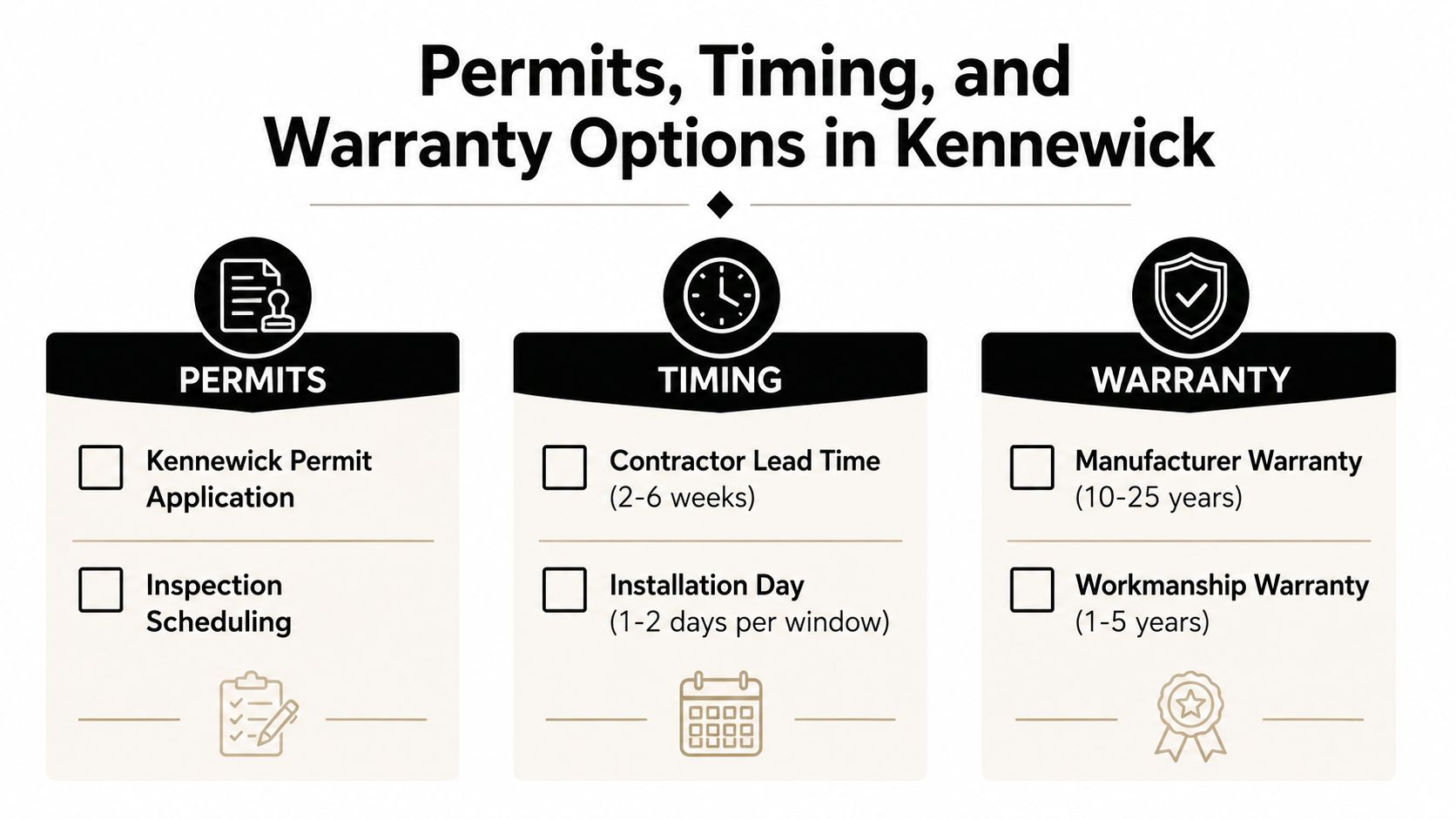
Plan around the actual work
A typical project may include measurements, product ordering, permit processing when required, installation, inspection, and a final walkthrough. Installation can move quickly for accessible openings, while custom products, multiple stories, weather, or repair work can extend the schedule.
Ask when final measurements happen and what the crew does if the rough opening needs repair. Confirm whether the proposal includes trim, exterior capping, insulation, flashing, caulking, paint-ready finishing, disposal, and any return visit for inspection corrections. These details often explain why two quotes with the same window count have different totals.
Read warranty language line by line
Compare the warranty before choosing a proposal:
- Product coverage: Which frame, hardware, seal, and glass defects qualify?
- Labor coverage: Will the installer correct installation-related problems?
- Transfer rules: Can coverage pass to a future homeowner?
- Exclusions: Are breakage, condensation, maintenance, or later alterations excluded?
- Service process: Do you contact the installer or manufacturer first?
Some premium local installers may offer lifetime limited product-and-labor coverage. Other proposals may include limited-lifetime product protection with shorter workmanship coverage. Financing through Synchrony may also be available for larger projects. Review the interest rate, promotional period, and repayment terms before accepting it.
Your Next Step Toward a Same-Day Accurate Quote
A reliable estimate starts with scope, not a catalog price. Before calling, count the openings you may replace, note whether the home is one or more stories, estimate the construction year, and write down the main reason for the project. Comfort, outside noise, appearance, resale preparation, and failed seals can lead to different recommendations.
Use this checklist during the consultation:
- Installation method: Is the quote an insert replacement or a full-frame tear-out?
- Included work: Does the price cover disposal, haul-away, trim, capping, insulation, flashing, and caulking?
- Glass performance: What U-Factor appears on the product documentation?
- Incentive paperwork: Who submits the utility rebate materials?
- Tax documentation: Does the product meet ENERGY STAR Most Efficient requirements for the federal credit?
- Repairs: What happens if the crew finds rot, damaged framing, or a mis-sized opening?
- Warranty: Which party handles product and workmanship claims?
| Incentive | Eligibility | Amount |
|---|---|---|
| Washington utility rebate | Contractor-installed window with U-Factor from .29 to .23 | $180 per window |
| Washington utility rebate | Contractor-installed window with U-Factor .22 or below | $225 per window |
| Federal Energy Efficient Home Improvement Credit | Qualifying exterior window meeting ENERGY STAR Most Efficient criteria | 30% of eligible product cost, capped at $600 per taxable year |
The most useful appointment includes custom measurements and a written opening-by-opening estimate. A complimentary in-home consultation can reveal whether the existing frames are suitable for inserts, whether full-frame work is justified, and which glass tier fits the home's comfort goals.
C & C Windows & Doors offers free in-home consultations, custom measurements, energy-efficient window and patio-door options, debris-free installation, a lifetime limited product-and-labor warranty, and Synchrony financing for qualifying projects. Visit C & C Windows & Doors to discuss your replacement scope and request a project-specific estimate.