
You can stand next to a window in Boise on a January morning and feel the problem immediately. The glass looks fine, but your hand tells the truth, the room has a cold edge, the floor feels drafty, and the furnace keeps running harder than it should.
That's the true test for the best windows for Idaho winters. Not the showroom pitch. Not the brochure language. The question is simple, does the window hold indoor heat in a heating-dominated climate, or does it leak comfort every time the temperature drops?
| Window option | Best fit in Idaho | What you should expect |
|---|---|---|
| High-performance double pane | Boise, Meridian, Eagle, and other Treasure Valley homes with decent walls and a solid budget | Good comfort, strong value, less upfront cost |
| Triple pane | Colder Idaho zones, drafty homes, or homeowners chasing maximum comfort and noise control | Lower heat loss and a heavier upfront investment |
| Older double pane | Only if you're replacing soon or budget is the only constraint | Better than single pane, but usually not good enough now |
| Single pane | No serious Idaho winter strategy | Heavy heat loss and cold glass |
For most homeowners, the right answer isn't “triple-pane no matter what.” The right answer is, buy the window that matches your climate zone, your house, and your tolerance for paying extra for comfort. If you're in the Treasure Valley and your current windows are tired, you need a clear-eyed buying guide, not a sales script.
Table of Contents
- What Idaho Winters Do to a Window
- The Four Performance Numbers That Matter
- Double Pane vs Triple Pane for Treasure Valley Homes
- Frame Materials That Hold Up to Cold
- Glass Upgrades That Actually Change How the Window Feels
- Why Installation Matters More Than the Window Sticker
- Cost vs Energy Savings in Real Numbers
- Choosing a Treasure Valley Installer and Final Recommendations
What Idaho Winters Do to a Window
A January morning in Boise shows you quickly how a window behaves in real life. Clear, cold nights pull heat out of the room, then the sun hits the glass the next day, then temperatures swing again after sunset. That constant cycling is hard on seals, frames, and anything that was already marginal.
Why the glass becomes the weak link
Your walls and roof are built to insulate. A window has to do insulation work while also staying clear, opening and closing, and handling moisture. That is a harder job, and it explains why old single-pane windows, which commonly land around 0.90 to 1.20 U-factor, feel so punishing in Idaho winters, and why many older double-pane units around 0.45 to 0.50 still underperform in a place that spends so much of the year heating the house (Idaho-focused window guidance).
The window is often the weakest thermal part of the envelope.
Practical rule: if a window feels cold to the touch in January, it is not doing enough for your home.
Homeowners make the same mistake over and over. They compare windows by brand name first. Start with performance. In the Treasure Valley, that means looking for a product with the right U-factor for your climate, because lower numbers mean less heat loss in a heating-dominated winter (Idaho climate guidance).
What you should care about before shopping
Your location matters first. Boise and the Treasure Valley need a different window than an Idaho mountain property. The coldest nights are when weak windows show their flaws, not when the salesman is standing in your kitchen.
That is why the first buying decision is not “double or triple?” It is, “what does this house need to stop bleeding heat?” A window that misses the target on insulation will keep making the furnace work harder, and no amount of trim color fixes that.
If you want a quick way to spot obvious problem windows before you price replacements, use this winter prep guide from C & C Windows & Doors.
The Four Performance Numbers That Matter
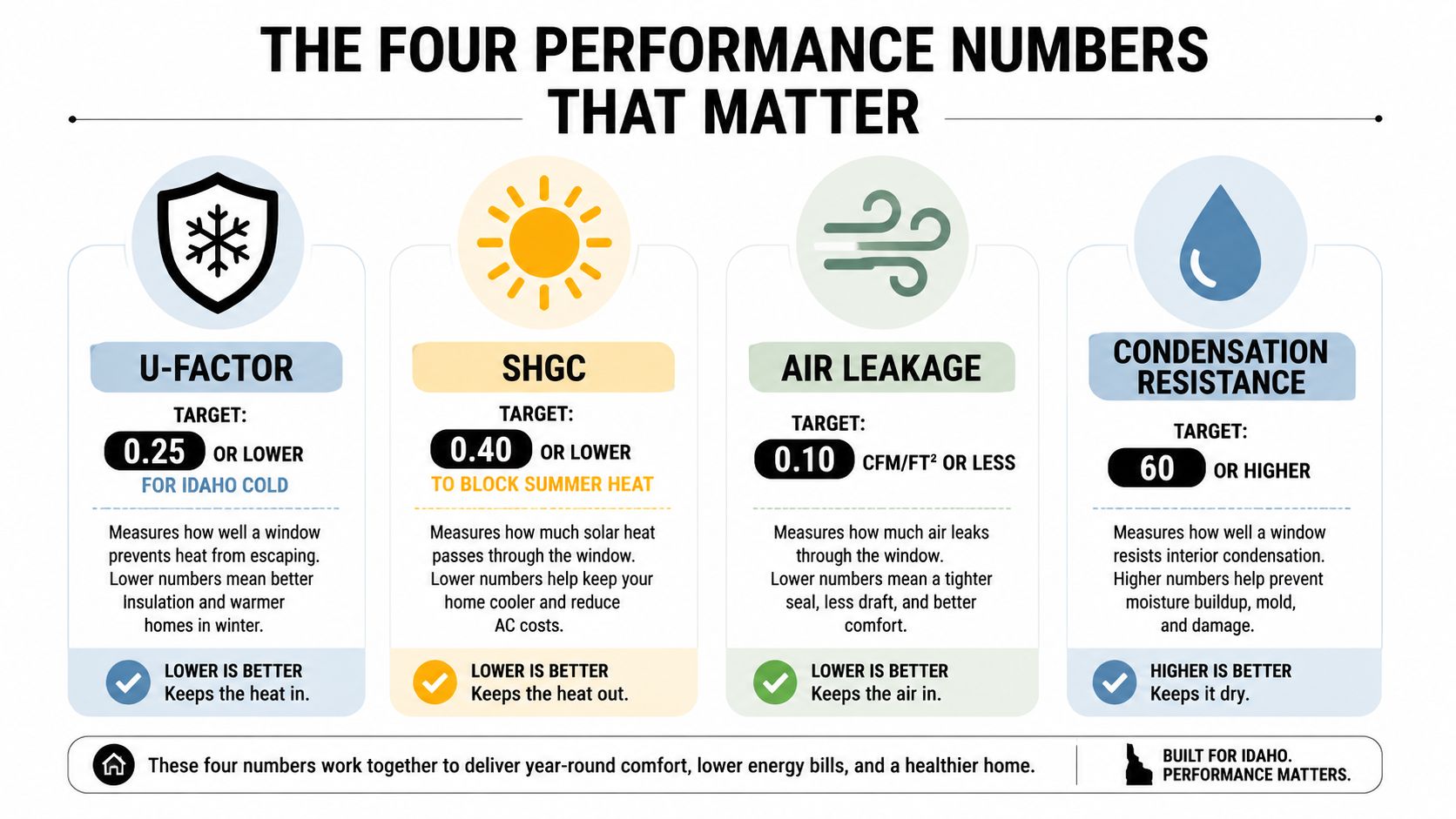
Window labels can look like alphabet soup, but in Idaho winter conditions, only four numbers really matter. If you can read these correctly, you can ignore most of the marketing noise and compare quotes like a pro.
U-factor is the headline number
U-factor tells you how much heat escapes through the window. For Idaho, that's the number to watch first. Independent Idaho-focused guidance says most of the state should target 0.27 or lower, while Southern Idaho and the Treasure Valley fall into the North/Central ENERGY STAR zone where 0.30 or lower qualifies (Idaho climate guidance).
That split matters. Boise-area homeowners can work within the 0.30 threshold, but if you want a stronger winter performer, aim lower when the budget allows. In colder parts of Idaho, the target tightens further, with guidance pointing to 0.22 for Zone 6 and 0.20 for Zone 7 (Idaho climate zone guide).
SHGC matters, but not as much as U-factor here
SHGC, or solar heat gain coefficient, measures how much solar heat comes through the glass. In Idaho, it matters more for summer sun control than for winter survival, because the heating season dominates. Southern Idaho guidance says 0.40 or lower qualifies in the North/Central zone (Idaho climate guidance).
That means you don't need to obsess over SHGC the way a desert homeowner would. You do need a number that keeps summer glare and heat gain in check.
Air leakage is the draft test
Air Leakage is where cheap windows get exposed. It tells you how much air slips through the unit. A leaky window can have decent glass and still feel miserable in a cold wind.
Condensation resistance matters on frosty mornings
CR, or Condensation Resistance, matters when you're seeing frost or interior moisture. A mountain-community Idaho guide lists CR ≥ 60 as a practical threshold for cold-weather performance (Sun Valley mountain window guide). That's a useful number if your windows run cold and you hate the look of moisture on the inside pane.
Use this Idaho window selection guide from C & C Windows & Doors if you want a second pass at what these numbers mean in a real home quote.
Double Pane vs Triple Pane for Treasure Valley Homes
This is the question homeowners ask, and they should ask it bluntly. Is triple-pane worth the extra cost in Boise and the Treasure Valley, or is a high-quality double-pane window enough? My opinion is direct, most Boise-area homes don't need triple-pane to be comfortable, but plenty of homes still benefit from it.
The real comparison
| Feature | High-Performance Double Pane | Triple Pane |
|---|---|---|
| Comfort in Boise-area winters | Solid if the unit is tight and well-rated | Better, especially near cold glass and drafty rooms |
| U-factor potential | Can land in the 0.27 to 0.30 range for Southern Idaho targets (Idaho climate guidance) | Can reach roughly 0.15 to 0.22 (Idaho climate guidance) |
| Upfront cost | Lower | Higher, because you're paying for another pane and more material |
| Weight and hardware load | Easier on older frames | Heavier sash, more stress on marginal openings |
| Best use case | Good Treasure Valley homes with decent insulation and reasonable comfort goals | Colder Idaho zones, drafty houses, or homeowners who want maximum comfort |
A high-performance double-pane unit is not junk. In the Treasure Valley, a good one can still meet the local climate target. That's the point a lot of guides miss. If your home is already reasonably sealed, and you're mostly trying to stop the chill and improve daily comfort, a strong double-pane package can be the smarter buy.
Triple-pane earns its premium when the house needs more help. That includes colder mountain pockets, older homes with weak openings, and spaces where comfort matters more than squeezing every dollar out of the quote. I'd also lean triple-pane if you're tired of waking up near a cold window or you want a noticeable noise reduction boost.
Straight answer: if your Boise home is mostly comfortable and you're replacing windows for value, high-performance double-pane is often enough. If the house is drafty, exposed, or sits in a colder pocket, triple-pane makes more sense.
One local option in the market is C & C Windows & Doors, which offers windows engineered for Idaho conditions, including ClimaTech Low-E coatings, Argon gas fills, and optional triple-pane glass for homes that want a stronger winter package.
Frame Materials That Hold Up to Cold
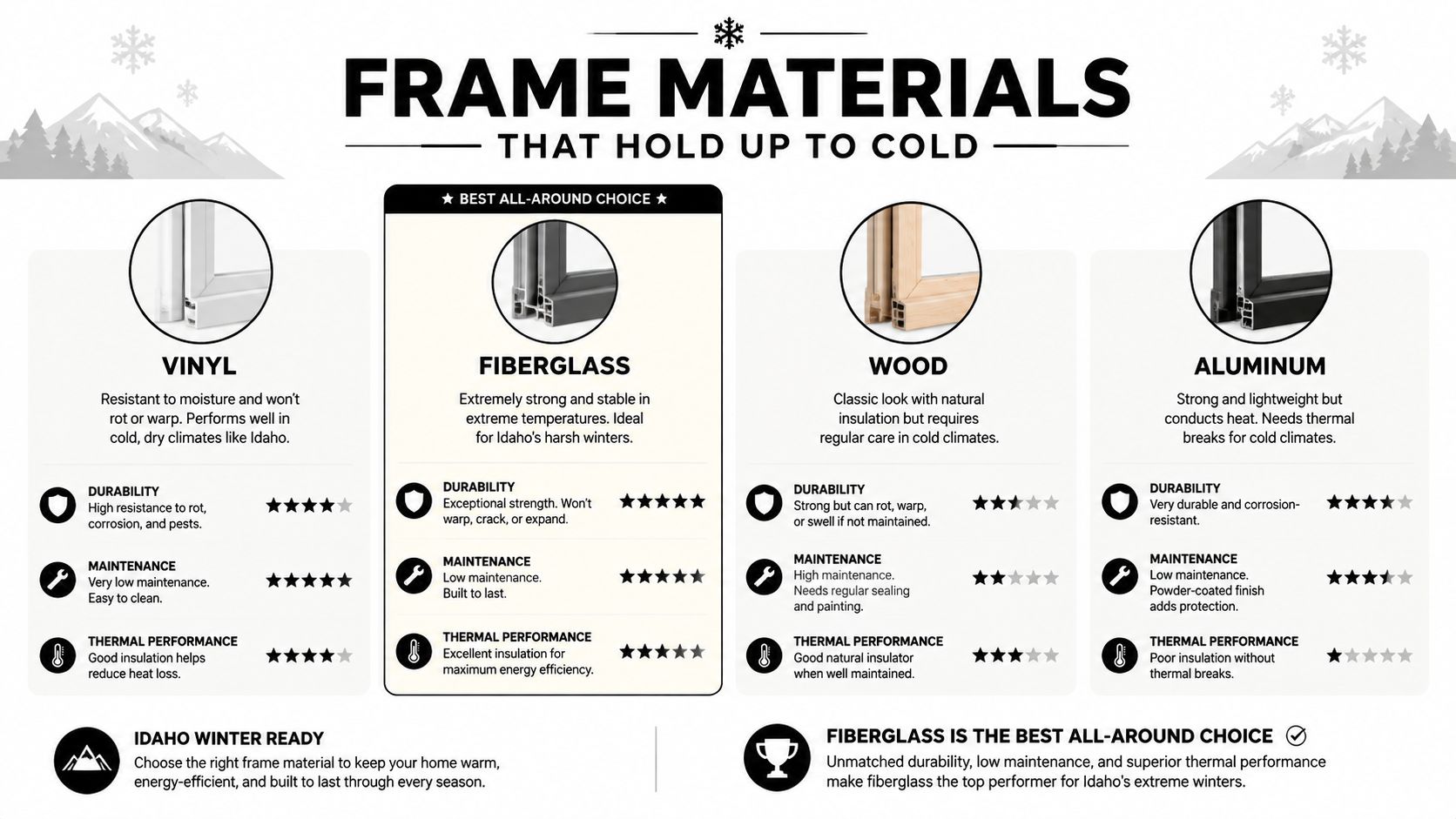
A lot of people shop glass first and frame second. That's backward. The frame decides whether the window stays square, keeps sealing, and resists condensation through years of winter and summer movement.
What each frame does in Idaho
Vinyl is common because it's cost-effective and generally performs well when it's built correctly. The catch is quality. Cheaper vinyl can move more with temperature swings, which is bad news in a place that shifts hard between freezing mornings and hot afternoons.
Fiberglass is the frame I trust most in colder, harsher conditions because it stays dimensionally stable. A mountain-community Idaho guide specifically recommends fiberglass frames for that reason (Sun Valley mountain window guide). That stability helps the seals stay aligned and keeps the window performing like it should.
Wood-clad gives you a strong interior look and solid insulation potential, but it needs more maintenance. If you love the finish and you're willing to care for it, wood-clad can work well. If you want low drama, it's not the easiest choice.
Composite usually lands in the middle. It can offer good stability and decent thermal performance, but the product quality varies more than people realize, so you need to judge the actual build, not just the category name.
My opinion on value
For a standard Treasure Valley home, good vinyl or fiberglass is usually the right conversation. Vinyl makes sense when the budget matters and the product is well-made. Fiberglass makes sense when you want a more stable frame and are willing to pay for it.
Installer's rule: if the frame can't stay square, the glass package won't save it.
For cold-climate homes, the extra frame quality pays off in fewer headaches later. For a normal Boise replacement, don't overspend on fancy materials if the home doesn't need them. Put the money where it changes comfort first, then decide if the frame upgrade is worth it.
Glass Upgrades That Actually Change How the Window Feels
Most homeowners think the big difference is just double pane versus triple pane. That's only part of it. The glass package decides whether the room feels sealed off from winter or just “new.”
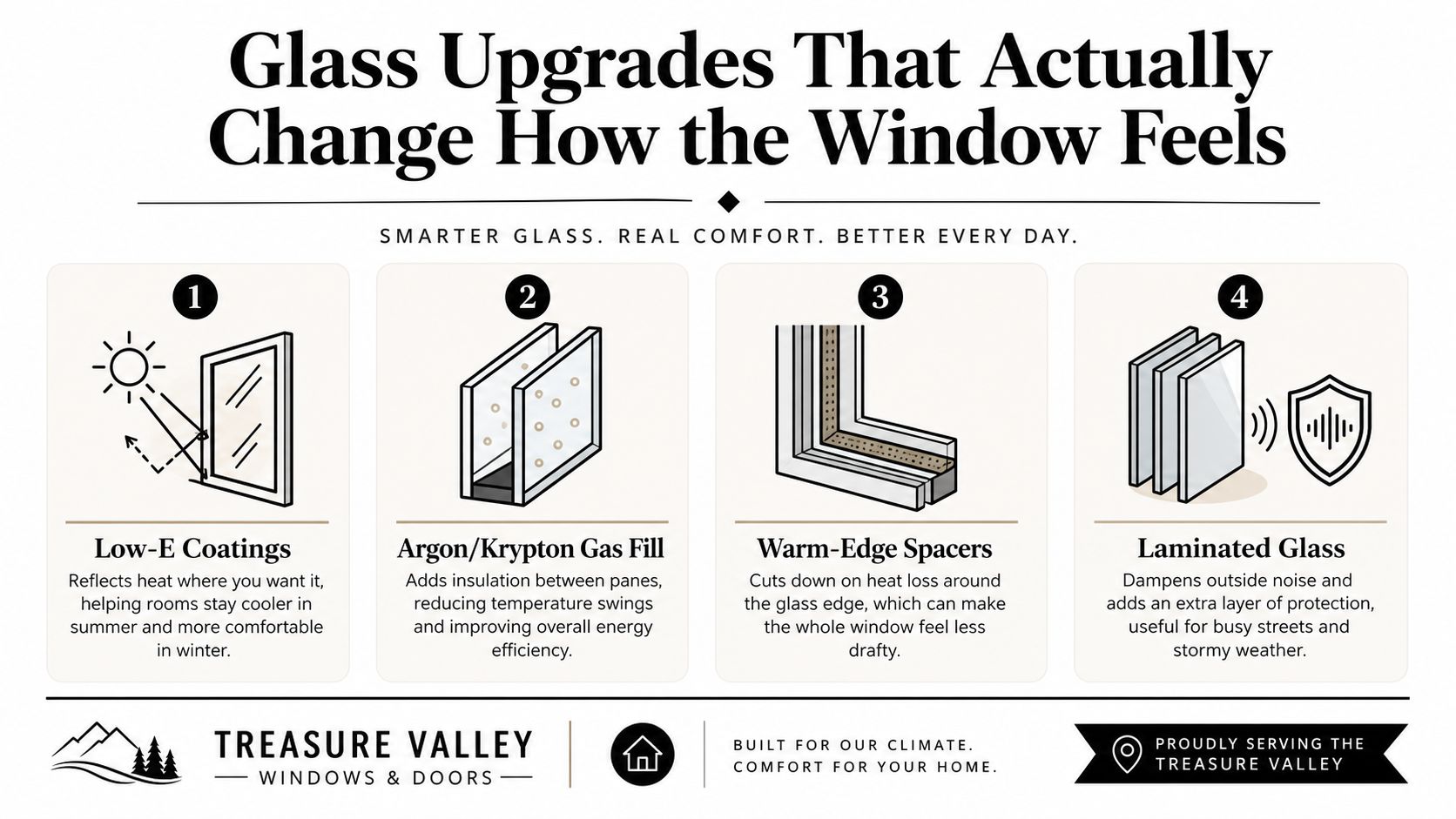
The upgrades that matter most
Low-E coatings are essential in Idaho. They reflect heat back into the room during winter and help block solar heat in summer. That's why they show up in serious winter packages, not just fancy brochures.
Argon gas fill improves insulation between panes. Idaho-focused guidance notes that argon conducts heat roughly 33% less effectively than air (Idaho climate guidance). That's a meaningful comfort upgrade, but only if the window is built and sealed well enough to hold the fill.
Warm-edge spacers help reduce the cold edge around the glass. That matters because the perimeter is often where condensation starts first. If you've ever seen moisture line up along the inside edge of a pane, you already understand why this matters.
Laminated glass isn't just for security. It can also soften outside noise, which matters if you live near busy roads, a school, or the airport corridor. A quieter room feels warmer and calmer, even when the thermostat hasn't changed.
What I'd actually pay for
If I were ordering windows for a Boise home, I'd prioritize Low-E, argon fill, and a strong spacer system before I got distracted by marketing extras. Those three influence daily comfort the most. Laminated glass is a smart add when noise is a real problem or when you want more security on exposed sides of the house.
Not every line item deserves your money. Some are just brochure shine. The honest quote should tell you which upgrades change performance and which ones are there to pad the package.
Why Installation Matters More Than the Window Sticker
A premium window installed badly will perform worse than a mid-range window installed with care. That's not a theory, that's what homeowners call about later when the first cold snap hits and the draft is still there.
The details that decide the result
The best install starts with the opening, not the sash. The crew should build a true sloped sill so water drains away instead of sitting in the rough opening. They should shim and fasten into framing, not rely on siding or guesswork. They should use low-expansion foam or backer rod at the perimeter, then seal the layers in the right sequence so air and water stay out.
The interior side matters too. A good crew ties the air seal into the drywall return so the opening isn't left half-finished. That's where a lot of the hidden comfort loss starts.
The failures homeowners actually notice
Bad installs show up fast. The sash starts sagging. Condensation appears where it shouldn't. Drafts come back on the first cold night, and the homeowner assumes the glass is bad when the problem is the install.
A window doesn't fail in the showroom, it fails at the rough opening.
If you're comparing bids, ask who is handling flashing, how they're sealing the perimeter, and what they do when the opening isn't square. The lowest price usually skips the most important work.
What to demand in writing
- Flashing sequence: ask how the crew tapes and layers the opening before the new unit goes in.
- Drainage detail: ask whether the sill is sloped for water management.
- Interior finish: ask if trim repair or drywall return work is included.
- Cleanup: ask whether debris removal is part of the job or an extra surprise later.
A careful local installer earns trust. It's also why companies that know Boise homes tend to perform better than crews that only know how to swap glass. If you want a cleaner, more accountable option, C & C Windows & Doors offers custom measurements, true sloped sills, and debris-free installation as part of its Treasure Valley-focused service.
Cost vs Energy Savings in Real Numbers
Homeowners want a straight answer on price, and they should. Professionally installed windows in Idaho generally range from $500 to $1,500 per window, depending on size, style, frame complexity, and glass package (Idaho installer guidance). For a 10-window project, that puts a full replacement somewhere between $6,000 and $12,000 before rebates, if you're choosing triple-pane vinyl in a typical install scenario (Idaho installer guidance).
Where the money usually goes
A high-performance double-pane package costs less because you're not paying for the third pane and the extra material that comes with it. Triple-pane pushes the budget up, but it also changes the feel of the room more noticeably in colder conditions. That's why the choice is rarely about utility savings alone.
For most Boise-area homes, the comfort and noise improvement drive the decision long before the utility payback does. That's the honest answer. If the house has single-pane windows, large west-facing glass, or rooms over garages, the upgrade tends to make more sense because those spaces lose comfort fast.
What I'd tell a homeowner with a real quote
If your current windows are still serviceable and your home is in the warmer Treasure Valley corridor, a strong double-pane replacement can be the smarter financial move. If your windows are old, drafty, or your home sits in a colder Idaho pocket, triple-pane starts to look like a better long-term buy.
The savings story is real, but it's not magic. The biggest value is comfort, stability, and reduced heat loss through the glass. Utility savings help, but they're not the only reason to replace windows in Idaho.
Choosing a Treasure Valley Installer and Final Recommendations
For a typical Boise-area tract home, I'd pick a high-performance double-pane window with Low-E, argon, and a tight installation. For a higher-end remodel with bigger view windows, I'd step up to triple-pane and a more stable frame. For a mountain or foothill home facing real cold, I'd go straight to the colder-climate package and not waste time pretending a basic unit will do the job.
Before you sign anything, use this Boise installer selection guide and ask these questions:
- Flashing and drainage: how will you handle the opening so water doesn't sit in the sill?
- Trim and drywall: is interior finish work included in the quote?
- Labor warranty: what does the warranty cover, and for how long?
- Cleanup: do you remove debris and leave the home clean?
Don't wait if your windows are already cold, drafty, or visibly failing. If the house feels uncomfortable every winter, the right replacement will fix more than the temperature around the glass. It changes how the whole room lives.
If you want honest guidance on the best windows for Idaho winters, C & C Windows & Doors can help you compare double-pane and triple-pane options, measure your home correctly, and install a package that fits Treasure Valley weather instead of generic brochure talk. Visit C & C Windows & Doors to schedule a free in-home consultation and get a clear recommendation for your house.