
You're inside your house, the windows are shut, and you can still hear the steady hum from the Connector, a delivery truck down the block, or tires slapping expansion joints on a busy Boise street. At night, that sound gets worse because the rest of the house goes quiet. A bedroom that should feel calm starts to feel exposed.
That problem is common across Boise and the Treasure Valley. Growth brings convenience, but it also brings more traffic, more density, and more outside noise finding the weak spots in older window systems. The good news is that window noise usually isn't random. It comes through specific failure points, and each one has a practical fix.
Boise also has a long relationship with the building trades. Boise Cascade was established in 1957, and by 2021 the Boise-headquartered company reported sales over $7.9 billion, a reminder that Boise has long been a serious building-materials hub, not just a fast-growing metro (Boise Cascade company history overview). That matters because homeowners here tend to care about materials, installation quality, and how products perform in local conditions.
If your house sounds louder than it should, don't guess. Start with the easy checks, move to the lower-cost fixes, and only spend replacement-level money when the window itself is the problem. If you're already seeing other signs of age, this Idaho window replacement warning signs guide can help you separate a noise issue from a broader window failure.
Table of Contents
- That Boise Rumble Is It Time to Silence Your Windows
- How to Pinpoint Your Window's Weakest Links
- First-Aid for Noisy Windows DIY Sealing Solutions
- Leveling Up Acoustic Curtains and Window Inserts
- The Ultimate Fix High-Performance Replacement Windows
- Knowing When to Call a Boise Window Professional
That Boise Rumble Is It Time to Silence Your Windows
A lot of homeowners start with the same complaint. “I thought replacing the blinds would help.” It won't. Blinds cut light, not sound. If road noise still comes through with the window locked, the weak link is usually the seal, the frame, the glass package, or the installation.
The Boise version of this problem has a pattern. South and west exposures often feel louder in the afternoon because the house is already working harder against heat. Bedrooms facing a busier collector road often feel louder early in the morning when traffic starts before the rest of the neighborhood does. Homes near frequent stop-and-go traffic tend to notice low rumble and acceleration noise more than sharp, high-pitched noise.
What noise usually means in a real house
There are a few common scenarios:
- You hear a faint whistle on windy days. That usually points to an air leak, not a glass problem.
- You hear broad traffic wash all day long. That often means the whole window assembly is underperforming.
- You hear sharp voices, barking, or tire hiss. That can come through gaps, thinner glass, or weak sash compression.
- You feel a draft and hear noise together. Air and sound often travel through the same path.
Practical rule: If the noise changes noticeably when you press on the sash or frame with your hand, the window likely has a sealing or fit issue, not just a “thin glass” issue.
Some homes can get meaningful improvement from simple sealing work. Some can't. If the unit is old, loose, or built with a basic glass package, patching around the edges may make it less annoying without ever making it quiet.
The phrase Cascade Windows Boise usually comes up when homeowners are trying to sort through replacement options and want something that fits local climate demands as well as comfort concerns. That's the right instinct. In Boise, better sound control and better thermal performance often overlap because tighter, better-built windows do a better job controlling both air leakage and outside disturbance.
How to Pinpoint Your Window's Weakest Links
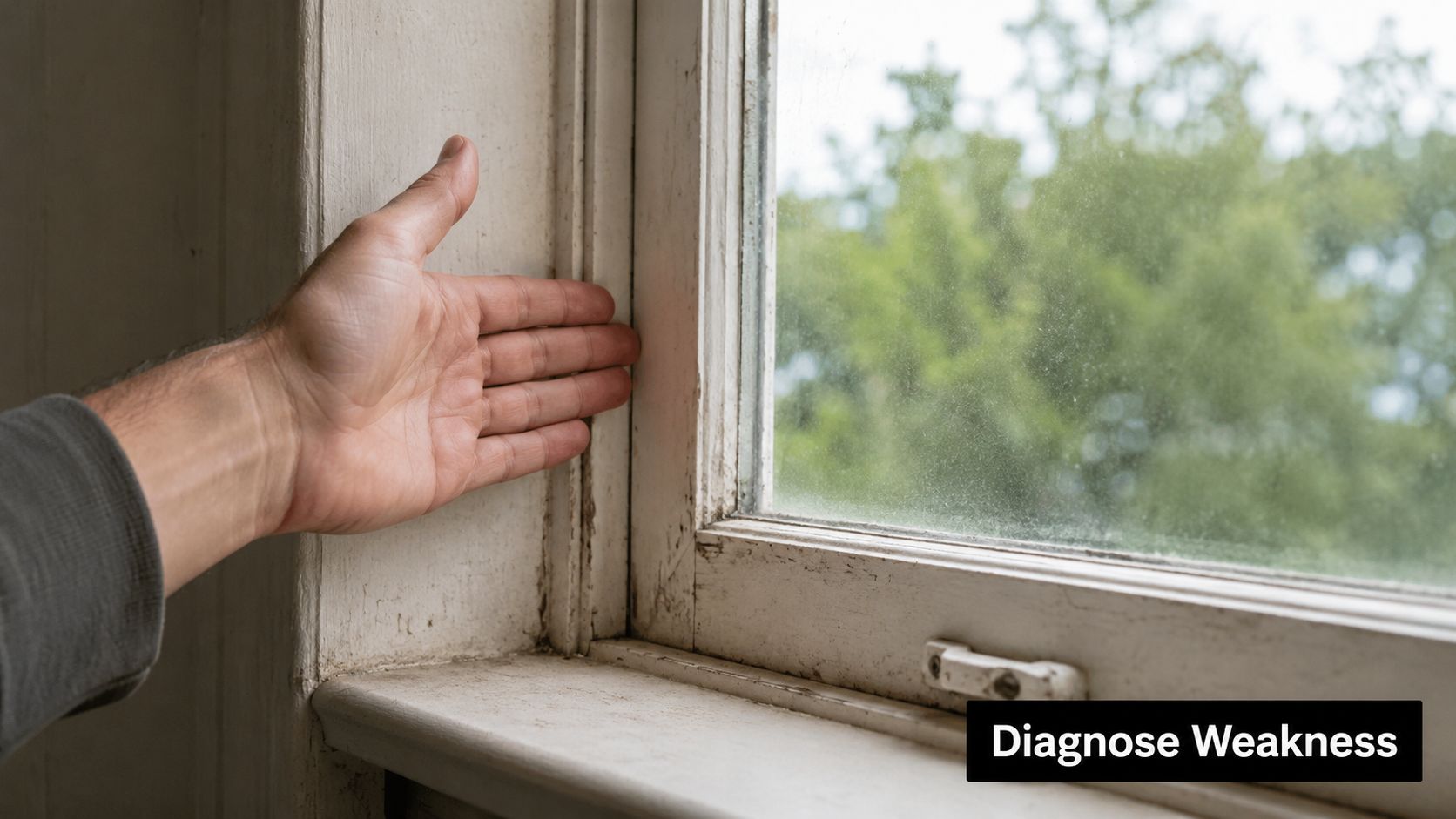
Before you buy anything, inspect the window like a technician would. You're trying to answer one question. Is the noise coming around the window, through the operable parts, or through the glass package itself?
Start with what you can see
Stand inside during daylight and inspect the full perimeter.
Look for:
- Cracked caulk lines: Old perimeter sealant often pulls away at corners first.
- Compressed weatherstripping: If it looks flattened, shiny, or brittle, it's not doing much.
- Fogging between panes: That points to a failed insulated glass seal.
- Warped sash lines: If reveal gaps look uneven, the sash may not be seating correctly.
- Rot, swelling, or soft trim: Moisture damage often goes with leakage and noise intrusion.
Open and close the window slowly. It should move smoothly and lock without forcing. If you need to tug hard to engage the lock, the sash may be out of alignment. If the meeting rails don't pull tight together, outside sound will find that path every time.
Noise that rides in with a draft is often the cheapest kind to fix. Noise that comes through a sealed but underbuilt window is usually more expensive.
Then check the sash pressure
Use the paper test. Close the window on a strip of paper and tug lightly. Try this at several points around the sash.
What you're looking for:
- Firm resistance means the sash is compressing the weatherstripping.
- Easy sliding means that spot is loose.
- Mixed results around the frame usually means uneven alignment or worn seals.
Do this on the latch side, the opposite side, and near the corners. Corners are common failure points.
Then do a simple listening test. Pick a steady outside sound, like traffic wash or an HVAC unit. Stand close to the center of the glass, then move to the edges, then the lock area. If the sound jumps near the edge, your leak path may be perimeter-related. If the volume stays similar across the whole surface, the glass package may be the limiting factor.
What your findings usually mean
A quick translation helps:
| Symptom | Likely issue | Best next move |
|---|---|---|
| Whistling in wind | Air gap at perimeter or sash | Re-caulk or replace weatherstripping |
| Rattle or loose feel | Hardware or fit problem | Adjust sash, lock, or call for service |
| Fog between panes | Failed insulated glass unit | Glass replacement or full window evaluation |
| Broad road noise with no draft | Glass and frame performance limit | Consider inserts or replacement |
| Binding when opening | Out-of-square frame or warped sash | Professional diagnosis |
If you're looking at Cascade Windows in Boise for a replacement project, this diagnostic step matters. Cascade's product information highlights a heavy 3-1/4" or 2-3/4" multi-chambered vinyl frame, welded frame and sash corners, double weather-stripping, and steel reinforcement at locking hardware, and the manufacturer's installation guidance requires full support under the frame, flashing at bottom and sides, a 3/8" nominal bead of flexible sealant behind the nailing fin, top re-flashing, and setting the unit square, plumb, and level before final fastening (Cascade product and installation details). Those details matter because a good window still performs badly if it's installed out of square or under-supported.
First-Aid for Noisy Windows DIY Sealing Solutions
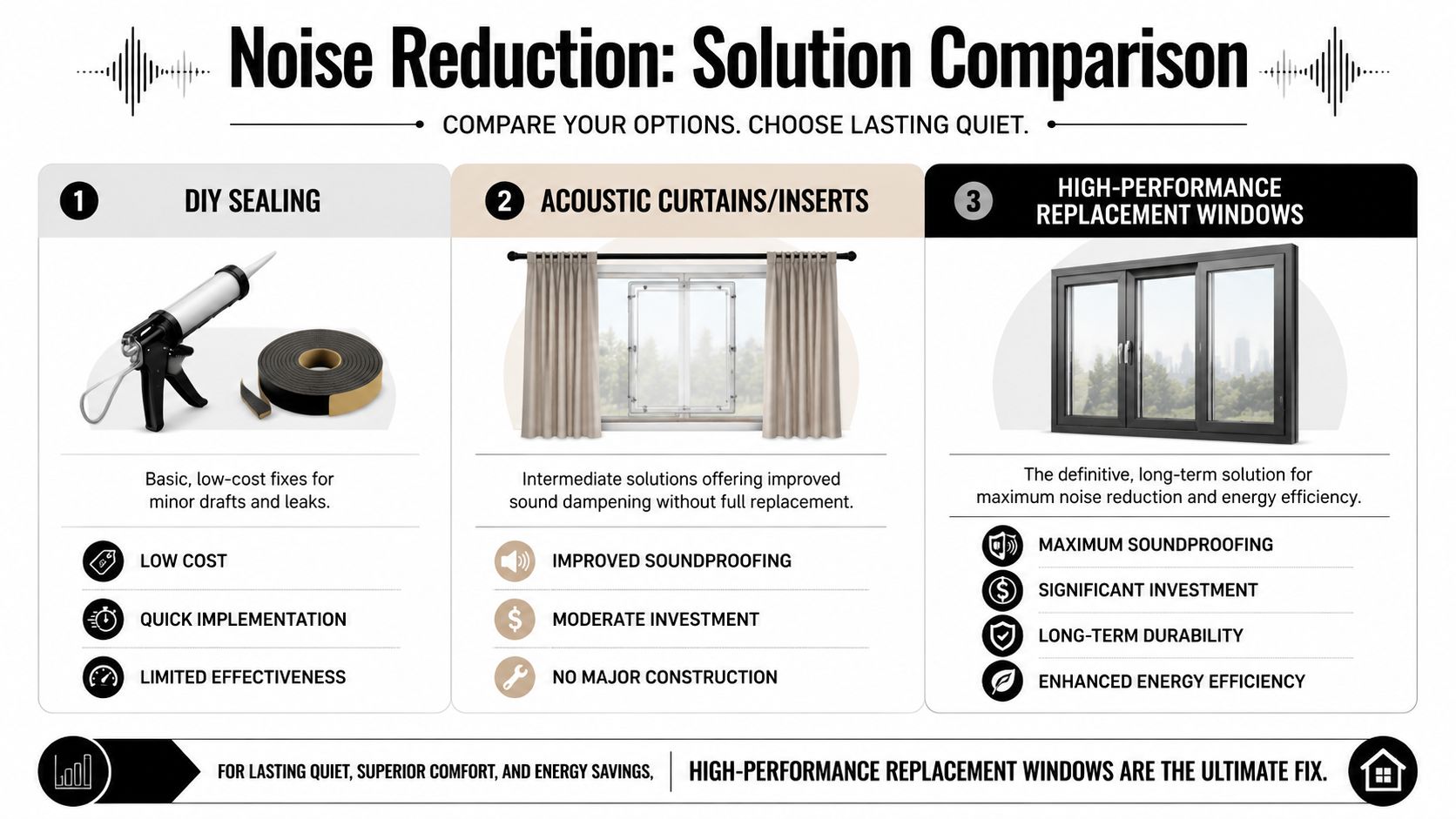
If your inspection found leakage, start there. Sealing work won't turn a loud street into silence, but it can cut the edge off the problem, especially if the noise is coming through gaps rather than through the glass itself.
What DIY sealing actually helps
The most useful first-pass materials are paintable exterior-grade sealant, interior acoustical sealant where appropriate, replacement weatherstripping, V-seal tape, a putty knife, a utility knife, a caulk gun, and a clean rag.
The order matters.
First, seal visible perimeter cracks where trim meets frame or wall. Don't smear new sealant over dirty, loose material. Cut out failed caulk, clean the joint, let it dry, then apply a continuous bead. Small gaps create surprising amounts of hiss and chatter from outside.
Second, replace worn weatherstripping on operable windows. Sliding and hung units often lose compression over time. Casements can lose seal contact if hardware loosens. A fresh seal helps most when the old one is visibly flattened or missing.
Third, use V-seal tape in narrow movement joints where the sash isn't contacting tightly enough. This is a useful low-cost fix on windows that are still serviceable but a bit loose.
What not to expect: these fixes won't do much against deep traffic rumble if the glass package is basic and the window is otherwise intact. Sealants are best at stopping leaks, not brute-force sound transmission.
A DIY seal job helps most when you can already feel the problem with your hand.
DIY Noise Reduction Methods Compared
| Method | Estimated Cost | Difficulty | Best For |
|---|---|---|---|
| Perimeter re-caulking | Low | Easy | Small cracks and exterior or interior edge leaks |
| New weatherstripping | Low to moderate | Easy to moderate | Operable sashes with weak compression |
| V-seal tape | Low | Easy | Minor looseness at sash contact points |
| Lock and hardware adjustment | Low | Moderate | Windows that don't pull tight when latched |
| Interior gap touch-up | Low | Easy | Small finish gaps around casing |
A few practical notes make these fixes work better:
- Use the right sealant: Flexible sealants hold up better where the frame and wall move differently with temperature changes.
- Don't block drainage paths: Some window systems need weep paths to manage moisture. Don't seal blindly.
- Test one window first: If one bedroom is the biggest problem, fix that opening before doing the whole house.
- Work clean: Sloppy caulk rarely seals as well as a properly tooled joint.
Many homeowners stop here because the house feels noticeably less drafty and slightly calmer. That's a good outcome if the problem was minor. If you still hear the same low road wash after sealing, the next step usually isn't “more caulk.” It's adding mass and air space.
Leveling Up Acoustic Curtains and Window Inserts
When sealing has done all it can, you're into a different category of solution. At this point, you're no longer chasing little leaks. You're trying to interrupt sound transmission more aggressively.
Curtains help when the problem is moderate
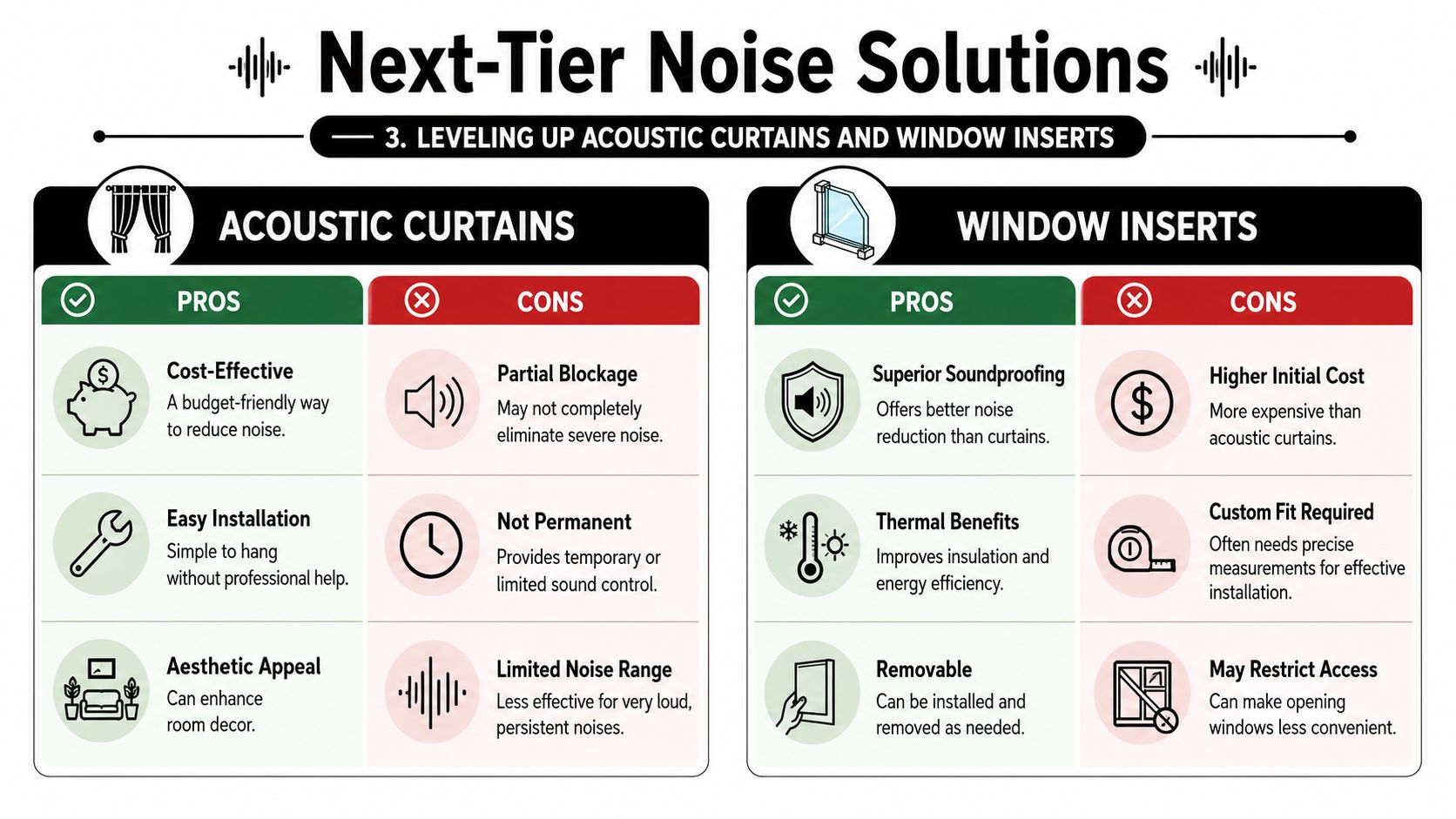
Acoustic curtains can help, but only when expectations are realistic. They add some mass, soften reflections inside the room, and reduce a portion of the sharper exterior noise. They also help if your room feels acoustically “hard” because of lots of bare surfaces.
They don't seal the window. That's their limit.
What to look for:
- Dense, multi-layer construction
- Full coverage past the trim edges
- A track or rod placement that minimizes side gaps
- A use case where you can keep them closed consistently
Blackout curtains are often sold as if they're acoustic curtains. Sometimes they help a little. Sometimes they mostly darken the room. Don't assume the label means serious sound control.
Inserts change the game
Window inserts are much more effective because they add a secondary interior layer and create a larger air gap. That air space matters. A standard double-pane window might have an STC rating of 26-32, while a high-quality window insert can raise the combined STC rating to 45 or higher, which significantly blocks human speech and traffic noise (window insert STC performance explanation).
That's why inserts are often the strongest non-replacement option for homeowners who need a real jump in performance.
Pros and cons are straightforward:
- Strong upside: Much better noise reduction than curtains. Often removable. Can improve comfort.
- Real downside: More expensive than soft treatments, usually custom-fit, and can make window access less convenient.
If you need the window to open constantly for ventilation, inserts can become annoying. If your top priority is a quieter bedroom, that trade-off is often worth it.
For Boise homeowners searching Cascade Windows Boise, this is the point where the decision often becomes clearer. If the existing frame is in decent shape and the main complaint is noise, inserts can buy you a lot of relief without construction. If the frame is aging, the sash operation is poor, and comfort is uneven room to room, inserts may feel like money spent on a temporary bridge.
The Ultimate Fix High-Performance Replacement Windows
If the street noise is heavy, the existing windows are old, or the whole assembly feels loose and underbuilt, replacement is the permanent answer. The conversation around Cascade Windows Boise then gets more serious, because product design and installation method start to matter more than quick fixes.
What makes a replacement window quieter
A quieter replacement window usually does several things at once. It seals more tightly. It uses a more substantial frame. It can pair different glass constructions to interrupt a wider range of sound.
For Boise homes, thermal performance belongs in the same conversation as sound. Selecting window specs based on NFRC thermal ratings and Energy Star compliance is critical for Boise's temperature swings, and a window with a low U-factor for winter and a low Solar Heat Gain Coefficient for summer won't just help energy use. It's also generally better sealed against air and noise infiltration (Cascade thermal ratings guidance).
That's why generic “energy-efficient” language isn't enough. Homeowners should ask what glass package makes sense for the room:
- South-facing living spaces: Solar control matters more because heat gain can become part of the comfort problem.
- Shaded bedrooms: Lower noise and winter comfort often matter more than glare control.
- Street-facing rooms: Upgraded glass options particularly deserve the closest look.
- Rental or high-use spaces: Hardware durability and serviceability matter more than marketing language.
Laminated glass is often the most important upgrade when the complaint is low-frequency road rumble. Standard insulated glass helps, but laminated glass adds an interlayer that is especially useful against the kind of sound that feels like it passes through the wall itself. Triple-pane can also help in the right build, especially when the whole unit is designed around tight sealing and real climate performance. If you're weighing that route, this guide to triple-pane windows for Idaho winters gives helpful context on where the upgrade makes sense.
Why installation quality matters as much as the glass
A replacement window only performs as well as it's installed. That's not a sales line. It's field reality.
If the frame isn't supported correctly, shimmed properly, and set square, plumb, and level, the sash may not compress evenly. That causes leaks, sticky operation, and noise paths that shouldn't exist in a new unit. I've seen homeowners blame the product when the true failure was installation tolerance.
For homeowners comparing options in Boise, it's reasonable to ask for specifics about the installation process, finish work, and follow-up service. One local option in that conversation is C & C Windows & Doors, which installs replacement windows and doors in the Treasure Valley. The more important point is what any installer should be able to explain clearly: how they measure, how they handle air sealing and flashing, and what happens if an operable part needs service later.
A good replacement project should solve several problems at once:
- Cut outside noise
- Improve room-to-room comfort
- Reduce drafts
- Fix operation problems
- Give you a service path if hardware or sash components need attention later
The right replacement window should feel quieter when it's closed, easier when it's opened, and less noticeable in daily life because you stop thinking about it.
Knowing When to Call a Boise Window Professional
There's a point where more DIY work just burns time. If you've sealed obvious gaps, tried the lower-cost improvements, and the room still sounds like the street is half inside the house, it's time for a professional evaluation.
A simple decision checklist
Call a Boise window professional if any of these are true:
- The sash binds or won't lock tightly
- You see fogging between panes
- The frame shows rot, warping, or movement
- Noise remains high after sealing work
- You want one fix that addresses comfort, operation, and sound together
This matters even more if you're shopping Cascade Windows in Boise and trying to compare product value, not just sticker price. One of the biggest information gaps for homeowners is what happens after installation. After-sale service, parts availability, and local warranty handling can be as important as the window's initial performance (Cascade contact and support information).
Questions worth asking before you buy
A useful consultation should answer practical questions, not just present brochures.
Ask things like:
- Who handles service if a lock, sash, or seal fails later?
- How are replacement parts ordered and tracked?
- What installation method will be used on my house type?
- How do you address out-of-square openings?
- What should I expect for cleanup, punch-list items, and follow-up?
If you're still unsure whether your windows are repair candidates or replacement candidates, this window repair versus replacement guide for homeowners is a good next read.
A quiet house usually doesn't come from one magic product. It comes from diagnosing the weak point, choosing the right level of fix, and making sure the installation matches the promise.
If traffic noise, drafty rooms, or aging windows are making your Boise home less comfortable, C & C Windows & Doors offers in-home consultations for replacement window projects across the Treasure Valley. A good consultation should help you identify whether sealing, inserts, or full replacement makes the most sense for your house, your noise exposure, and your budget.