
You're standing in the kitchen with a mug of coffee, staring at a window that feels cold even when the heat's running. The glass looks fine from across the room, but the draft at the sill tells the truth, and the patio door has started sticking just enough to annoy you every morning. That's usually the moment Boise homeowners start comparing quotes, second-guessing the timing, and realizing this isn't a trim touch-up, it's a real replacement project.
A window and door company Boise homeowners can trust has to do more than sell attractive frames. In this market, the difference between a comfortable upgrade and an expensive mistake usually comes down to measurement, product selection, and install quality. Boise is part of a large U.S. remodeling market where annual home improvement and repair spending reached about $600 billion in 2022 and stayed strong into the mid-2020s, which helps explain why replacement projects keep getting attention and why good installers stay busy. The right crew doesn't just drop in new units, they fit the whole system to the house, the climate, and the way you live.
Table of Contents
- Standing in a Drafty Boise Living Room Ready to Replace Windows
- Qualifications a Boise Window and Door Company Should Have
- Reading the Glass Package the Way an Installer Does
- Getting and Comparing Estimates Without Getting Burned
- What a Clean Install Day Actually Looks Like
- When the Upgrade Pays You Back in Boise's Climate
- Your Next Steps From Estimate to Final Walkthrough
Standing in a Drafty Boise Living Room Ready to Replace Windows
The first real clue is usually not the invoice. It's the spot on the couch where your feet feel cold, the condensation on the pane, or the way a window rattles when the wind shifts across the Treasure Valley. A homeowner in Boise can live with that for a while, then winter rolls in, the heating bill rises, and the room starts feeling like a compromise instead of a place you want to spend time in.
That's why the installer matters more than the brochure photo. A premium window underperforms if the rough opening is out of square, the flashing is sloppy, or the perimeter gets weak air sealing. Boise's market has plenty of companies advertising patio doors, sliding doors, double-hung windows, and casement windows, but the key question is whether they can make the opening tight, level, and climate-appropriate.
Why the install matters as much as the product
The house does not care what the showroom sample looked like. It cares whether the whole unit performs once it's fastened into your wall, sealed correctly, and matched to the orientation of the room. That's especially true when homeowners are replacing multiple windows, because the economics usually favor a real upgrade, not a patch job.
Practical rule: if a company talks only about glass style and never about rough openings, air sealing, or flashing, keep shopping.
Boise isn't a one-off market. There's a clear local installation ecosystem with long-running providers serving Boise, Meridian, Eagle, Nampa, Caldwell, Kuna, Garden City, and Star, plus nearby national-brand operations in Idaho. That competition is good for homeowners, but it also means you need a sharp filter. The right contractor should make the project feel controlled, not chaotic.
The rest of the decision comes down to a simple idea, choose the installer who can prove climate fit and installation discipline, not the one with the slickest sales line.
Qualifications a Boise Window and Door Company Should Have
A serious installer should pass a pass-fail test before you even talk finishes. Start with local experience, because Boise homes, Treasure Valley weather, and regional construction habits shape the job in ways a generic national pitch won't capture. Then look for factory training, clear insurance, and a documented warranty that covers both product and labor.
The best way to sort options is to ask for proof, not promises. If a company has real Boise-area work, it should be able to point to projects in Boise, Meridian, Eagle, or Nampa and explain what it installed, why it chose that product, and how it handled the details. If the answer stays vague, that's a warning sign.
Non-negotiables before you sign anything
Use this checklist and be blunt about it:
- Local project history: Ask for recent Treasure Valley work. If they can't name neighborhoods or nearby cities they regularly serve, that's a problem.
- Factory or product training: The crew should know the window system, not just the sales script.
- Climate-rated product line: The product should be selected for Boise conditions, not a one-size-fits-all package.
- Insurance and licensing: Ask for current proof. No hesitation, no excuse.
- Written warranty: You want to know what's covered, who honors it, and how long the labor coverage lasts.
- Responsive scheduling: If they can't get you a clear estimate window and a follow-up plan, that tells you a lot.
If the estimate comes from someone pushing hard on the spot, skip it. Door-to-door pressure and vague manufacturer names usually mean the company wants the sale more than the long-term outcome. A respectable Boise-area installer should be able to explain the line between product quality and install quality without making you feel rushed.
For a deeper vetting checklist, this guide to choosing a window company in Boise, Idaho fits the way local homeowners compare contractors. Use it to separate polished sales talk from a team that can do the job twice, and do it right both times.
Reading the Glass Package the Way an Installer Does
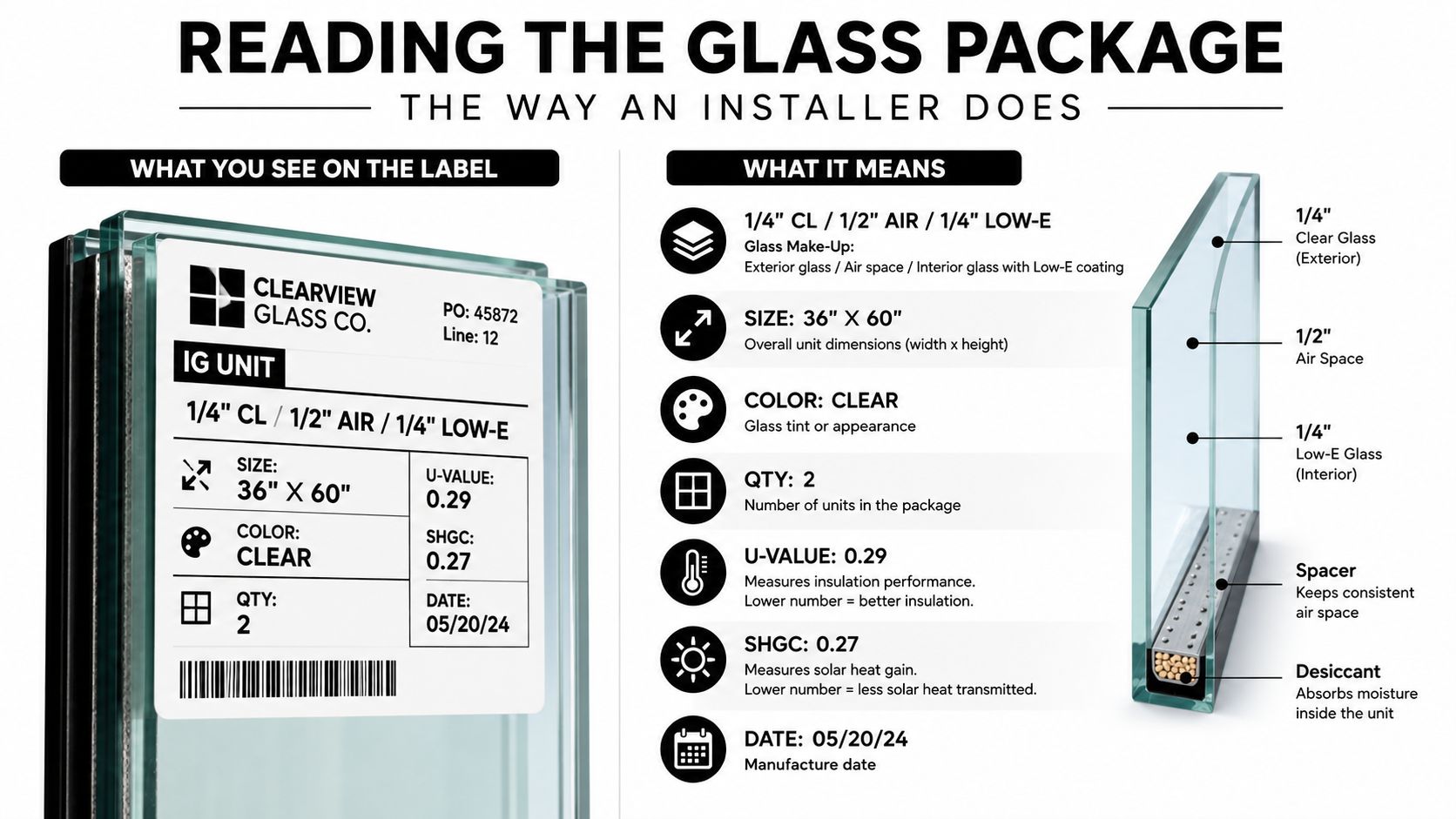
Boise homeowners get sold on words like high-performance, low-E, or triple-pane, but those labels don't tell the full story. The most important comparison is between measurable traits, U-factor, SHGC, and air leakage, because those numbers tell you how the whole unit behaves in your climate. The National Fenestration Rating Council explains that U-factor measures how well a window prevents heat from escaping, while SHGC measures how much solar radiation passes through, with lower numbers meaning better insulating performance and less solar heat gain.
What each part of the package actually does
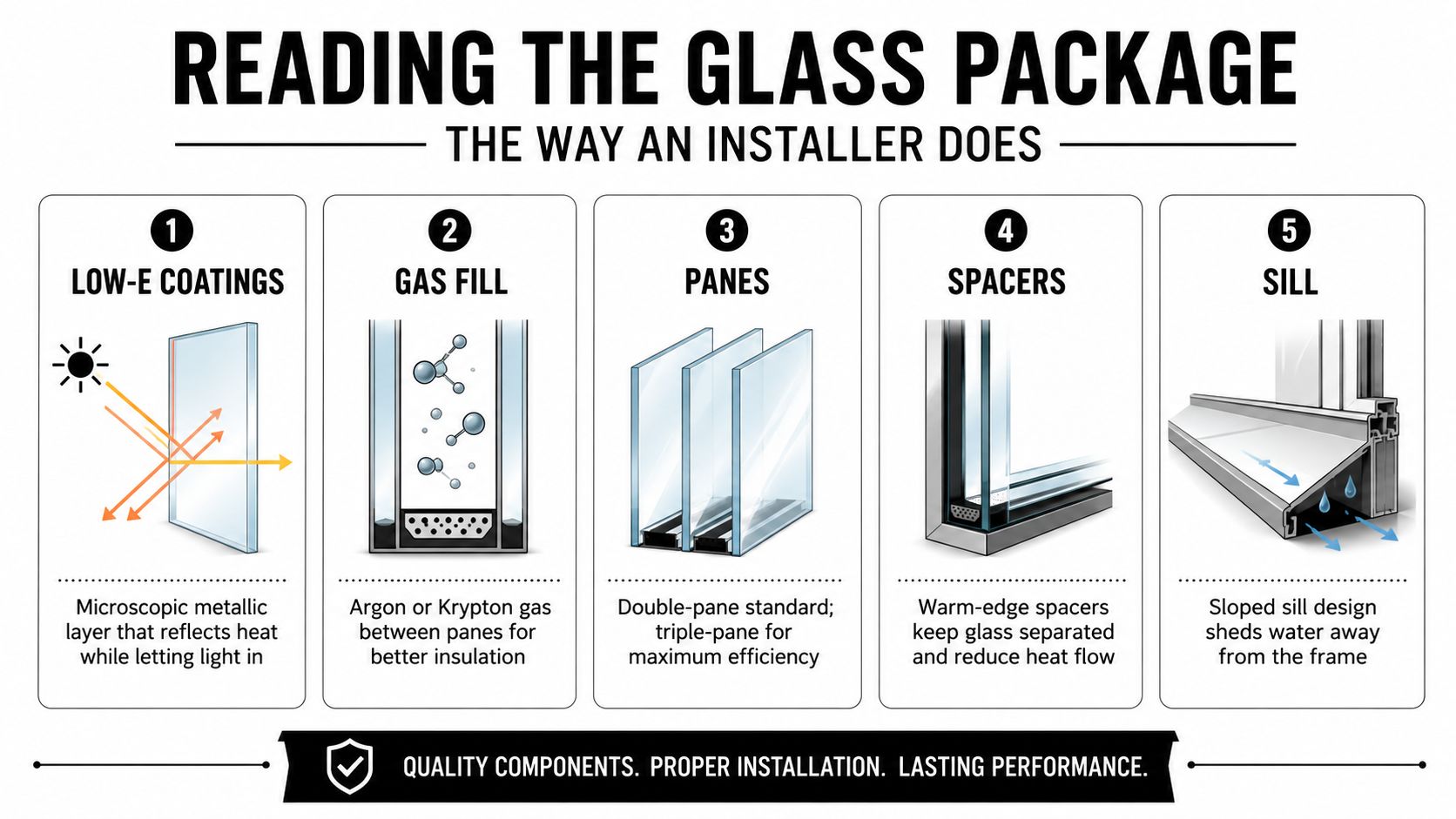
The Department of Energy notes that argon gas is denser than air and reduces heat transfer, while Low-E coatings help reduce heat flow by reflecting infrared energy and still letting visible light through. That's useful, but only if the rest of the package is built correctly. A window can look premium and still underperform if the install is sloppy or the product is mismatched to the room.
- Low-E coatings help with heat control without making the room gloomy.
- Argon fill adds insulation between panes.
- Double-pane is the standard baseline, and triple-pane can make sense in the right situation.
- Warm-edge spacers help reduce heat flow at the glass edge.
- Sloped sills matter for drainage and moisture control.
How to read the label without getting sold
Boise's mix of cold winters and strong summer sun means the label has to fit the room, not the sales pitch. A lower U-factor helps with winter heat retention, and the SHGC should be chosen so you're not baking rooms with too much sun gain. For homeowners who want to go deeper on gas fill trade-offs, this Idaho-focused note on argon gas windows is the right technical follow-up.
A triple-pane unit is not automatically the smartest buy. If the install is weak or the room doesn't need that level of spec, you've paid for a number instead of a result.
The better installer will talk about the whole unit, not just the glass. That means label verification, condensation management, flashing, and air sealing, because the rated performance only matters if the installed performance matches it.
Getting and Comparing Estimates Without Getting Burned
The estimate process should feel like a field measurement, not a sales audition. A good in-home consultation starts with custom measurements of the rough opening, then moves into frame material, energy upgrades, trim details, and what the job includes. If someone gives you a price from a quick glance at the house, that's not a quote you can trust.
A smart comparison starts by breaking each bid into parts. One company may include haul-away, trim repair, and cleanup. Another may leave those items floating, which is how a low number turns into a higher final invoice.
What belongs on every Boise estimate
Use this table and insist that each company spell it out in writing.
| Item to Compare | Estimate A | Estimate B | Estimate C |
|---|---|---|---|
| Window or door product line | |||
| Glass package details | |||
| Frame material | |||
| Installation scope | |||
| Trim work included | |||
| Haul-away and cleanup | |||
| Warranty on product | |||
| Warranty on labor | |||
| Timeline from order to install | |||
| Financing options |
The questions that expose the real difference
Ask who measures, who installs, and who handles the follow-up if something settles or sticks later. Ask whether the warranty is separate for product and labor, because those are not the same thing. Ask how long the company has been reachable in Boise, since a warranty is only useful if someone still answers the phone.
The local cost context matters too. Boise replacement-window pricing is commonly cited at roughly $450 to $650 per window, with some estimates placing typical single-window replacement closer to $600 and a broader range of $200 to $1,200 depending on size, material, efficiency, and labor, according to the Boise market summary from EcoWatch. That range is exactly why line-item clarity matters, because on a multi-window project, small omissions add up fast. For a cost breakdown, this Boise pricing guide on how much window replacement costs is worth reading before you sign.
One more thing, don't confuse financing with value. Financing can make the project easier to start, but it doesn't rescue a weak scope. Use it only after the scope, warranty, and install details make sense.
What a Clean Install Day Actually Looks Like
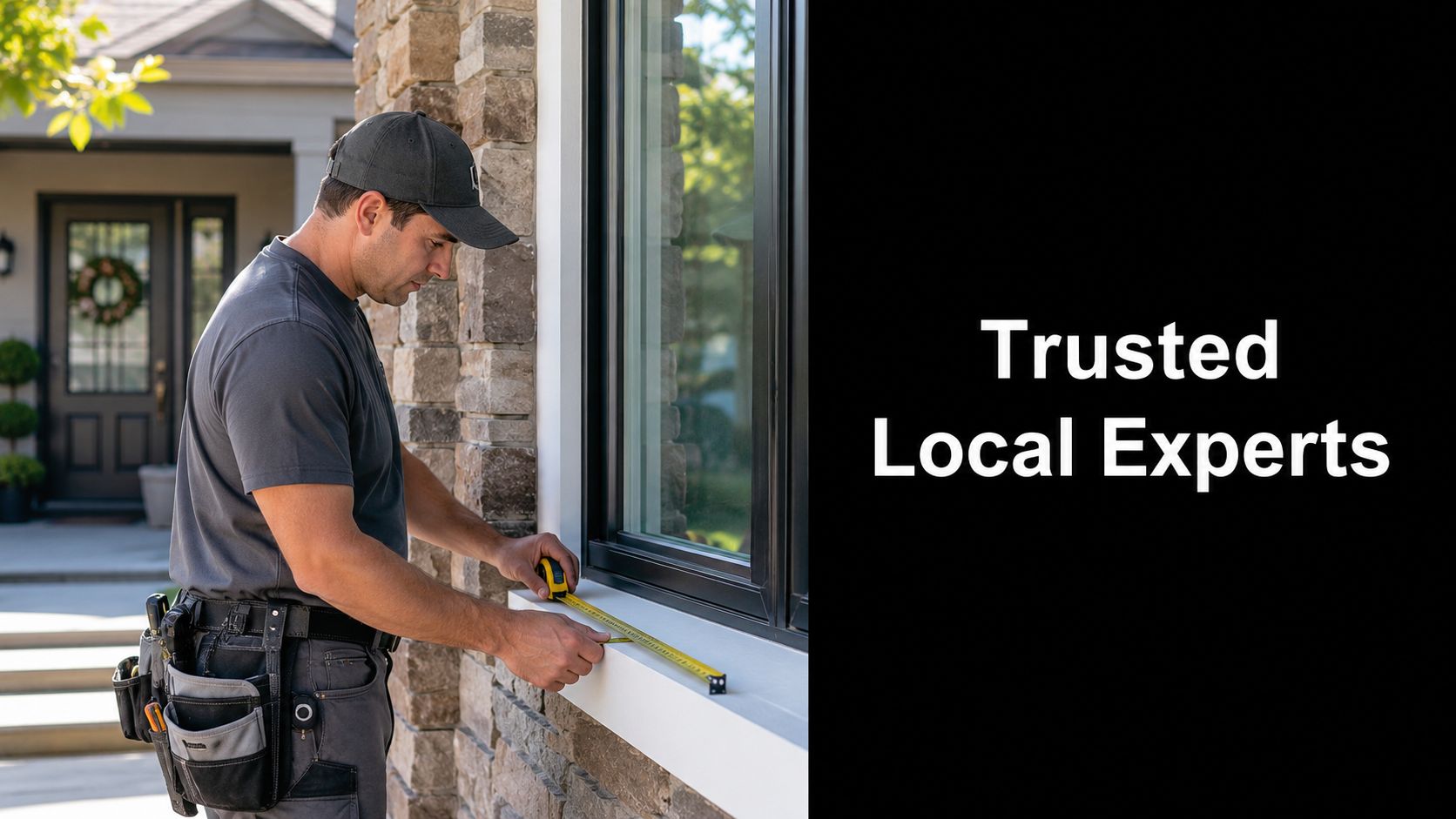
A good install day starts before the first old window comes out. The lead installer should walk the home, confirm the openings, protect floors, and tell you where debris will go. If the crew shows up and starts working like nobody planned the day, that's not efficient, it's careless.
The removal itself should look orderly. Old units come out, the opening gets inspected, and the crew checks the rough opening for squareness before they commit to the new unit. That matters because a window that's shimmed into a twisted opening can bind, leak air, or age badly even if the product was excellent.
What the best crews pay attention to
A careful team usually works through a few essential steps:
- Drop cloths and protection: Floors, furniture, and nearby finishes stay covered.
- Opening inspection: The rough opening gets checked before the new unit is set.
- Shimming and leveling: The unit sits true before fastening.
- Foam and seal work: The perimeter gets sealed so drafts don't survive the install.
- Exterior flashing: Water management is treated as part of the job, not an afterthought.
Homeowner rule: if you don't see the crew checking level, squareness, and sealing steps, you're watching a shortcut in real time.
Boise homes see wind, temperature swings, and enough seasonal stress to expose sloppy work fast. A poorly air-sealed perimeter drags down the performance of a good window, and you'll feel that in comfort before you ever think about test results. The cleanest installs usually feel almost boring while they're happening, because nothing is improvised.
If you're home for the work, ask the lead installer three simple questions. Did you verify the rough opening. What's being used at the perimeter seal. How are you handling the exterior drainage path. If the answers are crisp, you're in good hands. If they brush past those points, keep watching closely.
When the Upgrade Pays You Back in Boise's Climate
A homeowner in Boise usually wants one clear answer, does this upgrade earn its keep. It can, but the payoff shows up in different ways than a sales brochure likes to promise. HomeAdvisor Boise window guide notes that heat gain and heat loss through windows make up a major share of residential heating and cooling energy use, which is why weak windows make a house feel costly to run. Still, no two replacement projects pay back the same way.
Comfort is the first return, not the only one
New windows often pay back in comfort before you ever notice the utility bill. Rooms feel more even, the cold edge near the glass drops off, and that drafty strip near the floor gets easier to ignore. Noise control can improve too, but only when the product package and the install both hold up.
Resale works differently. Replacement windows can help curb appeal and give buyers confidence, but they do not fix a house that has bigger problems elsewhere. Boise buyers notice straight lines, clean proportions, and a home that looks cared for. They also notice when a project was done on the cheap.
What makes sense in Boise
The smartest buy is usually the window that fits the climate and the opening, not the priciest package on the estimate. A properly installed double-pane unit with Low-E and argon often makes more sense than chasing triple-pane just because it sounds premium. Boise's conditions reward practical performance, so the unit, the label, the orientation, and the install all need to work together.
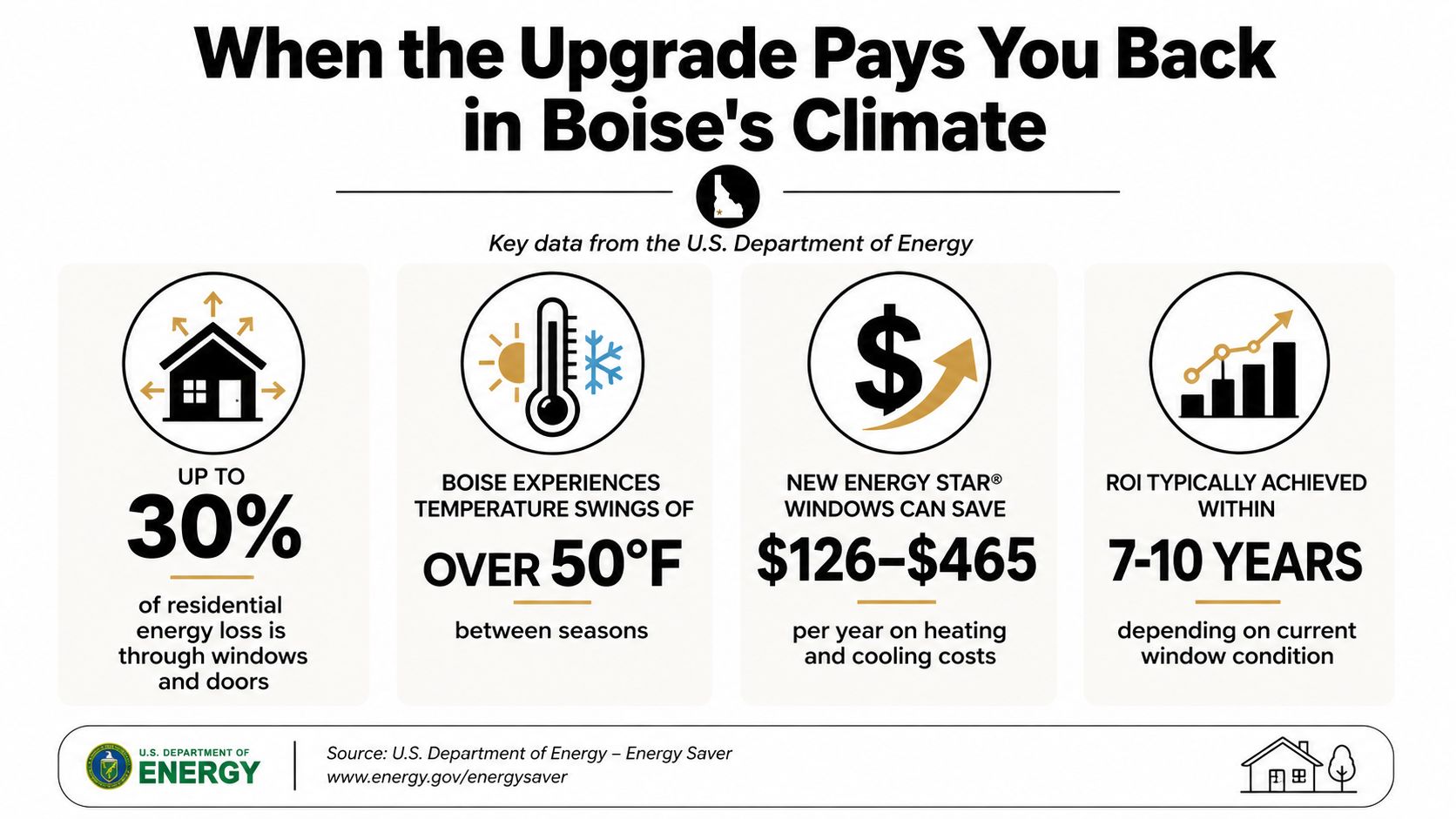
The right way to judge payback is straightforward. Ask whether the project improves comfort, cuts drafts, and supports the home's value in a way you can feel and future buyers can see. If the company cannot explain how climate zone, orientation, and install quality affect the result, they are selling a product, not a solution.
Your Next Steps From Estimate to Final Walkthrough
Start with a real in-home consultation, not a phone-only guess. Before the estimator arrives, count the rough number of windows and doors you care about, note which rooms feel hottest or coldest, and decide what kind of budget range you're willing to live with. That keeps the conversation practical and stops the meeting from drifting into brochure talk.
Once you have one estimate, get at least one more. Compare the scope, warranty, and installation details line by line, and don't let anyone blur product price with labor price. Financing can help with cash flow, and reputable Treasure Valley installers often make it part of the process, but it should never be the reason you choose a weak proposal.
What a solid finish should look like
A professional closeout should include a walkthrough, warranty registration, and a plain explanation of what to watch for in the first days after install. The crew should show you how each unit opens and locks, confirm that trim and seal work look right, and leave you with a contact path for any issues. That follow-up matters because a good installer stands behind the job after the last truck leaves.
If something looks off, document it immediately and raise it before the crew disappears. A respectable company will not dodge the conversation, because final quality is part of the service. That's the standard you should expect in Boise, Meridian, Eagle, Nampa, and anywhere else in the Treasure Valley.
C & C Windows & Doors handles free in-home consultations, custom measurements, energy-efficient replacement windows, and patio doors for Treasure Valley homes. If you want a local team to walk you through climate-fit products, installation details, and a clear next step, visit C & C Windows & Doors and set up the conversation before the cold side of the house starts costing you another season of comfort.