
A typical 10-window vinyl replacement in the Boise metro runs $3,800 to $4,800 installed, and a full 10 to 15 window project lands around $8,000 to $20,000. If you're staring at a drafty bedroom window in Boise, Meridian, or Eagle, that's the spending bracket before you even start comparing styles.
The core question isn't whether the old windows are annoying. It's whether you want to keep paying for comfort you're not getting, or replace them once and make the house easier to live in, quieter, and more marketable.
Table of Contents
- Why Treasure Valley Homeowners Replace Windows in 2026
- Treasure Valley Climate and What Your Windows Must Handle
- Window Styles That Fit Treasure Valley Homes
- Performance Upgrades Worth the Money in Boise
- What Replacement Windows Cost in the Treasure Valley
- The Installation Process From Estimate to Final Walkthrough
- Before and After in Boise, Meridian, and Eagle
- Choosing a Local Treasure Valley Window Company
Why Treasure Valley Homeowners Replace Windows in 2026
You know the moment. It's January in Boise, the kitchen feels fine until you sit next to the slider, and then you catch that cold edge against your ankle. In July, the same house can feel like a greenhouse on the west side. That's when replacement windows Treasure Valley stops being a shopping phrase and becomes a fix for a very real local problem.
Homeowners around Boise, Meridian, Eagle, Nampa, Caldwell, Kuna, Garden City, and Star usually replace windows for four plain reasons, comfort, energy bills, noise, and resale timing. Comfort is the one people notice first. Energy bills come next, especially when older windows leak conditioned air and the HVAC keeps running harder than it should. Noise matters more than people admit, especially near busier roads, arterial streets, or outdoor units. Resale matters because buyers notice ugly, fogged, or failing windows fast.
Practical rule: If a window is drafty, hard to open, fogged between panes, or making the room louder than it should be, it's no longer doing the job.
The resale side is not theory. A local market summary tied to the 2024 Cost vs. Value Report says new windows return 70% to 80% of their cost at resale, with vinyl at 74% payback (Treasure Valley market summary). The same source says fresh windows can help a home sell about one week faster and list 3% to 5% higher in the Boise metro, which it translates to roughly $13,500 to $22,500 more on a $450,000 home (local market summary).
That's why replacement windows in this market are rarely just about glass. They're a comfort upgrade that also affects how fast the home moves and how it looks on appraisal day. In plain English, the phrase means choosing new, properly sized, energy-conscious windows that solve Treasure Valley weather, improve day-to-day living, and support resale without wasting money on fluff.
Treasure Valley Climate and What Your Windows Must Handle
A window in Boise can look perfect on install day and still turn into a problem by the first cold snap or hot west-facing afternoon. I see it all the time. A homeowner picks a style for the curb appeal, then the room starts feeling drafty in winter, baking hot in summer, or louder than it should be because the frame and glass were never matched to Treasure Valley weather.
The specs that actually matter
Start with U-factor and SHGC. U-factor shows how much heat a window loses in winter. SHGC, or solar heat gain coefficient, shows how much solar energy gets through the glass. For Boise and the surrounding area, ENERGY STAR Climate Zone 5 calls for a U-factor of 0.30 or lower (Boise window guidance).
That is the filter. If a quote says “energy efficient” and does not list the U-factor and SHGC, you do not have enough information to compare products. In this market, guessing costs money.
Ask for the actual U-factor and SHGC, then check those numbers against the room and the exposure. A west-facing living room needs a different answer than a shaded north bedroom.
What holds up in this climate
Treasure Valley's freeze-thaw swings are hard on weak frames and sloppy seals. That is why regional installers keep steering homeowners toward stronger frame systems and tighter glazing packages. High-performance double-pane low-E windows commonly land around 0.25 to 0.30 U-factor in this climate range (Boise window guidance). For colder exposures, triple-pane glass raises winter insulation from roughly R-3 to R-5 to about R-6 to R-8, which helps reduce cold-glass downdrafts and makes north- and west-facing rooms feel less punishing.
Frame choice matters just as much as glass. Cheap frames expand, contract, and wear out faster when the weather keeps swinging, and that shows up as sticky operation, failing seals, and a house that never quite feels settled.
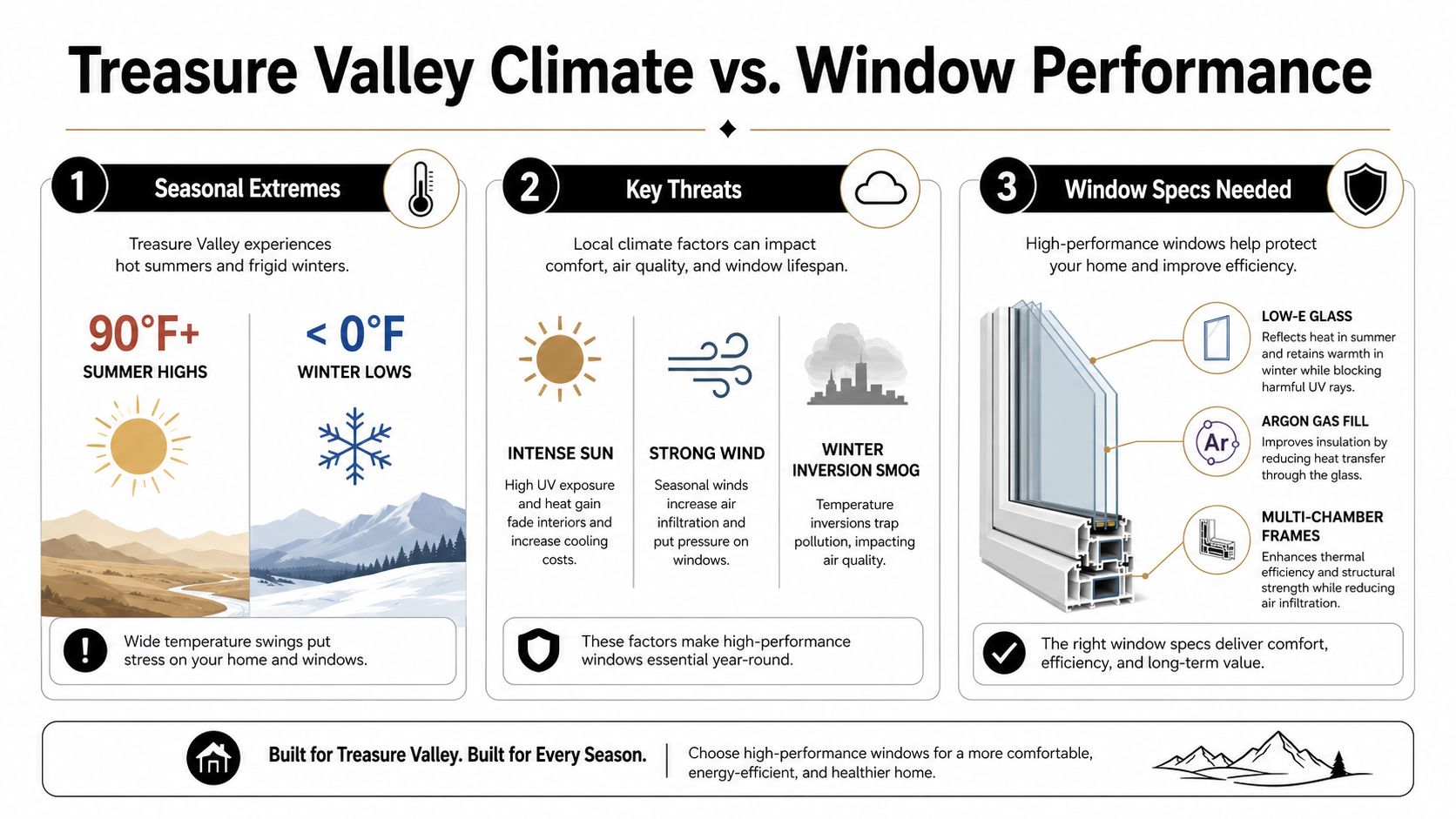
The bottom line is simple. Treasure Valley windows need to handle summer sun, winter cold, and the sharp temperature swings between them without turning the house drafty or fragile. If the product cannot do that, it is the wrong window for Boise, Meridian, or Eagle.
Window Styles That Fit Treasure Valley Homes
The right style depends on the room, the exposure, and how the house is used. Too many homeowners buy windows like they're picking trim color. That's the wrong way to do it. The room should drive the style.
What works where
Double-hung is still the local default for a reason. It fits traditional Boise and Meridian subdivisions well, looks familiar from the street, and works in bedrooms, hallways, and mixed-use spaces where homeowners want a straightforward replacement. Casement belongs on west-facing walls and places where you want a tighter seal against afternoon heat and wind. Picture windows make sense in great rooms and front elevations where the goal is light and a foothill view, not ventilation. Sliding windows work best over sinks, in kitchen walls, and where the opening needs to stay low-profile for a patio transition.
Here's a simple room-by-room view.
| Window Style | Best Room or Exposure | Why It Works Here |
|---|---|---|
| Double-Hung | Bedrooms, classic subdivision layouts | Familiar look, flexible operation, easy fit for many existing openings |
| Casement | West-facing walls, windy exposures | Seals tightly and helps control afternoon sun and drafts |
| Picture | Great rooms, view walls, front elevations | Maximizes glass area and frames the view without moving parts |
| Sliding | Kitchens, sink walls, patio-adjacent rooms | Simple operation and a practical fit where swing space is limited |
The newer narrow-frame systems matter too. Slim Mezzo-style profiles and composite-reinforced sashes let you keep a larger glass opening without making the frame feel flimsy. That's useful in newer builds where homeowners want clean lines and more daylight, but still want the strength to handle Idaho weather.
If you want a room to feel more expensive without overcomplicating the project, start with the exposure. West-facing rooms usually deserve the tighter seal of casements. The view wall gets the picture window. The practical spaces get double-hungs or sliders. That's the cleanest way to spend money.
Performance Upgrades Worth the Money in Boise
Glass packages matter more than glossy brochures. The upgrade that pays its way in Treasure Valley is usually the one that reduces heat transfer, handles the sun, and keeps the room comfortable without forcing the furnace or AC to work overtime.
Low-E and argon are the smart baseline
Low-E coating is the first upgrade I'd insist on for almost any Boise-area replacement. It helps reflect heat in summer and slow heat loss in winter, which is exactly what this climate needs. Argon fill is the invisible partner. You can't see it, but it helps slow heat transfer between panes, and that matters when the temperature swings are sharp.
Boise-focused contractor guidance says modern Low-E and argon-filled replacement windows can reduce heating and cooling costs by 15% to 30%, and another Treasure Valley source says energy-efficient windows can cut bills by 20% to 30% (Boise contractor guidance). That's a big enough range to matter, especially on a whole-home project.
When triple-pane earns its keep
Triple-pane is not a gimmick, but it's not the default answer either. It makes sense on colder exposures, noisy streets, and rooms where comfort matters more than keeping the budget tight. It also lines up with energy targets in a way that makes sense for homes chasing stronger performance labels. If you're comparing a full upgrade path and want a deeper breakdown of colder-weather performance, I'd point you to this Idaho triple-pane window guide.
ENERGY STAR 7.0 compliance is another phrase you'll hear on quotes, and it should mean the window package is being selected with current efficiency expectations in mind. That doesn't guarantee the right product for every room, but it does tell you the installer isn't selling outdated glass as if it were premium.
My rule is blunt. Buy Low-E and argon as the baseline. Step up to triple-pane where the room actually needs it, not everywhere just because the quote sounds impressive.
That approach keeps the budget grounded. It also keeps you from paying for upgrades in rooms that don't benefit much from them.
What Replacement Windows Cost in the Treasure Valley
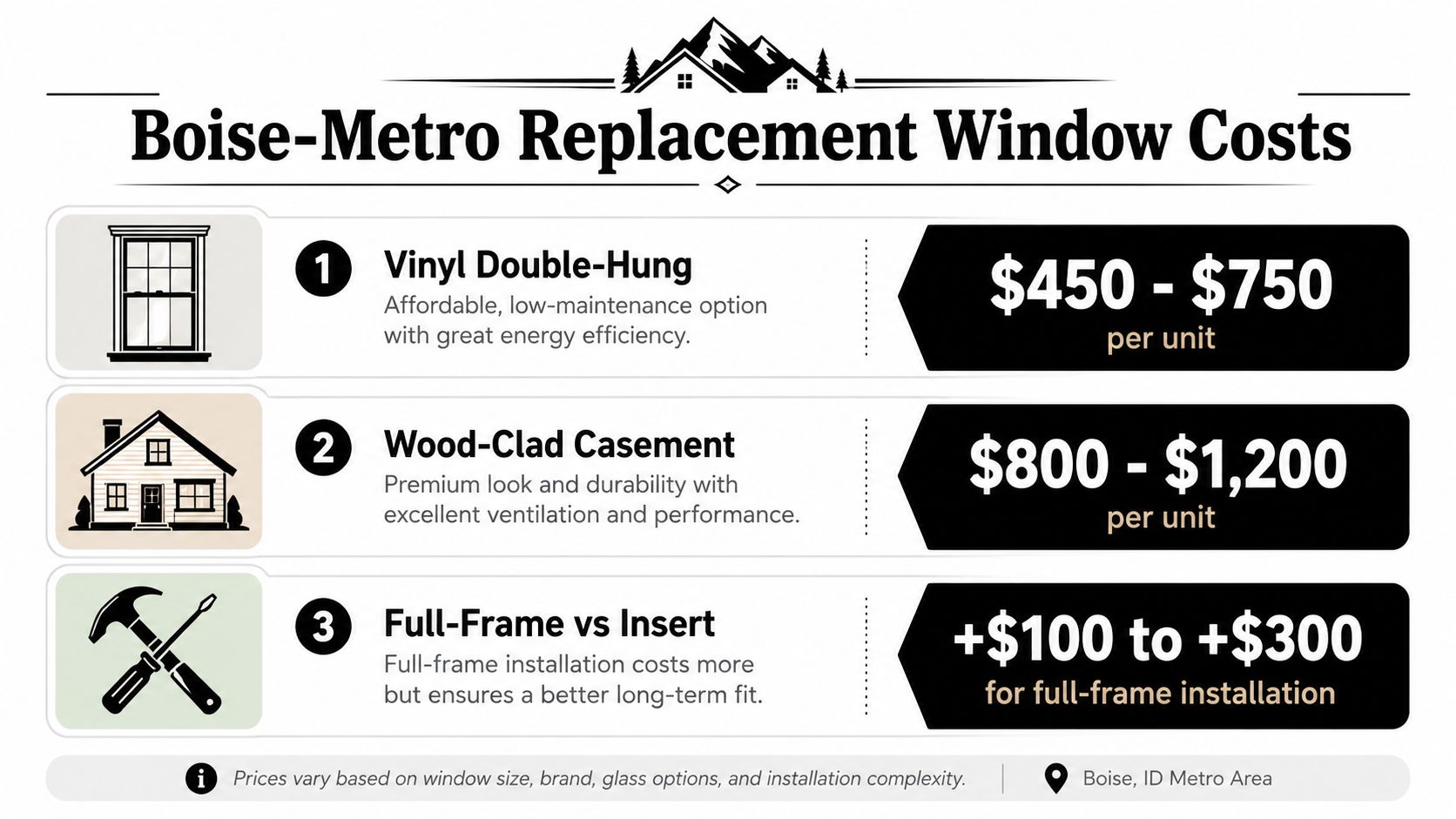
Homeowners in Boise, Meridian, and Eagle do not buy replacement windows for fun. They buy them because the old ones leak air, rattle in the wind, and drag down comfort and resale. In this market, vinyl double-hung replacement windows commonly land around $400 to $500 installed per unit, and some local pricing summaries put them at $450 to $750 each depending on the scope and the product line (Boise service area guidance, local market summary). Fiberglass can run up to about $1,300 each in the local resale summary (local market summary).
For a full home, that same market summary puts 10 to 15 windows at about $8,000 to $20,000 (local market summary). Another Boise market source says a 10-window home can run $3,800 to $4,800 for vinyl replacement (Boise service area guidance). That spread is the core planning range, and it lines up with how different homes are built, how much trim has to come off, and whether you are doing a straight insert job or a full-frame job. If you want a tighter local estimate, see the detailed cost breakdown here.
What changes the price
Frame material drives a lot of the total. Vinyl stays the practical choice for most Treasure Valley homes because it is low-maintenance and cost-effective. Fiberglass costs more because the material is tougher and usually comes in slimmer, more premium profiles. Glass package choices also move the number, especially when you step beyond standard double-pane into better efficiency or noise control.
Installation method matters too. Insert replacement is usually simpler. Full-frame replacement adds labor because the existing frame comes out and the rough opening gets rebuilt and sealed. That extra work is what separates a quicker refresh from a more invasive remodel, and it is where the invoice starts climbing.
Resale is part of the math, not just the comfort side. Local market guidance says new windows can help a home show better to buyers and support value in the Boise area (local market summary). That does not mean every upgrade pays back the same way. A clean, well-fitted midrange window package usually makes more sense here than overspending on features the house will never use.
How the job usually gets paid and scheduled
Most homeowners want the estimate quickly, the number written clearly, and the install to move without dragging on. That is normal. A good local estimate should show what you are buying, what you are not buying, and when the work starts.
The install timeline is predictable. Most window replacements in Boise are done in 1 to 3 days, a full-house project with 15 to 20 windows usually takes 2 to 4 days, and individual window installation generally takes 30 to 60 minutes per unit (Boise install timing). That is fast enough to work around jobs, school, and the rest of a normal week without turning the house upside down.
The Installation Process From Estimate to Final Walkthrough
A good window job starts before anyone touches a saw. The first visit should be a free in-home consultation with custom measurements, not a rough guess from the truck seat. If the person quoting your job can't explain how the unit is measured, they're not ready to install it.
What happens before installation day
The window size isn't taken from the old sash. It's sized to the rough opening, and that opening is usually 3/4 inch to 1 inch larger than the replacement unit so the installer can shim and seal it correctly (Lowe's buying guide). That extra space is not a mistake. It's part of making the window sit square, drain correctly, and stay sealed.
Sleeping-room openings can complicate the project too. Many jurisdictions require a minimum 5.7 sq ft net clear opening, 20-inch minimum width, 24-inch minimum height, and a maximum 44-inch sill height for egress windows (Lowe's buying guide). If a bedroom window needs to meet escape rules, that can change the design before install day.
What the day feels like
A single window usually takes 30 to 60 minutes to install, and most projects wrap in 1 to 3 days. A house with 15 to 20 windows typically runs 2 to 4 days (Boise install timing). That schedule is manageable, but only if the measurements were done right up front.
A Boise homeowner dealing with winter noise in a west-facing bedroom usually notices the difference fast when the old, loose sash is replaced with a tighter, modern unit. A Meridian homeowner getting ready to list gets a different benefit, cleaner sightlines, smoother operation, and a house that shows better at the first walkthrough. The install itself should end with a real walkthrough, hardware tested, locks checked, seal points inspected, and debris gone from the floor and yard.
A proper finish means you shouldn't be stepping over scrap, finding dust in the sill, or wondering whether the lock actually works.
If the crew leaves the place clean and the windows open, close, and lock the way they should, the job was handled correctly.
Before and After in Boise, Meridian, and Eagle
A Boise homeowner near a busy corridor had the classic winter complaint, cold glass, extra noise, and a room that never felt settled. After moving to Low-E argon double-hung windows, the first thing they noticed was quieter rooms. The second thing was that the house held comfort better without constant fiddling with the thermostat.
A Meridian seller used a 10 to 15 window refresh before listing and treated it like a resale decision, not a vanity project. That's the right instinct in this market, because the local resale summary says new windows can list 3% to 5% higher and help a home sell about one week faster (local market summary). When the house shows cleaner and the windows don't look tired, buyers stop nitpicking and start imagining move-in day.
Eagle homeowners tend to care about finish quality and comfort together. They want the house to look sharp from the street and feel better inside once the sun starts working on the west side. That's where craftsmanship and punctuality matter as much as the product itself. C & C Windows & Doors serves Boise, Meridian, Eagle, Nampa, Caldwell, Kuna, Garden City, and Star with that kind of local, measured-to-order approach, and homeowners usually notice the difference in the first room they walk into after install.
Choosing a Local Treasure Valley Window Company
A good Treasure Valley installer starts with the opening in your wall, not a sales script. They measure the rough opening, order made-to-fit units, flash the frame correctly, build in a true sloped sill for drainage, and use low-profile locking hardware that feels solid in daily use. The spec also has to fit Idaho weather, because Boise heat, Meridian freeze-thaw cycles, and Eagle's bright west-facing sun punish windows that were picked from a generic national catalog.
American-made Mezzo windows fit that standard well. The slim frame, composite-reinforced sash, and efficient glass packages are built for hot summers, freezing nights, and the weather swings in between. A lifetime limited warranty on products and labor matters too, because the window itself is only part of the purchase. The install has to hold up. Financing through Synchrony helps when the project is large enough that you would rather spread the cost than cut corners on the spec.
If you are comparing companies, keep the checklist plain. Ask whether the windows are measured to the rough opening, whether the quote lists U-factor and SHGC, whether the crew handles debris cleanup, and whether the warranty covers both product and labor. Ask where the installer is based. A crew that works here every day understands how Treasure Valley homes behave in summer heat, winter cold, and shoulder-season weather, and that matters more than a polished brochure.
For a local overview of what a Treasure Valley-based installer should provide, see this Treasure Valley window company guide.
C & C Windows & Doors handles Treasure Valley replacement windows with custom measurements, energy-efficient product options, and debris-free installation for Boise weather. If you want a local team that understands resale, comfort, and the way Idaho homes perform, visit C & C Windows & Doors and start with a free in-home consultation.