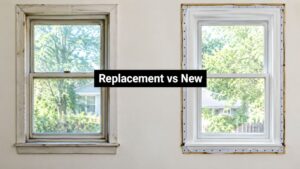


You wipe the glass. It looks better for a second. Then the haze is still there, trapped inside the window where no paper towel can reach it.
That's the moment most homeowners in Nampa realize this isn't normal condensation. It's a failed insulated glass unit, and once that seal is gone, the problem usually stops being cosmetic and starts affecting comfort. Rooms feel draftier. Afternoon sun feels harsher. In winter, that same window can make a whole side of the house feel colder than it should.
A lot of people searching for a door installer in Nampa, Idaho are really trying to solve a broader exterior-opening problem. Doors, patio doors, and windows all live in the same category of home-envelope work, and the frustrating part is that the symptom looks simple while the cause usually isn't. What matters most is understanding whether you're dealing with surface moisture, a broken seal, or an older unit that's reached the point where replacement makes more sense than another patch.
Table of Contents
- Why Are My Windows Foggy on the Inside
- The Science Behind a Broken Window Seal
- Is It a Failed Seal or Just High Humidity
- Should You Repair the Glass or Replace the Window
- Upgrading Your Home's Performance and Value
- Choosing a Partner for Your Window Project
Why Are My Windows Foggy on the Inside
A common call starts the same way. The homeowner says the window “looks dirty between the panes” or “stays cloudy no matter how much I clean it.” They usually noticed it first in early morning light or when the sun hits the glass at an angle. Once you see it, you can't unsee it.
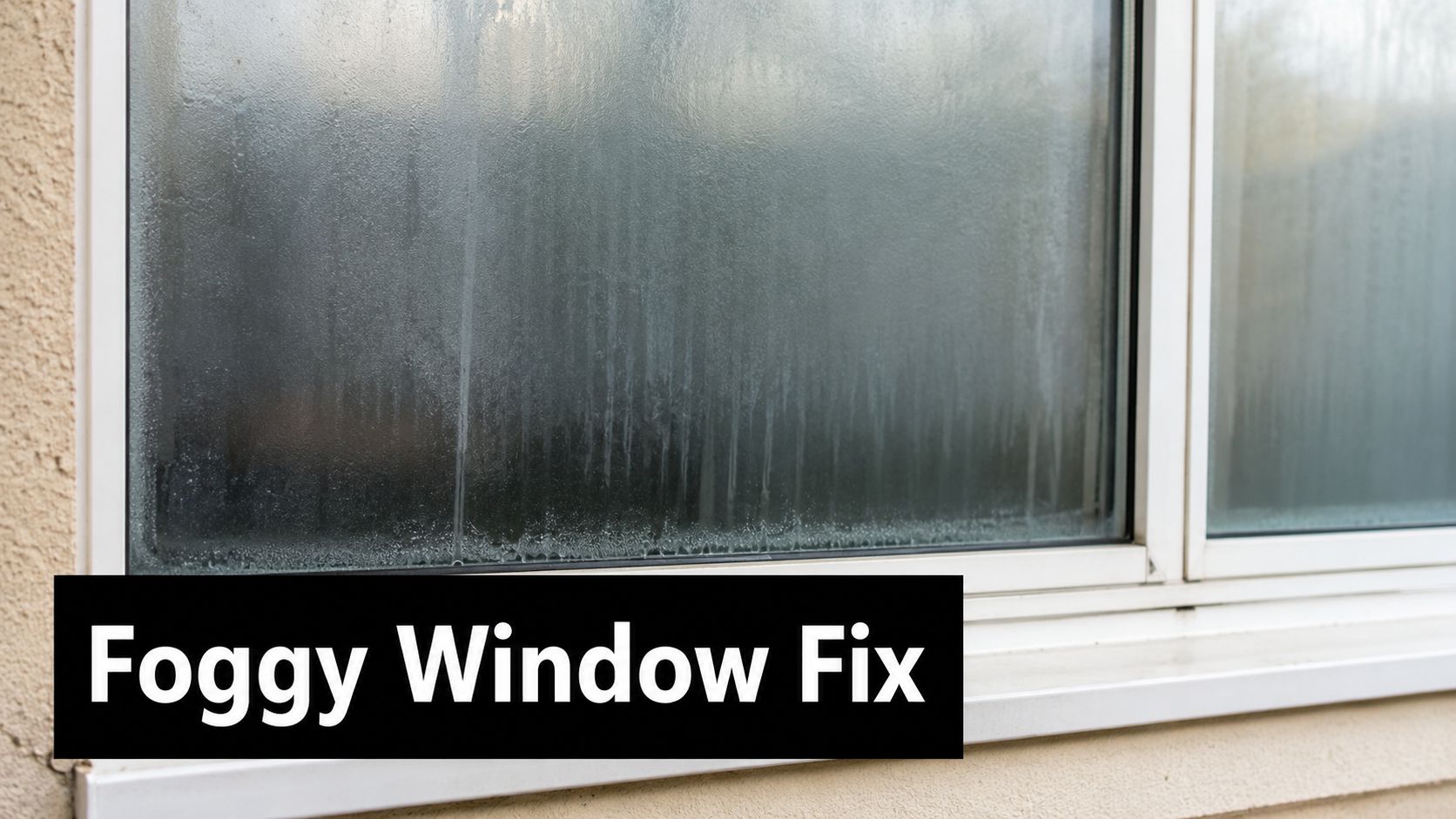
If the fog is inside the glass unit, that's not room humidity sitting on the surface. It's usually sealed unit failure. The edge seal that was supposed to keep that space airtight has broken down, and moisture has made its way into the cavity.
What homeowners usually notice first
- A milky haze that won't wipe off: You clean both sides and the cloudiness stays put.
- A window that looks worse in certain weather: Cold mornings, hot afternoons, and changing seasons tend to make the issue more obvious.
- Reduced comfort near the glass: The room may feel hotter by the window in summer or cooler in winter.
Practical rule: If you can't touch the moisture because it's trapped between panes, cleaning isn't the fix.
This catches people off guard because the window may still open and close. From the street, it may even look mostly fine. But the insulated part of the window has already failed.
In Nampa, the contractor pool for this kind of work is active but not huge. Angi lists 6 highly rated door pros in Nampa, and the broader Treasure Valley market functions as a regional service area rather than a city-only one. That matters because reputation, scheduling, and product-specific experience tend to separate a solid installer from a rushed one.
Why local experience matters
The Treasure Valley puts steady stress on exterior openings. Houses deal with strong sun, seasonal temperature swings, and normal settling over time. A local pro should know the difference between a glass-only issue, a frame issue, and a whole-unit issue. If they treat every foggy window like the same problem, they're guessing.
The Science Behind a Broken Window Seal
Most modern windows use an insulated glass unit, often shortened to IGU. The easiest way to think about it is a thermos bottle. A thermos works because it keeps a sealed space doing its job. A double-pane window works the same way.
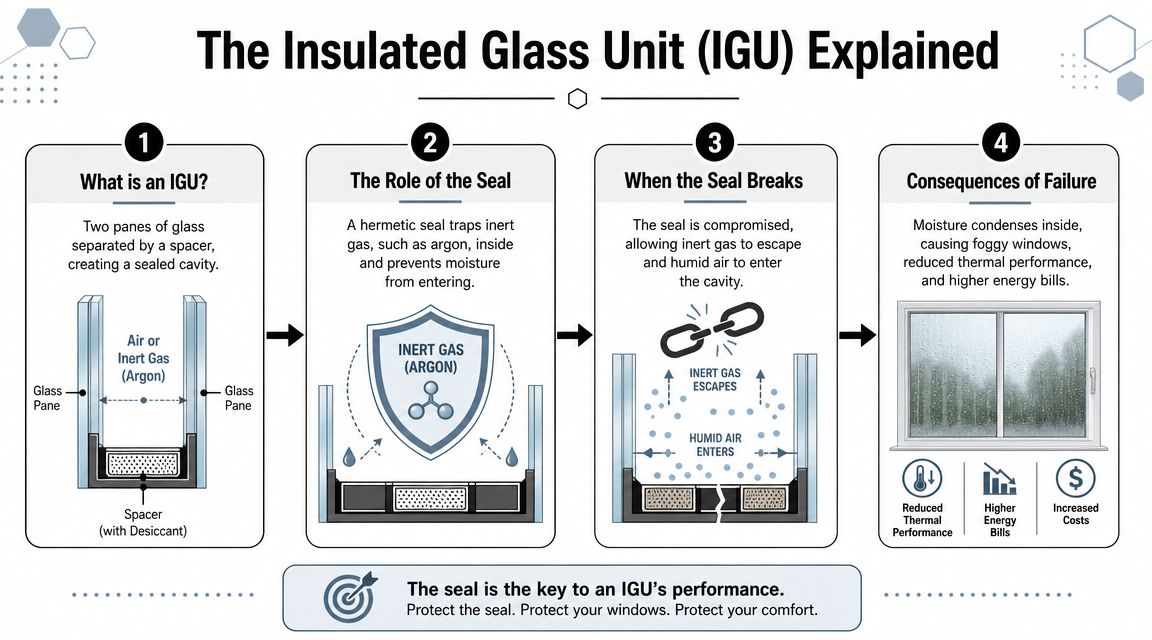
Inside that glass package, you have two panes separated by a spacer. Around the edge, seals hold the unit together and protect the space between the panes. That space is there for insulation. Once the seal fails, the system stops performing the way it was designed to.
What an IGU is actually made of
Here's the simplified version:
| Part | What it does | Why it matters |
|---|---|---|
| Glass panes | Create the inside and outside surfaces | They form the insulated assembly |
| Spacer | Keeps the panes separated | Maintains the cavity between panes |
| Edge seals | Hold the unit airtight | Keep outside moisture from entering |
| Gas fill or sealed air space | Improves thermal performance | Helps the window resist heat transfer |
A lot of homeowners focus only on the glass because that's what they can see. But a window is a system. Installers serving Nampa describe the slab or sash, frame, hardware, and casing as one integrated assembly, because alignment, air leakage control, and seasonal movement all depend on the whole unit working together.
A failure in one part compromises the whole system.
How the seal fails in real life
This usually happens slowly, not all at once.
The sun heats the window. Night cools it back down. Seasons swing from cold to hot and back again. Those repeated expansion and contraction cycles put stress on the edge of the glass unit. Over time, the seal can weaken enough to let air and moisture into the cavity.
Once that happens, three things follow:
- Moisture gets trapped between panes. That creates fog, haze, or streaking.
- The insulated space stops working as intended. The unit no longer performs like a properly sealed window.
- The problem tends to worsen. Temporary clarity in one season doesn't mean the seal healed.
Why simple surface fixes don't hold up
People understandably look for a shortcut. Drill-and-defog services and DIY kits can make the glass look better for a while. But they don't restore the original sealed cavity, and they don't turn a failed unit back into a healthy insulated unit.
That's why foggy glass often points to a bigger decision, not just a cleaning issue. If the seal is gone, you're deciding whether the rest of the window still deserves to stay.
Is It a Failed Seal or Just High Humidity
For many homeowners, this step saves time. Before you price anything, figure out where the moisture is.
If you know that, you can usually tell whether you have an indoor air issue, a normal outdoor condition, or a failed glass unit.
Use the fingertip test
Stand close to the window and look at the condensation or haze.
- If it's on the room side of the glass: That's usually indoor humidity.
- If it's on the outside surface: That's often a sign the window is insulating well and the outdoor conditions are causing surface condensation.
- If it's between the panes: The seal has likely failed.
That last one is the key distinction. If the cloudiness lives inside the unit, no humidity-control trick inside the house will fix it.
What room-side condensation means
Condensation on the interior surface is usually the house talking to you. Bathrooms, kitchens, laundry spaces, and tightly closed bedrooms can all push moisture levels up. You might reduce it by running exhaust fans, opening blinds, improving airflow, or managing moisture sources.
That problem is real, but it isn't the same as glass seal failure.
What outside condensation means
Exterior condensation surprises people because it makes them think the window is leaking. Usually it means the opposite. The outer pane is staying cool enough that moisture in the outside air condenses on it.
That can be inconvenient for the view, but it isn't the same as a failed window.
If the moisture is outside, wipe it. If it's inside the room, manage humidity. If it's between panes, the glass unit itself has failed.
Why defogging rarely solves the real problem
Quick-fix defogging appeals to homeowners for obvious reasons. It sounds cheaper, faster, and less disruptive. In some cases, it may improve appearance for a while. But there are trade-offs:
- It can clear visibility without restoring performance: The window may look better but still insulate poorly.
- It doesn't rebuild the original seal: The failed edge condition remains the underlying issue.
- It won't correct a bad frame or poor fit: If the sash, frame, or surrounding opening has its own problems, defogging ignores them.
DIY kits carry the same limitation. They tend to focus on appearance, not on rebuilding an insulated unit to factory condition. If your only goal is a short-term visual improvement in a low-priority space, that may be enough for you. For a main living area, bedroom, street-facing window, or any room where comfort matters, it usually isn't.
A practical way to decide
Ask yourself two questions:
- Do I want this window to look better, or perform better?
- Is the rest of the window still in excellent shape?
If you're chasing comfort, not just clarity, the answer usually pushes you away from surface fixes and toward either glass replacement or full replacement.
Should You Repair the Glass or Replace the Window
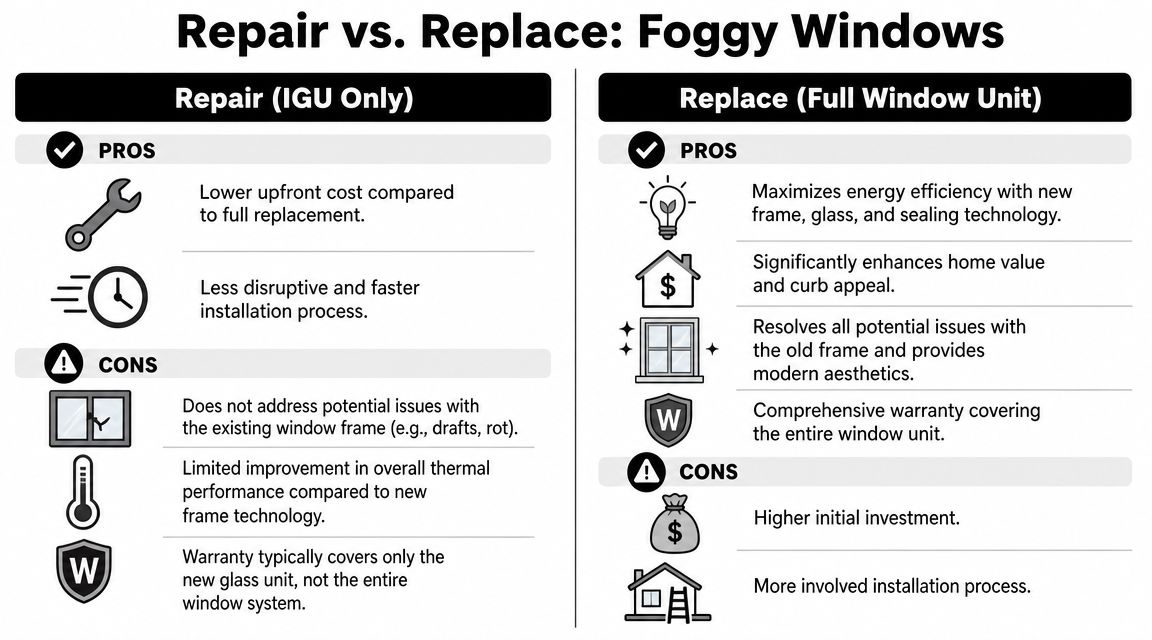
This is the decision point. If the seal has failed, you usually have two paths. Replace only the insulated glass unit, or replace the entire window.
Neither option is automatically wrong. The right choice depends on the age of the unit, the condition of the frame, how much draft you feel, and whether you're solving a cosmetic issue or trying to improve year-round comfort.
When glass-only repair makes sense
Replacing just the glass pack can be a reasonable choice if the window is relatively new and the rest of the unit is still solid.
Good candidates usually have:
- A frame in very good condition: No soft spots, no visible movement, no obvious draft paths.
- Hardware that still works properly: Locks engage, sash operation feels normal, and the unit closes tightly.
- A localized failure: One damaged pane in an otherwise healthy set of windows.
This route is usually less disruptive than a full replacement. If the existing frame is worth keeping, it can buy you time.
When full replacement is the smarter move
Older homes in the Treasure Valley often have more going on than failed glass. The fog is just the part you can see. The hidden issues are often air leakage, frame wear, old seals, difficult operation, or outdated glass performance.
Installers and home improvement retailers serving Nampa emphasize that installation quality is the single most important factor in performance, and they point to full removal and replacement as the best approach when you want the rough opening plumb, square, and properly sealed. That matters because even a brand-new glass unit will underperform if it's going back into a failing frame or an opening that was never corrected.
What works: Replacing the whole unit when the frame, sash, or air sealing is part of the problem.
What doesn't: Paying for new glass while ignoring drafts, movement, or poor fit around the opening.
Side-by-side comparison
| Option | Best for | Limitation |
|---|---|---|
| IGU-only replacement | Newer window with a healthy frame | Doesn't solve frame or air leakage issues |
| Full window replacement | Older unit, drafts, worn frame, overall comfort upgrade | Higher initial investment and more involved install |
A lot of homeowners try to save money by choosing the narrowest repair possible. That can work. But if the frame is worn, the sash is sloppy, or the opening has sealing problems, it often turns into paying twice.
For a deeper look at signs that push a project toward full replacement, this guide on window replacement in Nampa, Idaho is a useful reference.
DIY, repair, or replace
Here's the honest version.
- DIY is fine for cleaning tracks, replacing simple weatherstripping on accessible components, or reducing indoor humidity around otherwise healthy windows.
- Repair makes sense when the problem is narrow and the rest of the window is still in excellent shape.
- Full replacement is the right call when the unit is older, operation is poor, comfort has dropped, and you want a long-term fix instead of one more stopgap.
If you already feel drafts, struggle to lock the window, or notice multiple failed units in the same house, replacing only the glass usually treats the symptom, not the job.
Upgrading Your Home's Performance and Value
Once a seal fails, replacement isn't just about getting rid of the fog. It's a chance to improve how the house feels every day.
That matters in the Treasure Valley because windows do more than let in light. They regulate heat gain, heat loss, noise, and drafts. The difference between an older basic unit and a modern high-performance replacement is often most obvious in the rooms you use the most. South-facing living rooms, bedrooms with morning sun, and large picture windows tend to tell the truth fast.

Why newer glass packages perform better
Modern replacement products can include features such as Low-E coatings, Argon gas fills, and optional triple-pane construction. Those aren't just brochure terms. Each one addresses a specific comfort problem.
- Low-E glass: Helps manage solar heat gain and reduces unwanted heat transfer.
- Argon-filled units: Improve the insulating performance of the sealed space.
- Triple-pane options: Add another layer of separation and can improve comfort and quiet in the right application.
For many Idaho homeowners, performance-focused products such as Mezzo windows with ClimaTech glass packages make sense because they address the same issues older failed units struggle with: glare, seasonal discomfort, and inconsistent room temperatures.
What that means in a Nampa home
A window upgrade can change the feel of a room in practical ways:
- Summer comfort improves: Rooms with long sun exposure are easier to keep comfortable.
- Winter drafts drop: Properly sealed frames reduce the cold-edge feeling near the glass.
- Noise control gets better: Better glass packages and tighter installation help quiet down outside sound.
- Furnishings get more protection: Better-performing glass can reduce the harsh light exposure that wears on interior finishes.
Local service guidance tied to ENERGY STAR v7.0 notes that, in 2024, the efficiency conversation has shifted toward high-performance glass and correctly installed, air-sealed frames for reducing drafts, heat gain, and noise in Treasure Valley homes. That's especially relevant in older housing stock, where the window itself and the installation details both matter.
Better glass helps. Better installation makes that glass worth paying for.
When premium features are worth it
Not every opening needs the same build. A small bathroom window and a west-facing living room picture window don't have the same job.
Premium upgrades usually make the most sense when:
- The room gets intense sun
- You notice traffic or neighborhood noise
- The home has older windows throughout
- You plan to stay in the house and want a long-term comfort upgrade
If Idaho winters are part of your decision, this overview of triple-pane windows for Idaho winters can help you think through where extra glass layers pay off and where a well-built double-pane unit may already do the job.
Value isn't only resale value
Homeowners often ask whether replacement adds value. It can. But the more immediate value is daily use. A room that stays comfortable, a window that opens smoothly, and glass that stays clear all year is a quality-of-life upgrade, not just a line item.
That's why the right replacement is often more than a fix. In the right house, it's an upgrade to how the home performs.
Choosing a Partner for Your Window Project
A fogged unit tells you something important. The sealed system has failed, and the main question is no longer whether the glass looks bad. The main question is whether the installer can diagnose the whole opening correctly.
That matters because a homeowner searching for a door installer in Nampa, Idaho may be dealing with windows, patio doors, entry systems, or a combination of them. Local search results often blur those categories, which makes it harder to know whether you need a glass-only repair, a window specialist, or a more complete replacement approach.
What a solid process should include
Look for a company that does the basics well, without rushing past them.
- In-home evaluation: They should inspect the glass, frame, sash condition, operation, and visible air-leakage clues.
- Precise measurements: Replacement work should be based on the actual opening, not rough guesses.
- Clear scope of work: You should know whether they're replacing glass only, insert-style components, or the full unit.
- Clean installation habits: Good crews protect floors, control debris, and leave the opening finished properly.
Good answers sound specific
If you ask what they recommend, pay attention to how they explain it.
A strong installer should be able to tell you why the problem is happening, whether repair is still reasonable, and what full replacement would solve that repair would not. Vague answers are a bad sign. So is anyone who jumps straight to a quote without diagnosing the frame and surrounding condition.
The best installer isn't the one who says every window needs replacing. It's the one who can show you which units are worth repairing and which ones aren't.
The right standard to hold them to
You want a partner who understands Treasure Valley homes, communicates clearly, and stands behind both product and workmanship. Local knowledge matters because homes here see a mix of age, sun exposure, and seasonal movement that can make one opening very different from the next.
If you want a benchmark for what a regional specialist should look like, review what a local Treasure Valley window company offers in terms of consultation, measurement, installation discipline, and long-term support.
A good project feels organized from the first visit to the last cleanup. That's what homeowners should expect.
If you're tired of wiping a window that never gets clear, C & C Windows & Doors can help you sort out whether you need a repair or a full replacement. Their Boise-based team serves Nampa and the Treasure Valley with free in-home consultations, custom measurements, meticulous installation, and high-performance replacement windows built for Idaho homes.