
If your sliding patio door sticks every time you carry food out to the grill, fogs up when the temperature drops, or lets a cold draft roll across the floor on a January morning, it's probably doing more than annoying you. In Boise, an old patio door often means lost comfort, higher heating and cooling strain, and a weak point in the part of the house that should feel brightest and most connected to the backyard.
That's why sliding patio door replacement Boise homeowners choose shouldn't be treated like a minor repair. A patio door sits at the intersection of energy performance, weather exposure, security, daily use, and how your home feels in every season. The right replacement can make the room quieter, easier to heat and cool, and much better to live with.
Table of Contents
- Is Your Old Patio Door Ready for Retirement?
- Choosing Your Door Style and Materials for Boise Homes
- Decoding Energy Performance for the Idaho Climate
- Understanding the Cost of Patio Door Replacement in Boise
- The Step-by-Step Replacement Process and Timeline
- How to Choose a Trusted Local Installer in Boise
- Protecting Your Investment and Final Thoughts
Is Your Old Patio Door Ready for Retirement?
A lot of Boise homeowners wait too long because the door still technically works. It locks if you jiggle it. It slides if you lean into it. It doesn't look broken from across the room. But up close, the signs are obvious. Worn rollers. Drafts at the meeting rail. Condensation between panes. Water staining near the sill. A track that collects dirt because the door never sealed tightly in the first place.
Those issues usually show up at the worst times. Winter makes air leaks obvious. Summer exposes glass that turns the room into a hot spot by late afternoon. And when you're trying to move between the house and the patio every day, a stubborn slider gets old fast.
Practical rule: If you've started managing the door instead of simply using it, replacement usually deserves a serious look.
A modern replacement changes more than operation. It can tighten the opening, improve glass performance, update the threshold, and fix installation defects that may have been there since the original build. For Boise homes, that matters because the patio door isn't just a piece of glass. It's part of the home's exterior envelope, and it needs to handle cold snaps, strong sun, drifting debris, and year-round traffic.
Choosing Your Door Style and Materials for Boise Homes
Some patio door decisions are about looks. Most are about how the door will live in your house for the next many years. In Boise, that means balancing sunshine, winter cold, dust, irrigation splash, and heavy use.
How the main patio door styles compare
A sliding patio door is still the default choice for many homes because it saves floor space and gives you a wide glass area without requiring swing clearance. For tighter patios, furnished family rooms, and everyday convenience, it's often the most practical option.
French doors feel more traditional and can create a wider open feel, but they need interior or exterior clearance to swing. That sounds simple until a chair, rug, snow buildup, or deck layout gets in the way.
Bi-fold doors create a dramatic opening, but they make the most sense when the opening is large, the budget is higher, and the installation team is equipped for more complex alignment and weatherproofing. They can be excellent in the right remodel, but they're not an automatic upgrade over a well-built slider.
Which frame materials hold up best in Boise
The frame matters almost as much as the glass. A good glass package inside a weak or poorly insulated frame won't deliver what you expect.
| Material | Pros for Boise | Cons for Boise | Maintenance Level |
|---|---|---|---|
| Vinyl | Good thermal performance, low maintenance, works well for standard replacements, resists moisture | Lower-end vinyl can feel less rigid on large panels, color options may be more limited | Low |
| Fiberglass | Stable in temperature swings, durable, strong frame profile, good long-term choice for exposed elevations | Usually costs more than standard vinyl options | Low |
| Wood | Warm interior appearance, strong design value in traditional homes | Needs ongoing finishing and more attention around sun and moisture exposure | High |
| Aluminum | Slim sightlines, modern look, structural strength | Poor choice if it isn't thermally broken, can feel cold and transfer heat more readily | Low to moderate |
For many Boise homes, reinforced vinyl hits the practical middle ground. It's easier to maintain than wood and typically offers better insulation than older aluminum products. On standard sliding replacements, it often gives homeowners the best mix of comfort, value, and simplicity.
Fiberglass is worth a hard look if the opening gets intense sun or if the door is oversized. It stays stable through seasonal swings and tends to feel more substantial in larger configurations.
Wood still has a place, especially in custom homes where interior finish matters, but homeowners should go into it with open eyes. Wood asks for maintenance. If the exterior exposure is rough and upkeep slips, small problems turn into expensive ones.
Aluminum only makes sense when it's engineered for performance. In this climate, thermally broken aluminum is the baseline. Anything less can leave you with a frame that looks sleek but underperforms when the weather turns.
A patio door should match the house, but it also has to match the opening, the exposure, and the way the family actually uses it.
When homeowners compare styles, I usually tell them to start with three questions:
- How do you use the opening daily? A busy family going in and out to kids, dogs, or a grill usually wants the simplicity of a slider.
- What does the room allow? Swing doors need clearance. Large multi-panel systems need wall space and structural planning.
- How much maintenance are you willing to own? Materials don't all age the same way.
If you answer those truthfully, the shortlist gets much clearer.
Decoding Energy Performance for the Idaho Climate
The biggest performance jump in a patio door replacement usually comes from the glass package and the frame working together. That matters in Boise because homes deal with cold winter nights, hot summer afternoons, and strong sunlight for much of the year.

The specs that matter on a patio door quote
If you only ask whether the door is “energy efficient,” you probably won't get a useful answer. Ask for the actual numbers and product details.
Start with U-factor. Think of it as the door's resistance to letting indoor heat escape when it's cold outside. Lower is better if you want the room to stay more comfortable on winter mornings.
Then look at Solar Heat Gain Coefficient, often shortened to SHGC. That tells you how much solar heat comes through the glass. In Boise, this matters because west-facing and south-facing doors can add a lot of afternoon heat if the glass isn't tuned for the exposure.
Ask whether the glass has a Low-E coating and whether the unit uses argon gas fill. Low-E helps control radiant heat transfer. Argon improves insulation within the insulated glass unit. Those are standard features on better-performing patio doors, not luxury add-ons.
Also ask whether the frame is thermally broken or insulated. A weak frame can drag down the whole assembly.
What actually improves comfort
Modern ENERGY STAR-qualified sliding doors typically use double- or triple-pane insulated glass, Low-E coatings, argon gas fill, and insulated or thermally broken frames. According to Victory Windows on ENERGY STAR-qualified sliding doors, replacing a leaky single-pane patio door with that kind of unit can cut energy costs previously lost through the old patio door by 20 to 35%.
That doesn't just show up on utility bills. You'll feel it near the glass. The floor area by the door is less likely to run cold in winter or overheat in summer. The room becomes easier to use all day.
If your home sits near a busier road, glass upgrades can also improve the sound profile indoors. Multi-pane insulated glass tends to help with outside noise, especially compared with older single-pane units.
For homeowners already comparing full exterior upgrades, it's worth looking at how patio door specs line up with nearby window openings too. A good Boise window replacement guide can help you compare envelope performance across the whole room instead of treating the door as a standalone purchase.
A few spec checks separate strong products from weak ones:
- Glass package first: Don't stop at “dual pane.” Ask what Low-E package is included.
- Frame construction next: Reinforcement and thermal design matter, especially on large sliding panels.
- Match the exposure: A shaded north-facing opening and a hot west-facing opening may need different priorities.
- Installation still matters: Even excellent glass won't perform well if the frame isn't sealed correctly.
The best patio door on paper can still feel disappointing if the installer leaves gaps, skips flashing details, or fails to square the frame.
Understanding the Cost of Patio Door Replacement in Boise
Price is where a lot of homeowners either get stuck or get rushed. The mistake is assuming every sliding patio door replacement is basically the same job. It isn't. A clean insert-style replacement in a sound opening is one thing. A project with water damage, custom sizing, upgraded glass, and trim work is something else.
What the local numbers tell you
There is a real local baseline. ProMatcher's Idaho sliding door installation cost page lists the average cost of sliding door installation at $723.80, with a reported range of $668.12 to $779.47 as a fixed fee to replace an exterior sliding glass door. The same Idaho report lists exterior door installation at $389.26 per door, interior door installation at $178.83 per door, and storm door installation at $312.00, which helps show that sliding patio doors are a higher-cost exterior replacement category rather than a simple door swap.
That fixed-fee benchmark is useful, but it doesn't represent the full range of what Boise homeowners purchase. A Boise-area patio door replacement cost overview states that patio door replacement can range from $500 to $10,000 or more, depending on product type, customization, and installation complexity.
That wide spread makes sense in practice. The local market includes basic replacements, premium custom doors, and multiple patio-door configurations, not just standard sliders.
What moves a project up or down in price
Three cost buckets usually shape the final quote:
The door itself
Material, size, panel configuration, hardware finish, and glass package all matter. A basic vinyl slider costs less than a larger custom unit with premium finishes and upgraded performance features.Labor and installation method
Replacing within an existing sound opening is simpler than rebuilding part of the rough opening, correcting an old install, or integrating new trim details.Hidden conditions and optional upgrades
Rot, water intrusion, subfloor repair, threshold changes, security upgrades, and finish carpentry can all change the job.
A low quote isn't always a bargain. Sometimes it just means the estimate doesn't account for what's likely hiding once the old frame comes out.
Here's the budget reality Boise homeowners should keep in mind:
- Baseline labor exists, but product choice drives the spread: Installation isn't the whole story. Door configuration and performance package often move the total much more.
- Custom sizing costs more for a reason: Better fit, better glass, and more detailed manufacturing usually mean fewer compromises at the opening.
- Old openings can surprise you: Damage around the sill or side jambs can add repair work you won't see from the living room.
- Financing can be a practical tool: It lets some homeowners choose the door they want instead of settling for the cheapest short-term option.
If you're trying to ballpark scenarios before getting onsite measurements, a Boise replacement cost calculator for windows and doors can help frame the conversation before a formal quote.
The Step-by-Step Replacement Process and Timeline
Most homeowners are less worried about the concept of replacement than the disruption. They want to know what happens to the opening, how long the room is exposed, whether the floor will be protected, and what happens if the old frame comes out and reveals trouble.
The process should feel organized, not improvised.
What happens before installation day
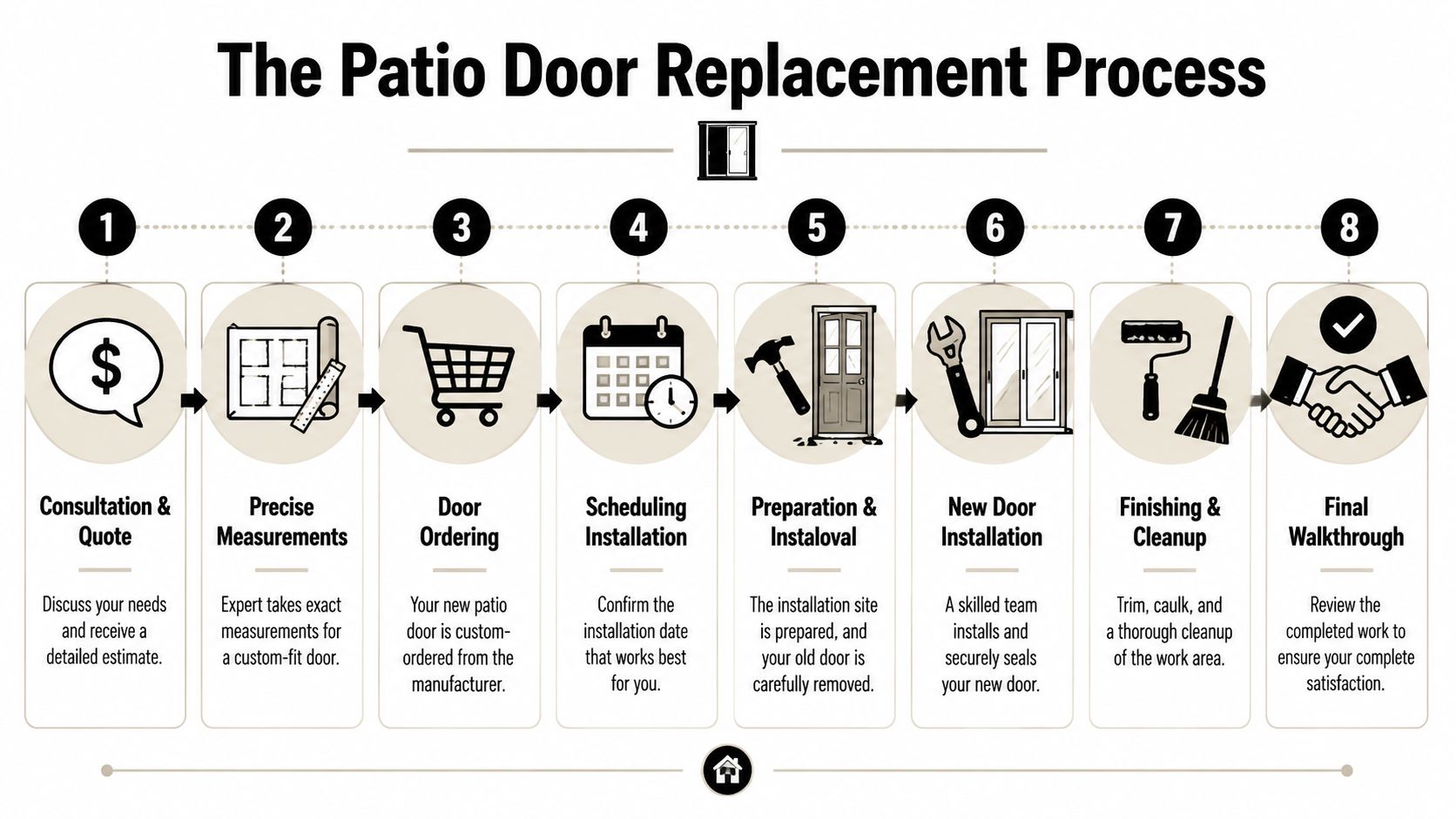
A proper project starts with an in-home visit and precise measurements. Patio doors don't forgive sloppy measuring. The installer needs to confirm width, height, plumb, level, condition of the surrounding frame, floor transitions, and exterior drainage conditions.
After that comes product selection and ordering. Since many replacement doors are built for a specific opening, lead time depends on the door and options chosen. This is also when you want clarity on hardware, glass package, screen options, interior finish, and exterior trim details.
Before installation day, the homeowner should know:
- What is being replaced: Just the operating unit, or the full frame and surrounding trim as well.
- What access the crew needs: Interior workspace, exterior path, and room to stage materials.
- How debris is handled: Old glass, frame components, and packaging should leave with the crew.
- What could change the scope: Existing water damage or structural issues don't always show until removal starts.
What a professional install should look like
The old door comes out carefully. Then the opening gets inspected, cleaned, and checked. This is the moment when hidden problems surface. According to Pella's Idaho patio door guidance, installers need to be prepared for hidden rot or structural framing problems, and those issues can affect both timeline and cost. The same guidance also stresses that poor installation can negate the performance benefits of a high-end energy-efficient door.
That's exactly right. Patio doors fail at the perimeter as often as they fail in the glass.
A solid installation day usually includes:
- Floor and work-area protection: Drop cloths, careful removal, and controlled debris.
- Opening repairs if needed: Damaged framing or sill areas should be fixed before the new unit goes in.
- Setting and shimming the new frame: The door has to be square, plumb, and properly supported.
- Sealing and weatherproofing: The perimeter must be insulated and sealed correctly so the unit performs as designed.
- Final adjustment: Rollers, locks, handles, and screen function should all be checked before sign-off.
A patio door should slide smoothly, lock without forcing, and seal tightly. If any one of those is off, the install isn't finished.
The final walkthrough matters. Open and close the panel yourself. Check the lock. Look at the sightlines. Ask where the weep system drains. Stand near the sill. A clean handoff gives you confidence that the door wasn't just installed, but installed correctly.
How to Choose a Trusted Local Installer in Boise
The door matters. The installer matters just as much.
A patio door can have excellent glass, a solid frame, and strong hardware, then still disappoint because the crew rushed the prep, skipped sealing details, or treated the opening like a generic swap. In Boise, where doors deal with summer sun, winter cold, dust, and moisture exposure, careful installation isn't optional.
Questions worth asking before you sign
You don't need to interrogate every contractor. You do need to ask enough to see how they think.
Use questions like these:
- Who will do the installation? Find out whether the crew is in-house or subcontracted.
- How do you handle hidden rot or framing damage? You want a clear process, not a vague promise.
- What does your labor warranty cover? Product warranties and workmanship warranties are not the same thing.
- How do you measure for replacement patio doors? A good answer sounds specific, not generic.
- What weatherproofing steps are included? Ask about sealing, sill treatment, and exterior integration.
- How is cleanup handled at the end of the job? Good installers plan for debris from the start.
What separates a careful installer from a fast one
A fast bid often focuses on the door. A careful bid focuses on the opening.
Look for an installer who talks about inspection, sill condition, frame alignment, finish details, and post-install adjustment. That's usually the company thinking beyond the sale. For example, local options such as Treasure Valley window and door installers may describe whether they provide custom measurements, factory-trained crews, or debris-free installation practices. Those details tell you how the work is likely to go.
One Boise-based example is C & C Windows & Doors, which offers patio door replacement as part of its local installation work and describes factory-trained installation, custom measurement, and debris-free jobsite practices. That doesn't replace your own vetting, but it does show the kind of process detail worth looking for when comparing companies.
Ask the installer how they correct an out-of-square opening. If the answer sounds improvised, keep looking.
Reviews help, but they shouldn't be your only filter. A stronger signal is whether the installer can explain the work plainly, identify the risk points, and put the scope in writing.
Protecting Your Investment and Final Thoughts
A new patio door should keep earning its keep long after installation day. That means choosing a door that fits Boise's climate, selecting glass and frame features that improve comfort, and hiring an installer who treats the opening with care.
Once the new door is in, maintenance is straightforward if you stay ahead of it. Keep the track clean so rollers don't grind through dirt. Check weatherstripping from time to time, especially after heavy seasonal use. Clean the glass with products appropriate for modern coated glass surfaces. Watch the sill and exterior drainage path so water can move away the way it should.
Small habits protect a large purchase.
Sliding patio door replacement in Boise isn't just about replacing an old slider with a new one. Done right, it improves how the room feels in winter, how it handles summer sun, how securely it closes at night, and how easily your home connects to the outside every day.
If you're comparing options for your home, C & C Windows & Doors provides Boise-area patio door and window replacement with in-home consultations, custom measurements, and installation for Treasure Valley homes.