
If you're in Meridian staring at foggy glass, feeling drafts near the couch, or watching one west-facing room turn into an oven every summer afternoon, your windows aren't just old. They're costing you comfort every day.
Most homeowners start by thinking about looks. I think that's backwards. In this climate, windows are part of your home's envelope. They affect heat, cold, noise, and how hard your HVAC system has to work. That makes replacement windows in Meridian, ID a performance decision first, and a style decision second.
Table of Contents
- Why Meridian's Climate Demands Better Windows
- Choosing the Best Window Materials and Styles for Your Home
- Decoding Energy Star 7.0 and High-Performance Glass
- Budgeting for Replacement Windows Cost and Value in Meridian
- Your Professional Installation A Step-by-Step Guide
- The C & C Promise Local Trust and Lifetime Assurance
Why Meridian's Climate Demands Better Windows
A lot of Meridian homeowners call about the same pattern. Winter comes, and the rooms along the north side feel colder no matter what the thermostat says. Then July hits, and the sun pounds the glass on the south and west elevations until one side of the house feels completely different from the other.
That isn't your imagination. It's usually the windows.
What homeowners usually notice first
The first signs are practical, not technical:
- Drafts by seating areas where people spend the most time
- Hot bedrooms in late afternoon from direct summer sun
- Cold glass in winter that makes the room feel uncomfortable even when the furnace is running
- Condensation or fogging that tells you the unit isn't performing like it should
For Meridian homes, this matters more than many people realize. The U.S. Department of Energy says heat gain and loss through windows can account for 25%–30% of residential heating and cooling energy use in homes, which is a big deal in a place that sees both summer cooling and winter heating demand (Department of Energy figure cited for Meridian homeowners).
Practical rule: If a room is always harder to heat or cool than the rest of the house, start by looking at the windows before you blame the HVAC system.
Why old windows struggle here
Meridian's climate asks a lot from glass and frames. You need insulation in winter, solar control in summer, and tight air sealing year-round. Older windows often fail on all three fronts. Some leak air. Some let too much solar heat in. Some have glazing that isn't built to current performance expectations.
That's why I tell homeowners to stop thinking of window replacement as trim work. It's a building-envelope upgrade. When you replace the right windows with the right glass package, you can change how the house feels every morning and every afternoon.
If you're trying to decide whether the energy side of the project is worth it, this guide on whether new windows save money on heating bills in Idaho is worth reading alongside your estimates.
Choosing the Best Window Materials and Styles for Your Home
Homeowners often ask for the "best" window. That's the wrong question. The right question is which style and frame setup fits the room, the house, and Idaho weather.
Match the style to the room
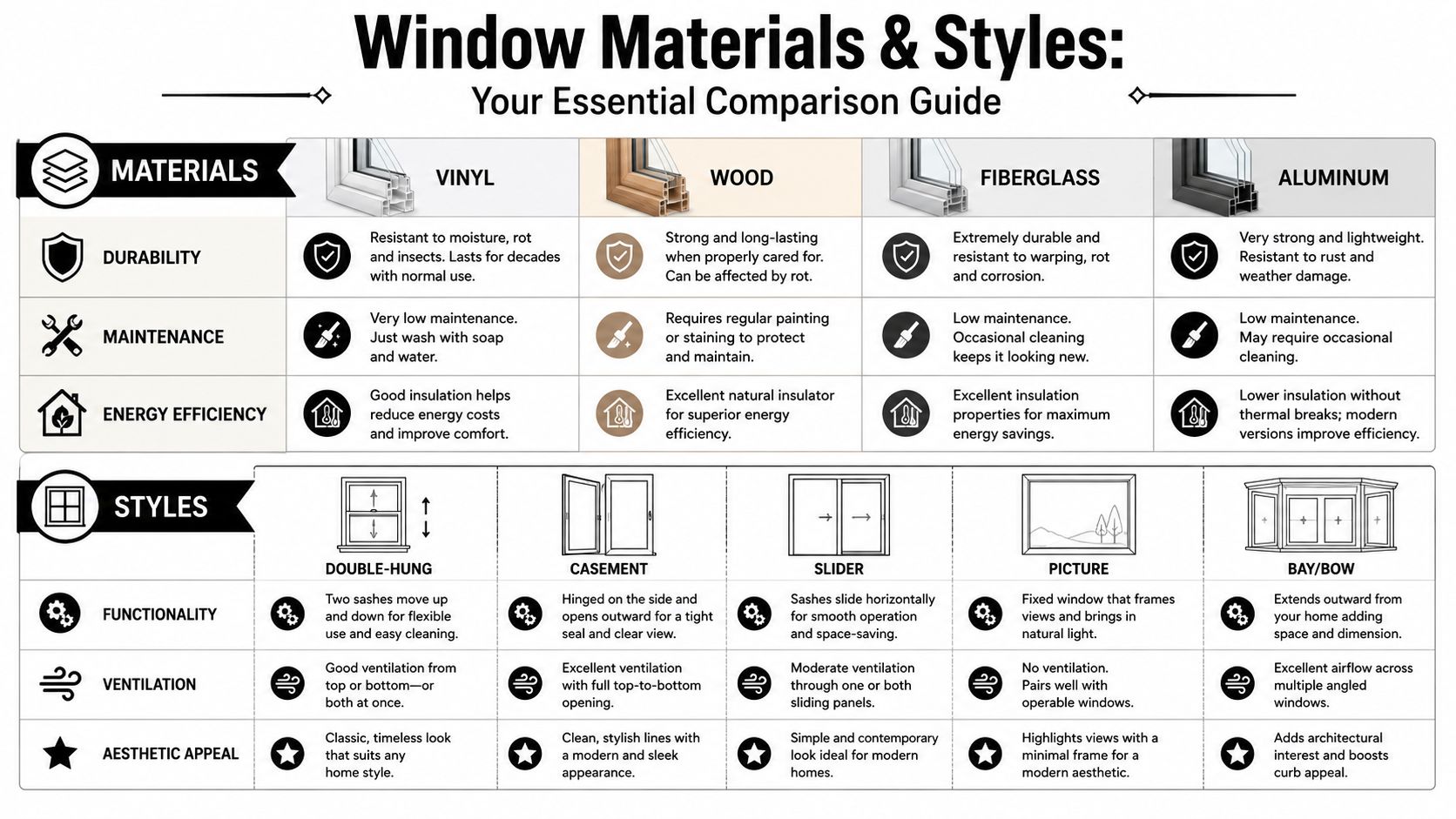
Different window styles solve different problems. Pick based on function first.
| Style | Where it works well | Why I recommend it |
|---|---|---|
| Double-hung | Bedrooms, front elevations, traditional homes | Easy to live with, familiar look, good for everyday ventilation |
| Casement | Kitchens, side yards, spots where you want airflow | Opens wide and catches breeze better than many other styles |
| Picture | Living rooms, view corridors, large openings | Gives you maximum glass and daylight when ventilation isn't needed |
| Sliding | Wider wall spaces, patios, contemporary layouts | Simple operation and clean horizontal lines |
A few direct recommendations:
- For bedrooms: Double-hung windows are a safe, practical fit when you want ventilation and an appearance that doesn't fight the architecture.
- For kitchens over sinks: Casements are often easier to operate because you crank them instead of lifting a sash.
- For living rooms facing views: Picture windows make sense when the goal is light and visibility, not airflow.
- For wider openings: Sliders can be a smart choice when wall geometry favors width over height.
Don't force one style into every room just to simplify the quote. Good window design is room by room.
Choose frame materials for Idaho, not for a brochure
Material choice affects durability, maintenance, appearance, and overall thermal performance. You want a frame that stays stable through seasonal shifts and supports the glass package you chose.
Here's the simple breakdown:
- Vinyl: Popular because it's low-maintenance and typically a strong value choice.
- Wood: Attractive, but it needs more upkeep and the long-term maintenance commitment is real.
- Fiberglass and other engineered options: Often chosen when stability and durability are priorities.
- Aluminum: Clean look, but usually not my first recommendation when thermal performance is the main goal.
For many homeowners shopping vinyl replacement windows in Idaho, vinyl remains the most sensible starting point because it balances maintenance, appearance, and efficiency well.
I also pay attention to frame design details that many estimates barely mention. Narrowline frames increase glass area and daylight. Composite-reinforced sashes add stiffness and help the unit stay true over time. In Idaho, those details matter because wide temperature swings expose weak frames and cheap sash construction fast.
If you want one opinionated takeaway, here it is: choose the window style based on how the room works, and choose the frame based on long-term stability, not showroom appeal.
Decoding Energy Star 7.0 and High-Performance Glass
You feel it first in the rooms you use the most. A bonus room that bakes by 5 p.m. A bedroom that stays cold no matter how high the thermostat runs. In Meridian, those comfort problems usually trace back to the glass package, not just the frame.
What Energy Star 7.0 changes
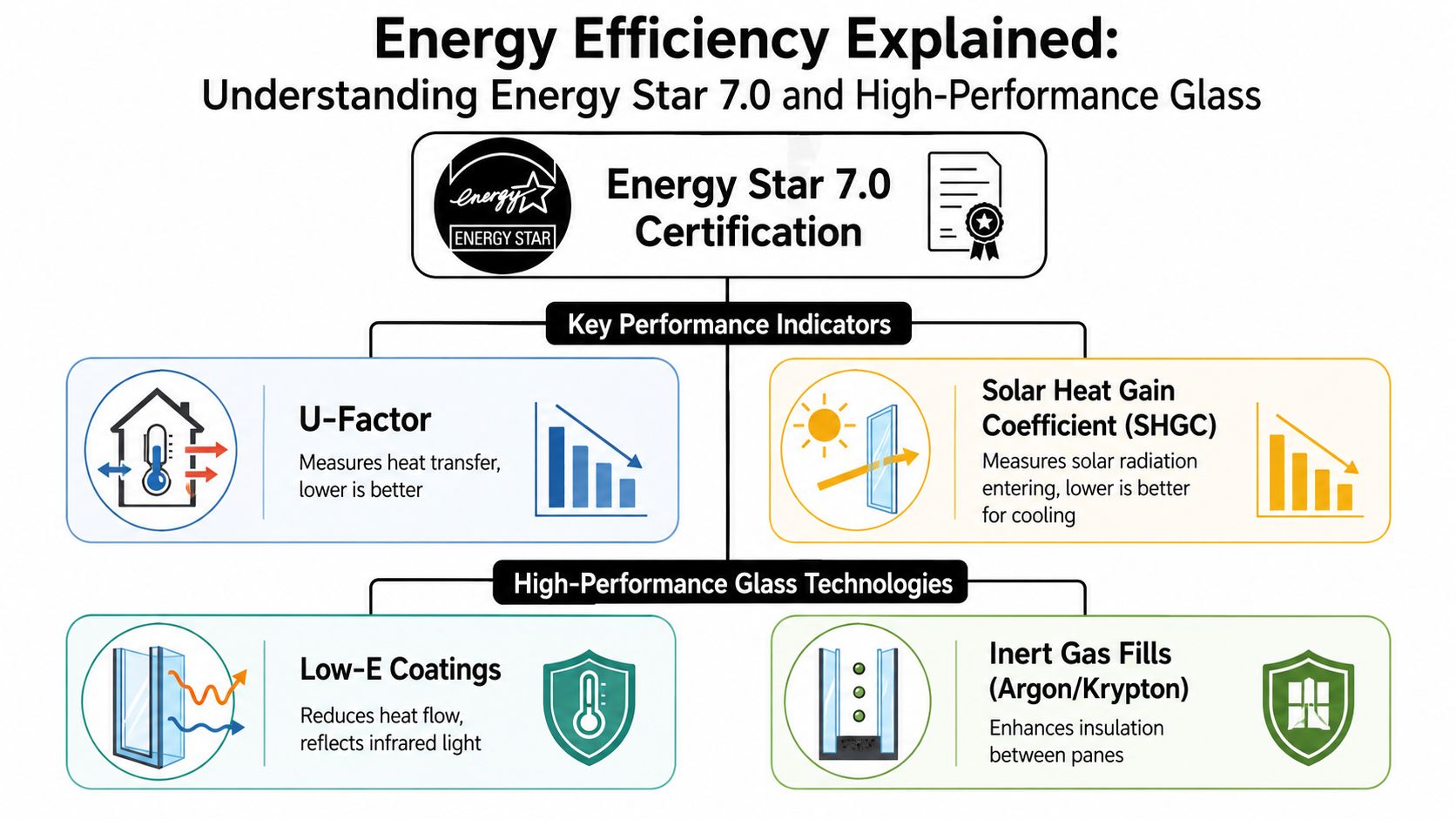
ENERGY STAR 7.0 matters because it forces a more climate-specific conversation. That is good news for Treasure Valley homeowners. Meridian is not coastal California, and it is not the Upper Midwest either. We deal with hot, dry summer sun, winter cold, and plenty of temperature swing between day and night. Your window spec should reflect that.
The National Fenestration Rating Council explains the two labels that matter most when you compare windows: U-factor and SHGC (NFRC ratings guide). U-factor measures how well the whole window resists heat loss. Lower numbers are better. SHGC measures how much solar heat the glass lets in. Lower numbers usually help on west- and south-facing exposures that take a beating in summer.
That is the Meridian-specific framework I recommend. Start with orientation, then match the glass to the room. Do not buy every opening with the exact same package unless the house performs the same on every side. It usually does not.
The glass package decides how the room feels
Low-E glass works by reflecting radiant heat instead of letting it pass straight through the glass. Gas fill between panes slows heat transfer further. The Efficient Windows Collaborative explains how low-E coatings, multiple panes, and gas fills improve window performance as a system, not as isolated features (high-performance window guidance).
That is why I push homeowners to ask better questions. “Is it double-pane or triple-pane?” is not enough. Ask which Low-E coating is being used, what the U-factor is for the full unit, and whether the SHGC fits the room's sun exposure.
Triple-pane can be a smart upgrade in the right spots. ConsumerAffairs, citing federal research, reported that triple-pane windows reduced heating costs by an average of 12% and cooling costs by 28% over a 10-week period (window and door statistics summarized by ConsumerAffairs). I would not put triple-pane everywhere by default, but I would seriously consider it for loud streets, harsh west-facing rooms, and homes where comfort is the main complaint.
Here is the blunt advice I give Meridian neighbors:
- Prioritize low U-factor if winter discomfort is your main issue.
- Watch SHGC closely on sun-heavy exposures, especially west-facing glass.
- Use triple-pane selectively where noise control or room-by-room comfort justifies the added cost.
- Read the NFRC label on the actual product, not just the brochure headline.
- Treat installation and glass as one system. Great glass installed poorly still underperforms.
If you want the homeowner version of the specs without the jargon, this guide to energy-efficient windows in Idaho for 2026 is a useful next read.
Budgeting for Replacement Windows Cost and Value in Meridian
Let's deal with the question everybody asks first. What does window replacement cost?
The honest answer is that the spread is wide, and that's normal. Window projects are priced per opening, not as one generic package.
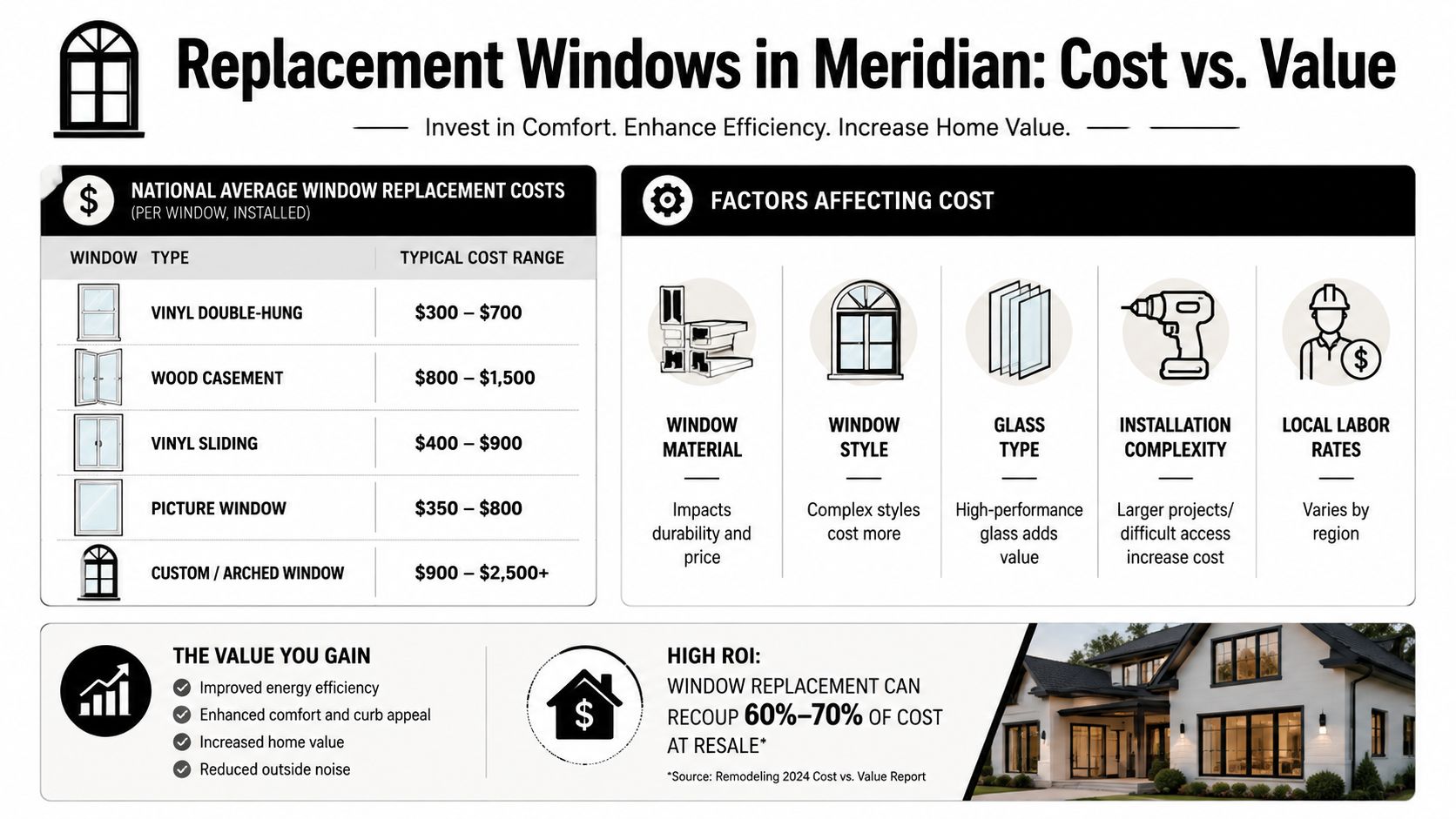
What window replacement usually costs
In the U.S. market, the average cost to replace a single window is reported at $650, and broader estimates often range from $200 to $1,200 depending on size, material, and location (national window replacement cost ranges).
That's the right starting point, but not the whole story for Meridian. Local consumer-facing estimates can look low for a basic per-window number and much higher once premium materials, higher-performance glass, and full installation are included. That's why a modest project and a premium project can land in very different places, even in the same neighborhood.
Here are the biggest cost drivers:
- Window size: Bigger openings generally mean more material and more labor.
- Style: Simple replacement units are usually more straightforward than specialty shapes or large feature windows.
- Frame material: Materials change both the product cost and the long-term maintenance profile.
- Glass package: Better thermal performance usually raises the upfront price.
- Installation scope: Existing-condition surprises, trim work, and access all affect labor.
A cheap window quote often gets cheap by cutting the glass package, the frame quality, or the installation scope. Sometimes all three.
How to think about value instead of sticker shock
Window replacement isn't a minor repair. It's a capital improvement. Treat it that way.
I tell homeowners to judge value through four lenses:
Comfort now
If the bedrooms are cold in winter or one living area overheats in summer, that daily frustration has value. A lot of value.Utility savings over time
You may not know the exact payback without utility history and product specs, but better-performing windows can reduce wasted heating and cooling energy when chosen and installed correctly.Resale and marketability
Buyers notice old windows fast. They also notice when a house feels quieter and more comfortable.Reduced maintenance headaches
Sticking sashes, failed seals, rotted trim, and recurring caulk fixes all cost time and money.
If budget is tight, don't replace every window blindly. Prioritize the worst performers first. Start with the windows that face the harshest sun, the rooms that are chronically uncomfortable, and the units with obvious seal or operation failures. That's usually smarter than spreading the budget thin across low-impact openings.
Your Professional Installation A Step-by-Step Guide
A January cold snap in Meridian will expose a bad window install fast. You feel it at the stool, see condensation where it should not be, and wonder why a new window already feels mediocre. That usually comes back to installation, not the brochure.
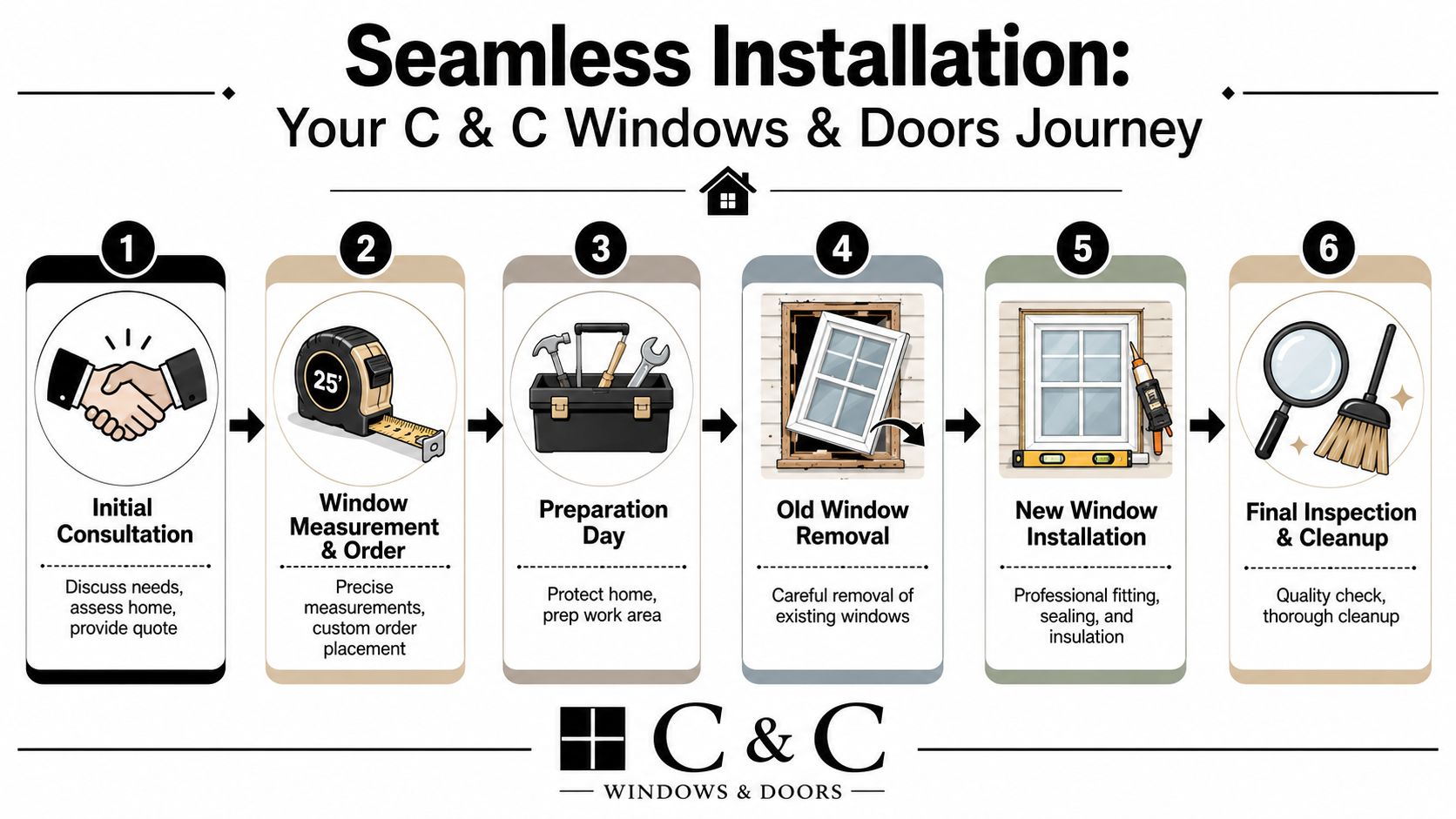
What a proper installation should look like
In Meridian, installation has one job. Keep the window square, airtight, and able to drain water out of the wall assembly. If any one of those is missed, you lose comfort, energy performance, and long-term durability.
Start with support. The window has to sit on a solid, properly shimmed base so the frame does not twist under load. Then the installer needs to air-seal the perimeter without blocking the path water uses to escape. The flashing and sealant details should send water down and out, especially on elevations that take wind-driven rain and strong afternoon sun.
ENERGY STAR 7.0 raised the bar on product performance. Installation still decides whether your home gets that performance in real life.
Ask every installer the same three questions: How do you support the sill, how do you air-seal the perimeter, and how do you handle drainage?
If the answer is vague, keep shopping.
The steps that protect your investment
A professional replacement follows a disciplined sequence:
Measure the existing openings carefully
Exact measurements matter because Idaho homes shift, settle, and rarely give you a perfectly uniform opening. The replacement unit needs enough room to be adjusted, shimmed, and sealed correctly.Protect the work area before removal
Floors, nearby furniture, and interior finishes should be covered before anything comes out. Good crews respect the house and control the mess.Remove the old unit without tearing up the opening
Rushed removal creates avoidable trim damage and can hide rot, moisture staining, or framing issues that should be addressed before the new unit goes in.Set, shim, and support the new window correctly
This is the point where quality separates itself. The installer should check for level, plumb, square, and proper sash operation before final fastening.Air-seal and manage water at the opening
Foam, sealant, backer rod, and flashing each have a specific job. Used correctly, they cut drafts and direct incidental moisture back out where it belongs.Test operation and finish the details
Locks should engage cleanly. Sashes should move smoothly. Exterior trim and sealant lines should look neat and shed water, not collect it.
A good installation also includes a final walkthrough. Open every unit. Lock every unit. Look at the exterior. This is a major home investment, and you should know exactly what was done.
One factual example of a local installer offering this type of replacement work is C & C Windows & Doors, which provides in-home consultations, custom measurements, and replacement installation for Treasure Valley homes.
The C & C Promise Local Trust and Lifetime Assurance
A Meridian window job is not proven on installation day. It is proven in January when cold air settles near the glass, in August when west-facing rooms heat up by midafternoon, and a few years later when seals, hardware, and trim should still be doing their job.
What matters after the sale
Long-term value comes from three things. The window has to match Idaho's climate. The installation has to hold up through heat, cold, wind, and dust. The company has to answer the phone if something needs attention later.
That is the standard I would use for any replacement project in Meridian. Brand names matter less than fit, glass package, and follow-through. ENERGY STAR 7.0 raised the bar, and that is good news for Treasure Valley homeowners. It pushes buyers to look past showroom language and focus on verified performance that affects comfort and utility bills.
A good warranty only helps if the company is still here to honor it. Local accountability matters in a market like Meridian, where homes deal with hot dry summers, freezing winter nights, and wide temperature swings in the shoulder seasons. You want a contractor that understands how those conditions affect expansion, contraction, seal life, and glass performance over time.
The standard I'd hold any installer to
If you are comparing bids, use this filter:
- Spell out the glass package. Ask for the Low-E coating, gas fill, spacer system, and the performance ratings, not just "energy efficient."
- Explain the labor warranty in plain English. You should know what is covered, for how long, and who handles service calls.
- Show local experience. Meridian homes are not all built the same. Older frames, stucco exteriors, and builder-grade units each create different replacement challenges.
- Respect the investment. A company should give you custom measurements, a clear scope of work, and realistic expectations about timing, trim, and cleanup.
Here is my advice. Buy from the company that can explain why a specific window is right for your house, your orientation, and your budget. Skip the one that leads with discounts and vague promises.
C & C Windows & Doors is one example of a local company offering in-home consultations, custom measurements, and replacement window installation for Treasure Valley homeowners. If you're ready to compare options for your home, schedule a free in-home consultation with C & C Windows & Doors. Get custom measurements, a same-day estimate, and straightforward advice on which windows are worth replacing now and which can wait.