Installed replacement windows in Boise typically run $400 to $800 per window for vinyl, $700 to $1,400 for fiberglass, and $900 to $1,800+ for wood-clad, with a typical 15 to 20 window whole-home project landing between $10,000 and $30,000+ depending on material. If you've been staring at a drafty living room window, a fogged-up double pane, or a full-house list that keeps growing, that's the price reality you need before you start collecting quotes.
Boise isn't a one-price market. The gap is wide because frame material, glass package, window size, and installation complexity all pull the number in different directions, and the cheapest quote is often the one that leaves out what you'll need later.
Table of Contents
- What Replacement Windows Cost in Boise Right Now
- The Factors That Drive Your Final Price
- Vinyl vs Fiberglass vs Wood-Clad Compared
- Three Real Boise Project Estimates
- Hidden Line Items Most Boise Quotes Leave Out
- Energy Upgrades and What They Are Worth in Boise
- Smart Ways to Lower Your Window Replacement Cost
- Get a Real Boise Quote for Your Home
What Replacement Windows Cost in Boise Right Now
A Boise homeowner usually starts with one question, then gets hit with five different answers. That happens because Boise quotes span basic vinyl swaps, mid-range fiberglass upgrades, and higher-end wood-clad projects, so the number changes fast depending on what is going in the opening.
The cleanest way to judge Boise pricing is by installed window first, then by the full home. Local guides place the market anywhere from roughly $311 to $1,242 per window for common replacement work at the broadest level, while more specific Boise contractor pricing often centers around $350 to $600 per standard double-pane vinyl window installed and $550 to $950 for fiberglass units, according to the Boise market guide from WindowReplaceCost.com. Premium and historic-fit wood-interior products can climb to $700 to $1,500+ per window in that same Boise guide.
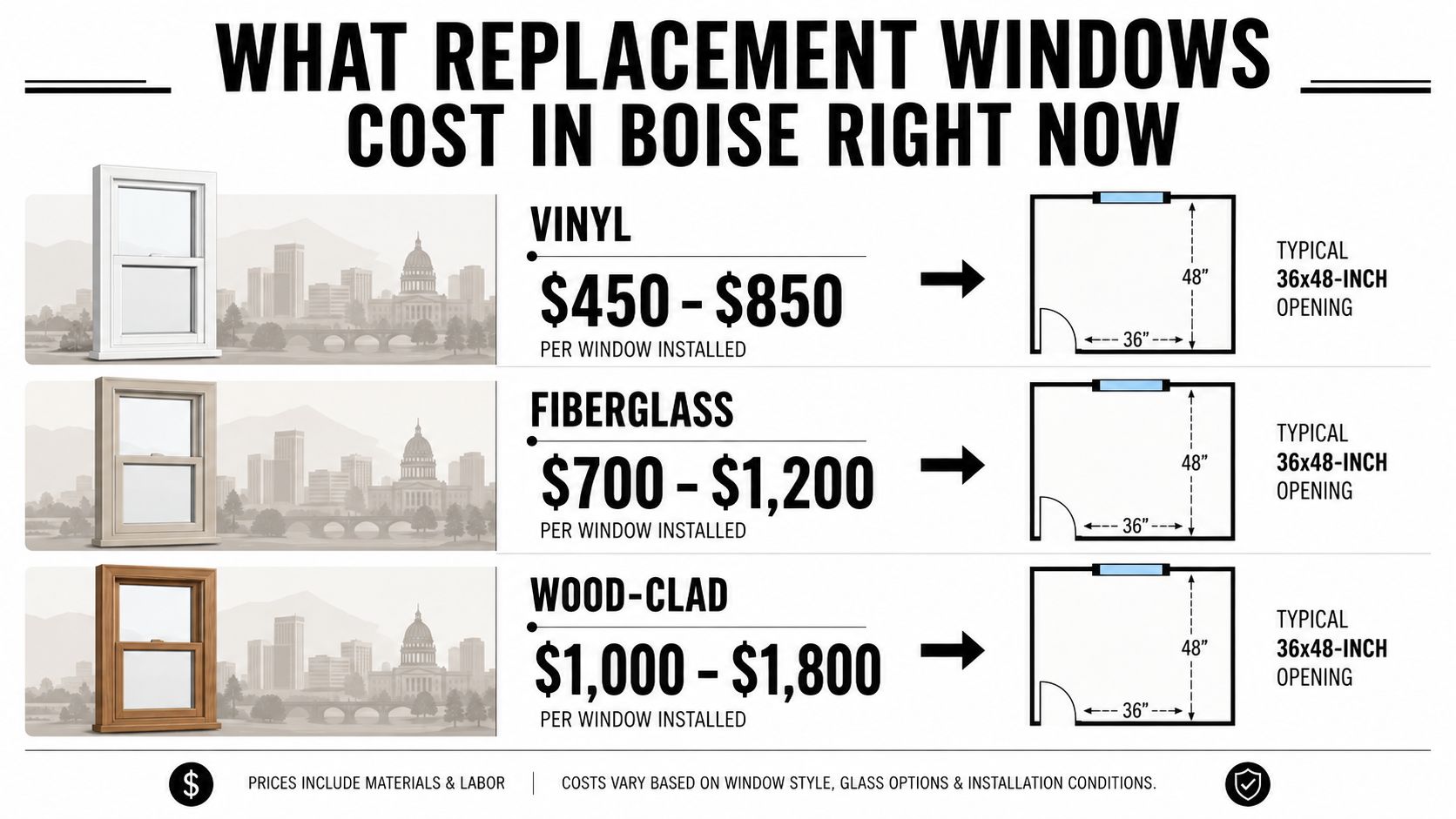
For a full-home project, the same Boise source shows 15 to 20 windows landing around $9,000 to $18,000 for standard vinyl and $15,000 to $30,000+ for fiberglass or wood-clad, which is why a real installed budget can move from about $400 per opening in entry-level cases to well above $1,000 in premium packages. A separate Boise guide from Modernize's Boise window installation cost guide puts the city's average replacement cost at about $614 to $1,309 per window, with bay or bow windows running $1,200 to $3,500+.
Practical rule: if your quote lands well below Boise's standard vinyl range, inspect the scope before you get excited. Low bids often leave out trim work, structural fixes, or the glass package you will wish you had later.
The Factors That Drive Your Final Price
Material does most of the heavy lifting
Frame material drives most of the price in Boise, and that is where homeowners see the biggest spread between a tight budget and a higher-end project. Basic vinyl sits at the low end, fiberglass lands in the middle, and wood-clad climbs higher because you are paying for appearance, performance, and more specialized fabrication. If you want a straight vinyl-only benchmark before comparing materials, this Idaho vinyl guide from C & C Windows & Doors is a useful reference point.
Boise contractor pricing puts quality vinyl around $400 to $800 installed, fiberglass around $700 to $1,400, and wood-clad around $900 to $1,800+ per window in the installed market, as summarized by IronCrest Remodel's Boise guide. That spread shows up quickly on a whole-house job. A 15 to 20 window project can stay near $10,000 to $22,000 with vinyl, while fiberglass or wood-clad often pushes into $15,000 to $30,000+. The reason is not just labor. Custom sizing, higher-spec frames, and better performance packages all raise the total.
Style, size, and access are the next big swings
Standard double-hung and slider openings are easier to price because crews deal with them every day. Larger bay and bow windows cost more because of their size and build complexity, and Boise pricing guides consistently place those styles at the top of the market. Common single-hung or double-hung windows usually price lower than casement, awning, bay, or bow units, and the gap gets wider as the glass package gets more specialized.
Labor changes fast when a crew has to work around second-story access, tight landscaping, or interior finishes that need careful protection. Boise's lower hourly labor estimates can look attractive on paper, but the final bill still grows when the job takes longer or needs more finish work. If a contractor will not separate the base window price from the installation conditions, the quote is not clean.
A quote that looks simple usually is not. In Boise, the actual cost shows up when the old unit comes out and the crew finds out whether the opening is standard, repaired, or a complete rebuild.
Vinyl vs Fiberglass vs Wood-Clad Compared
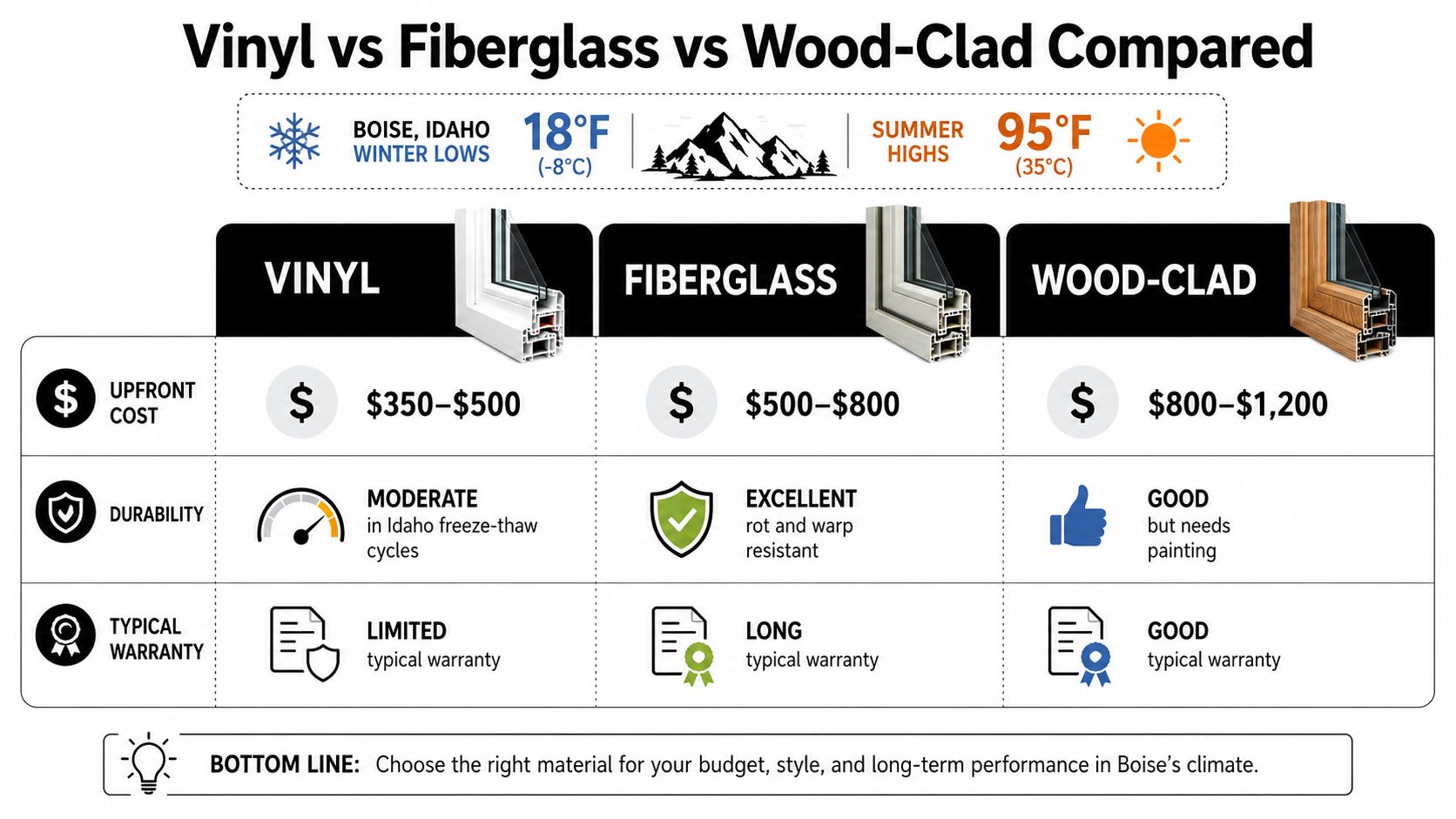
The cheap option is vinyl, and it earns that spot
Vinyl is the budget-friendly choice for Boise homeowners who want a sensible replacement without turning the project into a remodel. It's the right fit for standard subdivisions, rental properties, and homes where the main goal is stopping drafts and replacing failed windows without chasing a luxury finish. If you want to compare a straight vinyl-only approach in more detail, this Idaho vinyl guide from C & C Windows & Doors is a useful reference point.
Vinyl's tradeoff is simple. It's less expensive up front, but it doesn't bring the same premium look or rigidity you get from fiberglass or wood-clad. For many Boise homes, that's fine. For historic façades or high-end remodels, it can look out of place.
Fiberglass is the value pick for Boise climate stress
Fiberglass costs more, but it's the material I'd steer a lot of Treasure Valley homeowners toward if they want a better long-term balance. Boise's thermal swings are hard on windows, and fiberglass is commonly specified because it holds its shape better under that stress. It's the middle ground for homeowners who care about durability, tighter performance, and a cleaner profile without jumping all the way to wood-clad pricing.
Wood-clad is for appearance first, budget second
Wood-clad belongs on homes where the interior finish matters as much as the view out the window. It's a strong fit for historic homes, higher-end remodels, and projects where matching existing trim or preserving character is the priority. It costs more because it gives you the look that vinyl and fiberglass can't fully replicate, and because those units usually need more thoughtful installation.
My blunt recommendation is this, buy vinyl when you want practical and affordable, buy fiberglass when you want the smartest Boise value, and buy wood-clad only when the house or design justifies it. If you're trying to save money and still get a good result, fiberglass is often the better long-game answer than bargain vinyl that won't age as gracefully.
Three Real Boise Project Estimates
A quote makes sense when you can compare it to a real project shape, not a generic average. Boise homes don't all live in the same pricing lane, and a ten-window starter home, a mixed-material remodel, and a premium foothills install should never cost the same.
| Project Type | Windows | Primary Material | Glass Package | Estimated Total |
|---|---|---|---|---|
| Starter home update | 10 | Vinyl | Double-pane Low-E | Lower end of the Boise vinyl market |
| Mid-range remodel | 16 | Mixed vinyl and casement | Double-pane Low-E, performance upgrade | Mid-range Boise whole-home pricing |
| Premium foothills install | 20 | Fiberglass | Triple-pane with higher-spec performance | Upper end of Boise premium pricing |
What those projects look like in practice
A starter-home vinyl job usually makes sense when the windows are standard sizes, the frames are still usable, and the homeowner wants a direct upgrade from failing units without chasing extras. That's the project where Boise's lower installed vinyl pricing is most believable.
A mid-range Treasure Valley remodel usually lands higher because it mixes opening types and puts more pressure on finish quality. Once casements, custom trim, or a few larger openings enter the picture, the quote stops looking like a simple replacement and starts looking like a custom install.
A premium foothills project is where performance and aesthetics start driving the whole number. Fiberglass and triple-pane glass make sense there because the house is usually asking for more, better noise control, better thermal stability, and a cleaner finish on visible elevations.
Boise homeowners should use these buckets as a sanity check. If your house is a standard ranch and you're seeing a premium foothills number, ask why. If your home has custom openings and someone is quoting bargain vinyl, ask what's been left out.
Hidden Line Items Most Boise Quotes Leave Out
The number on the first quote is not always the number on the final invoice. Boise homeowners get burned when a contractor prices only the visible window and leaves out the work that shows up after the old unit comes out.
Ask what's included before you sign
Some jobs need permit handling, and Boise permit fees and review times come from the city, not the installer. As noted in the IronCrest Boise guide earlier in this article, permits are tied to valuation and the review schedule shifts with workload, so weak paperwork can add both delay and cost.
Disposal, rotten sill repair, failed flashing, water damage, and interior trim or stain work are common add-ons. They are not rare surprises. Older Boise homes often hide that kind of damage until the crew removes the existing window, especially when a leak has been ignored for years. The low bid usually assumes the opening is clean and ready, and that assumption is where homeowners get stuck paying more.
If a contractor won't say whether structural repair, trim, and disposal are included, you are not comparing prices, you are comparing guesses.
Access also changes labor. A second-story opening, a steep exterior setup, or a tight side yard can slow the crew enough to raise the charge. A Boise quote should say whether the price includes full removal, debris haul-off, and finish work, not just the window itself.
For Boise homeowners comparing upgrade choices, this Idaho window efficiency guide is a useful follow-up, because the window style is only part of the total cost.
Energy Upgrades and What They Are Worth in Boise
Boise sits in IECC Climate Zone 5B, Cold-Dry, and that matters more than most sales pages admit. The whole decision changes when you stop asking, “What's cheapest?” and start asking, “What improves comfort in winter, summer, and near-road noise?”
Pay for the upgrades that solve a real problem
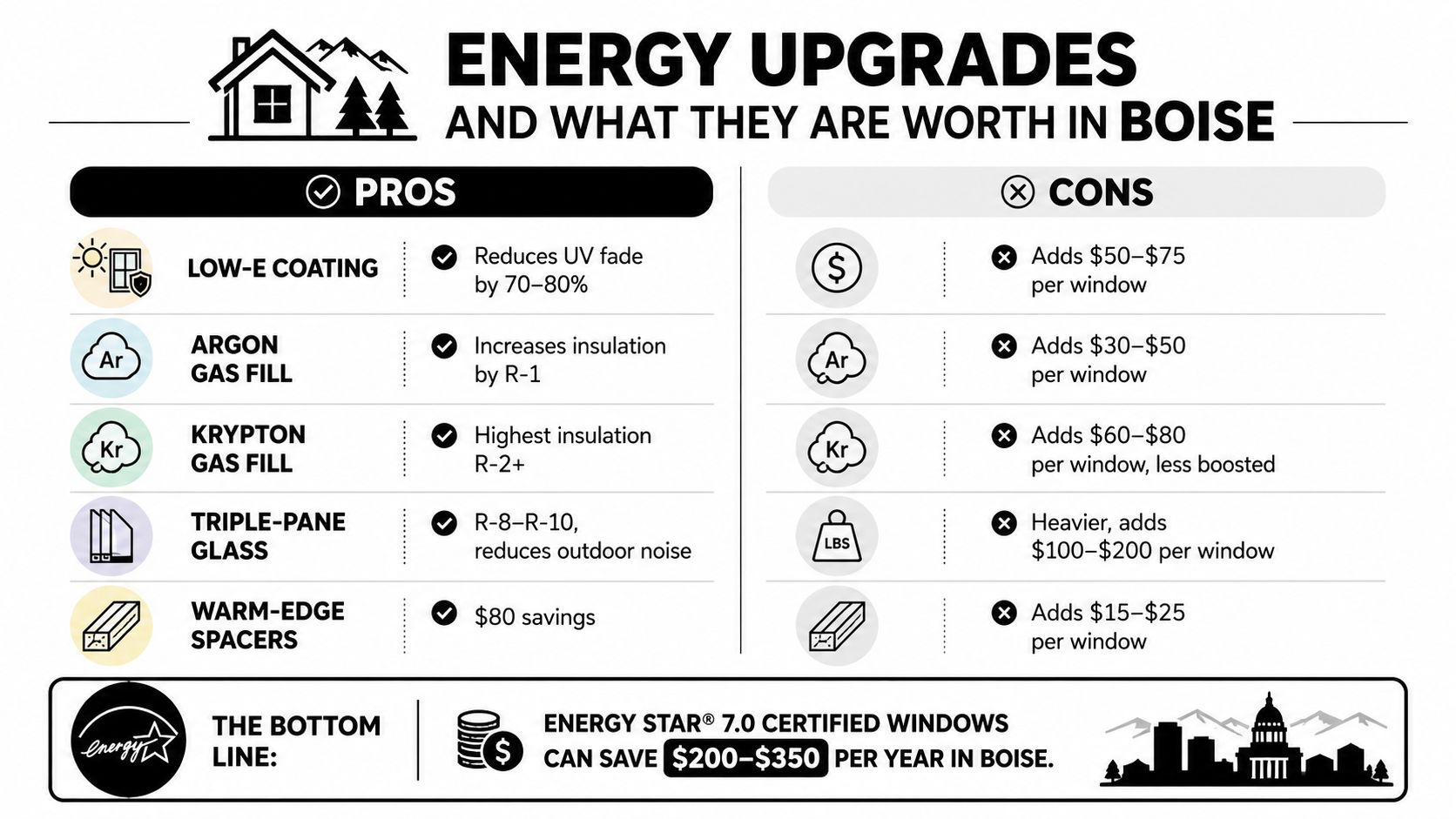
Low-E coatings make sense on most Boise homes because they reduce UV fade and improve general performance, but they shouldn't be sold as magic. Triple-pane glass is the key decision point. It costs more, it weighs more, and it makes sense when the home has south- or west-facing exposure, road noise, or owners who value comfort more than the lowest bid. Boise-facing content from GlassAdvisor's city guide raises the same question homeowners should be asking, whether the extra spend on triple-pane, Low-E, or fiberglass is worthwhile for Boise winters, summer heat, and traffic noise.
Warm-edge spacers, argon fill, and krypton fill are part of that same conversation. They're not flashy, but they help the window perform better once it's installed. If you're comparing them, think in terms of fit, not features. A bedroom facing a busy street deserves a different package than a guest room on the shaded side of the house.
Don't buy premium specs just because they sound premium
The mistake I see most often is homeowners paying for every upgrade on every window. That's wasteful. Use higher-spec glass where the sun, noise, or exposure is worst, and keep standard performance on openings that don't need the extra spend.
This Boise energy-efficient window guide from C & C Windows & Doors is a useful example of the kind of upgrade discussion that belongs in a real estimate, not just a brochure. The right question is whether the package changes the way the house feels, not whether it sounds impressive on paper.
Smart Ways to Lower Your Window Replacement Cost
The best way to lower your window bill is to avoid paying for unnecessary complexity. That doesn't mean cutting corners. It means making the project smaller, smarter, and more standard.
Start with the openings that actually need work
Replace the windows that leak, fog, stick, or no longer seal. Don't rip out good units just because you want matching frames everywhere. If a window frame is still sound, you may not need a full replacement on that opening, and targeted glass replacement can sometimes be the more sensible move. The Glass Guru's glass-replacement guide explains that a damaged pane can often be replaced without removing the full frame when the structure is still in good shape.
Keep the job standard wherever you can
Stock sizes cost less than custom sizes because the manufacturer isn't building around your opening one unit at a time. If your home has a few odd windows, isolate those and standardize the rest. Also, pick one material family if you want cleaner pricing and easier ordering. A mixed bag of vinyl, fiberglass, and wood-clad units can make the quote harder to control.
- Right-size the scope: Replace only the windows that are failing.
- Use standard openings: Custom sizing can push the price up hard.
- Bundle related work: If patio doors are part of the same elevation, combine them.
- Choose the right glass package: Don't overbuy triple-pane where double-pane Low-E does the job.
- Time the project well: Shoulder seasons usually give you more flexibility than peak summer scheduling.
The cheapest project is the one that solves the problem once. The most expensive one is the one that has to be revisited because the scope was wrong the first time.
Get a Real Boise Quote for Your Home
Boise window pricing only makes sense when it's tied to your openings, your frame material, your glass package, and the hidden conditions inside the wall. That's why generic calculators often undershoot older homes and overshoot simple standard replacements. A real estimate should be based on measurements, access, finish work, and the performance level your home needs.
If you want a number that reflects your house instead of a national average, use a local estimate tool like C & C Windows & Doors' Boise window replacement cost calculator and then compare it against an in-home quote. A Treasure Valley installer that handles custom measurements, energy-efficient products, and debris-free installation can tell you where the money is going before the crew starts.
I'd rather see a Boise homeowner pay for the right windows once than chase the lowest number and regret it later. Get the quote, inspect the scope, and make the upgrade that fits your house, not just the spreadsheet.
If you want a straight answer on your own home, book a free in-home estimate with C & C Windows & Doors. They measure the openings, review your material and glass options, and give you Boise-specific pricing tied to the house you live in.