
A full-home window replacement in Meridian often runs $15,000 to $40,000, or about $800 to $2,000 per window. If you're replacing old, drafty units in an Idaho home, that price is usually worth it when you choose windows built for cold climates instead of generic packages that weren't designed for the Treasure Valley.
If you're reading this, you're probably dealing with one or more familiar problems. Cold glass in winter. Rooms that heat up too fast in summer. Condensation at the edges. A slider that never quite locks right. Or maybe you're tired of looking at windows that make the whole house feel dated.
In Meridian, window replacement isn't just a style upgrade. It's an engineering decision. Idaho homes deal with hard winter cold, dry air, strong sun, and daily temperature swings that punish weak seals and sloppy installation. That's why a lot of national, one-size-fits-all window packages disappoint here. They may look fine on day one. The ultimate test is whether they still perform after years of expansion, contraction, and freeze-thaw stress.
A smart Window Replacement Meridian ID project starts with the same question I ask every homeowner: was this window system built for our climate, or was it just sold into our climate?
Table of Contents
- Understanding Idaho's Climate and Your Windows
- Decoding Window Performance for Maximum Energy Savings
- The Real Cost and ROI of New Windows in Meridian
- The C&C Difference Precision Installation and Superior Windows
- The Window Replacement Process from Start to Finish
- Answering Your Top Window Replacement Questions
Understanding Idaho's Climate and Your Windows
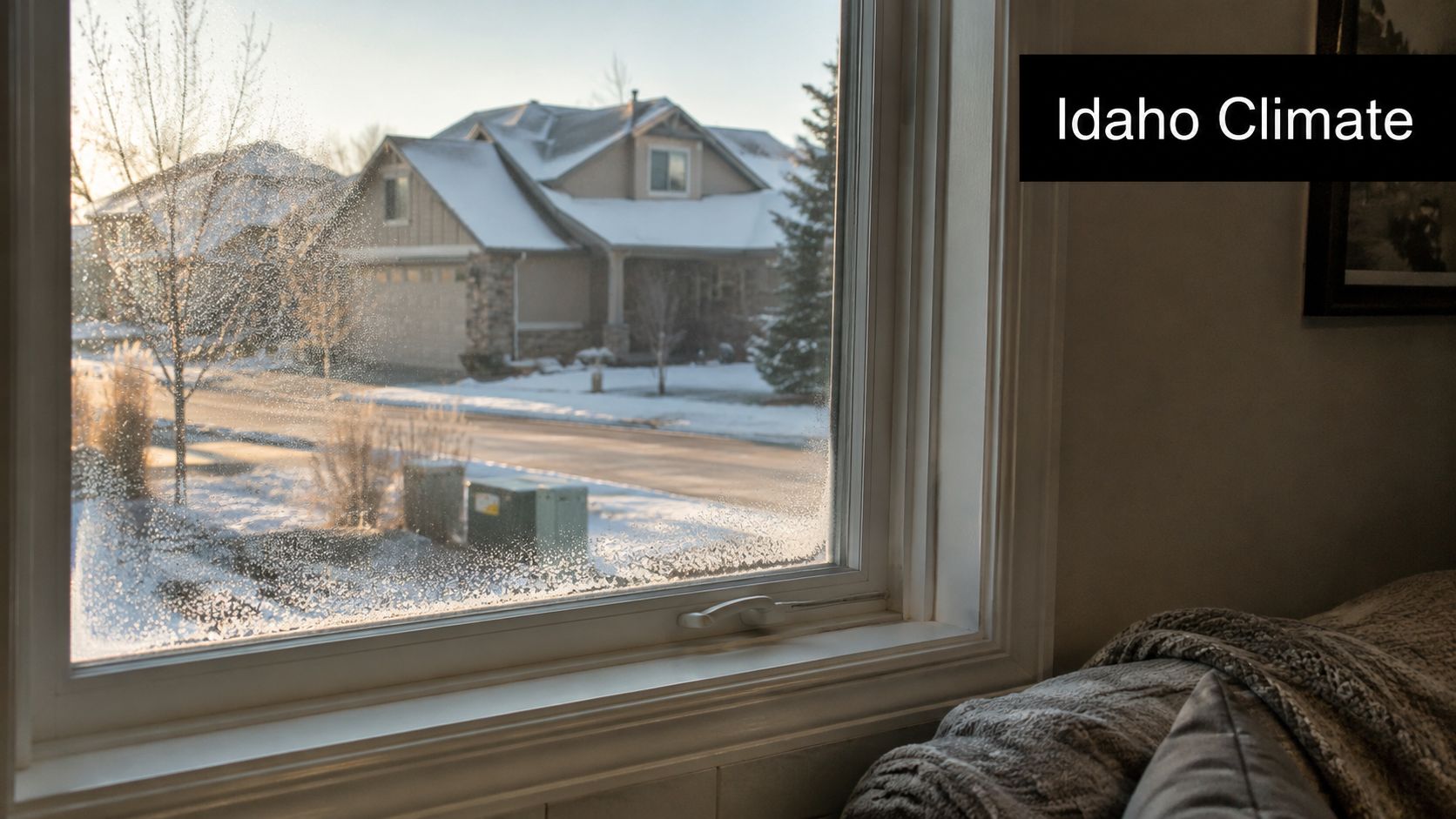
Older windows in Meridian usually tell on themselves. You see moisture at the edge of the glass, feel cold air near the frame, and notice one bedroom stays colder than the rest of the house. Homeowners often blame age alone. Age matters, but climate stress is what speeds the failure.
Why Meridian windows fail sooner than homeowners expect
Meridian homes sit in a climate that exposes weak window systems fast. Winter cold pulls heat to the glass. Summer sun beats on the exterior. Dry air and daily temperature swings work the seals and frame connections over and over again.
That's why generic window packages are a gamble here. They may be acceptable in milder regions, but Idaho puts more stress on the seal edge, spacer area, and frame opening.
Industry data indicates that 68% of window failures in cold-climate regions stem from expansion/contraction stress at the seal edge due to improper framing or non-localized glass specs, which is exactly the kind of issue Meridian homeowners need to avoid, as noted in this cold-climate installer guidance.
Practical rule: If a contractor can't explain how the window system handles Idaho temperature swings, they're selling a brochure, not a solution.
What Idaho-specific engineering actually means
A good Idaho window system isn't just “double-pane with Low-E.” That's too broad. You want the frame, sash, spacer, glass package, and installation method working together.
Focus on these decision points:
- Glass package first: In colder climates, gas-filled units with Low-E coatings are recommended because they reduce heat loss and improve interior comfort.
- Whole-unit performance, not cherry-picked glass claims: The National Fenestration Rating Council uses whole-unit ratings because the full product matters, not just the center of the glass.
- Drainage and moisture management: Freeze-thaw conditions punish water intrusion. If water sits where it shouldn't, materials fail faster.
- Tight fit at the opening: A strong window still underperforms if the opening is measured loosely or installed out of square.
If you want a deeper local breakdown of what makes a product suitable here, this guide on energy-efficient windows for Idaho homes is worth your time.
The main point is simple. In Meridian, windows are exposed systems. They aren't trim pieces. They're part of your thermal shell, and Idaho exposes every shortcut.
Decoding Window Performance for Maximum Energy Savings
Homeowners get tripped up by window labels because the terms sound technical and the sales pitch usually skips the meaning. Don't let that happen. If you can read the label, you can make a smarter decision than half the people selling windows.
Start with the NFRC label
The most important label on a replacement window is the NFRC label. That's where you see how the actual product is rated. The U.S. Department of Energy says homeowners need to evaluate metrics such as U-factor, and that values below 0.30 are typically required for ENERGY STAR 7.0 compliance in cold climate zones like Idaho, according to the DOE window energy ratings guide.
Here's the short version of what matters:
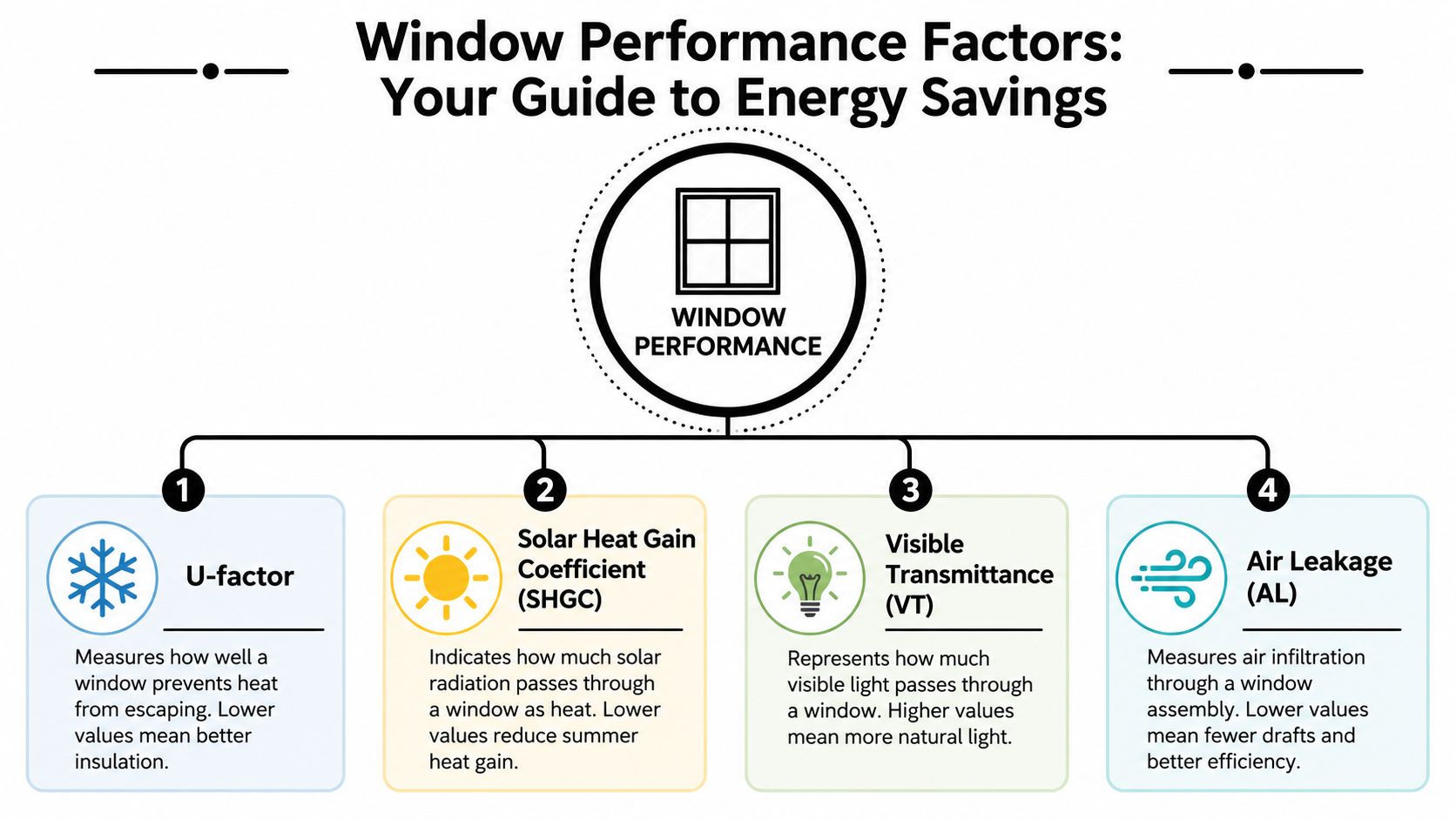
| Rating | What it tells you | What to want in Meridian |
|---|---|---|
| U-factor | How much heat escapes through the window | Lower is better |
| SHGC | How much solar heat comes through the glass | Keep it controlled |
| VT | How much visible light comes through | Balance light with comfort |
| AL | How much air leaks through the assembly | Lower is better |
How to read ratings like a homeowner, not a salesperson
Think of U-factor as your insulation score. In Idaho, this is the number I'd check first. If it's weak, you'll feel it every winter morning when the room near the window runs colder than the center of the house.
SHGC, or Solar Heat Gain Coefficient, matters because Meridian gets strong sun. You want sunlight without turning west-facing rooms into ovens. Lower SHGC can help control summer heat gain, especially in exposed elevations.
VT, or Visible Transmittance, is about daylight. Homeowners sometimes assume darker glass means better performance. Not always. You can get energy-efficient glass and still keep good natural light if the package is selected properly.
Use this order when comparing options:
- Check U-factor first. If the number isn't strong enough for Idaho, move on.
- Look at SHGC next. Match it to your sun exposure and room orientation.
- Review VT after that. Comfort matters more than chasing the brightest glass.
- Ask for the whole-unit rating. Don't accept center-of-glass talk as a substitute.
A window can look impressive in a showroom and still be the wrong product for a south-facing Meridian wall.
If you're weighing glass packages for winter performance, this comparison of double-pane versus triple-pane windows in Idaho winters helps sort out when an upgrade makes sense.
The Real Cost and ROI of New Windows in Meridian
Let's get to the number homeowners care about. For a full house in this market, the usual range is $15,000 to $40,000, with $800 to $2,000 per window as a working estimate, based on Department of Energy replacement guidance and regional pricing context.
That's a wide range because window replacement isn't one product. It's a custom project.
What pushes your project price up or down
A basic opening and a large custom opening don't cost the same. Neither does a simple insert job versus a project that exposes frame damage, trim issues, or the need for more extensive finish work.
The biggest cost drivers are usually:
- Window size and shape: Large picture units and specialty shapes cost more than standard openings.
- Operating style: Casement, sliding, and double-hung windows differ in hardware and construction.
- Glass upgrades: Better thermal packages add cost, but they also make more sense in Idaho.
- Installation scope: A straightforward swap is one thing. Rot repair or trim replacement is another.
- Whole-home volume: Larger projects can be more efficient per opening, but the total budget is naturally higher.
Where the return actually comes from
The return on new windows comes from three places. Lower heat loss, better daily comfort, and stronger resale appeal. Homeowners usually obsess over utility savings alone, but comfort is what they notice first. Less draft. More even room temperatures. Quieter interiors. Windows that open, close, and lock the way they should.
Here's how I'd think about ROI in practical terms:
- Energy performance: Low U-factors and Low-E coatings matter in cold climates because they reduce heat movement through the glass.
- Maintenance reduction: Newer systems eliminate a lot of the repainting, sticking, and patchwork repairs older windows demand.
- Visual payoff: Fresh windows clean up curb appeal faster than many exterior updates.
- Buyer confidence: Replacement windows tell future buyers that a major envelope component has already been addressed.
Don't judge a window project only by the invoice. Judge it by whether you still notice the old problems a year later. If you do, the cheaper option wasn't cheaper.
If resale value is part of your thinking, this article on window replacement ROI and home value gives a practical homeowner view.
The C&C Difference Precision Installation and Superior Windows
In the Treasure Valley, the best window won't save a bad installation. That's the mistake homeowners make when they compare projects by price alone. The product matters. The install decides whether the product performs the way it should.
Why the window itself matters
C & C Windows & Doors focuses on replacement windows engineered for Idaho homes, not generic units pushed into every market. That matters because local performance comes from the details. Slim narrowline frames preserve glass area. Composite-reinforced sashes add strength where cheaper construction flexes. True sloped sills help with drainage. Secure low-profile locking improves both operation and peace of mind.
The available styles also fit how Meridian homeowners live. Double-hung windows for easy operation and cleaning. Casement windows where ventilation matters. Picture windows for big views and light. Sliding windows where clearance and convenience matter.
Performance upgrades are where the system gets serious. Selecting windows with optimal Argon gas fills and ClimaTech Low-E coatings can reduce heat transfer by up to 40% and improve indoor comfort by maintaining consistent surface temperatures during Idaho's extreme weather, as described in this product performance overview.
Why installation decides whether performance lasts
A proper install starts long before the crew arrives. The opening has to be measured accurately. The existing condition has to be assessed accurately. The replacement method has to match the house.
Here's what separates precision installation from average installation:
- Custom measurement: The window should fit the opening. The installer shouldn't be “making it work” on site.
- Factory-trained crews: Product-specific installation matters because every system has details that affect long-term performance.
- Debris-free discipline: Good crews protect floors, control dust, and leave the site clean.
- Final operation check: Every sash, lock, and screen should be tested before the job is signed off.
This is why local experience matters so much in Window Replacement Meridian ID jobs. The work isn't just about swapping old glass for new. It's about building a tighter, quieter, more durable opening that can handle Idaho seasons without giving you trouble later.
The Window Replacement Process from Start to Finish
Most homeowners worry about disruption more than the actual decision. That's fair. Window replacement affects the inside and outside of the house, and nobody wants surprises. A clean process fixes that.
What happens before installation day
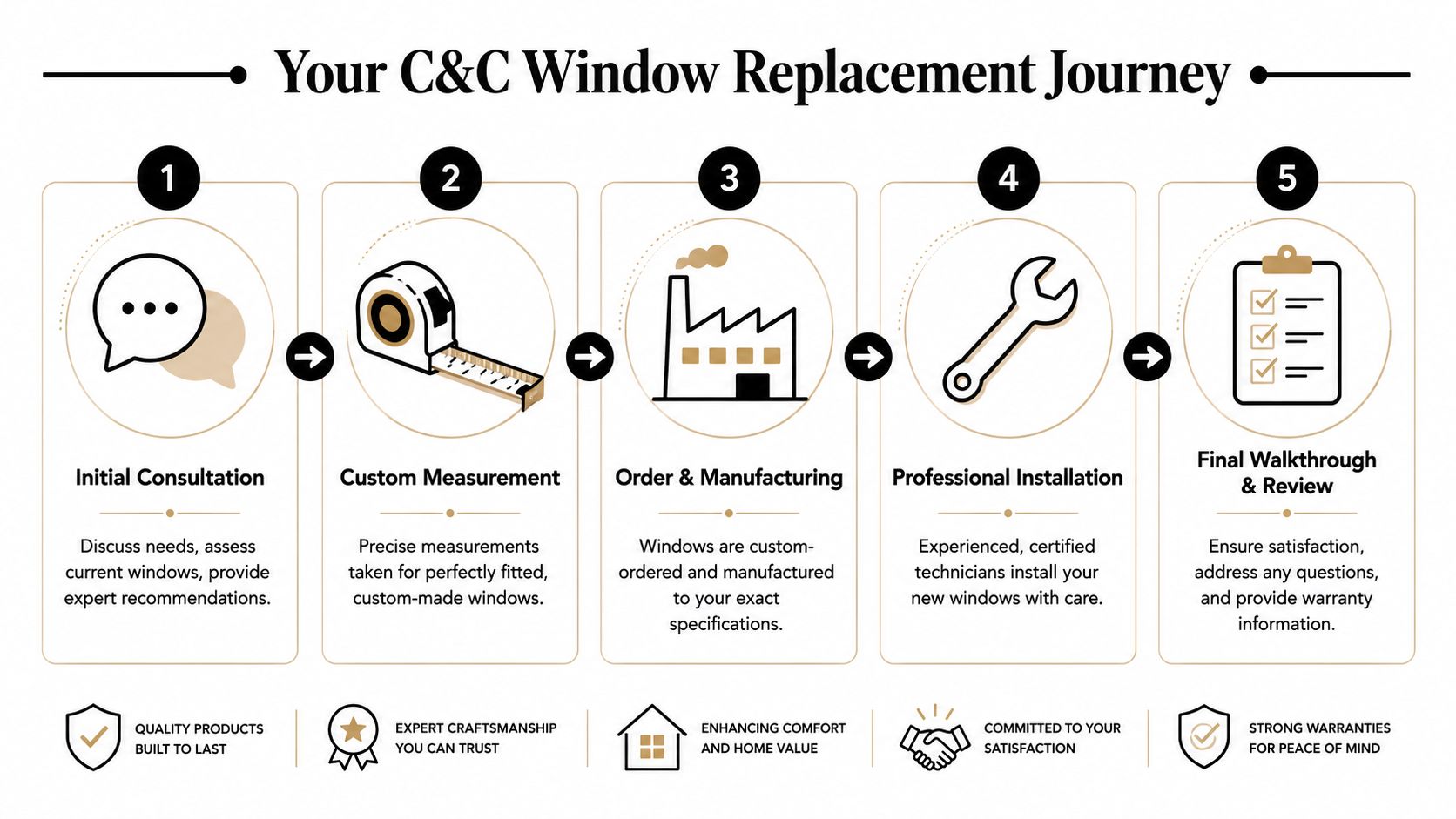
The process starts with an in-home consultation. That's where the current windows are inspected, goals are discussed, and the right product and glass package are selected. Measurements follow. These need to be exact, because replacement windows aren't shelf items for most homes.
After that, the windows are ordered to match the home. This part matters more than homeowners realize. A replacement project can be large and detailed. A recent Meridian-area job involved 21 windows and 1 glass door, which shows how substantial these projects can be when a whole house is being upgraded, as shown in this Meridian installation example.
What to expect during the install
Installation day should feel organized, not chaotic. Furniture and nearby surfaces get protected. Old units are removed carefully. The crew installs each new unit, insulates and seals the opening properly, checks operation, and cleans the work area before moving on.
A well-run process usually includes:
- Arrival and prep: Protect floors, staging areas, and exterior access points.
- Removal of old windows: Done methodically to avoid unnecessary trim or wall damage.
- Installation and sealing: Set the window square, secure it, and finish the opening correctly.
- Testing: Open it, close it, lock it, and confirm the fit.
- Walkthrough: Review the finished work and answer questions before the crew leaves.
The best install day is boring. The crew knows the plan, follows it, and leaves your house better than they found it.
Answering Your Top Window Replacement Questions
Most homeowners are down to a few practical questions by the time they're serious about replacing windows. Here are the answers that matter.
How long does it take
A single opening and a full-house project are obviously different, but the actual factors depend on scope, access, and product lead time. Installation day itself is only part of the process. Measuring, ordering, and scheduling take time too. What matters most is not rushing the custom measurement or the finish work.
What does the warranty usually cover
A strong warranty matters because windows are long-term products. In the Treasure Valley, leading installers, including C&C, provide lifetime limited warranties on both products and labor, along with financing through Synchrony, which gives homeowners long-term protection and payment flexibility, as outlined on the C&C Windows & Doors company information page.
That kind of coverage matters for the issues homeowners care about most:
- Seal failure protection: Important in a climate that stresses insulated glass units.
- Frame and operation coverage: Windows should keep working smoothly, not just look good on install day.
- Labor backing: Product warranties are weaker if the installation work isn't also covered.
Do you need to act now or can you wait
If your windows are only dated cosmetically, you may be able to plan the project on your timeline. If you're seeing condensation between panes, struggling with operation, feeling drafts, or noticing temperature imbalance near the glass, waiting usually costs you in comfort first and efficiency second.
You should move faster if:
- The seal has failed: Once insulated glass breaks down, the unit isn't doing its job.
- The frames are shifting or sticking: Operation problems often point to deeper issues.
- Rooms are uncomfortable year-round: That usually means the window system is underperforming, not just “old.”
- You're remodeling anyway: It's smarter to coordinate the work than redo trim and finishes later.
For Meridian homeowners, the best replacement projects aren't driven by a coupon. They're driven by solving the right problem with the right product, installed the right way.
If you're ready to stop guessing and get a clear plan for your home, schedule a free in-home consultation with C & C Windows & Doors. Their Treasure Valley team provides custom measurements, same-day estimates, premium windows built for Idaho conditions, and a clean installation process that treats your home with care.