You notice it first on a winter morning. The room closest to the street feels colder than the rest of the house. Then summer arrives, the sun hits the glass all afternoon, and the AC seems to run longer than it should. Maybe the frames still look decent. Maybe the windows even open. But they don't feel like they're doing their job anymore.
That's the part most homeowners in Boise and the Treasure Valley wrestle with. A window can still be standing in the wall and already be past its useful life. Idaho weather is hard on glass, seals, frames, and caulking. Cold snaps, summer heat, dry air, sun exposure, and constant expansion and contraction all show up in how long your windows really last.
If you're trying to figure out how long replacement windows last in Idaho, the short answer is this: it depends less on the label and more on how the window performs over time in this climate. Material matters. Installation matters. Glass package matters. The difference between a smart purchase and a frustrating one often shows up years before the frame breaks.
Table of Contents
- Your Guide to Window Longevity in Idaho
- The Real Lifespan of Idaho Windows
- How Idaho's Climate Tests Your Windows
- Choosing the Right Window Material for Longevity
- Beyond the Frame Components That Define Durability
- Signs Your Windows Are Failing and How to Extend Their Life
- Making a Smart Investment in Your Treasure Valley Home
Your Guide to Window Longevity in Idaho
A lot of Treasure Valley homeowners start paying attention to their windows after a January cold snap or a stretch of summer heat. One room never feels right, the glass runs colder than it should, and the house gets harder to keep comfortable even though the windows do not look broken.
That is the right time to ask about lifespan. In Idaho, the more useful question is not how long a window can stay in the wall. It is how long it will keep doing its job well under real local conditions. Builder-grade windows often lose comfort, seal performance, and smooth operation well before they are physically worn out, especially when the product or the installation was chosen to hit a short-term price point.
A window can still be standing and already be past its effective life. Homeowners feel that first through drafts, temperature swing near the glass, outside noise, sticking sashes, or condensation that starts showing up where it did not before.
Practical rule: Judge a window by performance in daily use. If it no longer holds comfort, controls air movement, opens properly, and keeps its seal, its useful life is already shrinking.
That distinction matters in Idaho because calendar lifespan and effective lifespan are not the same thing here. The homes that get the best long-term value usually have windows matched to the climate, installed carefully, and maintained before small problems turn into permanent ones.
The Real Lifespan of Idaho Windows
A lot of confusion comes from treating window lifespan like a single number. It isn't. There's the age printed in a brochure, and then there's the period when the window still works the way you bought it to work.
Calendar life is not the same as useful life
The most useful way to think about Idaho windows is with two categories: calendar lifespan and effective lifespan.
Calendar lifespan is how long the product may physically remain in place. Effective lifespan is how long it still delivers the comfort, efficiency, seal integrity, and operation you expect. Those aren't always the same thing.
That distinction matters here. General guidance often throws out a broad range, but it doesn't explain that poor installation, air leakage, and declining thermal performance can make windows feel worn out much earlier, even when the frame still looks fine. Industry guidance notes that quality replacement windows commonly last 20 to 30 years, while builder-grade products may perform closer to 15 years, and climate materially affects lifespan, as explained in this discussion of modern replacement window longevity.
What homeowners actually feel first
Homeowners don't replace windows because a calendar told them to. They replace them because daily living changes.
A window is reaching the end of its effective life when you notice things like:
- Uneven room temperatures that make one side of the house uncomfortable.
- Air movement near the frame or sash even when the window is closed.
- Hard operation where locks, balances, or sliders no longer move cleanly.
- Cloudiness between panes that points to a failed insulated glass seal.
- Noise intrusion that seems worse than it should be for a closed house.
A window can survive on the wall for years after it stops performing like a real barrier.
That's why low-priced, builder-grade units often disappoint homeowners sooner than expected. On paper, they may still count as existing windows. In real use, they may already be costing comfort and efficiency. Idaho has a way of exposing that gap faster than a milder market would.
How Idaho's Climate Tests Your Windows
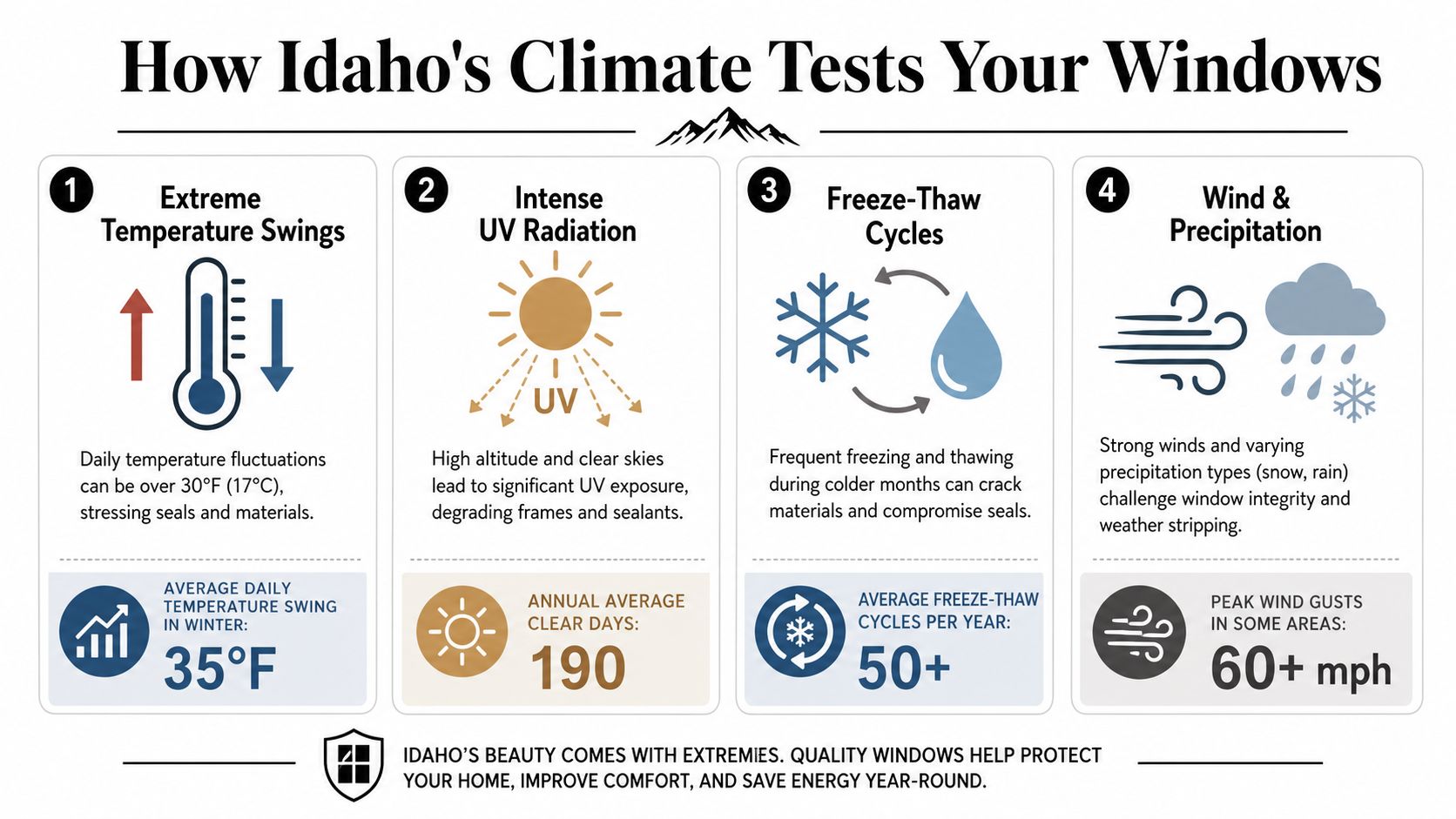
Idaho doesn't wear windows out with one dramatic event. It does it with repetition. The stress comes from constant cycling. Materials heat up, cool down, expand, contract, dry out, and get hit again.
Thermal cycling wears out weak window systems
One of the biggest Idaho issues is thermal cycling. In regions like Boise, the environment includes rapid temperature swings and over 120 freeze-thaw cycles annually, and that repeated movement stresses seals, frames, corners, and caulking over time. In that setting, fiberglass frames tend to show the longest service life, commonly 40 to 50+ years, because fiberglass expands at a rate much closer to glass and puts less stress on the sealed unit during those temperature swings.
That last part is a big deal in the field. When a frame and the glass move at very different rates, the sealed edges take the punishment. Year after year, that can lead to premature seal fatigue, fogging between panes, and a window that still looks presentable from the curb but no longer performs well.
Sun, dryness, and seasonal swings expose shortcuts
Summer is hard on windows too. Intense sun and UV exposure can fade finishes, dry out sealants, and punish lower-grade vinyl formulations. Winter brings the opposite kind of stress. Cold temperatures can stiffen components, reveal draft paths, and expose installation shortcuts around the perimeter.
In real homes, Idaho weather tends to uncover weak spots in this order:
- Perimeter air leakage around the installed unit.
- Seal fatigue inside the insulated glass.
- Frame movement that affects operation.
- Weatherstripping wear that turns small leaks into noticeable discomfort.
The result is why “good enough” windows often aren't good enough for long here. A mild-climate product or a rushed install might get by elsewhere. In the Treasure Valley, those decisions usually show up sooner.
The climate doesn't care what the sales sheet promised. It tests the whole window system every season.
Choosing the Right Window Material for Longevity
A window can carry a 30-year expectation on paper and still feel tired much sooner in Idaho. The difference is effective lifespan. That is the number homeowners live with, based on sun exposure, temperature swings, maintenance, and how well the frame holds its shape over time.
Material choice drives a big part of that.
A practical material comparison for Idaho homes
The broad industry ranges are familiar. Vinyl often lands in the shorter-to-mid range, fiberglass usually lasts longer, and wood or aluminum can perform well or disappoint early depending on exposure and upkeep. In Idaho, I would focus less on the advertised range and more on which material stays tight, square, and weather-resistant after years of hot afternoons, cold snaps, and dry air.
| Material | Typical Idaho Lifespan | Pros | Cons |
|---|---|---|---|
| Vinyl | Often a solid long-term option, but lower-grade units can show age early | Lower maintenance, usually lower cost, good efficiency in a well-made unit | Quality varies widely, cheaper vinyl can warp, fade, or loosen up sooner |
| Fiberglass | Usually the strongest bet for long effective lifespan | Stable through temperature swings, strong frame performance, holds alignment well | Higher upfront cost |
| Wood | Can last a long time with consistent care | Traditional look, good insulating value | Requires regular maintenance, vulnerable to moisture problems if neglected |
| Aluminum | Better suited to specific designs than long-term comfort in Idaho | Slim profiles, structural strength | Conducts temperature easily unless thermally improved, often feels colder in winter |
Vinyl is the material that gets judged unfairly and chosen carelessly. Good vinyl windows can hold up very well here. Poor vinyl windows often do not. The difference comes from frame thickness, corner weld quality, reinforcement, weatherstripping, and whether the sash stays rigid enough to keep a clean seal year after year. Homeowners comparing vinyl replacement windows for Idaho homes should pay attention to those build details more than the sales label.
Fiberglass usually gives the best shot at a long effective lifespan in the Treasure Valley. It stays more stable as temperatures swing, which helps the window keep operating smoothly and reduces the stress that shows up later as loose seals, harder operation, or air leakage.
Wood is a fit for homeowners who care about appearance and are honest about maintenance. If the finish is kept up and water is managed well, wood can serve for a long time. If not, the decline can start at the sill, lower corners, or trim joints long before the window looks bad from the street.
Aluminum has its place, especially in certain architectural styles, but it is usually a tougher sell for Idaho comfort. Even when the frame still looks sound, homeowners often get tired of the colder interior feel and weaker thermal performance.
What usually makes sense by homeowner priority
One homeowner wants the lowest upfront cost. Another plans to stay in the house for 25 years. Another wants a specific look and is willing to maintain it. Those are different jobs, and the right material changes with the goal.
- For a tighter budget: Choose well-made vinyl, not the cheapest unit on the quote.
- For longest effective lifespan: Fiberglass usually makes the strongest case in Idaho.
- For architectural character: Wood can make sense if maintenance is part of the plan.
- For older homes with aluminum windows: Replacement often improves winter comfort and day-to-day livability right away.
The best material is the one that fits the house, the exposure, and the owner's expectations. In Idaho, that answer is rarely the cheapest frame and almost never a builder-grade shortcut.
Beyond the Frame Components That Define Durability
A durable frame helps, but a window is a system. Glass package, coatings, gas fills, spacer performance, drainage design, and installation quality all decide whether the unit will hold up in a real Idaho opening.
Glass performance affects lifespan too
The U.S. Department of Energy says homeowners should compare whole-unit U-factors and SHGC, and it specifically recommends low U-factor products in colder climates. It also notes that upgrading or replacing windows can reduce energy loss, and ENERGY STAR-based estimates cited there put potential savings at up to $197 per year when replacing double-pane windows with ENERGY STAR-qualified replacements, as described on the Department of Energy's window update and replacement page.
That guidance matters because the glass package does more than influence utility costs. It also affects comfort and durability. A stronger insulated glass unit with Low-E coatings and gas fill can reduce temperature stress across the assembly and keep the window feeling useful longer.
When I look at a replacement recommendation, I want these pieces discussed clearly:
- Whole-unit performance ratings: Not just center-of-glass numbers.
- Low-E coatings: These help manage heat transfer and solar gain.
- Gas fills: Argon is a common upgrade for better thermal performance.
- Drainage design: Water needs a reliable path out.
- Hardware quality: Locks, balances, and rollers wear out long before a frame does if they're cheap.
Installation decides whether the window lasts
Even a strong product fails early if it's installed poorly. That's where effective lifespan gets won or lost.
A proper installation includes accurate measurement, a clean and stable opening, perimeter sealing that matches the conditions, and flashing and drainage details that control air and moisture. If those basics are missed, the homeowner may end up dealing with drafts, water intrusion, trim damage, or premature seal problems that look like product failure but originated with install quality.
If you're already seeing fogging or moisture issues, this guide on window seal failure in Boise homes is a useful way to separate glass failure from broader installation or age-related problems.
Buy the whole result, not just the frame. Product quality and installation quality have to show up together.
Signs Your Windows Are Failing and How to Extend Their Life
Most failing windows don't announce themselves all at once. They slide downhill. Comfort drops first. Then operation gets rough. Then the energy loss becomes hard to ignore.
What failure looks like in real homes
In Idaho, builder-grade vinyl and aluminum windows often show an effective functional lifespan of only 15 to 25 years because lower-quality units tend to lack reinforced sashes and more durable coatings. The practical problem isn't just age. It's that performance degrades early. The Department of Energy also notes that ineffective windows can account for up to 30% of a home's annual energy bill through energy loss.
Watch for these signs:
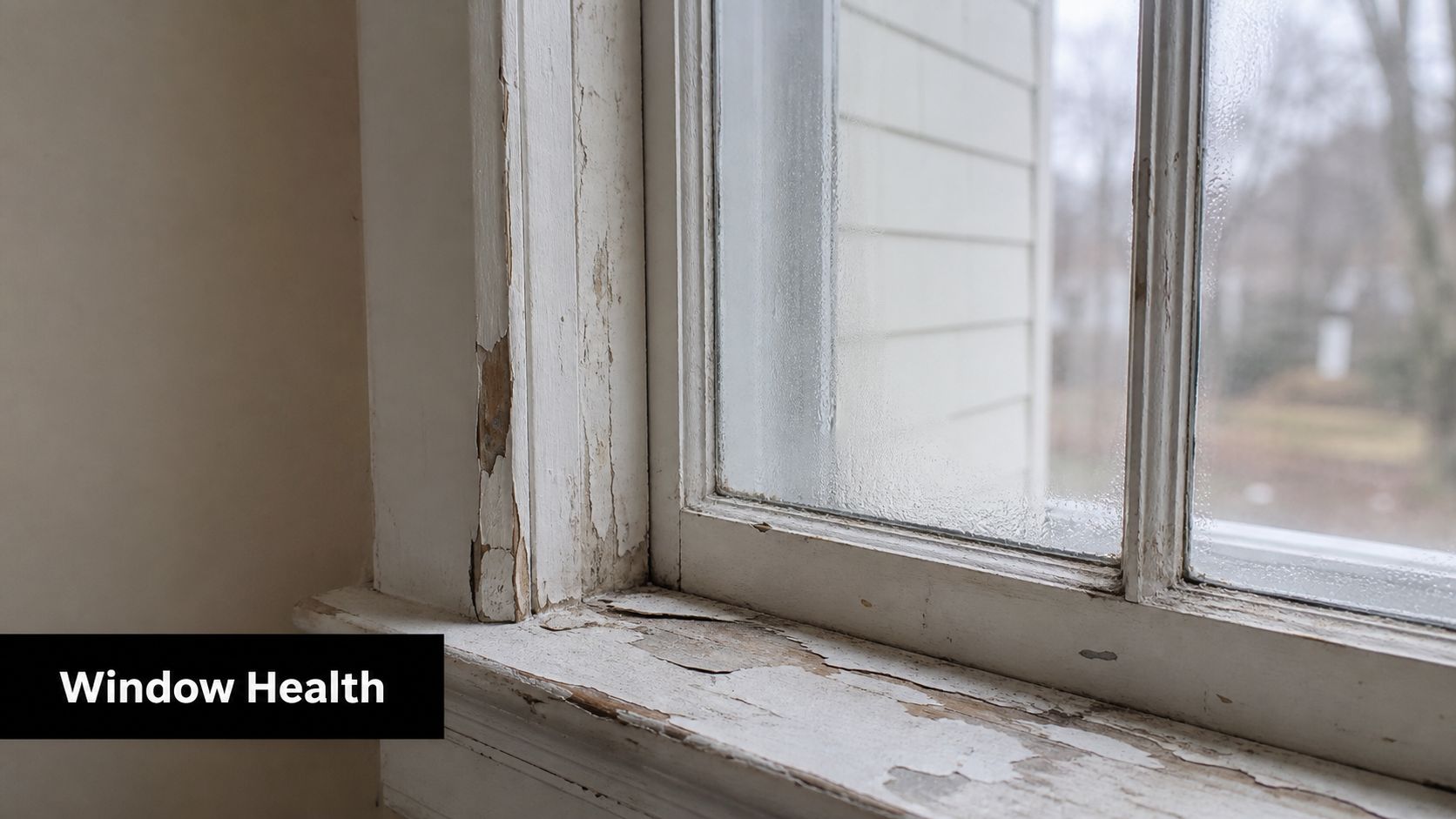
- Condensation between panes: This usually means the insulated glass seal has failed.
- Drafts near the sash or frame: Air leakage often shows up before visible damage.
- Windows that stick or won't lock cleanly: Frame movement, worn hardware, or sash distortion can all be involved.
- Rising discomfort in one room: Homeowners often notice this before they notice the window itself.
- Visible material breakdown: Peeling finishes, brittle caulk, rot, or warped vinyl all matter.
For a fuller checklist, these signs your windows need replacing in Idaho line up closely with what shows up in local homes.
Simple habits that help windows last longer
You can't maintain a bad window into being a great one, but you can help a decent window last closer to its potential.
- Keep tracks and weep paths clear: Dirt and debris interfere with drainage and operation.
- Check perimeter caulk and interior trim lines: Small gaps grow into bigger comfort problems.
- Operate windows regularly: That helps catch hardware issues before they become failures.
- Clean the glass and frames gently: Harsh methods can damage finishes and weatherstripping.
- Pay attention to change: If a room suddenly feels different, don't wait a full season to investigate.
Windows usually fail by getting gradually worse, not by suddenly falling apart.
Making a Smart Investment in Your Treasure Valley Home
Window replacement is one of those projects where the cheapest path can get expensive later. If the frame moves too much, the seal fails early, or the install leaves small air leaks around the opening, you'll keep paying for that decision in comfort and operating cost.
A smarter approach is to buy for effective lifespan, not just sticker price. That means choosing a material that fits Idaho weather, a glass package that matches the exposure of the house, and an installation crew that treats measurement, sealing, and finish work like the job depends on it, because it does.
Warranty terms matter too. A lifetime limited warranty on product and labor gives homeowners a clearer long-term picture than a vague promise about durability. Financing can also make the better window package more realistic when the alternative is choosing a weaker unit just to lower the immediate cost.
For homeowners in Boise, Meridian, Eagle, Nampa, and the rest of the Treasure Valley, this usually comes down to a simple question: do you want windows that merely replace the old ones, or windows that hold their performance through Idaho seasons with fewer compromises?
The right answer isn't always the most expensive product. It's the one that stays comfortable, operates well, and keeps doing its job years after installation.
If you want a practical assessment of how much life your current windows have left, or you're comparing options built for Idaho conditions, C & C Windows & Doors can help you sort through material choices, glass packages, installation details, warranty coverage, and financing in a straightforward way.