Your house usually tells you it's time for new windows long before you're ready to shop for them. In January, you stand near the living room glass and feel a cold draft on your ankles. In July, the west side of the house turns into an oven by late afternoon. The blinds stay closed, the HVAC keeps running, and one window suddenly won't lock without a shoulder bump.
That's the point where most Boise homeowners start searching how to choose a window company in Boise Idaho. Then the confusion starts. One company talks about frame material. Another pushes discounts that expire tonight. Another says every window they sell is “energy efficient,” but they never show the actual ratings.
The right choice isn't just about buying a decent window. It's about hiring a company that understands Boise's hot summers, cold winters, snow, sun, older shifting frames, and the installation details that decide whether the window performs well for years or becomes an expensive callback. If you want to avoid the usual mistakes, start with the company, not the brochure.
Table of Contents
- Your Guide to Finding the Right Boise Window Partner
- Verifying Credentials and True Local Experience
- Decoding Window Performance for the Boise Climate
- Comparing Window Products and Materials
- Evaluating the Installation Process and Warranty
- Getting and Comparing Your Window Estimates
Your Guide to Finding the Right Boise Window Partner
A lot of homeowners start with the wrong question. They ask, “What's the best window?” The better question is, “Who can install the right window for my house and my exposure?”
That matters more in Boise than many people realize. A home in the North End with older framing issues, a newer Meridian house with full west sun, and an Eagle property with large picture windows all need different conversations. The frame material, glass package, and installation method shouldn't be picked from a one-size-fits-all sales script.
Good window projects are built around the house you have, not the script the salesperson brought.
The company you hire should be able to look at your home and talk plainly about three things. First, how your current windows are failing. Second, which performance ratings matter on each side of the house. Third, what installation approach they'll use if your openings are out of square, your trim is aging, or your sill conditions aren't ideal.
A seasoned Boise installer also won't rush you into choosing based on showroom language alone. They'll ask where the bedrooms are, which rooms get beat up by afternoon sun, whether street noise is a problem, and whether you're replacing a few problem windows or doing the whole house.
Here's the practical lens I'd use if I were helping a neighbor sort through bids:
- Start with fit for Boise: Four-season performance matters more than marketing terms.
- Judge the installer before the product: A premium window installed poorly is still a bad result.
- Ask for proof, not promises: Ratings, scope, warranty terms, and measurement details should all be documented.
- Compare goals realistically: Budget value, appearance, comfort, and noise control don't always point to the same product.
That's how you narrow the field and avoid paying for features you don't need, or worse, missing the ones you do.
Verifying Credentials and True Local Experience
January in Boise exposes bad window work fast. A cold snap hits, the bedroom by the north wall feels drafty, and condensation shows up where the salesperson promised “energy efficiency.” In a lot of those jobs, the window itself is not the only problem. The bigger issue is that the company sold a product but never dealt with the opening, the sill, or the weather exposure of that side of the house.

What to verify before you talk about products
Start with the basics. Confirm the company is licensed, bonded, and insured in Idaho. Then ask a question that weeds out a lot of weak operators: who will be performing the installation?
If the person in your living room cannot tell you whether the job is handled by an in-house crew or passed to a subcontractor, slow down. You need to know who measures the openings, who orders the units, who is responsible if a frame arrives wrong, and who fixes water intrusion if the trim comes off and the wall condition is worse than expected.
In the Boise area, local experience is not a marketing line. It shows up in how a company talks about real field conditions. Older Bench and North End homes can be out of square. West-facing openings in Meridian and Eagle take hard afternoon sun. Some replacement jobs need a cleaner insert approach. Others need full-frame work because the old sill, flashing path, or surrounding wood is already failing.
Ask for clear answers on these points:
- Installer training: Ask what formal installation training the crew has completed and whether they follow the manufacturer's installation instructions on each product line they sell.
- Crew accountability: Find out whether the measuring technician and the install crew communicate directly, or whether details get handed off through a sales office.
- Boise-area job history: Ask how long they have been installing in Boise, Meridian, Eagle, Nampa, and Caldwell, not just how long the brand has existed.
- Problem recognition: They should catch rot, failed caulk lines, uneven openings, sill slope issues, and signs of past water entry before the order is finalized.
- Written scope: The proposal should spell out what happens to trim, insulation, exterior sealing, debris removal, and interior touch-up.
One more thing matters here. A company with true local experience should be able to explain why installation details change from house to house in the Treasure Valley. A good benchmark is the kind of neighborhood-specific knowledge described by a local Treasure Valley window company. Homeowners should expect that level of familiarity, not a generic national sales pitch.
Why Treasure Valley experience matters
Boise has a real four-season climate, and that affects installation choices. Winter cold exposes air leaks. Summer heat punishes west and south elevations. Wind-driven rain, snow, and strong sun all test whether the opening was prepped correctly and whether the unit was integrated with the house the right way.
That is why I pay close attention to the questions a contractor asks during the first visit. Do they check the sill for level and slope? Do they look for settlement that has racked the opening? Do they inspect exterior trim and cladding instead of staying inside and talking brochures? Do they explain whether the existing condition supports an insert replacement, or whether a full-frame install is the safer call?
Those details separate a Boise installer from a Boise salesperson.
A polished website and a good showroom can help you narrow the field. They do not tell you how the crew handles a rough opening that is twisted, damp sheathing behind old trim, or a replacement on the south side of the house that takes the hardest seasonal stress. The company you hire should be able to explain its process in plain language and tie it back to how homes in this valley age.
If the conversation stays on discounts, brands, and financing, keep looking. The right company will spend time on conditions, measurements, and risk points first, because that is what keeps the new window operating, sealing, and draining properly after Idaho weather gets to work.
Decoding Window Performance for the Boise Climate
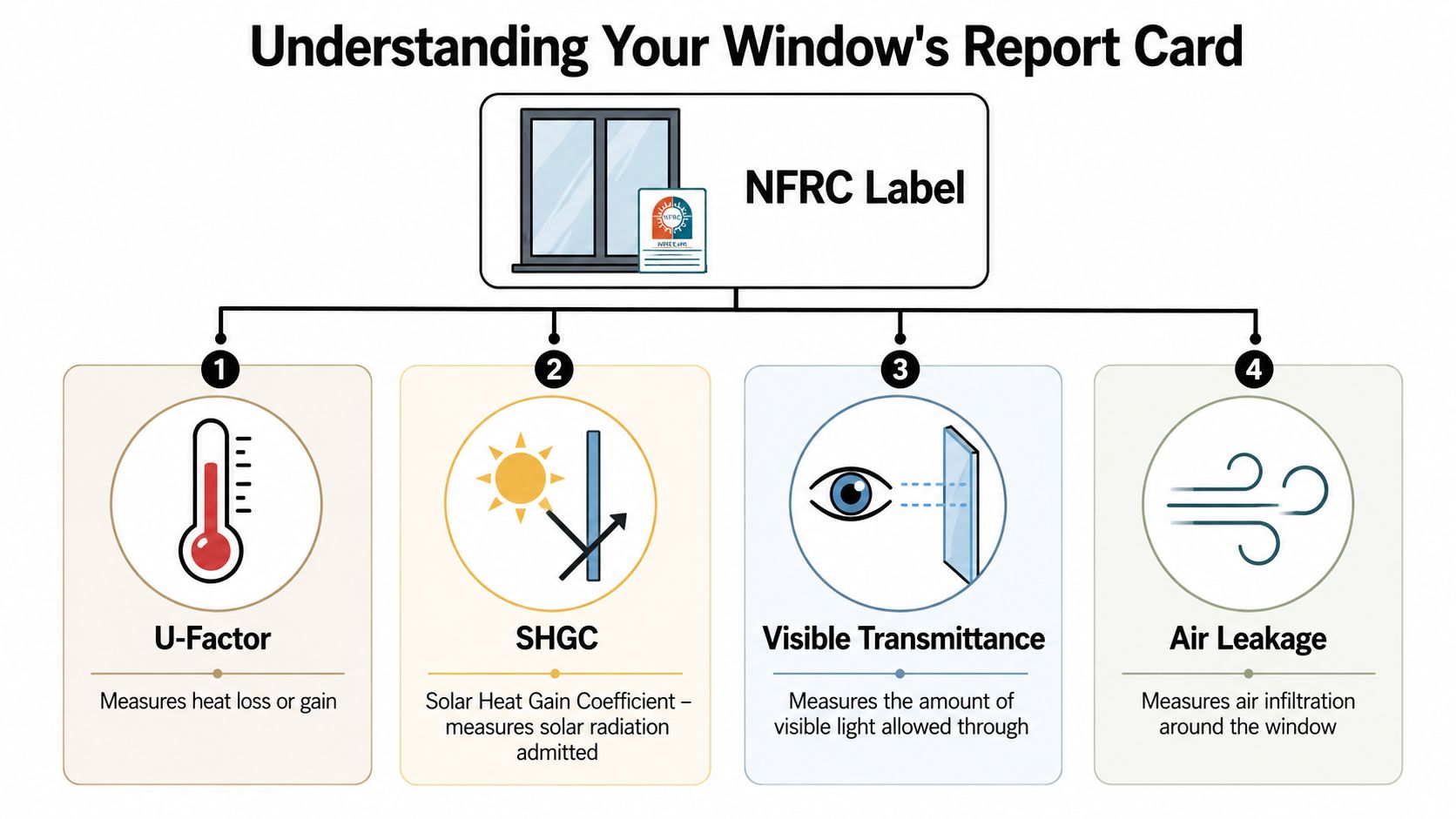
Most homeowners see the sticker on the glass and ignore it. That sticker is the useful part. The NFRC label is the report card that tells you how the window is likely to perform, and in Boise, two numbers matter more than the rest: U-Factor and SHGC.
Read the NFRC label first
If a salesperson says a window is high performance but doesn't show you the NFRC label, you're being asked to trust marketing instead of verified data. The label gives you independently rated numbers for thermal performance and solar gain.
Here's the simple version:
- U-Factor tells you how much heat the window lets escape. Lower is better when you want to hold heat inside during winter.
- SHGC stands for Solar Heat Gain Coefficient. It tells you how much solar heat comes through the glass.
- Air leakage matters because even a decent glass package can disappoint if air movement around the unit is too high.
- Visible transmittance helps explain how much daylight gets through.
In Boise, that label shouldn't be an afterthought. It should drive the product discussion.
Match ratings to the side of the house
Generic advice often proves insufficient. Many articles say to buy “energy-efficient windows” and stop there. That's not enough for Idaho's four-season climate.
North-facing windows usually need stronger insulating performance because they don't get much help from winter sun. West-facing windows have a different problem. They can take a beating from summer afternoon heat, so solar control becomes more important. The right company should be able to walk around your house and explain where a lower U-Factor matters most and where SHGC deserves closer attention.
A Boise homeowner with a chilly north bedroom, a blazing west-facing family room, and a quieter south side may not want the exact same glass package in every opening. Some households still choose one package across the whole home for budget or consistency. That can be perfectly reasonable. But the decision should be informed, not assumed.
Industry guidance aimed at Boise homeowners notes that many local guides fail to explain orientation properly. It also states that 2025 data indicates 70% of replacement windows in Boise are vinyl, and that improper SHGC or U-Factor selection can increase heating and cooling costs by up to 30% for Boise homes with the wrong specs for their orientation, according to Iron Crest Remodeling's Boise window replacement service page.
For homeowners trying to sort through efficiency options, this guide to energy-efficient windows in Idaho is a helpful companion to the NFRC and climate-zone discussion.
Don't ask, “Is this window energy efficient?” Ask, “What are the U-Factor and SHGC, and why are those numbers right for this side of my house?”
What Energy Star 70 means in Idaho
Boise falls in the Northern climate zone, and the current benchmark is tighter than many homeowners expect. According to Andersen's Energy Star 7.0 update, Energy Star 7.0 requires windows in this climate zone to have a maximum U-Factor of ≤ 0.22 and a minimum SHGC of ≥ 0.17.
That doesn't mean every good window is identical. It means the floor for certified performance is stricter, and homeowners should expect a company to speak clearly about those thresholds. If they can't explain how the proposed product meets climate-zone requirements, or why one option might be worth upgrading over another, they're not really helping you choose.
One more practical note. The NFRC label is where you verify the numbers. Don't accept vague claims like “meets the latest standards” without seeing the actual label on the exact product line and glass package being quoted.
Comparing Window Products and Materials
A Boise window quote can look simple on paper and still hide a bad fit for your house. I see that a lot. Two bids both say “energy efficient,” but one uses a basic vinyl frame with a standard dual-pane package, while the other uses a better-built frame and glass package that holds up better through our hot summers, cold snaps, and big day-to-night swings.
Frame material matters. So does how that material performs on the west side of the house in July, on a north-facing bedroom in January, and after years of sun exposure in the Treasure Valley.
What vinyl does well and where it has limits
Vinyl is still the default choice for many Boise homeowners because it usually gives the best balance of price, efficiency, and low maintenance. A local Boise cost guide from Iron Crest Remodeling places installed vinyl windows in the $400 to $800 range per window, which lines up with why vinyl shows up so often in whole-home replacement projects.
That said, vinyl is not all the same.
Some vinyl product lines are well built and hold their shape nicely. Others feel flexible, have thicker frames, and lose some glass area. In a small bedroom window, that may not matter much. In a big living room opening where you want a cleaner look and more daylight, it can matter a lot.
Vinyl usually makes sense when you want:
- Lower upfront cost across multiple openings
- Low upkeep over time
- Good thermal performance for the price
- A practical choice for standard-sized replacement windows
Ask to see the exact product line, not just the material category. That matters more than homeowners expect. A good local installer should be able to explain the difference between entry-level vinyl and a better vinyl series without hiding behind brand names. That is one reason many homeowners compare a local window installer against a big box provider before deciding who should supply and install the windows.
When fiberglass or composite makes more sense
Fiberglass and composite windows usually cost more, and there are houses where that extra cost pays off. The gain is often in rigidity, narrower frames, and a more solid feel when the sash operates.
That matters in Boise homes with larger window openings, stronger sun exposure, or homeowners who care about slimmer sightlines. A west-facing great room, for example, puts more stress on a window than a shaded bathroom on the east side of the house. Better frame stability can help the unit keep its shape and operation over time.
Composite is a category that deserves a closer look before you buy. Some composite products are excellent. Some are mostly marketing. Ask what the frame is made of, how thick the walls are, what the warranty covers, and whether the company has installed that line locally for years.
A simple side-by-side view helps:
| Material | Best fit | Main strength | Main trade-off |
|---|---|---|---|
| Vinyl | Whole-home value projects | Good efficiency for the price | Some lines have thicker frames and a less refined look |
| Fiberglass | Premium remodels and larger openings | Strong frame, slimmer profiles | Higher cost |
| Composite | Homeowners focused on durability and finish quality | Can combine strength and efficiency well | Quality varies a lot by manufacturer |
How to think about double pane and triple pane
Glass package decisions usually affect comfort more than the frame brochure does.
Triple-pane glass often makes sense in Boise, but not in every room. The same Boise cost guide noted earlier says triple-pane commonly adds $150 to $300 over dual-pane. I usually tell homeowners to spend that money where they will feel it.
Good candidates for triple-pane include north-facing rooms that stay cold, bedrooms near traffic, and larger openings that lose more heat in winter. In those spots, the upgrade can improve comfort and cut down on noise. On a protected side of the house or in a room you barely use, a strong dual-pane package may be the smarter buy.
The main mistake is treating every window in the house the same. Boise's climate does not hit every elevation equally. West and south exposures deal with stronger summer sun. North-facing rooms often expose weak winter performance. The best companies build a package around the room, the orientation, and the homeowner's budget instead of pushing one glass option everywhere.
The right choice is usually a matched system. Frame, glass package, and house orientation all need to work together.
Evaluating the Installation Process and Warranty
Homeowners spend a lot of time comparing glass packages and not enough time asking how the window will be installed. That's backwards. Installation is where a good product either gets protected or gets ruined.
What a solid installation process looks like
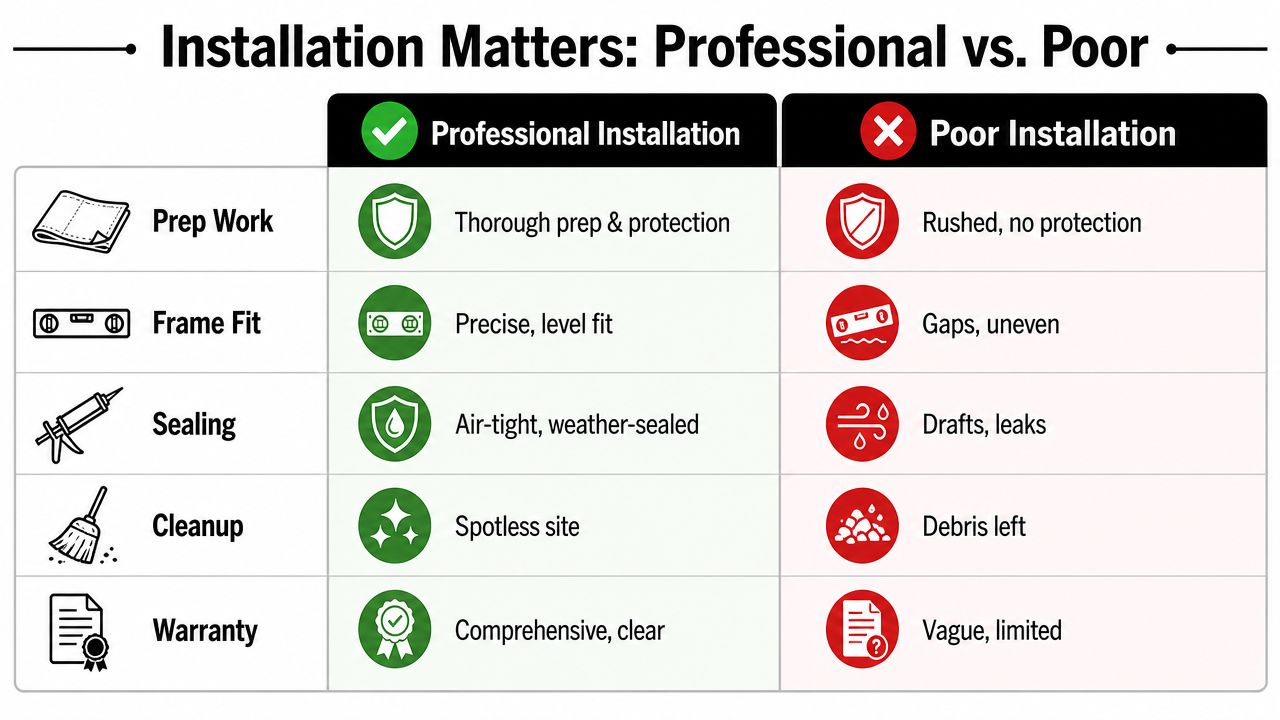
A professional install starts before the old window comes out. The crew should confirm measurements, protect interior floors and nearby finishes, inspect the opening once the unit is removed, and adjust the plan if they find hidden damage, prior leaks, or out-of-square framing.
The replacement itself should leave you with a window that is level, square, properly shimmed, sealed correctly, and able to drain as designed. The trim should look clean. The sash should operate smoothly. The lock should engage without forcing it. The crew should also clean up like they were never there.
Industry research highlighted by Gra-Boyes Windows says improper flashing or sealing causes 75% of post-installation failures in this kind of climate. That's why I'd put more weight on installation discipline than on glossy brochures.
If you're weighing whether to hire a local specialist or a larger retail channel, this comparison of a local vs big box window installer frames the service and accountability differences well.
The warranty question most homeowners miss
Most homeowners hear “lifetime warranty” and assume they're covered. Sometimes they aren't. The critical distinction is between the manufacturer warranty and the installer warranty.
A manufacturer warranty often covers defects in the product itself. It may not cover labor. It may not cover the cost of removing and reinstalling the window. It may also be limited by the way the window was installed. If the installer makes a sealing mistake and the unit leaks, the homeowner can end up caught between two parties pointing at each other.
That same Gra-Boyes source points out a gap many guides miss. Homeowners should demand proof of a labor and materials warranty from the installer, not just the product brand, because installation quality is often what decides whether the warranty helps when there's a real problem.
Here's what to ask for in writing:
- Who pays for labor if the window leaks after installation
- Whether the installer warranty covers sealing, flashing, and adjustment issues
- Whether product defects and installation defects are handled separately
- What actions could void the coverage
- How service calls are requested and documented
A window warranty isn't strong because it sounds long. It's strong because it clearly says who fixes what, and who pays for it.
A careful final walkthrough matters too. Open and close every sash. Lock every unit. Look at caulk lines, trim joints, screens, and sightlines. If something feels off on day one, it won't feel better in February.
Getting and Comparing Your Window Estimates
January hits, the furnace is running hard, and a new window by the family room still feels cold to stand next to. In July, that same room bakes in the afternoon sun. I've seen that happen after homeowners picked the lowest bid without checking what glass package was quoted or how the installer planned to seal the opening. In Boise, a window estimate needs to answer climate questions, not just price questions.
What should be in a real estimate
A usable estimate identifies the exact window, the exact glass, and the exact scope of work. If it only says “10 windows installed” with a lump sum, you still do not know enough to compare bids.
For Treasure Valley homes, the glass package matters as much as the frame. A north-facing bedroom may benefit from a different balance of U-Factor and SHGC than a west-facing living room that gets hammered by summer sun. A solid estimator should be able to explain why they chose that package for your house, not just hand you a brochure.
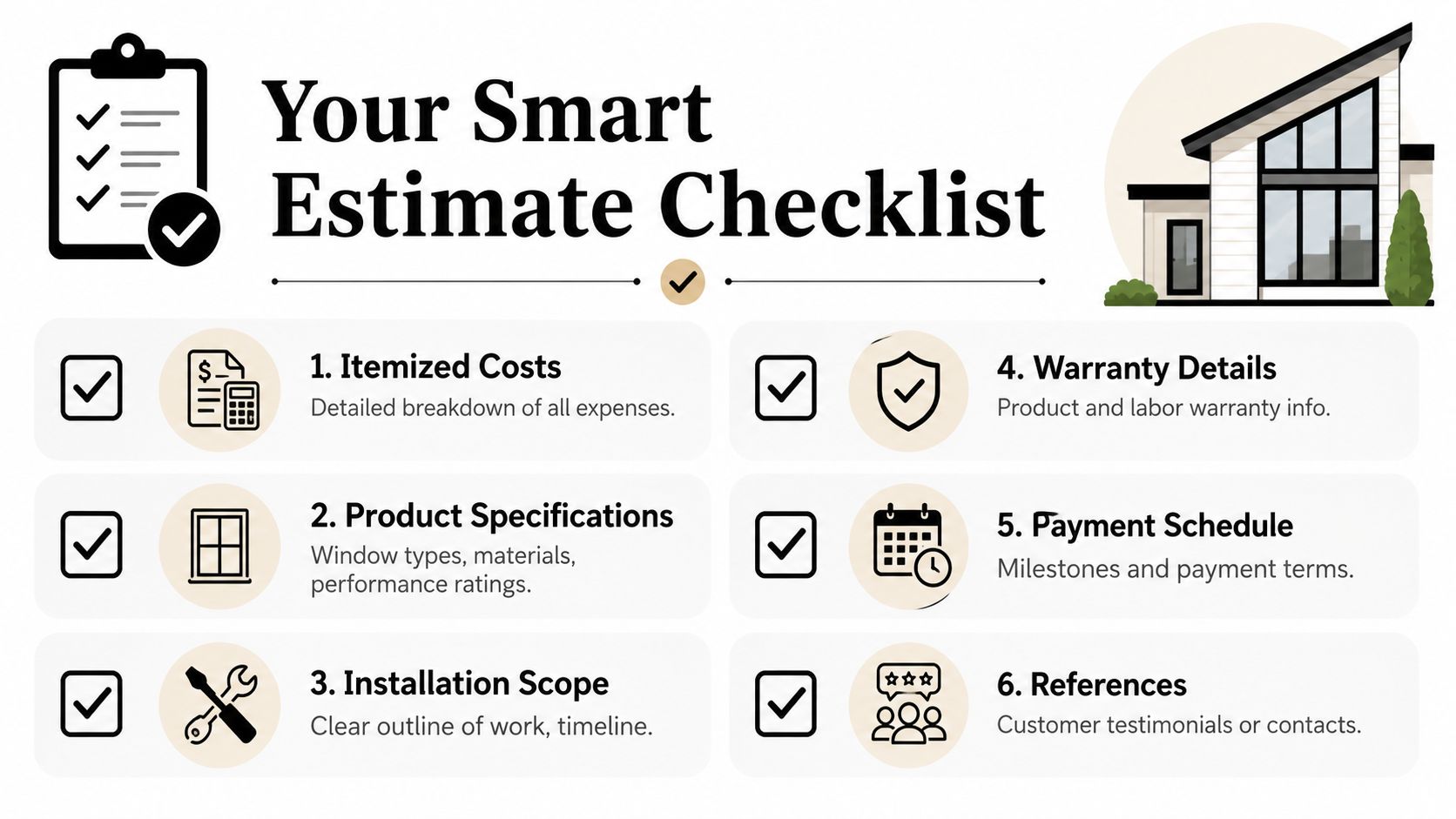
Look for these details in writing:
- Exact product identification: Brand, model line, style, and size for each opening or window group.
- NFRC performance ratings: U-Factor, SHGC, and the specific glass package being quoted.
- Installation scope: Full-frame or retrofit insert, plus trim, capping, disposal, insulation, and interior or exterior finish work.
- Site-condition allowances: How rot, failed flashing, damaged sills, or out-of-square openings will be handled if discovered.
- Payment terms: Deposit amount, payment schedule, and what triggers final payment.
- Project timing: Final measure, order lead time, install window, and cleanup expectations.
A quick remote quote can be fine for rough budgeting. It is not enough for a final decision on an older Boise bench home, a drafty foothills property, or any house where the existing openings may hide water damage or framing movement. An in-home visit gives the contractor a chance to check exposure, measure correctly, and catch problems before they become change orders.
How to spot a bad bid fast
The bad estimates are usually easy to recognize once you know what to look for.
Some sales reps push same-day pricing and try to keep the conversation on monthly payment instead of product details. Others hand over a polished proposal that still avoids the two things that matter most. What exact window are you getting, and how exactly will it be installed?
Watch for these red flags:
- Same-day pressure: A fair bid should still be fair tomorrow.
- Missing model and glass details: If the quote does not identify the product clearly, you cannot compare performance.
- No mention of install method: Boise homes vary a lot. Brickmold replacement, insert installs, and full-frame work are not interchangeable.
- Weak climate fit: A quote that ignores U-Factor and SHGC usually came from a generic sales script, not a house-specific recommendation.
- Too-low pricing: Cheap bids often leave out trim work, disposal, insulation, or repair allowances. You pay for that later.
- Loose wording: Terms like “as needed” or “standard install” need clarification before you sign.
One more practical point. If one estimate is far lower than the others, ask what was excluded. The answer is often more revealing than the price itself.
Questions worth asking before you sign
You do not need to grill every estimator for an hour. You do need answers that show they understand Boise conditions and your specific house.
Ask these:
- What are the U-Factor and SHGC for this exact configuration, and why do they fit this side of my house?
- Are you quoting an insert replacement or full-frame install, and why?
- How will you air-seal and insulate the gap between the new unit and the framing?
- What happens if you find rot, water staining, failed flashing, or framing damage once the old window comes out?
- Which parts of the job are excluded from this price?
- Who comes back for service if a sash drags, a lock needs adjustment, or a leak shows up after the first storm?
The best estimate is usually the clearest one. It tells you what window is being installed, why it fits Boise's four-season weather, what the crew will do on site, and where extra cost could show up before the contract is signed.
If you want a local team that understands Treasure Valley homes, C & C Windows & Doors is worth a closer look. They provide in-home consultations, custom measurements, energy-efficient window options built for Idaho's climate, and a clear installation process backed by a lifetime limited warranty on products and labor. If you're comparing bids and want straight answers without the pressure, they're a solid place to start.