If you're shopping for replacement windows right now, you're probably feeling two things at once. One is urgency. You can feel the draft, hear the street noise, or see fogging and worn frames every day. The other is hesitation, because once you start getting estimates, the gap between a local installer and a big-box option can look wider than expected.
That's where most homeowners get stuck. On paper, it can seem like a simple buying decision. In real homes, it isn't. Window replacement affects comfort, noise, curb appeal, energy performance, and what happens if something goes wrong after the crew leaves.
The question behind local vs big box window installer which to choose is this: are you buying a product, or are you hiring one party to own the outcome?
Table of Contents
- The Window Replacement Dilemma Why Your Installer Choice Matters
- Product Quality and Customization The Shelf vs The Solution
- Energy Performance and Certification Decoding the Labels
- Installation Workmanship The Most Critical Difference
- Warranties and Service Who Answers the Phone
- The Complete Picture A Side-by-Side Comparison
- Making Your Choice A Practical Decision Checklist
The Window Replacement Dilemma Why Your Installer Choice Matters
A homeowner in Boise gets two quotes for the same project. One comes from a big-box store with a familiar brand name. The other comes from a local window company that handles the measuring, ordering, and installation. On paper, both quotes promise new windows. In practice, they can lead to very different experiences once the work starts.

Window replacement is expensive enough that mistakes carry real consequences. Earlier industry reporting showed average spending on windows and doors rising sharply year over year. At that price point, the main question is not just what window you buy. It is who owns the outcome if the opening is measured wrong, the install runs behind, or a leak shows up after the first hard winter.
That chain of responsibility is where many homeowners get surprised.
What homeowners usually compare first
The first comparison usually centers on convenience, price, and brand recognition.
| What gets compared first | Big-box appeal | Local installer appeal |
|---|---|---|
| Upfront buying process | Convenient retail shopping | Consultation-based process |
| Initial impression | Lower sticker price on standard options | More tailored recommendations |
| Perceived risk | Feels familiar | Feels more specialized |
Those are fair starting points, but they do not tell you who is accountable from first measurement to final service call.
In the big-box model, the sale is often handled by one company and the installation by another. That setup can work fine. It can also create finger-pointing when something goes wrong. I have seen jobs where the homeowner calls the store, the store refers them to the installer, the installer points back to ordering, and nobody takes clear ownership of the full problem.
A local specialist usually works under a shorter chain. The same company often measures, orders, installs, and handles follow-up. That does not guarantee perfection, but it does make responsibility easier to trace and service easier to get.
Why the market structure matters
The window installation field is crowded, with thousands of businesses competing for the same work. That matters because different business models solve different problems. Big-box stores are built for retail volume and broad consumer traffic. Local window companies stay in business by getting the details right on homes in their own market.
For homeowners, that difference shows up in practical ways:
- Clear accountability: You know who measured, who ordered, and who installed.
- Fewer handoffs: Less chance for errors between the sales desk and the crew in your home.
- Faster problem-solving: Service issues are usually handled by the same company that did the work.
- Better fit for older homes: Local installers are often more prepared for out-of-square openings, trim issues, and hidden framing problems.
Practical rule: Judge a window project by who will still answer the phone after installation, not just by who gave the lowest quote.
A big-box option can be reasonable for a simple project where convenience matters most. If the home is older, the openings are inconsistent, or you want one company responsible for the full job, installer choice carries more weight than many homeowners expect.
Product Quality and Customization The Shelf vs The Solution
A window order can look simple on paper and still go sideways in the field. The issue is not just product grade. It is whether the window was selected for your actual opening, your wall condition, and your climate, or pulled from a retail catalog that has to work for a broad range of homes.
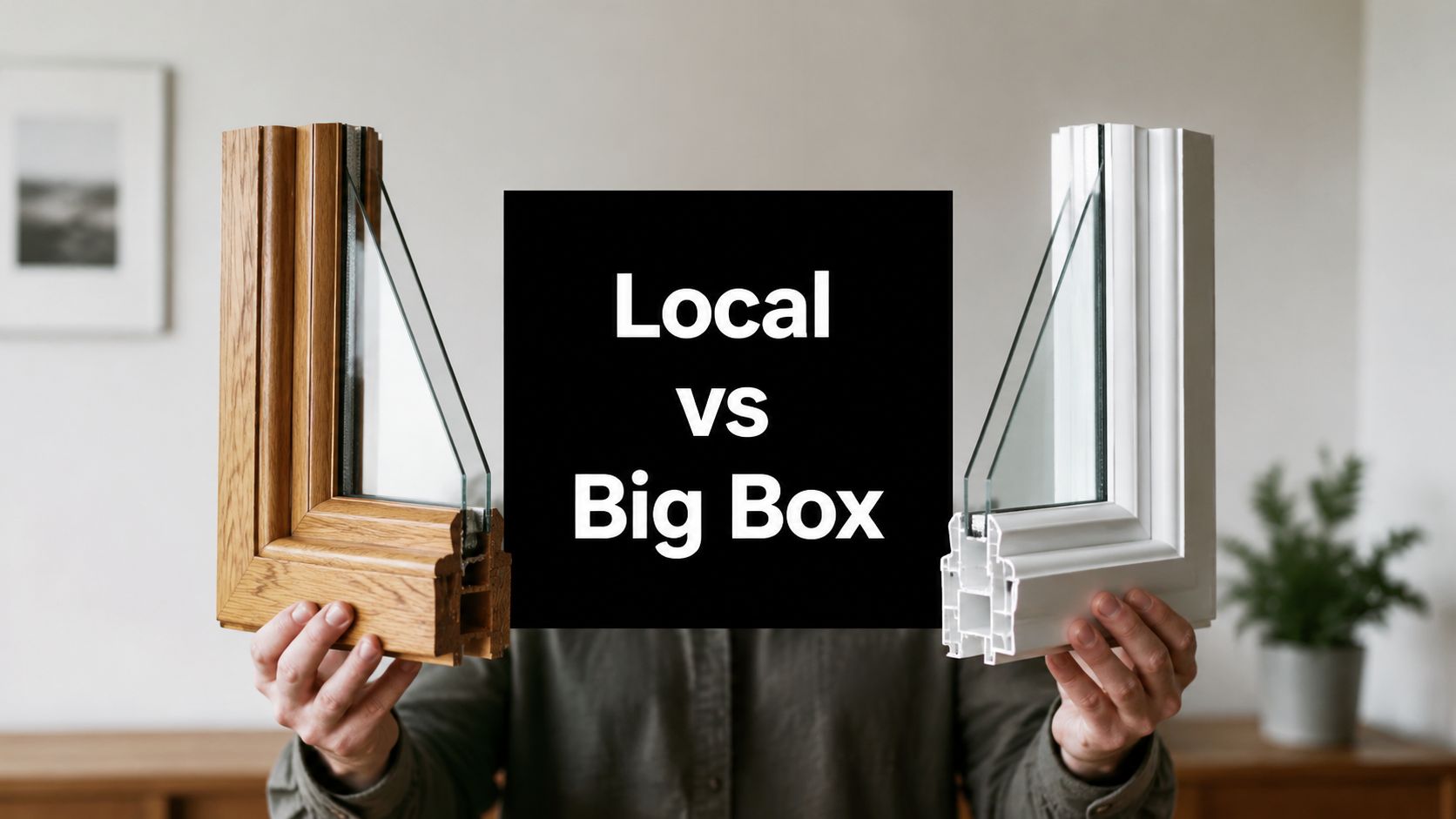
Big-box stores usually sell around standard sizes, standard features, and simpler ordering systems. Local specialists usually start at the house. They measure the opening, look at how the existing unit was installed, and match the replacement to the conditions they find. That difference affects sightlines, hardware, frame strength, glass options, and how much adjustment the installer has to make on site.
Price alone misses a significant risk. Industry guidance notes that big-box products are often less expensive upfront than custom-made options, but that lower entry price often comes with fewer choices, weaker after-sales support, and less precise fitting, as explained in this comparison of local specialists and big-box stores.
In practice, the bigger issue is the chain of responsibility. If a retail rep sells a standard unit for an opening that is out of square, the installer inherits the problem. If the fit is poor, the homeowner can end up between the store, the manufacturer, and the subcontracted crew, with each party pointing to the next step in the chain. That is a product issue and an accountability issue at the same time.
Older Treasure Valley homes expose this fast. In Boise, Meridian, Eagle, and Nampa, plenty of openings have settled, been reframed, or been covered up by years of trim work and remodels. A standard stock size can work in a clean, consistent opening. In an older house, "close enough" usually means more shimming, more trim adjustment, and a higher chance the finished job looks forced.
Here is how the product decision usually breaks out in the field:
- Standard sizing: Works best for straightforward openings where speed and lower initial cost matter most.
- Measured-to-order units: Fit better when openings vary, the house has moved, or appearance matters from room to room.
- Broader option selection: Local providers are usually better positioned to recommend frame profiles, sill design, hardware, and glass packages that match the house instead of the display model.
- Climate-specific choices: Idaho homes benefit from glass and frame packages picked for seasonal heat, winter cold, and sun exposure. Homeowners comparing those options should review an Idaho guide to energy-efficient replacement windows before choosing by price alone.
One local example is C & C Windows & Doors. The company follows the specialist model with custom measurements and Idaho-focused replacement windows. Features such as slim narrowline frames, composite-reinforced sashes, low-profile locking, and true sloped sills matter for daylight, drainage, rigidity, and daily use. Those are not showroom details. They affect how the window performs after the crew leaves.
A shelf product fills an opening. A well-selected replacement window solves the opening, the trim condition, and the comfort problem at the same time.
If the job is simple and the goal is the lowest upfront number, a big-box option can make sense. If the house has quirks, the openings are inconsistent, or you want fewer surprises after the order is placed, a measured solution is usually the safer buy.
Energy Performance and Certification Decoding the Labels
Homeowners hear terms like Low-E, argon, double-pane, triple-pane, and ENERGY STAR all the time. The problem is that the labels can blur together, and not every window carrying a familiar sales pitch performs the same way in the house.
What the performance differences mean indoors
The practical difference shows up in comfort first. Better glass packages help a room feel steadier through hot afternoons and cold mornings. They also help with outside noise, which matters more than many people expect once traffic, neighbors, or dogs are part of the daily soundscape.
Performance metrics indicate that custom windows with double or triple-pane argon fills and Low-E coatings reduce indoor noise by 15 to 25 dB and solar heat gain by up to 70%, while big-box windows, typically single or double-pane with basic coatings, offer 5 to 10 dB noise reduction and 30 to 40% solar heat gain reduction, according to this window performance comparison.
That's the difference between a room that merely has a new window and a room that feels more controlled.
How to read labels without getting lost
When reviewing options, keep the conversation grounded in homeowner outcomes:
- Low-E coatings: These help manage heat transfer and sun exposure.
- Argon-filled insulated glass: This supports thermal performance inside the glass unit.
- Double-pane vs triple-pane: More glass layers can improve insulation and sound control when the full window system is built and installed correctly.
- Climate fit: Idaho homes need products that can handle seasonal swings, direct sun, and winter cold.
For a deeper homeowner-level breakdown of climate-fit products and window efficiency considerations, this guide to energy-efficient windows in Idaho is useful.
Certification matters, but only with the right window package
Certification labels help narrow the field, but they don't replace product selection. A lower-tier window with a basic glass setup and limited options isn't the same as a well-built unit configured for local conditions.
Bottom line: Don't ask only whether a window is energy efficient. Ask what glass package, coating, gas fill, and frame design are being quoted for your home.
That's where local specialists usually do better work. They tend to specify a solution. Big-box sales paths often start with a standard product and work backward from there.
Installation Workmanship The Most Critical Difference
A good window installed poorly is still a bad result. That's the part homeowners often learn too late.
The product gets most of the attention during shopping, but the installation determines whether the window performs the way it should. Air leakage, water intrusion, trim problems, sticking sashes, and early callbacks usually trace back to installation quality, not the brochure.
What good workmanship looks like
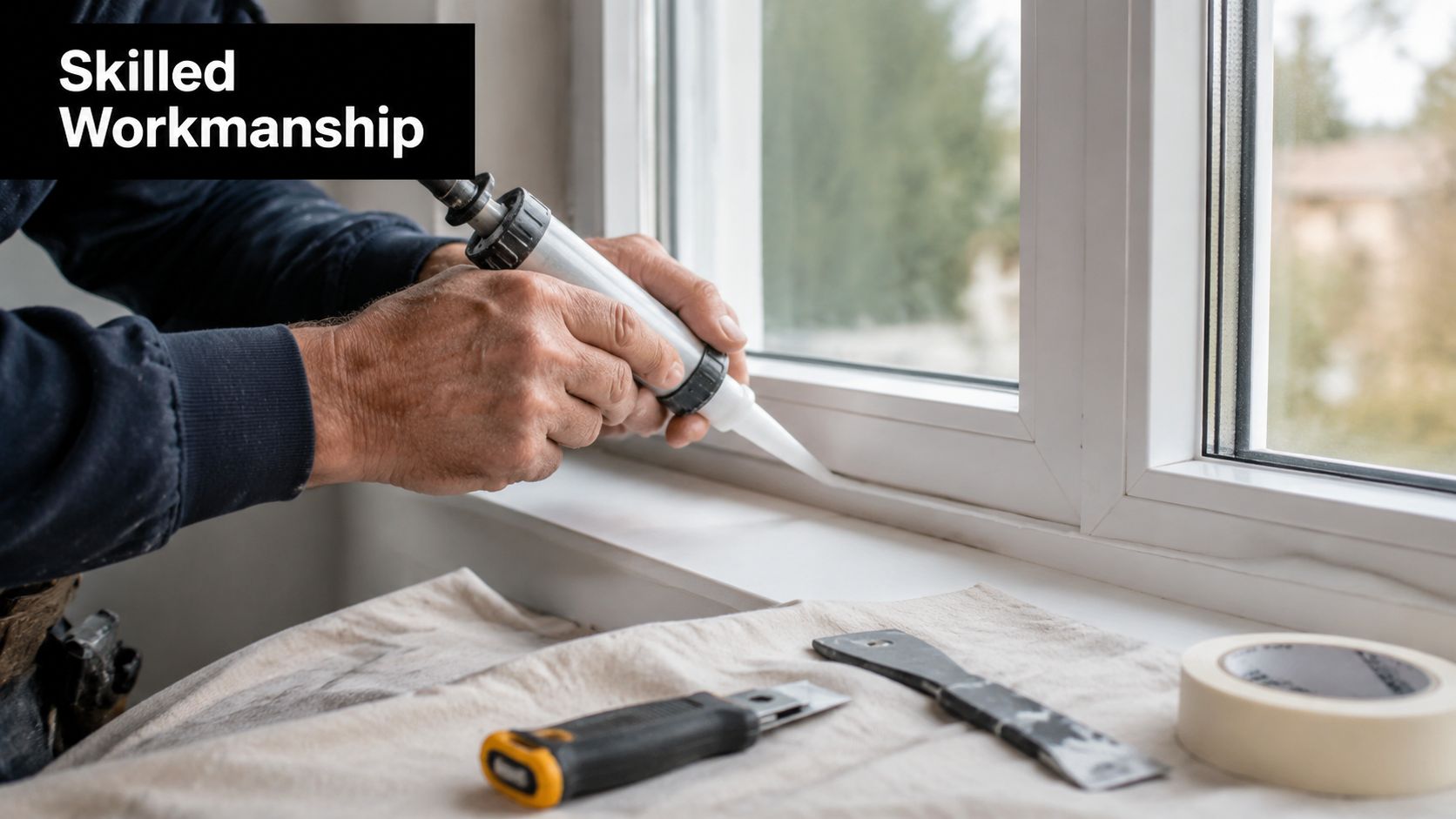
Homeowners should expect more than “the window went in.” Proper installation includes careful measuring, opening prep, correct placement, insulation and sealing, clean exterior finishing, interior protection, and a final check of operation.
A quality crew should also pay attention to details that homeowners notice immediately:
- Protection of the home: Floors, furnishings, and nearby surfaces should be covered and respected.
- Seal quality: Caulk and perimeter sealing should look intentional, not rushed.
- Operation check: Locks, balances, sliding panels, and screens should all work before the crew leaves.
- Clean finish: The site should be left clean, with debris removed rather than piled near the house.
The crew model matters
In the field, the local versus big-box split becomes obvious. Big-box jobs often depend on a separate installation crew, and that can create uneven execution from one project to the next. Local specialists are more likely to run a tighter process because measuring, ordering, and installation are coordinated together.
If you're evaluating replacement work in the Boise area, reviewing how a provider approaches window replacement in Boise can help you see whether they treat installation as a core craft or as an add-on service.
Sloppy installation can cancel out the value of premium glass, stronger frames, and upgraded hardware. Homeowners don't live in the brochure. They live with the install.
What doesn't work in the real world
Fast turnaround by itself isn't quality. Neither is a vague promise that the installer is “licensed and insured.” Those are baseline expectations, not proof of workmanship.
What works is a crew that measures carefully, communicates clearly, protects the house, seals correctly, and owns the punch list without argument. In window replacement, that's the line between a project that feels done and one that lingers.
Warranties and Service Who Answers the Phone
Most warranty conversations are too shallow. Homeowners hear “manufacturer warranty” and assume they're covered. Sometimes they are. Sometimes they're covered on the product but not the labor. Sometimes the installer and seller are different businesses, and each points at the other when a problem shows up.
That's why the chain of responsibility matters more than the warranty brochure.
One project can involve multiple parties
A key question is, who is responsible for measurement, fit, and warranty when the retailer and installer are different companies? The big-box model can fragment that responsibility, which complicates accountability for leaks, defects, and post-install problems, as described in this explanation of custom residential windows versus big-box windows.
That issue gets overlooked because the buying experience feels simple at first. You buy from one place, schedule through one process, and expect that to continue if anything goes wrong. But after installation, homeowners can discover they're dealing with separate responsibility lines for:
- Measurement questions
- Product defects
- Installation workmanship
- Service scheduling
- Warranty interpretation
What a homeowner should ask before signing
Ask these questions out loud and get the answers in writing:
- Who measured the openings and who carries responsibility if the fit is wrong?
- Who installs the windows. Company employees or a separate contractor?
- Who handles service calls after the job is complete?
- What does the labor warranty cover, and who honors it?
- If a leak appears, who diagnoses it and who pays to correct it?
If the answers feel vague, the risk is landing on you.
If your retailer sells the window, a different crew installs it, and a manufacturer controls product coverage, you may end up coordinating the fix yourself.
Why local accountability usually feels different
With a local installer that manages the process end to end, the homeowner usually makes one call. That matters. It reduces delay, finger-pointing, and the common problem of trying to prove whether an issue came from the product, the measurement, or the installation.
This is especially important on premium and energy-focused projects. The more the homeowner is investing in comfort, appearance, and long-term performance, the less sense it makes to accept a broken chain of responsibility.
A warranty has value. A clear owner of the outcome has more.
The Complete Picture A Side-by-Side Comparison
For most homeowners, the decision becomes easier once everything is on one page. The sticker price still matters, but it stops being the only thing in view.
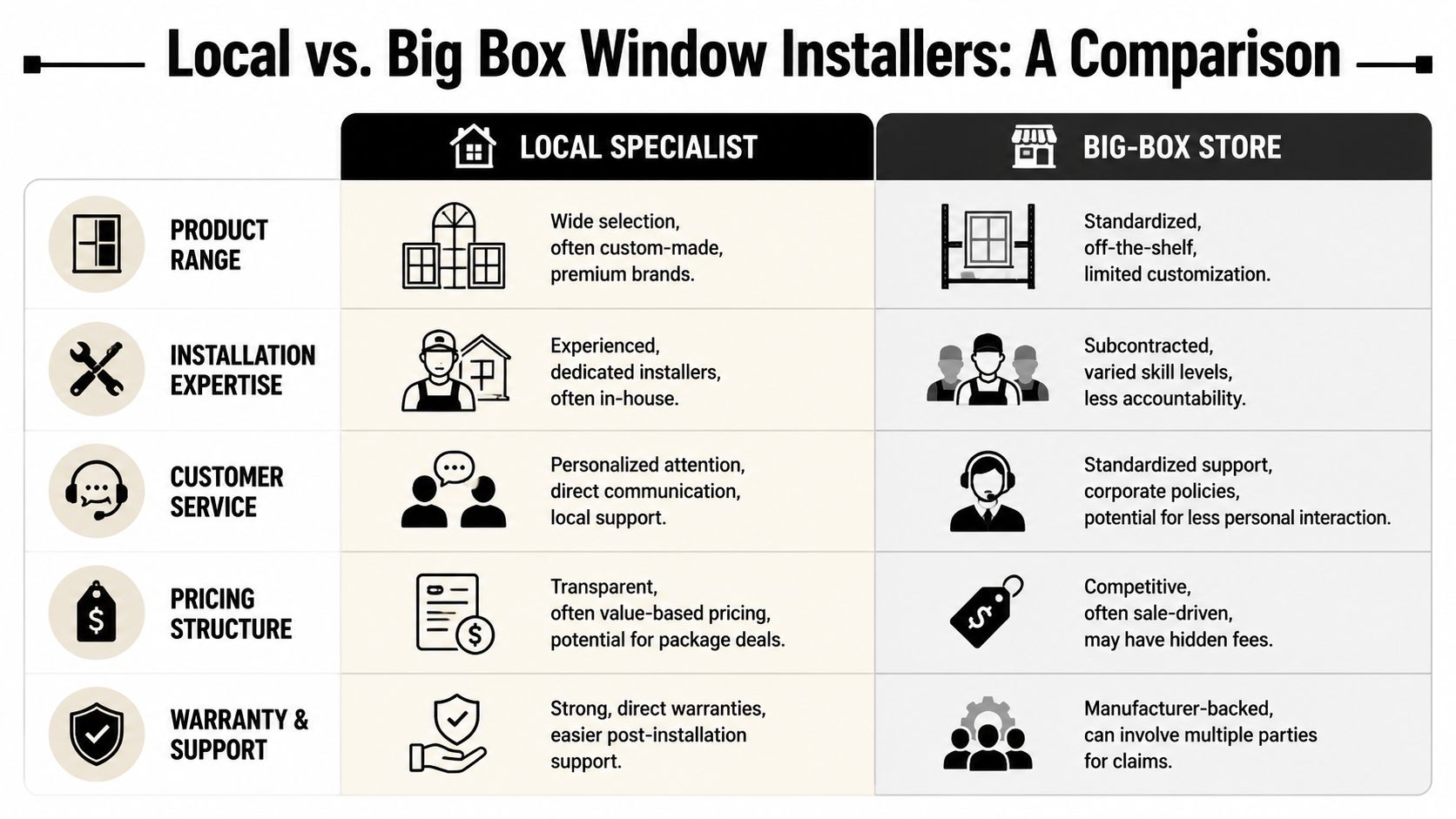
Local specialist vs big-box installer at a glance
| Decision Factor | Local Specialist (e.g., C & C Windows) | Big-Box Installer |
|---|---|---|
| Product Quality and Customization | Measured-to-order options, broader configuration choices, better fit for non-standard openings | Standardized inventory, fewer customization paths, stronger fit for basic replacement scenarios |
| Energy Performance | More likely to offer advanced glass packages and climate-specific recommendations | More likely to start with standard packages and limited upgrade depth |
| Installation Workmanship | Usually tighter coordination between measuring, ordering, and install | Often split between retail sale and third-party installation |
| Warranty and Accountability | Cleaner chain of responsibility, simpler service path | Responsibility can be divided between seller, installer, and manufacturer |
| Pricing and Value | Higher upfront in many cases, stronger fit for long-term ownership | Lower upfront in many cases, stronger fit for budget-first decisions |
| Scheduling Experience | Often consultation-driven and project-specific | Often built around retail process and contractor scheduling windows |
How to use the table
This isn't about declaring one model right for every homeowner. It's about matching the model to the project.
If your job is straightforward, the opening is standard, and your main goal is entry price, a big-box route can be reasonable. If the home is older, the comfort issues are real, or the project needs stronger performance and cleaner accountability, local tends to make more sense.
The most expensive mistake isn't always paying more upfront. It's paying less and still carrying the risk yourself.
The homeowners who feel best about their decision later are usually the ones who judged the whole process, not just the quote total.
Making Your Choice A Practical Decision Checklist
If you want to make a smart decision without getting buried in sales talk, use a short checklist. It forces clear answers and makes weaker providers easier to spot.
The questions worth asking every installer
- Who measures the windows: Ask whether the person who measures is the same company responsible for ordering and fit.
- Who does the install: Get a direct answer on whether the crew is in-house or subcontracted.
- What glass package is included: Don't accept “energy efficient” as a complete answer.
- How are service issues handled: Ask what happens if a sash sticks, sealant fails, or trim needs correction after install.
- What is covered in writing: Product and labor should both be explained clearly.
- How is the home protected during work: Ask about floor protection, debris removal, and cleanup standards.
Which option fits which homeowner
A big-box option may fit if:
- You need a basic replacement fast
- Your opening is standard
- The lowest upfront cost matters more than customization
- You're comfortable managing some of the coordination risk
A local specialist usually fits better if:
- You plan to stay in the home
- You care about comfort, noise, and finish quality
- Your house has older or inconsistent openings
- You want one company to own measurement, installation, and follow-up
If you're in a market like Kuna or the broader Treasure Valley, it also helps to work with a provider that understands local housing stock and replacement conditions. Looking at how a company approaches window contractor work in Kuna can tell you a lot about whether they think like installers or just sellers.
For most long-term homeowners, the safest answer to Local vs Big Box Window Installer Which to Choose comes down to accountability. If something goes wrong, you want one responsible party, not a trail of phone numbers.
If you want a straightforward next step, C & C Windows & Doors offers in-home consultations, custom measurements, factory-trained installation, and a lifetime limited warranty on products and labor for Treasure Valley homeowners who want a single company responsible for the full job.