If you're looking at your windows in January and feeling cold air near the glass, or fighting hot west-facing rooms in August, you're already asking the right question. In Idaho, window replacement isn't just about curb appeal. It's about comfort, heating load, summer sun, condensation, and whether the new unit will still operate well after years of temperature swings.
That's why Vinyl replacement windows Idaho searches usually lead people into a confusing mix of sales language, glass jargon, and style choices that don't answer the core issue. What matters is how the full window system performs in an Idaho home, how it's installed, and whether the product fits your climate, architecture, and budget.
Table of Contents
- What Are Modern Vinyl Windows Anyway
- Why Vinyl Windows Are a Smart Choice for the Idaho Climate
- Decoding Energy Performance and Savings
- Popular Vinyl Window Styles and Their Uses
- Estimating Cost ROI and Financial Incentives
- The Window Installation Process From Start to Finish
- Your Checklist for Choosing a Trusted Treasure Valley Installer
What Are Modern Vinyl Windows Anyway
A modern vinyl window isn't just a plastic frame with glass in it. It's an engineered system built around uPVC, rigid frame construction, insulated glass, weatherseals, hardware, and tested performance ratings. The easiest way to think about it is this. Old windows were often simple building parts. New vinyl windows are closer to assembled performance products.
That matters because Idaho homes don't need a window that only looks clean on day one. They need a unit that handles winter heat loss, summer exposure, and daily expansion and contraction without turning drafty or hard to operate.
What separates modern vinyl from older budget products
The frame is where many homeowners underestimate the difference. Better vinyl windows usually use multi-chamber frame construction, which creates internal air pockets that slow heat transfer. They also use fusion-welded corners, which matter because corners are common failure points for air and water intrusion if the build quality is poor.
A quality unit also depends on the whole package working together:
- Frame design: Multi-chamber vinyl frames insulate better than hollow, basic profiles.
- Corner construction: Fusion-welded corners tend to create tighter, more durable joints.
- Glass package: Low-E coatings and gas fills do much of the thermal heavy lifting.
- Weatherstripping and seals: This is what keeps a window from feeling drafty even when the glass itself is efficient.
- Drainage design: A well-built sill and weep system helps move incidental moisture out rather than trapping it inside the frame.
Practical rule: Don't judge a vinyl window by frame thickness alone. A bulky-looking frame can still underperform if the seals, glass package, and construction details are weak.
Why the frame material alone doesn't tell the whole story
People often ask whether vinyl is “good enough” as if the answer lives in the material name. It doesn't. Two vinyl windows can perform very differently depending on the frame design, spacer system, glass package, and installation quality.
In practical terms, homeowners usually notice three things first after a proper replacement. The room feels more even, the glass area feels less cold in winter, and the window operates more smoothly. Those real-world results come from the entire unit being designed and installed as a system, not from vinyl by itself.
For Idaho homes, that's the right lens to use. Don't shop for “vinyl” as a generic category. Shop for a tested window assembly built to handle climate stress, air sealing, and long-term daily use.
Why Vinyl Windows Are a Smart Choice for the Idaho Climate
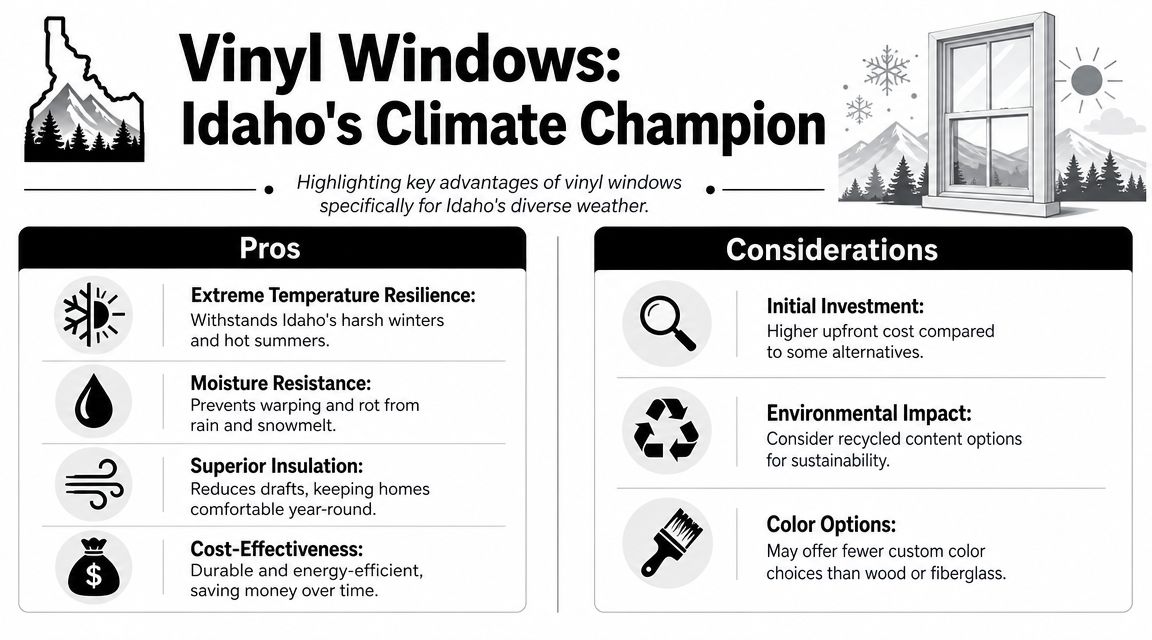
Idaho is hard on windows. You can have blazing sun, dry heat, wind, freezing nights, and long heating seasons in the same year. One local installer notes that Idaho's climate can see summer-to-winter temperature swings exceeding 120°F, and that vinyl expands and contracts with those changes, which is why premium welded and reinforced frames hold up better than budget models in this kind of thermal cycling, as noted by Iron Crest Remodeling's Idaho window replacement guidance.
Where vinyl works well in Treasure Valley homes
Good vinyl performs well here because it doesn't rot, it doesn't need repainting the way wood often does, and it handles moisture better than many homeowners expect. That matters in homes that see snow, irrigation splash, condensation around older openings, or sun exposure on one elevation all afternoon.
Vinyl is also a practical fit for replacement work because many Idaho homeowners want three things at once:
- Lower maintenance: No scraping, repainting, or regular finish upkeep.
- Better thermal performance: Especially when replacing older single-pane or aluminum-framed units.
- Reasonable value: Homeowners want comfort gains without moving into a much more expensive frame material unless the home requires it.
Where cheap vinyl disappoints
Not all vinyl windows are equal. Lower-end products can struggle with frame movement, weak corner construction, lower-grade hardware, and seal issues over time. In a mild climate, a homeowner might tolerate that longer. In Idaho, climate cycling exposes weak products faster.
A few warning signs show up again and again in budget installs:
- Thin frame construction: More prone to flex and less confidence-inspiring over time.
- Poor reinforcement: Less stable under repeated expansion and contraction.
- Weak weatherseals: Draft complaints usually start here, not with the glass itself.
- Basic installation practices: Even decent windows disappoint when the opening isn't sealed correctly.
Premium vinyl is usually the right call when you want efficiency and low upkeep. Bargain vinyl often becomes an air-leak problem wearing a clean white frame.
That's why the smart choice in Idaho isn't “vinyl or not.” It's whether the vinyl window is built for thermal movement, sealed well, and matched to the opening. When those pieces line up, vinyl is a very sensible fit for Boise, Meridian, Eagle, Nampa, and the rest of the Treasure Valley.
Decoding Energy Performance and Savings
A west-facing bonus room in July and a north bedroom in January will expose a weak window fast. In Idaho, comfort problems usually show up as radiant heat, cold glass, draft complaints, and rooms that never seem to match the thermostat. That is why the energy label matters more than the sales pitch.
Most homeowners hear terms like Low-E, argon, U-factor, and NFRC label, then check out. The useful part is simpler than the terminology suggests. The frame still matters, but the glass package, spacer system, and tested label tell you far more about how that window will perform through Boise heat and freezing valley mornings.
The specs that matter most
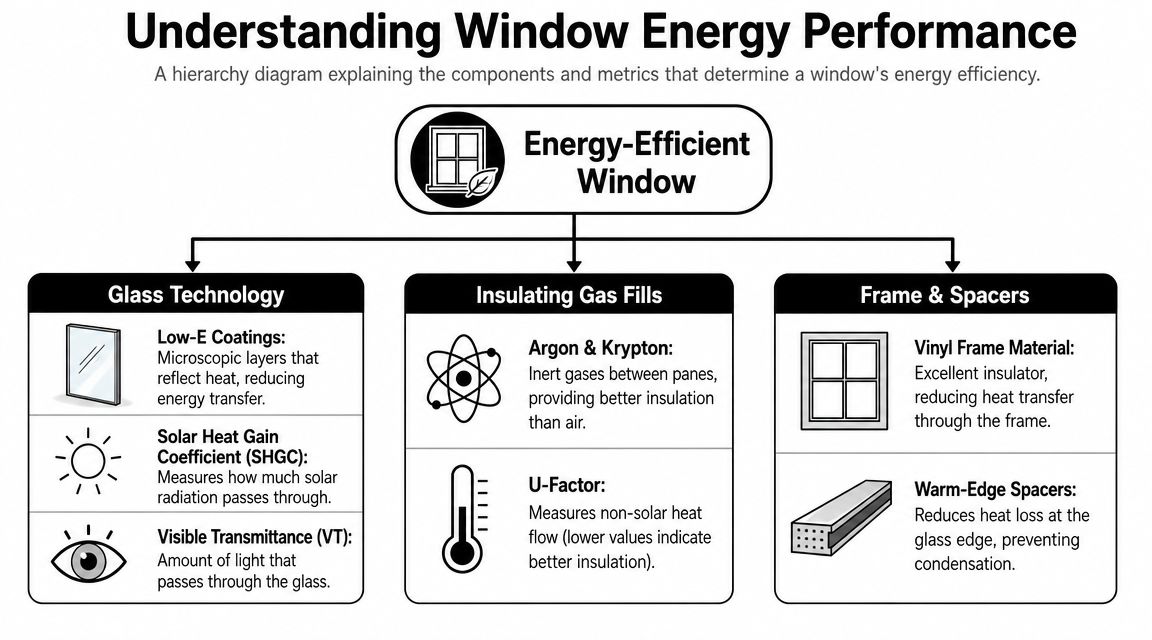
Low-E glass uses a microscopically thin coating to slow heat transfer. In winter, it helps keep interior heat inside the home. In summer, it cuts some of the sun-driven heat that builds up on exposed elevations. For Idaho homes with real seasonal swings, that coating does practical work every day.
Argon gas fill improves insulation between the panes. By itself, it does not fix a poorly built unit. It performs best when the insulated glass unit has dependable seals and a spacer system that limits edge heat loss. Cheap glass packages often advertise argon, but long-term performance depends on whether the whole assembly holds up through repeated expansion and contraction.
U-factor deserves the closest attention in our market. According to Idaho code guidance on efficient windows, U-factor typically ranges from 0.20 to 1.20, and lower numbers indicate better resistance to heat flow. In plain terms, lower U-factor usually means warmer interior glass in winter and less of that chilly, uncomfortable feeling when you sit near the window.
Style also affects real-world performance. A casement, for example, usually gives you a tighter operating seal than a slider because the sash pulls in against weatherstripping when locked. If you are weighing style and efficiency together, this guide to casement windows for Idaho homes is worth reviewing.
How to read the label without getting lost
The NFRC label is the cleanest way to compare one product to another. It gives you tested numbers instead of showroom language.
Look at these first:
- U-factor: Lower is better for insulation and winter comfort.
- SHGC: Important on sunny sides of the house where summer heat gain matters.
- Visible transmittance: Shows how much daylight the glass lets in.
- Certification details: Confirms the unit was tested and rated under a recognized program.
One caution from the field. Homeowners often focus on center-of-glass performance and miss the full window rating. The full unit number is the one that matters, because the frame and edge details affect comfort just as much as the glass itself.
If the conversation stays on color options and never gets to the NFRC label, you still do not know how the window will perform.
The savings piece is real, but comfort is usually the first thing homeowners notice. Efficient double-pane and Low-E vinyl units can reduce heating and cooling demand compared with older single-pane windows, especially in rooms with large glass areas or direct afternoon sun. In Idaho homes, the better test is simple. Does the room stay steadier through a cold snap and a heat wave, and does the furnace or AC have to fight less to keep up? That is the kind of performance worth paying for.
Popular Vinyl Window Styles and Their Uses
Style matters for more than looks. It affects airflow, cleaning, operation, sightlines, and whether the replacement still makes sense for the house. A good window style solves a room problem. A bad one becomes something you work around for years.
Choosing by room, not just by catalog photo
Double-hung windows fit homes where traditional proportions matter and where you want a familiar look. They work well in bedrooms, front elevations, and older homes where preserving visual rhythm matters.
Casement windows are a strong option where you want a tighter operating seal and easy ventilation control. They're often practical over sinks or in spots where lifting a sash is awkward.
Sliders work well in wider openings and spaces facing patios or walkways. They're simple to operate, but they aren't always the right visual fit for older architecture.
Picture windows are ideal when the goal is light and view rather than ventilation. They're often paired with operating units on either side in living rooms or larger front-facing openings.
For traditional homes, this guide to double-hung windows in Boise, Idaho can help if you're trying to maintain a classic appearance while improving efficiency.
Vinyl Window Styles At-a-Glance
| Window Style | Primary Benefit | Best For | Consideration |
|---|---|---|---|
| Double-hung | Familiar look and versatile ventilation | Bedrooms, front-facing elevations, traditional homes | More moving parts than a fixed unit |
| Casement | Strong seal and directed airflow | Kitchens, bathrooms, hard-to-reach areas | Needs clearance to open outward |
| Slider | Easy horizontal operation and wide view | Broad openings, patios, contemporary layouts | Not always ideal for historic-looking homes |
| Picture | Maximum glass area and daylight | Living rooms, view corridors, focal walls | Doesn't provide ventilation |
Older homes need more care in style selection
Boise's historic-window guidance says replacement windows should be congruous with the original shape, placement, and material, and it specifically warns that replacing traditional double-hungs with horizontal sliders is often inappropriate, according to the City of Boise historic window brochure.
That's an important reality in older Boise, Eagle, and Nampa neighborhoods. You can improve efficiency and still make the house look wrong if the replacement ignores original proportions.
On older homes, the right style usually preserves the opening's character first and upgrades performance second. Both matter, but the style choice can't fight the architecture.
Estimating Cost ROI and Financial Incentives
Homeowners usually ask for a per-window price first. That's understandable, but it's not the cleanest way to judge value. Real window replacement cost depends on opening size, style, glass package, installation complexity, trim conditions, and whether the project involves insert replacement or more extensive exterior and interior finish work.
So the better question is this. What are you buying beyond the new frame and glass?
Where the return shows up
The most obvious return is utility savings. Replacing old single-pane windows with ENERGY STAR-certified models can save roughly $125 to $465 per year, and the broader U.S. vinyl windows and doors market exceeded $7 billion in 2023, which shows how mainstream vinyl has become as a cost-effective upgrade, according to Freedonia's U.S. vinyl windows and doors industry study.
The second return is comfort, which homeowners often feel before they calculate anything. Less draft near the glass, fewer hot and cold spots, and better temperature stability in bedrooms and living spaces often matter as much as the bill reduction.
The third return is practical ownership value:
- Lower maintenance burden: Vinyl avoids many of the refinishing issues that come with older wood units.
- Better day-to-day livability: Rooms near large windows become easier to use year-round.
- Stronger resale presentation: Buyers notice updated windows, even when they don't ask for the spec sheet.
Utility incentives can change the math
In Idaho, some utility support is tied to actual thermal performance, not just the idea of replacement. Idaho Falls Power's residential program requires replacement windows to have a U-factor of no greater than 0.30 and limits eligibility to homes with existing single-pane wood-frame, single-pane aluminum-frame, or double-pane aluminum-frame windows. It also lists incentives and zero-interest loans for windows, insulated doors, and insulation at $12 to $16 per square foot for single-family, multifamily, and manufactured homes, according to Idaho Falls Power insulation and window incentive details.
That tells homeowners two useful things. First, performance thresholds are real. Second, if you don't choose a rebate-ready product, you can miss available support.
When discussing product options with homeowners, some local installers, including C & C Windows & Doors, offer vinyl systems with Low-E glass, argon fills, and reinforcement options that align with the kind of performance criteria Idaho buyers should be asking about. The important part isn't the brochure language. It's whether the ordered window matches the published ratings and the home's actual needs.
The Window Installation Process From Start to Finish
Most window projects feel intimidating because homeowners don't know what happens between signing a quote and seeing the finished opening. A professional installation should feel orderly, not chaotic.
The process is straightforward when the crew knows what they're doing and the expectations are clear from the start.
What happens before installation day
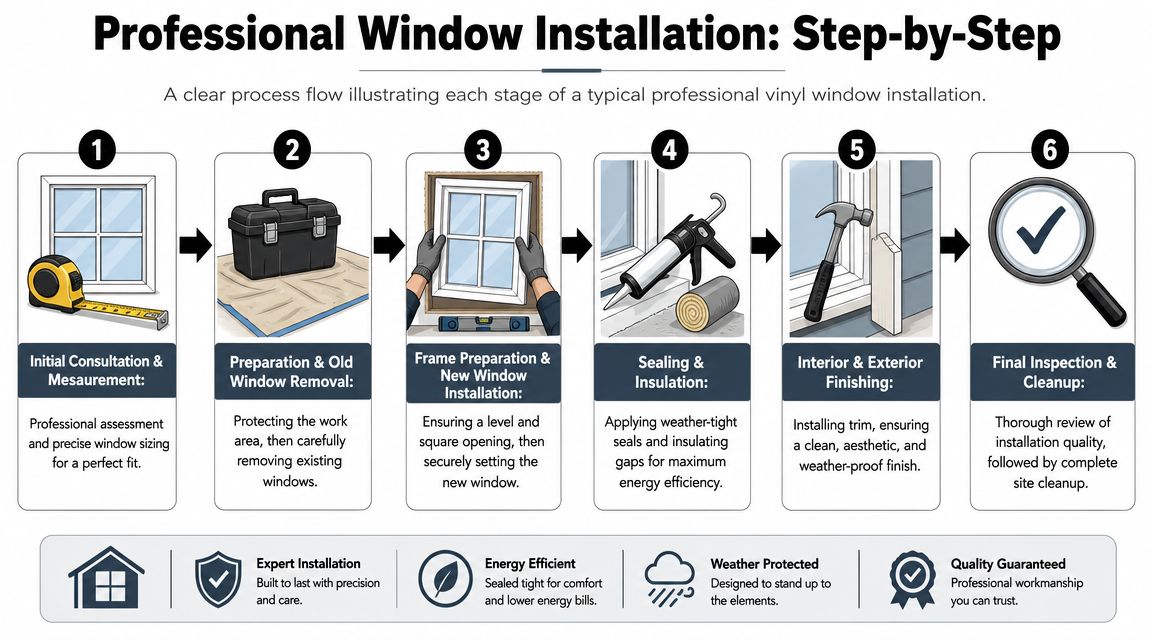
It starts with an in-home visit and precise field measurements. Good measuring is not a formality. Replacement windows are ordered to fit the actual opening conditions, and older homes often have small variances that matter.
After that, the installer confirms product details, operating style, glass package, colors, and trim approach. This is also when homeowners should clarify whether the job includes haul-away, interior touch-up needs, and how exterior caulking or trim finishing will be handled.
What a proper install day looks like
On installation day, a professional crew typically works in a predictable sequence:
- Protect the work area. Floors, furniture zones, and nearby finishes should be covered before removal starts.
- Remove the old unit carefully. The point is to preserve surrounding finishes when possible, not rip everything out fast.
- Inspect and prep the opening. Installers check for squareness, surface condition, and any issues that need correction before setting the new unit.
- Set, shim, and fasten the new window. A window has to be level, square, and properly supported to operate correctly.
- Seal and insulate. Long-term comfort is established or compromised at this point.
- Finish and clean up. Interior and exterior trim details should look intentional, not patched together.
A high-performance window installed poorly becomes an average window very quickly.
What to check in the final walkthrough
Before the crew leaves, every homeowner should test operation and look at the details. Open and close each sash. Lock it. Check sightlines. Look at caulk lines, trim fit, and whether debris has been removed from inside and outside.
Use this quick punch list:
- Operation: Does each unit move smoothly and lock cleanly?
- Seal feel: Do you notice obvious air movement around the frame?
- Finish quality: Are trim joints neat and consistent?
- Glass condition: Any scratches, seal issues, or labeling that still needs removal?
- Cleanup: Were old units, packaging, and work debris hauled away?
A calm, methodical install usually produces a better result than a rushed one. Homeowners should expect that.
Your Checklist for Choosing a Trusted Treasure Valley Installer
A window can test well on paper and still disappoint in an Idaho house if the installer misses the details. I've seen that happen after hot west-facing summers, cold snaps, and a few seasons of expansion and contraction around a poorly prepared opening. The installer matters as much as the product line because the primary job is fitting a tested window system to your home's exposure, framing condition, and moisture risk.
If you're comparing companies, this guide on choosing a local window company in the Treasure Valley is a useful place to start.
The questions worth asking
Use this checklist before you sign:
- Ask about Idaho climate experience. Treasure Valley homes deal with sharp temperature swings, strong sun, dry summers, and winter cold. Your installer should be able to explain how those conditions affect frame choice, glass package, seal durability, and installation method.
- Verify label-based performance. Ask to see the NFRC label on the exact window being proposed, or the manufacturer data for that configuration. That is how you confirm the ratings instead of relying on a sales pitch.
- Look at installation scope in writing. The proposal should explain what happens to trim, insulation, sealants, cleanup, disposal, and any interior or exterior finish work.
- Ask who performs the work. Get a clear answer on whether the company uses in-house installers, long-term trade partners, or rotating subcontract crews.
- Review warranty details carefully. Product warranty and labor warranty should both be spelled out. Also ask who handles service if a sash, balance, or sealed glass unit needs attention later.
Signs the company is likely a good fit
Good installers tend to be plainspoken. They answer directly, measure carefully, and point out conditions that could affect the result.
A few green flags stand out:
- The estimate is specific. It lists window style, glass package, color, hardware, and scope of work instead of using broad allowances.
- The conversation includes trade-offs. A trustworthy installer will explain where a premium glass package pays off, where it may not, and whether full replacement or insert installation makes more sense for that opening.
- They respect the house. An older Boise bench home, a Meridian subdivision build, and a rural Canyon County house with lots of sun exposure do not all call for the same recommendation.
- They show the ratings. If the company cannot show what the window is built to do, you are being asked to buy on trust alone.
Pay attention to how the company handles the hard questions.
Do they explain why one vinyl system is better suited for a south or west exposure? Can they discuss air leakage, spacer systems, and glass options in plain language? Do they mention what happens if they find rot, out-of-square framing, or failed exterior trim during the job? Those answers tell you a lot about how the project will go.
The right installer makes the technical side clear and ties each recommendation back to comfort, durability, and operating cost in an Idaho home.
The goal is a company that can match the window to the house, install it cleanly, and stand behind the work after the crew leaves. If you're comparing Vinyl replacement windows Idaho options and want clear answers without pressure, C & C Windows & Doors provides free in-home consultations for Treasure Valley homeowners, with custom measurements, product guidance, and installation details explained in practical terms so you can choose the right window system for your home.